SaaS companies could afford to be wrong about value. With near-zero marginal costs, even a badly chosen pricing metric left the business profitable. You left money on the table, but the table was still standing.
AI products change that. With real marginal costs, being wrong about value is no longer just missed upside. It can threaten the economics of the product itself.
That is the shift most SaaS companies adding AI have not fully reckoned with yet.
Hardware Had the Burden of Real Costs
Hardware companies always priced with a floor because they had no choice. When every unit you sell costs something real to produce, there is a natural alignment between what you charge for and what costs you money.
Yet this cost/product alignment pushes almost all hardware companies into some form of cost-plus pricing. It’s guaranteed to cover variable costs, but it misses much of their buyers’ willingness to pay.
Hardware companies did not choose that discipline. Their economics forced it on them from day one.
Pure SaaS Had the Freedom of No Costs
Pure SaaS removed that constraint. One more customer often cost almost nothing to serve, which meant the pricing metric did not need to track the cost of delivering the product.
In theory, that freedom pushed companies toward value: What are buyers willing to pay, and what metric best reflects the value they receive? After all, it’s hard to price based on costs when there are none.
But even companies that never quite figured out value-based pricing survived. A poor pricing metric meant missed revenue, not losing money every time a customer used your product.
That forgiving failure mode trained an entire generation of SaaS companies to treat pricing as important but not urgent.
AI Products Changed the Economics
AI brings meaningful marginal cost back into software. Every query, every inference carries a real, measurable expense.
But AI products are mostly being built and priced by people with SaaS instincts: seats, tiers, flat subscriptions.
The stakes are closer to hardware than to pure SaaS, but the instincts are still pure SaaS.
And AI adds another complication: the thing that drives your cost may not be the thing that best represents value to the buyer.
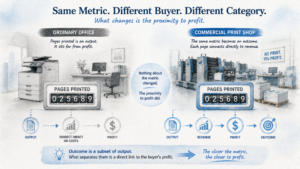
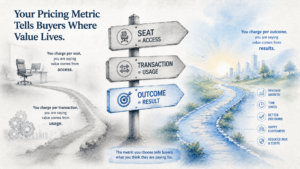
A seat may correlate with value while telling you very little about compute consumption. An output may align beautifully with what a buyer values while being expensive to produce. An outcome may be even closer to value while sitting further away from the underlying cost.
AI companies now have two problems to solve at once:
What should we charge for to capture value?
And how do we make sure the economics work as usage grows?
Token Pricing Solves Half the Problem
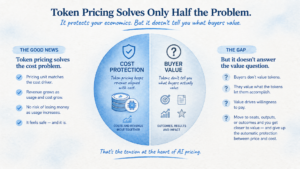
Token pricing solves the second problem completely and the first one not at all.
The pricing unit and the cost driver are closely aligned, so as usage and cost increase, revenue increases with them. There is no version of token pricing where you lose money as a customer uses more. That is why token pricing feels safe, and the safety is real.
But it answers the cost question by ignoring the value question. Buyers do not value tokens. They value what the tokens let them accomplish, and value is what drives willingness to pay.
Move to seats, outputs, or outcomes and you get closer to value and give up the automatic protection between price and cost.
That is the tension at the heart of AI pricing. Costs are hard enough. Value perception makes it harder.
That is the subject of Part 2.
Share your comments on the LinkedIn post.
Now, go make an impact!
A note on process: Every idea, argument, and opinion is mine. Claude made the writing better.
 Tags: ai cost, ai pricing, pricing, Pricing AI, pricing metrics, pricing strategy, saas pricing, token costs, token pricing, value, value pricing