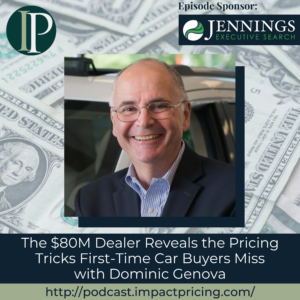
Dominic Genova spent 17 years on the factory side at Chrysler and 27 years owning car dealerships. He grew one dealership from a building with no power or water and no sales into a business with 87 employees and $80 million in annual sales of cars, trucks, and service. He rejected the traditional dealership model of commissions, hidden fees, and payment games in favor of transparent, salary-based selling.
In this episode, Dominic exposes the pricing tricks hiding behind the “great deal”, from payment games to hidden fees, while Mark challenges his sales philosophy from a pricing perspective.
Together, they unpack why the price isn’t the price, how a $500 cheaper car can become a $700 worse deal, and why Dominic believes the real product isn’t the car. It’s taking care of the customer.
Podcast: Play in new window | Download
Why you have to check out today’s podcast:
- See how a $500 “better deal” can become $700 worse once financing enters the picture.
- Spot the pricing landmines first-time car buyers rarely see coming.
- Discover how Dominic built an $80M dealership by replacing sales games with trust, transparency, and repeat business.
“I made the buying process, I made our taking care of you a competitive advantage.”
— Dominic Genova
Topics Covered:
03:00 – The Price Isn’t the Price: What Buyers Actually Need to Calculate
05:00 – From No Sales to an $80M Dealership. Hear how Dominic grew a dealership that started with no power, no water, and no sales into an 87-person, $80M business—and why his pricing philosophy focused on bringing customers back instead of maximizing every transaction.
08:30 – How to Build a Sales Team That Actually Cares. Learn why Dominic rejected traditional commission incentives and instead looked for people who genuinely wanted to treat customers well—and how that became part of the dealership’s culture.
10:30 – The Buyer Test: How to Tell If a Salesperson Is Sincere
13:00 – Fit the Customer to the Car, Not the Other Way Around. Discover Dominic’s “cars are like shoes” philosophy
18:00 – How Dealers Turn a Great Price Into a Worse Deal. Learn how financing and payment tactics can undermine an attractive vehicle price, including Dominic’s example of a $20 monthly payment increase that adds $1,200 over a 60-month loan.
20:30 – The Dealer Tricks Buyers Don’t Know to Look For. Get a glimpse into the tactics Dominic saw during his career calling on hundreds of dealers, including misleading advertisements, small-print conditions, and additional charges.
23:00 – Why Trust Became Dominic’s Real Product. Discover why Dominic viewed his dealership’s product as more than cars: “We take care of you.” That philosophy helped create repeat customers, referrals, and a reputation that carried throughout the community.
26:00 – The Counterintuitive Profit Strategy: Maximize Satisfaction, Not Price
28:30 – How First-Time Buyers Can Spot a Bad Deal. Learn how to look beyond the advertised price and evaluate the entire deal, rather than assuming the lowest vehicle price automatically means the lowest total cost.
30:00 – Dominic’s Final Pricing Advice
Key Takeaways:
“So a lot of people go and shop price and then the unethical dealer sticks it to them on something else.” — Dominic Genova
“My philosophy was an agricultural philosophy… to get you to come back again and again rather than draining every dime I could when I saw you.” — Dominic Genova
Connect with Dominic Genova:
- LinkedIn: http://linkedin.com/in/dominic-genova-99a12b66/
- Website: http://dontbetaken.com/
Connect with Mark Stiving:
- LinkedIn: https://www.linkedin.com/in/stiving/
- Email: [email protected]
Full Interview Transcript:
(Note: This transcript was created with an AI transcription service. Please forgive any transcription or grammatical errors. We probably sounded better in real life.
Dominic Genova
Cars are like shoes. They have to be comfortable, affordable, a style you like, and you can’t return them.
So the salesperson is taught to fit the car to the customer financially, design-wise, drivability-wise, and you’re not trying to sell them something, you’re trying to fit them into something.
[Intro]
Advertisement
Today’s podcast is sponsored by Jennings Executive Search. I had a great conversation with Jon Jennings about the skills needed in different pricing roles. He and I think a lot alike. If you’re looking for a new pricing role or if you’re trying to hire just the right pricing person, I strongly suggest you reach out to Jennings Executive Search.
They specialize in placing pricing people. Say that three times fast.
Mark Stiving
Today’s podcast is sponsored by Jennings Executive Search. I had a great conversation with John Jennings about the skills needed in different pricing roles. He and I think a lot alike. If you’re looking for a new pricing role, or if you’re trying to hire just the right pricing person, I strongly suggest you reach out to Jennings Executive Search. They specialize in placing pricing people. Say that three times fast.
Welcome to Impact Pricing, the podcast where we discuss pricing, value, and how buyers decide.
I’m Mark Stiving.
I help companies turn hidden value into willingness to pay. Our guest today is Dominic Genova. Okay. He told me not to say this, but I’m going to say it anyway. He’s a used car salesman. He’s actually not.
Dominic Genova
Well, well, at least you didn’t call me somebody with a PhD. How about that?
Mark Stiving
Oh, that’s cruel, isn’t it?
Dominic Genova
Oh, yes, that is cruel, Dr. Mark.
Mark Stiving
So here are three things you want to know about Dom before we start. He is a managing member of Next Revolution Strategies and host of the No Nonsense Roundtable. It’s a radio show.
He spent 17 years on the factory side at Chrysler and 27 years owning car dealerships.
And he rejected traditional dealership commissions, hidden fees, and payment games in favor of salary-based selling and transparency.
Welcome, Dom.
Dominic Genova
Well, thank you for having me. Not everybody would.
Mark Stiving
Well, and so, as you know, I’m a pricing guy. But you know what really fascinates me is how buyers make decisions.
And the fact that I got this invitation to have you on, and you’re a car guy, everybody’s fascinated by how car sales dealerships work and how they cheat us and what they’re doing badly or poorly or well.
And so I just find this, you know, we’re going to combine those two topics and we’re going to find really fun, fun things to talk about.
Dominic Genova
Well, we certainly will because I’m kind of a unicorn. There’s very few people, they probably be counted on one hand, of people that work for the factory like I did and then went out on their own, risked everything they had to start a dealership, especially the way I did in a building with no power, no water.
We were going across the street to the Ford dealership to go use the bathroom. and built that into an entity that had no sales, and six people to an entity that had 87 people working for selling $80 million worth of stuff a year, and I sold the dealerships just before the COVID shutdown, actually one week before the COVID shutdown.
And I get paid these, well, they gave me a lot of money that I can do whatever I want now. I’d like to talk to you during the day.
Mark Stiving
Yeah, exactly.
Dominic Genova
So, but I’m fascinated by your, the way you particular structure, your, your concept, you want to maximize the selling price of whatever somebody’s selling, right?
Mark Stiving
Kind of right. Here’s what I focus on more.
And that is how is it that buyers determine what they’re willing to pay for something? Right.
Because when I think of that, then I have the ability to go back and say, OK, what should companies be doing to help sure that we’re getting the majority of that willingness to pay?
Dominic Genova
OK, well, the thing about the car business, first of all, I wrote a book about this thing. It’s called Don’t Be Taken for a Ride.
I’m going to hold up a copy of the book, OK? I’m going to take a little advantage of you. This is on Amazon. Don’t be taken for a ride. Know what your dealer knows and drive home happy.
The thing is with pricing on a car, it’s different than pricing on cornflakes. It’s much more complicated than people conceive. The problem with it is that there is an unintended conspiracy. by the manufacturer, the dealer, the associations, and even the AG’s office to look the other way and with a wink, let these things go by.
And most people shop price, but the price really isn’t the price. As a matter of fact, I’m writing another smaller book that is a bad deal at any price.
And the thing I teach in my seminars, which are on dontbetaken.com and this book is how to figure out what the dealers are doing. And the thing is, is that the way I teach you how to price a car or go find the best deal on a car is to show you the strategy and tactics that you need to do to overcome the traditional system that they use against you.
Because the price isn’t the price. The price is not the price because the price on the car is just one of the factors.
Then it’s what’s your trading worth, what’s your financing, how much money you’re putting down, what’s your monthly budget for it.
So a lot of people go and shop price and then the unethical dealer sticks it to them on something else.
So the price really isn’t the price. And when you look at an ad on TV or the radio or whatever, you see the small print. And that’s the thing that drives me crazy, because in the small print, there are these landmines.
And some of these landmines are pretty big. Now, one of the things that a customer does, one of the things I explain in the book is a thing called the delivery bump. You ever hear of a delivery bump?
Mark Stiving
Not in those words.
Dominic Genova
Okay. A delivery bump. So you go and you shop on your car and you get a price that’s $500 less than the guy down the road, right? And the guy gives you a payment and the payment is going to be $450 a month, let’s say.
And then when you go pick up the car, because your credit hasn’t been approved yet, we were kind of figuring this is the payment going to be. You find out that the payment went up by 20 bucks a month. It’s 470 now, Mr. Customer, it’s not 450. Well, you know, your credit wasn’t as good as whatever it is.
And you sit there and you settle for it because you didn’t shop the credit, right? You found out that you had good credit, but you didn’t shop that particular part of it. Now, on the 60-month note, he just bumped you by $1,200, right?
So the deal that you got that you thought you had that was $500 less money is actually $700 more because you didn’t figure everything into the deal. I show you how to figure everything into the deal.
Because here’s the one thing, and you’ll be amazed by this, every new car dealer buys the cars for the same price from the factory. It’s right in the dealer agreement, okay?
So the small dealer possibly could give you a better dealer than the guy who’s selling millions of cars.
Because he’s buying them at the same price. So if you’re buying them at the same price, you gotta do one of two things.
You either have to sell them for less money or you have to have some rigmarole where they’re charging you for something you shouldn’t be charged on and being overcharged for something else.
And that’s where the profit of the dealers come in.
Now, the other thing about this thing is that most people are vastly unaware of how the process works, why they do what they do. I show you something in the book called a four square system.
Faking a pass in football is not illegal. It’s something that you do as a tactic, so I show you these tactics.
But the pricing that’s interesting to me is, and this goes to what you teach, is that for a car dealer, it’s pricing, but it’s also frequency.
So when i started my dealership and we had like i said eight people and we sold everything we had to start a dealership back then we had eight people we had no sales because the building had no power, no water we’re gonna cross the street to the for dealership to go to the bathroom actually i grew this into a business that was selling eighty million dollars worth of cars and trucks and service a year.
And had eighty seven employees got an ethical award from the Rochester Ethics Association and a torch award. And I sold them a week before the COVID shutdown. Now I have money to talk to you guys.
But my philosophy was an agricultural philosophy. And this is what I mean. I developed in my pricing in my presentation to the public was to get you to come back again and again rather than draining every dime I could when i saw you.
Okay so now you’re building an orchard you’re building an orchard where apples come in every year And then next year they come in and next they come in.
So I built this to where I had like 14,000 customers because I made somebody happy. I made the process easy for them because 87% of the people that buy cars hate the process.
24% would rather have a root canal. That’s a pretty low bar.
So what I did is I made the buying process transparent. We advertise real price, real payment. So somebody came in and they were like, oh, I didn’t understand this. Wow, that’s really cool. I’m going to buy the car from you.
Then they would send other people in like, well, you know, they’re friends and then, you know, their family and then their kids. OK.
And then after 26 years, the kids are coming in. So I had this I have this wonderful orchard of people that were coming in. They were satisfied. I eliminated all the stuff that people don’t like because, I mean, think about this. What’s the best hamburger you ever had? Not a McDonald’s?
Mark Stiving
No, not, of course not.
Dominic Genova
Who sells more hamburgers than anybody else in the world? McDonald’s, you’re selling the same stuff. You’re selling a hamburger like everybody else’s hamburger, but everybody buys McDonald’s, right?
So that’s the thing with my dealership. I made the, the buying process, I made our taking care of you a competitive advantage.
Mark Stiving
So Dom, as you say, I love the story, but explain to me why you succeeded and Saturn failed.
Dominic Genova
Saturn had a less than good car, but also they did this with such ridiculous insincerity. It was incredible.
You had to go and they had a flip chart, you know, so the salespeople had to show you a full of, Oh, before I can give you a price now, blah, blah, blah. And blah, you know, you know, there’s a difference between caring about somebody and appearing that you’re caring about somebody. Right?
I mean, what I did is I had a culture that took care of the customer. Now, this in particular. So most dealers have a policy that you can spend $75 making a customer happy no matter what. Right? I mean, this is what it is. They put some type of budget on it.
Believe it or not, the dealer that I sold the dealership to wouldn’t honor an $8 check from me when somebody came back. I mean, that’s another story.
What my philosophy was i don’t care how much money that you spend to take care of a customer if he deserves it, if the transmission cost us you know five thousand dollars because we screwed something up just take care of it.
I mean what’s the worst is gonna lose i’m gonna lose a little bit little money, will you take that process away from somebody and people can tell if you care about them are you appearing to care about that. I can smell it.
They can smell it they know and most dealers have this process set up and it’s this and this and this is a bureaucracy i mean so it really wasn’t any different it was different is the appearance of being different but it wasn’t really any different.
You make a very excellent point because when I went business in nineteen ninety four. The saturn was the sales process is gonna be so good people are gonna come back well first of all the car wasn’t that good okay and the other thing is is that they had this like I said this bureaucratic we really don’t care about you sort of it wasn’t there was no sincerity in it.
I had to say since I didn’t have a finance manager i didn’t sell you rust proofing and all this other stuff where the high markup stuff is some like i said was an agricultural metaphor analogy.
Mark Stiving
Yeah, I love this concept that says people can tell if you’re being sincere or not.
How did you build true sincerity into a Salesforce, into a team?
Dominic Genova
Oh, what a great question that is. What a great question that is. Oh, that’s the best question I got to ask so far. Seriously.
It has to do with what’s in here, you got to find people. Now I’m non-commissioned sales, but now think about this non-commissioned salespeople, they’re going to have to, they don’t get more commission.
As everybody knows, you can make more money if you make the customer pay more money, right? There’s some people that hate that. Okay. I mean, there’s salespeople that hate that. You know, I just want to give Mr. Smith a good, you know, have a relationship with him, give him a good deal or whatever.
I know I’m going to make maybe making less money in the summer, but you know, in February here in Rochester, New York, where it snows every day, oh, at least I’ll be able to pay my mortgage and whatever. And you get those people.
I’ve had 400 shows so far, maybe 450 on my radio show and podcast. Usually what I ask somebody is that what did you want to do when you were 10 years old? Okay.
I’ve got some really interesting answers. I’ve never had anybody say, I want to be a car salesperson. That’s a tough job. It’s a good paying job, but you’re working five days a week, maybe six days a week, maybe seven days a week. You’re staying there at eight o’clock at night. It’s Halloween. You want to go do trick and treating with your kids and your manager says, no, you got to stay here.
But we eliminated all of that. I mean my feeling about my dealership was that my product is that we took care of your personal transportation needs.
Most of the time we sell your car or we fix your car but sometimes we have to do other things to help you navigate you know navigate your personal transportation life and people understand that.
Oh, do you know what you know what Genesee Valley did for us? Blah, blah, blah, blah, blah, blah. Yeah, you had a real good relationship.
Mark Stiving
OK, but I’m back to the question.
How did you get a sales team or a whole team of people that actually cared about customers?
Dominic Genova
Right. They had this.
Mark Stiving
Oh, yeah. Just throw them.
Dominic Genova
There are people that are, you know, there’s undervalued everything.
Seriously, there’s undervalued property, there’s undervalued stocks. Chrysler said this dealership that I sold all these cars, you know, that was only gonna sell like a couple hundred cars a year, you know, it’s undervalued.
You find people that are undervalued, people that have a good soul and have a good atmosphere in their home life, their family life, and they just wanna treat people well, and they like the car business, and you gotta sort through those people.
It becomes a culture because the dealership becomes a culture they’re subscribing to not a pay plan you find those people my first sales manager.
I mean people would buy cars from him no matter what he sold I had a salesperson working for twenty six years and tom they came back to tom because they like Tom. It wasn’t the cars, he could be selling Studebakers that buy them from him. And that was it.
When they realized, when customers realized that you really have their best interests at heart and you can give them alternatives and you’re not trying to drag money out of them, you’re not selling them some worthless warranty or hiding the deal in the small print.
They come to trust you and people who come to trust you will do more business with you because they hate dealing with everything else. That’s our competitive advantage.
Our competitive advantage was actually just taking care of people. Now, I have to say, I mean, the dealers, I tried to market this as something the dealers could use, and the problem is is that you really gotta start with a clean sheet of paper.
You know, if you have a finance manager now and he’s selling rust proofing, the latest thing, I went to my car a couple of weeks ago because my wife’s car got totaled, thank God she’s okay, but somebody sends me a quote with $399 for nitrogen in your tires.
Are you out of your mind? I told you I was a dealer. I mean, don’t you understand the scam of this thing?
You know, you heard the analogy with the frog and the scorpion, right?
It’s just his nature. I told you I was a dealer, right?
Mark Stiving
So let me ask the question, and this is probably a little bit harder. Put yourself on the buyer’s side. How is it that a buyer knows that someone’s being sincere or, you know, deceitful?
Dominic Genova
Oh, another great question. It’s in my book. It’s in my book.
One of the things, ask them a question you know the answer to. Ask them a question you know the answer to. That’s, I mean, really, and see how they treat you.
Sometimes, you know, I tell people, give them a ridiculous, something ridiculous, and see if they look at you funny or they have, I don’t know, bad, you know, how much would that be with a late payment?
And see how the guy answers you, the guy answers it. If he goes, well, you know, blah, blah, blah, or if you ask him something about the car, he goes and looks it up, that’s fine, but if they give you some bull that you know the answer to, well, there you go.
And somebody doesn’t want to answer the question properly or disrespects you because you asked that question, well, you know, bad engagements make bad marriages.
And I mean, you can tell, it’s in the book. The other thing is i tell you how to use their system actually against them. Because prices only the cornerstone it’s not the whole deal and down doesn’t mean down. Download lease doesn’t mean what downloads on a payment and when somebody says and you own it what that means.
My favorite, excuse me for talking so fast and so much, I’m from the downstate New York area. The worst example in the book was that a dealer was advertising your payment on this Jeep Grand Cherokee was $299. Your payment is $299. You know what it was? Twice a month.
So it’s a $598 payment. And this is what I mean about my book and what I do. I think I’m helping customers, but I’m also helping the good dealer because the analogy I give is that this dealer is fishing upstream.
I don’t see these customers when he goes into that dealership, when the customer goes into the dealership and he gets snookered.
He doesn’t know he got snookered. There’s so many people that think they got a great deal and they didn’t.
Mark Stiving
I think everybody walks out of a dealership thinking they got a great deal.
Dominic Genova
They need to. People need to win. That’s why one price selling is a bunch of bull. I mean, people want a little something else. They want to win. They want the mudflaps. They want the thing. They want the thing. Yeah, okay. If it’s within reason, you need to feel that you got a really great value. When I was selling cars, because like I said, with that few people, I had to sell my own cars, I would say, Mr. Customer, I know you want to get the car for free. I got that. OK.
And I want to make three point five million dollars on you and go retire someplace in the middle. We’re going to have to settle. And if somebody couldn’t understand that process, sometimes I would say, I’m sorry, I just can’t do business with you. I need to make a little bit of money in order to keep the lights on.
And if you think you’re going to get this car, you know, $5,000 less someplace else, they’re taking advantage of you someplace. They’re low-balling you or, you know, whatever. I called on probably 450 dealers in my career at Chrysler.
Trust me, I’ve seen all the tricks. Oh, all the tricks. I have a dealer to English dictionary in the book. When he says this, it really means that.
This is fun. I call this trying to save the ducks. Okay. I was selling all those cars, couple of hundred cars a month and whatever.
And those people I could take care of. Now I’m trying to take care of, you know, like everybody else wants to listen.
Mark Stiving
Okay, so first off, I want you to know that I’m against all deceitful pricing practices, right?
So I’m totally with you in the fact that you’re out trying to stop this, essentially, or helping buyers avoid these problems.
But I’m a huge, huge fan of getting paid for value that I deliver. And so you’ve crafted a sales methodology, a relationship that says, hey, we’re honest, we’re looking out for you. Does that give you the ability to raise prices, to charge a higher price than a neighbor does?
Dominic Genova
No, no. The frequency, you get the profitability from the frequency. I mean, how much is McDonald’s making on that Big Mac? Okay. But again and again and again and again. So what I did is that my expenses were so low at the dealership. I always kept them low. As far as investments go, I used to say all my money’s tied up in cash. When things went bad in 2008 and whatever, I didn’t have any problems.
The back end, the dealership had a 100% overhead absorption. It’s not because we charged people more, it’s because we kept our expenses low. And the thing is that, here, I’m gonna show the book again. Okay, see the book? Okay, now you see the picture of the book. You see me in the book? Okay. Do I look anything like that now? I don’t look anything like that now.
I look like a hundred years older than that. You know what that proves? Everybody exaggerates. Every dealer is going to tell you, we got the best deal. Okay.
We all drive 70 in a 65. I had a conversation with Leticia James at a fundraiser the other day, and we were talking about this and she’s the New York AG. She goes, yeah. I go, yeah. I said, Leticia, everybody drives 70 in a 65. I says, it’s the people that are going 120 and drunk, when the cop pulls them over, we’re all happy with that.
And so that’s my philosophy about what I do with dealers is helping out the good dealers to do business. Now, does he exaggerate? Yeah, everybody exaggerates. I mean, just go look on match.com. I haven’t been there, but I’m sure those pictures are probably nicer than the people actually look.
Mark Stiving
So when I think about the car business and I think about McDonald’s or I think about an orchard or this recurring business, I don’t think of people buying cars every year or I don’t think of repeat business, which is one of the reasons why I think car dealers get away with such deceitful practices, because I only need to cheat you once and then someone else will come in and I can cheat them. I don’t need to have you come by again.
Dominic Genova
I learned that because I was calling on dealers in the New York City area.
Now, the metaphor analogy is that that ocean is incredibly large, incredibly large. If you’re not catching this fish, there’s enough fish in that pond or that sea that you don’t have to treat anybody well. We’re in Rochester, New York. Okay.
It’s fairly, the demographics are fairly regional. You know, you’ve got, there’s a lot of empty space between Rochester and Buffalo and Rochester and Syracuse.
So you get a reputation. So the reputation you get will carry you through that, but you can’t waste customers.
You can’t waste customers because there’s not that many of them. And everybody’s related to somebody. I mean, this is, like the town I started in with, I started my dealership with, it’s 6,000 people.
Everybody, you know what, I gotta tell you something. If they weren’t related to each other, they knew each other.
So you couldn’t do anything anyway that was detrimental like that without it coming to bite you in the tail. I had a newscaster here, a very famous guy in the local community, and he passed away at a very young age, but he said, I buy my cars from Dom because at least I know I’m not getting screwed.
Mark Stiving
Well, and so in the world of behavioral economics or game theory, people know that losses loom larger than gains. I would do a lot to not get cheated, more so than to win.
Dominic Genova
The thing about it is that, like I said, it was an agricultural thing.
You know, people from miles away, 20, 30 miles away, would come in to us because of our process.
We got all the business for the police departments in Rochester and the surrounding towns because of the way we treated. We took care of people.
Our product was taking care of people. And they, they saw that they understood it. It was, like I said, it was an agricultural metaphor, I guess.
And I knew it would work when I worked for Chrysler, I tried telling them this. But the thing is, if you have in any bureaucracy, if you have an idea that is outside of the scope of what your boss subscribes to, you’re going to have a problem.
You know, Kodak thought their product was pictures on pieces of paper. No, it’s not. It’s imaging.
You know, I mean, so my product was we take care of you. You know, we love to be loved. We just take care of you.
And you know, if you had a problem, you fix the problem. You know, I have stories for you, you know, of successes that we had that we never got, you know, didn’t have any credit for it, but you just do things to, you know, I mean, people, they can tell, they can tell, they can tell if you really care about them or not.
Mark Stiving
So I want to go back to the sincerity question and you can really tell.
So I’m picturing someone walks into the dealership, salesperson comes up and talks to them. What kinds of questions are they asking at that point in time?
Dominic Genova
You know, let me give you.
OK, man, you’re you’re good at what you do. And this is good.
Cars are like shoes. They have to be comfortable, affordable, a style you like, and you can’t return them.
So the salesperson is taught to fit the car to the customer financially, design wise, drivability wise, and you’re not trying to sell them something, you’re trying to fit them into something, right?
And you give the customer advice and he’s free to not accept that advice.
You know, somebody wants a Wrangler and we showed them the Wrangler and it drives like a Wrangler. If you want to buy that, go ahead and buy it.
But you know, you also have to understand like three weeks from now when you don’t like that because it rides too hard. Well, you made that decision.
So you try to fit them in a pair of shoes. And I don’t know if you like sneakers, you like boots, I have no idea. So we’d fit you into them.
And financially too. I know you want a lease for $299 a month, and that’s what the dealer down the road says, but it’s for 48 months and it’s 5,000 miles a year and you’re gonna have a big payment at the end.
So I just want to tell you, this is what you’re doing. And we eliminated the finance manager because the finance manager makes money on the financing and the after sale stuff.
I wouldn’t sell you a warranty unless it was a Chrysler warranty because I’ve seen too many people get screwed from these aftermarket warranties.
And we constructed it that, that, you know, if you had a lease and you’re traveling 15,000 miles a year, we’re not going to sell you one for 7,000 miles a year and say, well, you know, you’ll handle that at the end.
I mean, we just didn’t do that. You know, so you have to pass on some making some deals where people think that they’re getting a deal, but they’re not getting a deal.
Mark Stiving
So I think the best line that you used is the fit, right? We’re trying to make the fit. And what that really says is you’re looking out for the customer, right? Which is the whole point.
Dominic Genova
Right.
And the whole thing about this, Mark, is that you have to have like, you know, a faith.
I don’t know if you talk about a faith in God, a faith in yourself, a faith in humanity or whatever it is.
We started out and I wanted to be a small dealer in upstate New York rather than working for the factory. The kids were one in four.
People are staying at the office till nine o’clock at night because nobody wanted to leave. You know, making ninety four making like a hundred grand, which ninety four was good money at a company car.
My wife had a lease car. My car, you got to pay for the gas insurance and everything. It was amazing. I got five weeks vacation and all the healthcare I could use.
I had $80,000 after I cast out of everything. The only thing we didn’t sell was the kids and the bird, okay? And we started with this.
My wife’s statement to me, God love her, we’re married 40 years this year.
She goes, yeah, let’s do this. She goes, the worst that’s gonna happen is that you get a job selling cars, I’ll get a job waiting tables. Holy crap, I mean, think about that.
A woman with two kids, right? Everything, like financially and everything, and she’s like, nah, I don’t like this lifestyle either.
Being transferred, you know, and she goes, I don’t want you being 65 years old, you know, and a t-shirt, you know, looking at TV saying we should’ve.
And she took a jump with me, and it was like, okay, we’re just gonna take care of people, we’re gonna go to the diner in the morning, we’re gonna have some, you know, blah, blah, blah.
She’s gonna work, you know, with the Catholic school here and everything. Yeah. And really, really worked out.
Well, I never tried to maximize the price on selling the car. It was like maximize the customer’s feeling of satisfaction.
So he would bond with us.
Mark Stiving
Just love that. Just love that.
I got one last question that you may not have an answer to. Do you have a good Lee Lacocca story?
Dominic Genova
No, I only met him a couple of times, but I do had a dealer once with Lee Iacocca We had a meeting on Long Island someplace. And I won’t tell you the last name, but his name was Jay. He went up and he was so happy. He kissed Lea Iacocca on the neck.
Mark Stiving
I’m sure that went over well.
Dominic Genova
Actually in my book, I have some stories in there too. I mean, there’s, there’s a story in there about my, my naked parts manager. Yeah, absolutely. Yeah. The guys upstairs in the parts bins, you know, sending naked pictures to one of my customers. You think it’s easy? I had a, that’s customer service, Dom. You can’t make this stuff. I’m working for Christ. I almost got fired because I unwrapped cheese balls.
You know, those cheese balls, those things that look like a softball and it’s right in the front of the book. And I can’t believe that I didn’t get fired, but I got yelled at for unwrapping cheese balls. But anyway, the simple absurdity of it really.
Mark Stiving
This has been fabulous. Thank you so much for your time today. If anybody wants to contact you, how can they do that?
Dominic Genova
Well, the best thing to do, because you get to get some free advice there, is go to DontBeTaken.com. And on DontBeTaken.com, I give you some little snippets of things that are in the book, Don’t Be Taken for a Ride, Know What Your Dealer Knows, and Drive Home Happy, which is available on Amazon mainly.
Yeah, but if you go to dontbetaken.com, that’s probably the best place you can get in touch with me. You can contact me, you can ask me questions.
I’ve been giving like 40 minute lectures on this to civic groups. I have to tell you, Mark, people keep me like an hour after that. It’s really fun because so many people are like, well, you know, I had this deal. I think I got screwed.
Yeah, you did get screwed. Let me show you how you got screwed. It’s fun. It is absolutely fun. I know stuff you don’t know.
Mark Stiving
There’s no doubt. There’s no doubt.
So finally, to our listeners, if you have any questions or comments about the podcast, or if you want to see value through your buyer’s eyes, email me, [email protected]. Now, go make an impact.
Thanks again to Jennings Executive Search for sponsoring our podcast. If you’re looking to hire someone in pricing, I suggest you contact someone who knows pricing people. Contact Jennings Executive Search.
Advertisement
Thanks again to Jennings Executive Search for sponsoring our podcast. If you’re looking to hire someone in pricing, I suggest you contact someone who knows pricing people.
Contact Jennings Executive Search.
[Outro]