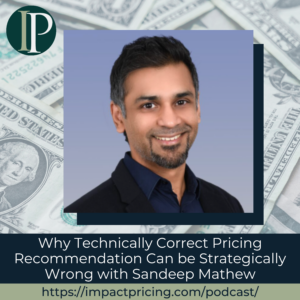
Sandeep Mathew is a sales and marketing leader with 19 years of global CPG experience, including extensive work at Unilever building and deploying revenue growth management (RGM) capabilities. He eventually managed RGM as a global capability across markets and channels, and now works on customized RGM analytics across different markets, categories, and channels.
In this episode, Sandeep explains why even sound RGM data and technically correct pricing recommendations can lead brands in the wrong direction.
Podcast: Play in new window | Download
Why you have to check out today’s podcast:
- Learn why a technically sound RGM recommendation can still be strategically wrong for a brand’s long-term health.
- Discover how promotions can become a downward spiral that erodes brand equity and profitability.
- Build a better promotional strategy by connecting source of growth → brand job to be done → promotional objective before analyzing the data.
“Don’t take any recommendation at face value. Look at all angles to it. Most importantly, from the long-term health of the brand. Never compromise that for any short-term gains.”
— Sandeep Mathew
Topics Covered:
01:20 – From Marketing to RGM: Why Sandeep Trusted Purchase Data. Learn why Sandeep became drawn to RGM after seeing how actual purchase data could produce more actionable insights than consumer intention research.
03:30 – One RGM Framework Doesn’t Fit Every Channel. Discover why e-commerce, value channels, omnichannel, and quick commerce each require customized RGM approaches rather than one standardized framework.
06:00 – The RGM Paradox: When Good Data Leads to a Bad Decision. Sandeep explains how he went from trusting RGM recommendations almost completely to realizing that short-term data can miss long-term brand consequences.
08:00 – Why Three Months of Data Can’t Protect a 100-Year-Old Brand. Understand the mismatch between RGM’s typical 3–6 month or 3–5 year view and the 10–15+ year horizon required to manage brand equity.
10:00 – The Brand vs. RGM Tension. Learn why marketing teams understand the brand but may not understand RGM, while RGM teams can produce powerful analytics without seeing the long-term brand picture.
12:00 – The Hardest Question: How Do You Measure Long-Term Brand Impact? Sandeep explains why long-term data is ideal, why 10–15 years of data still creates causality challenges, and how to combine brand-equity measures, consumer surveys, and RGM analytics when perfect data isn’t available.
14:00 – The Promotion Spiral That Can Kill a Brand. Discover how brands can respond to an underlying brand-equity problem with promotions, temporarily chasing volume while gradually increasing discounts and eroding profitability.
16:00 – What Does Your Brand Actually Stand For? Learn the three questions Sandeep uses to diagnose brand strength: What do you stand for? What meaningful value do you bring? How differentiated and salient are you?
18:00 – Build the Promotional Strategy Before Running the RGM Analysis. Sandeep shares his framework: identify the brand job to be done, determine the source of growth, translate it into promotional objectives, and then use RGM to evaluate the options.
19:30 – Final Pricing Advice: Never Trade Long-Term Brand Health for Short-Term Gains. Sandeep’s closing principle for making better pricing decisions.
Key Takeaways:
“When you’re making decisions at that level for a certain brand, you don’t want to only win over the next three months or six months. You want to win for the next five years, 10 years.” — Sandeep Mathew
“Don’t forget that there are long-term impacts on the brand. That’s the most important thing.” — Sandeep Mathew
“Sampling will only work if you want to do penetration. Don’t do sampling if you want to switch from your lead competitor.” — Sandeep Mathew
Connect with Sandeep Mathew:
Connect with Mark Stiving:
- LinkedIn: https://www.linkedin.com/in/stiving/
- Email: [email protected]
Full Interview Transcript:
(Note: This transcript was created with an AI transcription service. Please forgive any transcription or grammatical errors. We probably sounded better in real life.
Sandeep Mathew
Don’t take any recommendation at face value. Look at all angles to it. Most importantly, from the long-term health of the brand. Never compromise that for any short-term gains.
[Intro]
[Advertisement]
Mark Stiving
Welcome to Impact Pricing, the podcast where we discuss pricing, value, and how buyers decide.
I’m Mark Stiving. I help companies turn hidden value into willingness to pay.
Our guest today is Sandeep Mathew.
Here are three things you want to know about Sandeep before we start.
He’s a sales and marketing leader with 19 years of global CPG experience all around the world. He spent much of his career at Unilever, deep experience building and deploying revenue growth management capabilities.
And he believes a technically correct pricing recommendation can be strategically wrong.
Welcome Sandeep.
Sandeep Mathew
Thank you so much, Mark. That was a good, good info.
Mark Stiving
Let’s start with the big question. How’d you get into pricing?
Sandeep Mathew
So marketing is my passion. I did my B school fundamentally to get into marketing. And I’ve been dabbling in marketing since a very long time from theater plays that used to put up, you know, magazines that I came up back in college, things like that, trying to build a brand all the way to 200, $300 million brands that I worked with later in life.
So marketing was my co-passion and throughout my time in marketing, and many people who’ve been in marketing would probably empathize with this, that we are always at the receiving end of a lot of researchers and analysts and different kinds of documents that we need to ingest and pretty much make the best decisions for our brands.
In the time that I spent at marketing and all of these materials that I used to be handed out, the ones that I found most useful was always from RGM (Revenue Growth Management).
Because it always comes from a very, very clear empirical data point of view and makes structured observations and gives structured insights that you can take clear action on, which sometimes, you know, many of the other kind of researchers would lack.
So that sort of got me interested in RGM (Revenue Growth Management). And at a certain point in my career, when I was looking for a change in my career trajectory, a role in RGM (Revenue Growth Management) came up.
And that’s when I got into it. And I spent a few years in RGM (Revenue Growth Management) at Unilever itself. And it really, you know, created a very strong foundation for me.
So then when I moved out of Unilever, I started working as a consultant, working also with people like Bain and continuing my work with RGM (Revenue Growth Management).
So that’s how I got into it. Long answer.
Mark Stiving
Nice. In a second, I’m going to ask you a specific question about RGM (Revenue Growth Management) because what you just told me fascinates me.
But one of the reasons we’re having you on today is because you’re going to be a speaker at the EPP20 event that’s coming up in Amsterdam.
Can you give us a quick preview on what it is you’re going to be talking about there?
And then that’s not what we’re going to be talking about today.
Sandeep Mathew
Okay perfect so at my time at Unilever when I was I started in Unilever doing RGM (Revenue Growth Management) for one small part of it and over the years it kept growing and by the time I left Unilever I was managing RGM (Revenue Growth Management) as a capability for the whole organization globally.
And at the time that I left we basically had one framework that we followed across all our market all our channels the only customization that we probably had to it was for the e-commerce channel let me call it back then.
And I realized that e-commerce, yes, it’s a big, fast-growing channel that needs certain custom ways of looking at it, but that’s not the only channel.
You have many other channels in different markets that are really growing. And a few years back, it used to be Value Channel, then there was Omnichannel, and now recently, in the last few years, there is QuickCommerce.
So each of these channels come up with their own nuances, and a very standardized RGM (Revenue Growth Management) framework doesn’t suit it all. You need to look at all of them very, very differently.
So that’s what I’ve got into. And in the last few years, I’ve been doing custom RGM (Revenue Growth Management) analytics for different channels. So you always do for different markets, different categories. I’ve added the third element of channels as well to it.
And that’s what I’m going to be talking at EPP. I’m going to talk about how you can customize RGM (Revenue Growth Management) for the different channels. And I’ll give some examples across each of these channels.
Mark Stiving
Sounds fascinating. Absolutely.
I’m also going to be at EPP, or at least by video maybe, but I’m launching my latest book, Buyer Disconnect: How Smart Companies Lose Winnable Deals.
And I’m really excited about it. It’s going to be a lot of fun. So it’ll be great.
Okay, so let’s jump back into the topic for today. And so one of the things you just said when you described RGM (Revenue Growth Management) and your career path, was that RGM (Revenue Growth Management) gave you data that was actionable and other stuff didn’t.
What’s the other stuff we’re comparing it to for a minute? Why was the information different?
Sandeep Mathew
Okay, so usually a lot of research are based on customer surveys, consumer, you know, qualitative data. It can be as sound as possible, so you can make it statistically relevant, go to as many respondents and all of those things.
But at the end of the day, they’re still, I mean, your end customer has not put their money down. They have not, you know, you can say one thing and do something completely different.
So a lot of those things, they’re good analysis, but typically as a marketer who’s been very close to the brand for a very long time, sometimes you just have this gut feel that you know what, this recommendation cannot work.
But when it comes to RGM (Revenue Growth Management), it’s very difficult to say something like that. So when I look at an RGM (Revenue Growth Management) presentation, it’s very difficult for me to say, you know what, I have a gut feeling this will not work because RGM (Revenue Growth Management) will show me data that it can.
So yeah, that’s what sort of got me interested. I figured there are ways to do analysis and there are ways to look at data that can make it almost irrefutable in logic.
Mark Stiving
So if I were going to reinterpret what you just said, RGM (Revenue Growth Management) data is actual purchase data. We get to see people put money out and most market research data is intention data, right?
So what do people say they’re going to do?
Sandeep Mathew
Yes.
Mark Stiving
And there’s a huge difference between the two.
Sandeep Mathew
That’s absolutely right. Yeah.
Mark Stiving
Excellent.
And so it surprises me because the topic we want to talk about today is how RGM (Revenue Growth Management) often misleads us in terms of buyers brand equity, how buyers are perceiving our brand.
And it almost feels like it’s contradictory to what you just said. So let me just let you pontificate on that for a minute, and then I’ll see where my confusion lies.
Sandeep Mathew
Yeah, yeah, no, absolutely, which is why I knew this topic is going to be a little difficult to manage, because I pretty much went through a full circle.
So I started exactly what I told you, you know, that I was not very convinced with the different non-RGM (Revenue Growth Management) analysis that used to come through.
And eventually, you know, RGM (Revenue Growth Management) analysis would end up being a lot more convincing. But after having spent so much time at RGM (Revenue Growth Management), I actually have realized that although data can be sound and the recommendations are very, very solid, Sometimes you need to go against those recommendations and the reason for that is.
As a marketer or as a brand custodian if you’re working on a brand working with a company where you are interested in the long term success of that company sometimes you need to disregard some of the argument recommendations because most argument recommendations usually do analysis on very recent data.
It could be three months, six months, like I’ve seen in a lot of quick commerce data, or at best, three years or five years at best, you know, with some of our more evolved, mature categories and channels. But it doesn’t go beyond that.
But when you’re talking about a brand, and at least at Unilever, I’ve been with brands that have been around for hundreds, you know, more than 100 years, so when you are making decisions at that level for a certain brand, you don’t want to only win over the next three months or six months, you want to win for the next five years, 10 years.
And that’s why you need to sometimes be a little careful about the recommendations that RGM (Revenue Growth Management) gives you.
So that’s where I completely flipped. Flipped as in I still do a lot of RGM (Revenue Growth Management) analysis, I still believe in the logic. But I have now reached a certain level where I look at that logic and then I still try to bring in my gut or try to figure out what could be the impact if I make this decision on a near-term basis against a certain long-term strength of the brand.
I don’t know if I can answer that.
Mark Stiving
No, no, no. I think that’s absolutely brilliant.
And I think that’s exactly the tension. So before I ask the next question, I want to tell a quick story. A hundred years ago, not quite, I had hired a pricing consultant. They had come into our company and they helped us make some specific changes.
And I can tell you that they were phenomenal at short term price increases. Yes. right at short term impacts.
But the long term impact is actually kind of painful. And so consultants tend to get paid for short term, where in truth, the company wants to manage for the long term. And it’s almost exactly what you just said, right where RGM (Revenue Growth Management) is telling a short term, but in truth, I want to manage for long term.
Sandeep Mathew
Yeah. Absolutely.
And I think there’s a very real gap in the industry because the teams function very differently. You have marketing teams, brand custodians who understand the brand really well. They don’t understand RGM (Revenue Growth Management).
And you have RGM (Revenue Growth Management) teams that do great RGM (Revenue Growth Management), they don’t look at the long term picture of the brand. And that’s the tension that I feel I’m trying to resolve most of the time in my work right now, because I’m trying to bring them both together, trying to bridge the gap and tell them I’ve been a marketer, I’ve also been RGM (Revenue Growth Management), and I know, you know, the tension that exists.
And therefore, this is what the analyst is telling you, and this is what the analyst is not telling you.
And equally, I mean, this is probably the recommendation that you should take. And these are the impact at a short-term level, at a long-term level, and now you decide.
I mean, it can be so that certain times short-term pressures are huge, and you need to make that decision, which is fine. You know, make that decision, but at least know what you’re offsetting, so.
Mark Stiving
Okay, so here’s a hard question for you.
Assuming that I want to know the long-term impacts, what are the metrics or what are the studies that you would use? Is it a brand equity study? What is the study I would use to say, yes, this price decrease impacted my long-term future?
Sandeep Mathew
Yeah, so in a couple of my studies, I’ve actually tried using long term data.
See, brand equity does not change in two, three years. A lot of typical portfolio product performance, brand attributes, they don’t fluctuate in very near term.
You need to look at significantly long term, at least 10 years, 15 years.
So a couple of projects that I’ve worked with, I’ve actually looked at pretty long term data. And once you look at that kind of data, you you’re able to extrapolate and project for the future.
But not a lot of brands or companies have the luxury of access to that kind of data. So in those cases, you sort of need to make judgment calls, which is basically a combination of what you can do with consumer surveys, which is the analysis that I told you that always comes with a lot of question marks, combined with sound near-term RGM (Revenue Growth Management) studies.
And then try to put in as much of brand equity measures as you can in those studies. So even if it is just two, three years, use those data points. Don’t just leave out those brand equity measures. Use them.
And yeah, so basically, to summarize, use long term data whenever possible. And when that’s not possible, go with consumer surveys, and then combine it with sound RGM (Revenue Growth Management) analytics.
Mark Stiving
Okay, so first off, understand that I’m 100% behind your thought process and desires.
I’m not 100% behind how we’re getting there yet.
Sandeep Mathew
Yeah. To be very honest, I mean, it’s not like I’ve solved it.
Mark Stiving
Because once you go to 10 years, there’s a hundred things that happened that could have been causality other than the RGM (Revenue Growth Management) decisions we’re making. Right?
And so that becomes challenging. It would be really nice if there was a metric, if there was a consumer survey we could run that was a precursor, a predictor of future brand equity.
Sandeep Mathew
Yeah, true. Exactly. I mean, you can design a lot of these studies to give you that indication. You can never, I mean, it’ll be very difficult to justify the accuracy of it, but it can be designed in that manner and then supplement that with RGM (Revenue Growth Management) analytics.
So that’s the only way I know to go about it right now. You try to use long-term data and where you don’t have it, you try to make the best of your near-term RGM (Revenue Growth Management) analytics and surveys and make the best decision.
So it’s difficult to navigate it. I don’t have a permanent solution. I’m still working with a lot of clients and trying to figure out the best way to go about it.
But I think the more important question is to just make sure you’re asking that question. Don’t forget that there are long-term impacts on the brand. That’s the most important thing.
Mark Stiving
So can you think of any great examples?
I’m going to give you the one that I could think of. And you could tell me, hey, this is a great example or not.
But I remember when I was growing up, Izod shirts were like all the rage. They were super expensive. They had the little alligator on the side of the polo shirt. And suddenly they became almost worthless, right? They lost that complete brand.
And I think it was because they started selling at discount stores and started selling at prices really low because they were trying to push volume.
First off, is that a reasonable example? And do you have any other examples like that?
Sandeep Mathew
Quite a few.
I wouldn’t want to name the brands because I’ve worked with many of them. But I think they all tell the exact story that you said, because you get into a certain, actually, you know, if I could draw one panel across all these brands, all of them had actually one issue, which actually boiled down to something to do with the brand equity.
And because you couldn’t address it at that point in time, you try to solve it with other near term solutions.
So there was a certain brand equity problem, and you try to fix it by by addressing volume, like you just said, you give some promos, try to make it up.
And then every time you do promos, that’s a downward spiral, you have to keep giving promos, and then promos keep increasing and keeps eroding profitability.
So it just keeps going that way. And I think all the brands at some point in time that sort of eroded equity and went down that funnel and lost volume, and some of them even died.
Pretty much started with some issue in their equity and probably if you went back in time and could address that issue and a lot of times the equity issue can be as fundamental as saying I’m not standing or I don’t stand for anything.
My end consumer does not if I were to ask them what do I represent or summarize me in one word or. two words, three words, they’re not able to do it.
So what do I really stand for? What do I bring meaningful to them? How am I differentiated to them? And how am I salient? So those are the three parameters that you typically check with consumers.
You need to ask that question and really answer that. Find where your gap is and then solve for that. So in all the brands that I have seen, they have failed to solve for that and try to sort of like just fix the symptoms and not address the real problem and ended up going down that spiral.
Mark Stiving
Yeah.
So let’s assume that everything we’re talking about is absolutely right. And that is I can make really bad pricing decisions to impact my brand. Yeah. How do you know ahead of time?
And can you give examples or can you think of, hey, this is where my gut says, don’t do this.
Sandeep Mathew
Yeah. So one of the things, in fact, I’ve noticed that a lot of brands that end up making these mistakes end up mostly making it in promotions.
They start going down that route. And therefore, whenever I’m doing certain promotion optimization work with the brands, I always try to create a framework first.
So to say that, what is it, you know, what is your brand job to be done? And you may have many of them. And for each of those jobs to be done, what is the corresponding promotional strategy?
So what is it that you really want to get out of? What action do you want to get out of your consumers and promote for that only?
And once you have that clear promotional framework, then it becomes an easy filter. Then when you make these RGM (Revenue Growth Management) recommendations that can come up with, say, 20 different promotional options, you can actually look at it and say, you know what, 15 out of these don’t relate to my original strategy and my original job to be done.
And therefore, let me look at only these other five. So I think that’s usually the way I approach it. Before you get into this framework, start from the brand, start from your basic job to be done.
Where is your source of growth? And translate that to promotional objectives and then do your study. So that’s one way of doing it.
Mark Stiving
So when you say where’s your source of growth, here’s what’s going through my mind and tell me if I’m totally off.
And that is, am I pulling future purchases today? Am I stealing business my competitor would have won?
Am I generating more demand that would have existed before the promotion? Is that what you’re thinking when you say where’s my growth going to come from?
Sandeep Mathew
Yeah, a hundred percent.
I mean, is my growth going to come from new users? So is it penetration? Is it going to come from competition? Is it going to come from category switchers? Is it going to come from future buyers to now? Like you said, there are different ways you can articulate your source of growth.
So get that clear, and that can change not just at a brand level, but brand variant, brand variant SKU, brand variant SKU, market, you know, all of those things. So articulate that very clearly. And then, for every single grant JTBD, you can clearly have a promotional JTBD.
Like, for example, sampling will only work if you want to do penetration. Don’t do sampling if you want to, you know, switch from your lead competitor, for instance. I mean, there is a reason why they are the biggest player in the market. You can’t sample and expect consumers to just switch.
So that’s just one example. But for every single job to be done, you can clearly map it to what promotional, you know, objectives you can have, and then do your analysis accordingly.
Mark Stiving
Yeah, and I think the interesting thing is once you have these hypotheses, you say, this is what we’re going to go do.
Now we can find ways to go test it, right? We can go find ways to go collect data to say, is this actually what happened or not what happened? And what do people think?
Sandeep Mathew
Correct. Exactly. And a lot of times RGM (Revenue Growth Management) analysts don’t work that way. They always work bottom up. You know, you start with all your data, just do a bunch of analysis, and then you can come up with a lot of recommendations that give you amazing volume, amazing growth.
But then, you know, you end up missing the big picture when you do that. So it needs to start the other way around, or at some level, link the two.
Mark Stiving
Yeah, it’d be really interesting to know who’s buying the product, right? Is it a first-time buyer? Is it someone who buys from competition? This is hard to get when we’re talking about consumer data.
Sandeep Mathew
It’s yeah, there could be certain cases where it’s hard to get. But it’s not that difficult. Because sometimes if you work with, you can, you know, just work with a certain customer, you can have a certain relationship with them, where you can agree to certain ways of working where you have access to data from them, and then scale it up to an entire market. That’s one way of doing it.
That’s how we usually work with QuickCommerce, for instance, because ecommerce as a channel, I mean, it’s too evolving. So we work with a few partners, few customers try to work with their data, and then make reasonable assumptions to how it could work with other ecommerce customers as well.
So that’s one way of doing it. So you can scale data, you can do surveys, of course, so there are different. And now with AI, there’s, there’s a lot of new things coming in. So you have these things called synthetic data, where you can, you know, pretty much like the data doesn’t exist, but you can make reasonable assumptions to what that data could be.
And synthetic data could fit in and fill in gaps. So you have data to a certain level, but it lacks certain areas and that you can bring in with synthetic data.
And once you add synthetic to your overall data, it makes the whole data a lot more robust and you can do better analysis that way.
So I think with AI, there’s a lot, you know, there’s more better ways of doing it, but essentially it comes down to the same thing. So try to answer those original questions.
Even if it’s difficult to do, there could be partnerships, there could be ways of getting there and try to answer them.
Mark Stiving
Nice. So Sandeep, I find this fascinating. I’ve been, my world is focused on how buyers make decisions because that’s, you know, how I get to figure out how much I want to charge them.
And your world is more about how do I aggregate all of that? Look at all this aggregated data and then make inferences about how buyers are making decisions. Yeah. Which is really cool. Really cool. Okay. We’re running out of time, but let me ask you the final question.
What is one piece of pricing advice you’d give our listeners that you think could have a big impact on their business?
Sandeep Mathew
I think pretty much exactly what we discussed. Don’t take any recommendation at face value. Look at all angles to it. Most importantly, from the long-term health of the brand, never compromise that for any short-term gains.
Mark Stiving
Awesome.
And Sandeep, thank you so much for your time today. If anybody wants to contact you, how can they do that?
Sandeep Mathew
On my LinkedIn. I’m available at Sandeep John Matthew on LinkedIn. And you can always message me.
Mark Stiving
Perfect, and we’ll have that link in the show notes. And to our listeners, thank you for your time.
If you enjoyed this, would you please leave us a rating and a review? And if you have any questions or comments about the podcast, or if you want to see value through your buyer’s eyes, email me, [email protected].
Now, go make an impact.
[Outro]