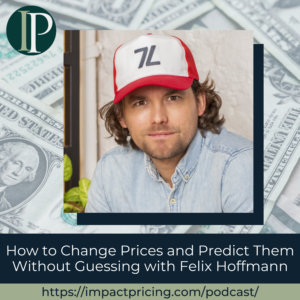
 Felix Hoffmann is the CEO of 7Learnings, where he helps companies move from intuition-based pricing to predictive, data-driven pricing systems.
He previously led pricing optimization at Zalando, managing pricing across millions of products and markets—giving him a front-row seat to how pricing actually behaves in the real world.
In this episode, instead of relying on gut feel or delayed results, Felix introduces predictive pricing—a system that forecasts the impact of price changes before you make them. They break down why most pricing decisions today are still reactive, how companies are leaving profit on the table by not simulating outcomes, and why testing alone isn’t enough anymore.
If you’ve ever changed prices and hoped for the best—this episode will challenge that approach.
Podcast: Play in new window | Download
Why you have to check out today’s podcast:
- If you’re changing prices without knowing what will happen—this episode shows you a better way.
- Understand why testing pricing isn’t enough—and what comes after testing.
- Discover how companies are using simulations to make faster, smarter pricing decisions.
“You shouldn’t decide based on gut feeling—you should decide based on what you predict will happen.”
— Felix Hoffmann
Topics Covered:
01:30 – What Is Predictive Pricing? How to forecast the impact of price changes before making them
04:00 – Why “Should We Change Price?” Is the Wrong Question The real question: what happens if you change it
07:00 – What You Need to Predict (Beyond Sales) Profit, costs, returns, and long-term effects of pricing decisions
13:30 – Why Testing Alone Isn’t Enough You can’t test everything—so you need simulations
17:00 – Competitor Pricing: Guessing vs Predicting Why most companies match competitors blindly—and how to avoid it
20:30 – The Role of External Signals (Weather, Seasonality, Trends) How real-world factors shape pricing decisions
23:30 – B2B vs B2C Pricing Reality Why predictive pricing is easier in high-volume environments
29:00 – Final Advice: Predict First, Decide Second Why simulation is the missing layer in pricing strategy
Key Takeaways:
“The question is not: should I change my price? The question is: what happens if I change it?” — Felix Hoffmann
“Nobody is doing perfect decisions today… perfect decisions would require mathematical optimization.” — Felix Hoffmann
Platforms & Pricing Model Examples:
- Amazon Web Services – Example of committed spend and consumption-based pricing at scale
- Snowflake – Known for credit-based pricing, highlighting the tradeoff between flexibility and pricing clarity
- DocuSign – Example of outcome-based pricing where customers pay per completed transaction
- ZoomInfo – Combines seat-based pricing with credits, illustrating hybrid pricing in practice
Resources Mentioned:
- 7Learnings – Platform for predictive pricing and revenue optimization
- Zalando – Example of large-scale pricing optimization
Connect with Felix Hoffmann:
- LinkedIn: https://www.linkedin.com/in/felix-hoffmann-7learnings/
- Website: https://7learnings.com/
Connect with Mark Stiving:
- LinkedIn: https://www.linkedin.com/in/stiving/
- Email: [email protected]
Full Interview Transcript:
(Note: This transcript was created with an AI transcription service. Please forgive any transcription or grammatical errors. We probably sounded better in real life.
Felix Hoffmann
I really would recommend to make predictions up front. I think tests are great. Tests are really awesome. And many people have understood this, although not all of them are doing it yet. But the thing is that you can’t test everything. And that’s why the next step is you need to enable simulations.
[Intro]
Mark Stiving
Welcome to Impact Pricing, the podcast where we discuss pricing, value, and the spicy relationship between them. I’m Mark Stiving, and I help companies see value through their buyers’ eyes.
Our guest today is Felix Hoffmann. Here are three things you want to know about Felix before we start.
He is the co-founder of 7Learnings, a company focused on AI-driven pricing and revenue optimization. He has deep expertise in applying machine learning to pricing decisions in e-commerce and retail, and he’s known for helping companies move from intuition-based pricing to data-driven automated pricing strategies.
Welcome, Felix.
Felix Hoffmann
Thank you so much for having me, Mark. Thank you so much.
Mark Stiving
How was the intro? Was it close to accurate?
Felix Hoffmann
Yeah, I think so. Yeah, absolutely. I mean, there’s one thing I typically tend to explain a bit further is that, yeah, my role at Zalando, I’m not sure how well-known Zalando is in the US, but it’s the biggest fashion platform in Europe. Yeah.
And I was responsible for the pricing optimizer there for 4 million products, 28 markets.
So yeah, that was also really how I got into pricing. I was working for Kani before, this American consulting company, and did a lot of pricing projects there.
And then I basically discovered this predictive approach to pricing that I can explain a little bit today also.
And I really fell in love with it, you could say, because it’s really so much better than what I had seen before in my consulting career.
And then I thought, okay, we have like a hundred people working on this at Zalando. Not every company can afford that.
Maybe it’s a good idea to create a service for this advanced pricing method that enables more people to use that method basically.
Mark Stiving
Nice. So what do you mean? When you say predictive pricing, what are you talking about?
Felix Hoffmann
So the idea of predictive pricing is basically to predict upfront what will happen if you change your prices.
So typically we’re working with retail companies. It works also everywhere else, by the way, but this is what we focus on.
And you can say, okay, I can go up with the price. I can go down with the price. I can stay with my current price. And the idea would be to make really very accurate, as accurate as possible predictions upfront what it would mean if you are changing your price.
Not only to like sales, there’s not only an elasticity model, but also to your profitability. And that means to your logistic costs, to your return rates, which are also changing with changing prices.
Commission costs are often changing and marketing costs could also change because your conversion is changing.
And that could also have an influence on the stock at the end of the season, if you have a seasonal product.
So it also has long-term effects that you can predict.
Yeah. And that’s what we’re doing basically for seven years now. And we just went to New York and expand in the US now.
Mark Stiving
So it sounds fascinating. How do I know that the prediction was right?
So are you using historical data and saying, Hey, let’s build a model on historical data and then we’ll test it on the next prediction and the next prediction?
Felix Hoffmann
Yeah, exactly.
So what we are doing is basically we get daily data and then we make a prediction for a very accurate prediction per day for every single day for every product, every channel.
And so that’s billions of predictions every day already today. And then next day you can check, right, you made a prediction for that day and then you can check was the prediction correct and then you’re improving.
So in our case, that’s what we call 7Learnings. We’re improving the models automatically every day. So every day we are basically throwing away the old models and retrain all the models.
And based on the accuracy data of yesterday, improve the models for the next day.
Mark Stiving
That’s actually really smart. I love that idea.
And so how do you get all of the other data? So we talked about things like conversion rates. How do you get conversion rate data?
Does the company, the customer give it to you?
Felix Hoffmann
Yeah, sometimes the customer already has their clicks data on product level, need some attribution typically, but many big companies already have that type of attribution because they’re also interested in this data.
If they don’t have it, we sometimes also can get it from Google for specific channels.
For example, you can get clicks data from Google ads or also Google analytics, depending on what you’re running, which analytics system you’re running on your web shop.
Mark Stiving
Yeah.
Felix Hoffmann
Yeah.
Mark Stiving
So of course we’re pricing geeks. I’m a pricing geek.
And so I want to know, hey, when I change price, what happens?
But it also seems that now we’re dealing with, hey, I’m, I’m investing more in Amazon ads this week.
So what happens to sales? Are you taking that information into account as well?
Felix Hoffmann
Yeah, so we are really making predictions for each channel separately.
So you, let’s say you’re a big retailer, you’re active in, I don’t know, 20 different markets and you’re active in each market on Walmart and Amazon and eBay and whatever.
And then on each of these markets, you have different customers, you have different willingness to pay. You have different competition, you have different commission costs, logistic costs, return rates, all of that is different.
And therefore we think you have to predict each channel separately and then make predictions for each channel. And then yeah, let’s say Amazon changes the, that’s one of the nice things once you have implemented the system.
Anything dynamic coming up, like commission cost change from Amazon, for example, would automatically run into the data because we get this data feed basically.
And then we adapt the predictions and based on the predictions we adapt the prices. And a good example for this would also be tariff costs in the US at the moment, right?
So a lot of companies are thinking now, okay, should I change my prices, yes or no?
And I think that’s not the right question. The right question is, what happens if I change my prices? And if I have a good answer to that based on my predictions, which should use the last tariff data and last oil cost shock data and therefore the impact on your purchase prices, and then you can run a prediction based on that prediction.
You should decide not based on gut feeling. Yeah.
Mark Stiving
Yeah. So I think another one of the really probably the biggest factors that influence purchase volume is competitor pricing.
Are you collecting competitor pricing?
Felix Hoffmann
We’re not crawling ourselves because that’s really a commodity. There’s like so many crawlers out there. It’s something that we would get in, but it’s also included in our prediction.
So we know that around this competitor price, there is the most elastic part of the demand curve. And that is also included in our prediction.
And on top, you can also set a rule. So you can still, what many people like to do, especially in the US, right, is kind of trying to match competitors. You can still do that. The difference is that you will get a prediction what happens if you do it upfront before you do it.
And then you can say, okay, do I want to follow this competitor or which, which competitor do I want to follow actually? Yeah.
And you get a prediction for it before you make these rule-based decisions. I think today, even in the U S most people are making rule based decisions without really knowing what they are doing because they don’t have a prediction for what happens if they do it.
Mark Stiving
Yep. I would certainly agree with that. Here’s a really interesting one. Tell me about the weather. The weather is going to impact whether I go shopping today or not.
So how do you incorporate that?
Felix Hoffmann
Yeah, the weather is incorporated centrally.
So we actually get that from a central weather forecast globally, basically. And then we include it into, since we do daily predictions, in daily predictions, by the way, there’s more included, not only the weather forecast, but also like Is it a holiday for example, yeah?
Or is it a Black Friday day? Or is it, yeah, is it a day where there’s a lot of vacation? What month is it actually? Or what day of the week is it? There’s weekly seasonality as well, right?
And all of these things are also included in the daily prediction as well.
So there are specific models inside 7Learnings. The model we are talking about now is kind of more like a global model which predicts total sales in your shop. And then there’s other models which do other specific predictions. Yeah. For example, return rate would be a specific model.
Mark Stiving
Nice. Okay. So I’m going to ask a tech question, but I want you to try to answer it in a way that a non-techie can understand like me.
Felix Hoffmann
Okay. Give it a try. You got a PhD from California as well, right? So like.
Mark Stiving
I do, but, but that’s beside the point.
I try to keep everything so that I could understand it even if I didn’t have an education.
So let’s talk about AI for just a second.
And so what I really am curious about is before these new LLMs came out.
There were pricing companies using machine learning to do pricing predictions or price segmentation and saying, here’s what your optimal price point might be.
And then once LLMs came out, I’m not sure that they changed the type of AI they use.
So can you help us understand the difference between machine learning and LLMs and tell me what you do and which of those you use and how much and how?
Felix Hoffmann
That’s a big question, really. Yeah.
So for me, generally, I would say that, that this whole, what we are living right now, right, in our society is a revolution of decisions.
So I think what we’re seeing is in the industrial revolution, we saw mechanical tasks automated. And now today we see human decisions automated, but that’s just the start of what we’re seeing. Right.
And the question is, I think your question, how I interpreted it is like, what is the best technology to automate a pricing decision?
And for me, it cannot be LLMs for sure.
They can help here and there, but the core technology for this has to be deterministic.
So it has to be something that gives you the same answer each time you’re asking, because like pricing is such a sensible, super crazy important part of your business that you shouldn’t give it over to like a something that hallucinates.
And the other thing is most companies would want to have something that is explainable, right? So you want to, if you get a price out of a kind of a black box, that is not something that will help you much because then you say, okay, why did you make that choice? I want to understand the decision. And I think you want to understand the decision on product level.
And that is why I think this is why we’re going this way around, right? We could also build a black box and just give you the price, but that’s not our philosophy. We think it’s good to have this, yeah, to make all this work on making the predictions for all your options, because then you can look at all those options and you can understand why we’re making a decision.
And there’s a lot of value in that.
Mark Stiving
Yeah, I like the comment that said the calculation should be deterministic, right? We should get the same answer each time.
So I like that a lot. So that implies machine learning over LLMs. But I could also see how you would use an LLM to explain what the machine learning did.
Felix Hoffmann
Yeah, or like make a recommendation what rules you could try, because even if you have a predictive system, that doesn’t mean you’re limited anyway, right? I mean, what we are doing, I don’t know if you’ve seen the app, but you can do target-based steering, right?
You can say, I mean, there’s not just one perfect price, right? The price depends on your strategic goals, right? So if you want to grow very fast, your optimum prices will be lower, as opposed to if you want to maximize profitability. And therefore, even if you have such a system in place, you still need to make decisions. They are more like on a higher level.
So they are more like, okay, you want to grow fast, and if so, how fast do you want to grow? This is a decision you still have to make, because I cannot make that decision for you, even if I do this system right.
And then, yeah, I think LLMs can help on this decision making process. But they, yeah, I don’t believe in like agentic based decisions on pricing.
I think they even try this sometimes for like vending machines in the US. I think in Entropic, there are some vending machines in-house basically in their office, which are running on their LLM and it doesn’t work even on the vending machine.
And then think about like a super complex company. Yeah, you don’t want to, yeah, if it doesn’t even run on like 10 products in a vending machine, you don’t want to use it for your company for sure. Yeah.
And it’s also not going to change, I think, because it will never be deterministic, I think. And the other thing is that you do need also the prediction, right? I mean, LLMs are generally something that do really well on communication on words, but they don’t do so well on numbers.
Therefore, I think, yeah, this one is not going to change, I think, in the next 10 to 20 years, actually.
Mark Stiving
Yeah. Well, I’m not sure what the 10 to 20 cause that things are moving so fast, but, but I’m with you that you can’t do it today. It’s hard.
I use LLMs a ton and even on the language side, it’s great, but it isn’t perfect. It makes a ton of mistakes.
Felix Hoffmann
Yeah.
Mark Stiving
So I’m just very cautious about it.
So most of my work I do in B2B and mostly small and mid-sized businesses.
So I’m going to ask you a few questions, even though it’s not your world. I want to see if you could see how you apply this to this world.
First question seems obvious to me, and that is for your method to work, we have to have a lot of purchase data.
Is that a true statement or not?
Felix Hoffmann
Yeah, I mean, the more price changes also you have made historically, the more accurate the predictions are going to be for sure. Yeah, I think that’s true.
And in B2B, there’s a couple of specific topics, right? You often have like customer specific prices, actually. I mean, yes, you have one black price or like one kind of recommend retail price.
But then there are actually customer specific discounts. I mean, what I typically tend to recommend for B2B is then optimizing the recommended retail price with a predictive tool.
And we could be used for that, by the way. And then you need something else to optimize the customer specific discount, because that’s not our job, basically, or not what we’re doing.
But I think for a price increase campaign, for example, often a black price increase is also easier to implement than a customer specific discount discussion.
Because you can at least say, Hey, look guys, we need to increase kind of recommended retail prices for everybody. Instead of discussing with your B2B customers, every single one of them basically, Oh, I have to reduce your personal discount. Right. That’s a much more difficult discussion. Yeah.
Mark Stiving
Yeah. It’s challenging.
And so one of the things I think about in B2B, and I think almost all B2C companies don’t think about this, and that is how do my buyers perceive the value of my product?
And so I say that as in I’m not asking questions of B2B clients and saying, you know, what’s important? What problems do you have? How are we solving it? Different buyers get different amounts of value.
And that has a lot to do with the fact that we give customers specific discounts, right? These guys get a ton of value, so we charge them a lot. These guys don’t get much value, we charge them less.
In B2C, we do, I call it TIOLI pricing, right? Take it or leave it. We put a price out and you can buy it or you don’t buy it. It doesn’t matter. Is there any way for us to start to move towards capturing value or how buyers perceive value in the consumer retail world?
Felix Hoffmann
I do see there a convergence actually, I have to say, because what, for example, Zalando is doing more and more often, if you’re on their website or even in the app, they check basically your personal purchase history.
Based on that history, they would give you kind of a specified coupon just while you’re there in the app.
And that’s very similar to what B2B is doing basically, right?
So if you have been historically shopping a lot and you didn’t shop for like, let’s say six months, and historically you’ve been very profitable for the company, then they would give you a large discount just to make you shop again while you’re there. Yeah, and that’s going in that direction, actually, and I think it makes a lot of sense.
I think there’s also this discussion of personal pricing, which you could also technically do, right? You could kind of separate the price by user.
But I would not recommend doing that because already what we are doing is very, very difficult, I would say. And there’s so much more potential in doing that, like doing, having like one optimal price, like for all your customers in the channel.
And then the rest of the personal pricing, I would do that like Zalando with coupons, with personal offers or coupons.
Mark Stiving
Yeah, it is really hard to do price segmentation per person in retail.
Unless we’re going to do custom discounts, custom coupons.
Felix Hoffmann
Yeah, but one thing is you can try to analyze like what would be the value of getting this person to buy again, keep that being a customer and you have to calculate that. And that’s not so difficult, actually, based on your historical data. Because you know, like if this guy was giving you a profit of 100 euros last purchase, it’s likely to be a good customer and then You should try to retain that customer.
And then depending on that historical purchases, you can decide how much you want to give in terms of coupon.
So that’s something everybody can do.
And most people are not doing it right now. It’s also technically, of course, tough. You have to be really fast or kind of technically enable that displaying this coupon, but I think it’s really worth it.
Mark Stiving
And there’s also, the coupon thing is okay, but there’s also a huge fairness conversation that goes on in B2C, where when you charge two different people two different prices, you have to have a good justification or it has to look fair to the buyer.
Felix Hoffmann
Exactly, I mean, there are some companies tried this here and they got a huge social campaign against them basically on the media, especially on like, I think Uber is doing the search pricing as well.
If it’s raining, it’s more expensive. Right. And I think that everybody got used to it now, but there were some other companies doing it and they didn’t get a lot of good reviews.
And I think the main reason I would say is that even what we are doing, like I would say Amazon is doing it by the way, as well, they do predictive pricing.
But then a lot of the other companies are not doing it even yet.
So it’s like, this is kind of the next step to do that. And then when you have implemented it, the next one would be this coupon, which allows you to kind of customize the price by consumer.
But I mean, the first step is this predictive step, which nobody is doing, or like not a lot of people are doing at the moment.
Mark Stiving
Yeah, even for Uber, it took them several years to get people used to paying surge pricing. It was not easy for them.
Felix Hoffmann
Yeah.
Mark Stiving
To convince buyers it was okay.
Felix Hoffmann
Yeah, but I think people can get used to it.
Yeah, that’s also part of the other discussion, right?
For example, there’s a big discussion and almost every second time I have a discussion with a company I have this discussion where it’s like, if you are having a price in your shop and you have an online shop, should you have the same price or can they differentiate?
And I think from a pricer I would say it’s always for sure the price has to be different.
But yeah, of course, customers generally don’t like it. You have to somehow manage that.
But it doesn’t seem a good idea to me that you always have the same price on all channels, right?
Because the value is different, right? And that’s something that the customer also gets used to, I think.
Mark Stiving
Yeah. Well, we see that all the time, right?
The price of a bottle of water at the grocery store is different than a convenience store.
Felix Hoffmann
Yeah.
Mark Stiving
And it’s different at the airport.
Felix Hoffmann
Exactly.
But still you have these discussions and many big retailers even in Germany, they struggle with this.
And some of them really still have made, this is the thing with pricing. I mean, often they have like government issues where I say, okay guys, you know exactly what I would do to kind of to get like, get you going. Yeah.
Sometimes often the management says we are not allowing any price differences, for example. Right. This is kind of a huge, huge problem.
Mark Stiving
Yeah. I’ve worked with companies like that. It’s challenging. It is challenging.
So do you recommend experiments that people run?
So you say, hey, this is some uncertainty in our world, so let’s go try this just so we can get data and see what’s going to happen.
Felix Hoffmann
Yeah, so I mean, we often do A-B tests in the beginning to onboard, then we just kind of cut the products into two pieces, like one you do your old thing and the other thing you price with 7Learnings and then we check what the benefit is. Benefit is pretty high. I mean, yes, you know that working in pricing for such a long time.
So I think on average, I kind of, it can vary a lot, but I think the median is even above 20% or something like this.
And we kind of promise like at least 5% uplift typically.
So it’s like, it’s really high for a large organization and it’s one of the most underworked profit levers for sure.
And in the short term, there’s, there’s nothing else you can do that can give you so much profit.
Mark Stiving
Yeah. And a 5% uplift on revenue is all profit. which is huge, especially for retailers because their margins tend not to be that high.
Felix Hoffmann
But really on a seasonal level, I think if you use it like full scale, also on your seasonal optimization, it’s even higher, the profit uplift.
So it’s like stuff has become very, very complicated and more and more dynamic with the tariffs and the oil changing now.
And also the, of course, competition is changing prices much more often.
So yeah, you have to kind of ramp up your game a bit to stay ahead, I think.
Mark Stiving
Yeah. And you probably have the data now that you could help governments understand this is what happens when oil prices go up.
Felix Hoffmann
Yeah, exactly.
You can actually try to simulate that because if retailers do rational decisions, then it’s not always increasing the price. For sure not. It really depends.
But yeah, you can model that. And I think that’s the best thing. It really also makes the strategic decisions much more like data-based.
Even like you can kind of run a scenario A. This is one of the things that I often recommend to say, okay, you have a discussion internally whether you should match the prices of one of your competitors as an example, right?
And then you can say, okay, let’s run a simulation. Let’s say, okay, we’re matching or we’re not matching. And then you look at the simulation and then you can make a decision if you want to do matching.
But today most people just say, okay, we want to do matching, but they don’t have any data actually. They don’t have any prediction. They don’t even run a test on this.
So this is completely nuts in my opinion. Most of them just do matching and have some weird rules somebody came up with. They don’t even know where they came from.
So I think even if you want to do rule-based pricing, right, and you want to do matching, even then you should do a prediction upfront to know what you’re doing there. Yeah.
Because this can be very, very expensive, this matching strategy, especially on the long tail, it doesn’t make any sense. I mean, at least we didn’t do that at Zalando.
We matched like a very small part of the portfolio and most of the portfolio we didn’t match because it doesn’t make any sense profit wise. Yeah.
Mark Stiving
Nice. Okay. Felix, I’m gonna ask one really hard question.
You’re allowed to pass, but since you’re a pricing geek and you’re running a pricing software company, how do you price your software? I don’t need to know the numbers. I actually want to know the pricing metrics.
What is it that you charge for?
Felix Hoffmann
Yeah, we typically, we try to keep it simple, actually, that is what I was trying to do. So it’s really like a monthly subscription fee that you’re paying.
And that depends on how much revenue you’re optimizing with us. And if you compare that to the value, which you can measure with the A-B test, then we’re too cheap, if that’s your question.
Mark Stiving
No, no, I’m not.
So aren’t we always afraid to charge too much?
When I’m coaching someone else, I can tell them to charge way more. But when I’m pricing myself, it’s like, oh, I can’t raise prices.
Felix Hoffmann
Yeah. No, yeah, I mean, I think so, yeah. I think, I mean, for many, I mean, for some of our customers, we, like, the value we created is, like, completely nuts.
Like, some of them, we really increased profit by, like, 100% or something like that. Some of them were, like, very, very thin margins, and we really showed them how to improve that a lot.
And then, yeah, for those, we are really far too cheap. But then there are some other retailers who are already doing it really well.
And then maybe you can just achieve 3 or 4% uplift. That also happens. Yeah, but 3 or 4% uplift is still a lot of money often.
Mark Stiving
So if I could provide any advice to you, I would suggest that you try to grab 10% of the incremental profit you give to your customers.
Felix Hoffmann
Okay.
Mark Stiving
Right. However, you craft your pricing strategy. Right.
And so if you do A B testing up front, you could say, here’s what it’s going to, here’s what it looks like.
Or the biggest problem is attribution.
So you come in and you far increase their profitability and marketing says, yeah, but that’s because we ran an awesome marketing campaign this year.
Felix Hoffmann
Yeah. We also have a marketing product by the way.
Yeah. So really our dream is really to say, okay, you tell me where you want to go. Like, let’s say you want to grow 10% and I tell you how to get there. That’s it. Period.
I think that’s the future really is target driven decision-making.
You make the big decisions and I make the product specific decisions for you.
I mean, you can, you don’t want to necessarily optimize kind of the marketing steering on Amazon for all of your 20 million products manually. Right.
So that’s where like AI can help you. Yeah. And I think it’s really maybe that like, that’s one thing I still want to share is like, it’s really a positive thing.
At least in Europe, the discussion is quite negative of AI. And I am always surprised when I hear that because. I mean, who wants to do 20 million decisions on product level every day?
That’s not something you want to do. Right.
So. Yeah, and so you want your company to be successful, right?
So I mean, I don’t see anything negative in this actually, it’s going to be a more relaxed world. It’s a bit of work to get this going. But once it’s running, it’s really helping you and making you also like I think, make your daily job easier.
Mark Stiving
Nice, nice. Felix, we’re out of time, but I’m gonna ask you the final question, if that’s okay.
And that is, what is one piece of pricing advice you’d give our listeners that you think could have a big impact on their business?
Felix Hoffmann
Yeah, I really would recommend to make predictions upfront. I think tests are great.
Tests are really awesome. And many people have understood this, although not all of them are doing it yet. But the thing is that you can’t test everything.
And that’s why the next step is you need to enable simulations, right? You have a lot of questions during the week. What could happen when you do this or that? And you have to have something that simulates this for you.
And then you can make much better decisions based on these simulations. Yeah.
Mark Stiving
Now, so I have to say, I love that answer. And I’m even going to take it away from software or pricing or anything.
And that is, by the way, all buying is a prediction of the future.
In fact, every decision we make is a prediction of the future. And so doesn’t it just make sense to try to articulate what your prediction is and then see how well it came true and learn from it and get better and better each time you do this.
Felix Hoffmann
That’s by the way, one of the things that will also drive this change because consumers are more and more like getting help on their own consumer decision, right? That’s a big one coming.
And yeah, if you’re a retailer, you’ve got to prepare for this.
And I think the logical response is to also try to automate more your decisions to make them more optimal, right? Because I think if you critically think about it, nobody would really say that they think they do perfect decisions today.
Perfect decisions would require an optimization and you have to do like a mathematical optimization. You have a target, you have constraints.
And then you need to have a mathematical optimization. Nobody’s doing that today. Nobody. And it’s striking to me, but yeah, that’s how it is.
Mark Stiving
Well, if we thought there weren’t enough transactions in B2B, there are certainly not enough transactions for my B2C decisions or for my consumer decisions.
Felix Hoffmann
Yeah, that’s true.That’s true, but there are in total, and if I’m an LLM and I know all of the consumer decisions, then it might be different, right? That’s maybe the thing. And on the consumer decision, I think you also have the benefit. There’s all the reviews, right?
You can check all the reviews that people wrote about in terms of how good the quality of the product was. Yeah.
But I think even B2B will also be optimized that way, predictive, but you’re right. It’s more difficult that, yeah, I absolutely agree. But on, we do some B2B already, like for example, on automotive parts or something like this, where you have like millions of products as well, and lots of, it’s kind of small shops buying these products.
So it’s almost like a consumer. And then you have a lot of transaction data and then it works also really well.
Mark Stiving
Yeah, I think the key is two things.
Number one, it’s a lot of transaction data.
And number two, it’s the take it or leave it pricing. We’re not negotiating with individual customers, or at least most of our customers are not.
Felix Hoffmann
Yeah.
Mark Stiving
So Felix, this has just been fascinating.
Thank you so much for your time today. If anybody wants to contact you, how can they do that?
Felix Hoffmann
Yeah, just on LinkedIn, search for 7Learnings on LinkedIn or Felix Hoffmann, and I’ll be glad to answer any questions coming up.
Mark Stiving
Excellent, and we’ll have the URL in the show notes.
And to our listeners, thank you for your time. If you enjoyed this, would you please leave us a rating and a review?
And if you have any questions or comments about the podcast, or if you want to see value through your buyer’s eyes, email me, [email protected].
Now, go make an impact.
[Outro]