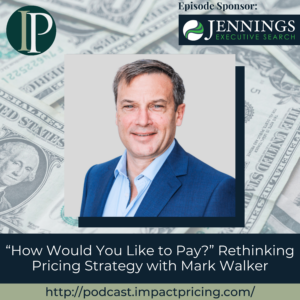
Mark Walker, CEO at Nue.io, helps companies design pricing models that align with how customers actually experience value—across usage, subscriptions, and hybrid approaches.
In this episode, he joins Mark Stiving to unpack a growing tension: companies are pushing more flexible pricing models—but customers don’t always want them. At the center is a simple question that changes everything: “How would you like to buy?”
They explore why pricing isn’t about finding one perfect model, but about giving customers the right options—while avoiding the complexity that slows decisions.
If you’re trying to evolve your pricing so customers can decide faster (without overwhelm), this is a conversation you’ll want to hear.
Podcast: Play in new window | Download
Why you have to check out today’s podcast:
- Understand why the future of pricing isn’t choosing the “right” model—but giving customers the right options.
- See why customers don’t want to decode your pricing—and how simplifying it builds trust faster.
- Learn how to experiment with pricing without breaking your business—or your customer relationships.
“You need to introduce your customers to what you’re going to be changing about your product set and ask them to tell you how they would relate that to value.”
— Mark Walker
Topics Covered:
02:26 – What is a revenue architecture system? Why pricing, billing, and quoting can’t live in silos anymore—and how unifying them enables pricing flexibility
05:11 – Aligning pricing models to customer value Why the same product needs different pricing models depending on how customers experience value
08:11 – What “hybrid pricing” really means Breaking down how companies combine subscription and usage to better reflect real-world value
19:29 – Why changing pricing is so hard The hidden risk: once a pricing model is live, you’re locked into it longer than you think
21:39 – Optionality as a pricing strategy Why giving customers multiple ways to buy may outperform forcing a single pricing model
25:42 – Outcome-based pricing: what it actually means Why outcome-based pricing isn’t new—and really comes down to who takes the risk
29:36 – Don’t guess pricing—ask your customers Why involving customers early can prevent costly pricing mistakes
30:44 – How to talk to customers about pricing changes The role of communication in introducing new pricing without creating resistance
Key Takeaways:
“The more abstract you make the relationship between what the person is doing and what that costs, the harder it is to get the customer to budget for it.“ — Mark Walker
“Outcome-based pricing is not a real thing. It is just a subset of usage-based pricing.” — Mark Walker
“You need to introduce your customers to what you’re going to be changing… and ask them to tell you how they would relate that to value.” — Mark Walker
“Align your pricing to how your customer measures value.” — Mark Walker
Platforms & Pricing Model Examples:
- Amazon Web Services – Example of committed spend and consumption-based pricing at scale
- Snowflake – Known for credit-based pricing, highlighting the tradeoff between flexibility and pricing clarity
- DocuSign – Example of outcome-based pricing where customers pay per completed transaction
- ZoomInfo – Combines seat-based pricing with credits, illustrating hybrid pricing in practice
People Mentioned:
- Steven Forth – Pricing thought leader referenced in discussions about credit-based pricing and abstraction
- Ray Tetlow – Mark Walker’s mentor; known for simplifying business models and influencing his perspective on pricing structures
Connect with Mark Walker:
- LinkedIn: https://www.linkedin.com/in/markwalker/
- Website: https://www.nue.io/
Connect with Mark Stiving:
- LinkedIn: https://www.linkedin.com/in/stiving/
- Email: [email protected]
Full Interview Transcript:
(Note: This transcript was created with an AI transcription service. Please forgive any transcription or grammatical errors. We probably sounded better in real life.)
Mark Walker
You need to introduce your customers to what you’re going to be changing about your product set and ask them to tell you how they would relate that to value.
[Intro]
Advertisement
Today’s podcast is sponsored by Jennings Executive Search. I had a great conversation with Jon Jennings about the skills needed in different pricing roles. He and I think a lot alike.
If you’re looking for a new pricing role, or if you’re trying to hire just the right pricing person, I strongly suggest you reach out to Jennings Executive Search. They specialize in placing pricing people. Say that three times fast.
Mark Stiving
Welcome to Impact Pricing, the podcast where we discuss pricing, value, and the dynamic relationship between them.
I’m Mark Stiving.
I help companies see value through their buyers’ eyes.
Our guest today is Mark Walker. Here are three things you want to know about Mark before we start.
He’s focused on modern pricing strategy with an emphasis on AI, usage-based pricing, and hybrid monetization models.
He’s deeply engaged in how software and SaaS companies evolve pricing, and he’s passionate about helping companies navigate the shift from traditional SaaS to more flexible, value-aligned models.
Welcome, Mark.
Mark Walker
Hey, Mark. Great to be here.
Mark Stiving
Hey, I didn’t give your company any love. What’s your company name?
Mark Walker
The company’s called Nu, N-U-E dot I-O, and we’re based in the Bay Area, but I’m based here in Toronto.
Mark Stiving
Yeah, and just to be fair, I want to get the level set here for a second.
You’re doing the equivalent of a billing system, is that right? Or am I messing that up totally?
Mark Walker
No, that’s a really good question, right?
So traditionally, people have thought that there were three systems, three core systems that people need to have besides their bookkeeping system, whatever the hell that is, right?
That was their configure price quote system, a self-service system to the sense that you had PLG or customer self-service in-app, that sort of thing. and a billing system, and the billing system is owned by finance, and the self-service system is owned by engineering, and the CPQ is owned by sales.
Well, the big thing about new is, NUE is a new type of system called a revenue architecture system that sits underneath all those, and billing is one of our functions, and self-service is a different function.
And at CPQ, our quoting is a different function, but people buy those different pieces and use them in different ways. So some people buy just CPQ, some people buy CPQ plus self-service, some people buy self-service plus billing, and some people buy everything.
Or sometimes just billing as well, sometimes just billing.
So it’s all those things. But fundamentally, it’s a system for enabling you to do the billing transaction successfully regardless of which part of that process we’re doing.
Mark Stiving
Got it. That was a great explanation. Thank you very much.
So before I hit the button record, I said, hey, Mark, our conversation is going to go a lot like this. And you said, oh, let’s start the conversation with that sentence.
So here’s the sentence.
And that is, my claim is that pricing fails in two different places.
It fails in the buyer’s mind and it fails in the company’s systems. And I started off by saying, I care about the buyer’s mind. You care about the company systems.
And now, Mark, what did you say?
Mark Walker
So i said so actually of course i can of course that’s true but we also are fully aware of the problem about the buyers mind.
And the reason is because our customers are running into the helicopter blade of the difference of expectation between. the financial markets and the pre-market part of that who are expecting everybody to move to a form of hybrid pricing and what their customers, the CFOs of their customers want, which is not to enter into a contract with hybrid pricing in it where they don’t understand some of the drivers. I’ll give you a good example from our own customer base.
We offer our own product in multiple different buying modalities. You can buy it on the basis of seats and transactions and API calls.
Or you can buy it on the basis of percentage of revenue, or you can buy it also on a percentage of growth, right? And we let people buy the same thing. And you can buy any part of it on those models.
So you can say this is on seats and this is on something else. And the reason for that is, is because the customers are vastly different. I just came out of a meeting where somebody pointed out that one of our customers had just consumed 9 million API calls, right?
And if they were paying for that on a per API call, that would be really bad for them. But it turns out they’re not, they’re paying a percentage of revenue.
So it’s our problem. It’s our problem to basically figure out how to make that efficient.
And that’s, we’re going to see that type of cycle, that conversation where the customer’s like, you figure out how to make this efficient. I don’t want to figure out how to make this efficient. And that’s a big change in the marketplace, I think.
Mark Stiving
You know, I didn’t think we were going to go here, but I’ve got to ask this question.
I’ve rarely seen companies be willing to pay a percentage of revenue.
How did you get a company to do that?
Mark Walker
I think you need to ask a question about value.
So let’s think of two different companies, right?
Actually, this goes right to where your happy place is.
So you’re selling to two companies. They’re both $100 million software companies, right?
One company has $100 million clients. Maybe that’s a bit unusual. Let’s say they have 1,000 $100,000 clients, right?
And then you have another company that has $100,000 customers, right? What they value in a system is so radically different, even though they have exactly the same ARR.
In the first case, they could probably, what’s that work out to be, like 90-ish invoices a month? They could have somebody type out the invoice.
As long as they got the data out of it, they could have somebody.
So there’s some value to getting the invoice, right? That’s certainly true, but it’s not like the other one where you’re doing 100,000 invoices a month or something like that, right?
And so what we tend to see is the revenue deals, they tend to skew to the high volume side of the equation.
And then the per whatever deals, they tend to skew to the other side.
Interestingly though, some of our customers are the very largest AI companies in the world.
And I can’t talk about what the pricing is for them, but it’s not that simple. It’s not that simple because they have things that look and quack like both of those things. Right.
Does that make sense?
Mark Stiving
Yeah, it absolutely makes sense.
What I often think about and I even talk to my clients about is the fact that, hey, when I go buy a new car, I can lease it, I can take a loan out, I can pay cash for it, right?
There’s lots of different ways that I can pay for it and I can choose to buy this thing. There doesn’t have to be a single pricing metric or pricing mechanism there.
And so it makes all the sense in the world.
As long as you’re still profitable, buyers are going to choose the way that’s best for them.
Mark Walker
Right, we even let people change. Like, if you sit there and you bought one way and you want to change, why?
Because super happy customers who are really, really feel that your company delivers a tremendous amount of value are so much more valuable than customers who are kind of pissed off and they think they got shoehorned for a three-year contract into a deal they don’t like. that it’s worth, even if it caused a bit of down sell, it’s kind of worth it. Because they go, oh my God, like we love you as a vendor. Only a couple of customers have ever done that, but they basically people who made really bad deals for themselves, and they should have picked what we offered the other time.
Basically we were right about what they should have picked. And they went, yeah, you were right.
We said, it’s okay, we can switch. But it does lead to some very interesting conversations where somebody says, you know, how do you price your software?
And you say, well, how would you like to buy it? And the CFO goes, sorry, what?
And you go, no, look, I want to get my pricing as closely aligned to your measurement of value.
What is that?
So, yeah.
Mark Stiving
I absolutely love that. I’m going to have to step back and think about it some more because I’ve never heard anybody say that line before, but I absolutely love it.
Talk to me about what you mean when you say the word hybrid pricing.
Mark Walker
So hybrid pricing has been around for a while. It’s not a new idea, but it’s becoming much more in vogue right now because of the switch to outcome-based, well, the expectation for outcome-based pricing maybe more than the actual reality.
So we can think of two different companies. Those are three different companies and sort of create some analogies.
So there’s always been pure consumption models. And the best example of the ones that are really like outcome-based are like, you know, credential checking, know your customer type things.
DocuSign, right? Where you basically go, I’m paying for that check. I’m paying for that clearance. I’m paying for that signature, right?
And, you know, Envelope and DocuSign, right?
Well, that seems simple except that what the vendor wants is some kind of idea about what you’re going to consume.
So normally what they would do is they would package that in one or two ways.
One is package it so that you can approximate it on the basis of something you know. Like I have a thousand sales reps or I have so many employees and therefore if I price on the basis of employees I get this a bundle of envelopes, say DocuSign, bundle of clearance checks because of a certain amount of employee turnover, bundle of know your customer, whatever, embedded in it. So that’s the simplest form of hybrid pricing.
So I bought something on a seat basis, but it includes a credited basis. ZoomInfo was a good example of that. I buy, each rep gets $100,000, 100,000 to whatever, and that adds up, right?
The second type is pure play credit-based systems, right? And the pure play credit based systems, they basically don’t have, there’s no seed equivalent of a seat in snowflake, right?
Or AWS, right? There’s no such thing.
And so what they’re doing is they’re saying, we are going to give you just credits, which you can apply across all sorts of different things. But what we’re going to do is we’re going to create a subscription for a pool of credits. That’s a different type of hybrid pricing.
So the subscription, sometimes it’s represented as a platform, sometimes it’s represented as the, you know, a tier of relationship, and that includes a whole bunch of credits at a different price point, right?
And so those are two different forms of hybrid pricing. The one that’s really emerging right now, the third form, kind of flips the entire first one on its head, where you go, I’m going to buy a committed, these are called committed spend contracts.
I’m going to buy a committed, I’m going to commit to spend a million dollars with you. or $10 million, whatever, and I can basically deduct from that anything the company sells, or maybe almost anything the company sells.
Some people will say you can take, obviously, subscriptant-based products, you can also do consumption-based products or outcome-based products, but you can also do professional services, forward engineering, support, all these things come out of that bucket.
And in the case of AWS, of course, who famously do this, other companies’ products, which is kind of wild, right?
And so those are three really quite distinct versions of hybrid pricing. And we deal with customers who are doing all those things and actually multiple of those things at the same time. Does that make sense?
Mark Stiving
It does.
On the last one, I’m going to push on a couple different things, if I may. In the last one that you talked about, a good friend of mine, Steven Forth, and I, we argue a lot about this concept of credits and how to use credits and are credits coming and, you know, do they make sense?
It seems to me that this last form that you talked about is really simply credits, right? I’m going to spend a million dollars and now we’re going to figure out how I’m going to spend it with you.
Mark Walker
No, I don’t think so.
So actually, the credit thing that you’re arguing with your friend about, with Steven, is a real thing. The more I think that companies are making, even in the case of Snowflake, who has been famously successful at this, the more abstract you make the relationship between, this is my opinion, between what the person is doing and what that costs, the harder it is to get the customer to budget for it.
Because they go, okay, so I’m going to do this and that’s three credits and three credits are the equivalent of 12 Twinkies.
And then, you know, whatever, like the more, you know, or so many tokens. So for example, our agentic capabilities, we’re not charging, we’re just charging people the API calls.
We’re like, yeah, the agentic stuff, like the actual LLM, that’s part of. calling the api like it’s like it’s like that’s our car of doing this video gateways that so we don’t end up in the taco bell situation or whatever it was with the hey can you order a kind of a coke but can you first actually compute the entire net worth of the north america or something you can do this programming problem doesn’t do that but. If you make it really abstract, then it gets problematic.
So what these new models are is they’re dollar pools. So we have committed dollar pools, either prepaid committed dollar pools, or postpaid committed dollar pools.
Prepaid generally give you better discounts against what you’re going to be consuming than postpaid, for the obvious reason that they get the money up front.
And so, and they lead to different billing modalities. In prepaid, you close the order, you send a bill for $10 million. and then you don’t send another bill until they go over, until they run out of money, right?
Post-paid, you close the order, you send them nothing. You don’t send them any bill at all, and every month they consume stuff, and you send them bills for those things, and you deduct that from the $10 million, and at the end of the year, you then have to send them the differing bill.
But people are really moving away from the credit part, because the person goes, sorry, how much is that, I gotta do the math, where they can literally just say, oh, I get a 15% discount of 50 cents or whatever, and they go, okay, 50 cents seems like a good number for that thing.
Make sense? Or 35?
Mark Stiving
Yeah, I’m totally on your side of this argument.
I think the more you abstract between price and value, the harder it is for people to make decisions.
The harder it is for people to see.
So yeah, I’m totally on your side of this argument. But Steven has some good arguments. I’ll save those for him.
Mark Walker
We don’t have a dogmatic point of view on this. I think that people should do what’s right for their customers. Generally speaking, I would give you this guidance.
If your customer is the CIO, Credits may be a much better way of doing it because a CIO is used to thinking in consumable tokens, in a sense, and they already are probably buying stuff from AWS and Snowflake anyway, which sell that way, so they probably are fine.
If your customer is the CFO, meaning the CFO is the decision maker, or the CRO, or anybody else who’s not the CIO, you probably shouldn’t go with a credit-based model.
And again, this is just my opinion, but generally speaking, those people do not buy that way and don’t think that way.
And therefore, if you do it, you’re going to have to teach them how to think that way, and why bother?
Mark Stiving
Yep. Understood.
So when I think of a hybrid model, I want to just try to test this definition. When I think of a hybrid pricing model, I often think I’m using more than one pricing metric.
So for example, I might be using number of connections and I might be using amount of data flow.
And both of those are pricing metrics I’m using at the same time.
Mark Walker
Yeah, that’s one way of thinking about it.
I would say hybrid models, I would say, have more than one, I think that that definition is true, but you could have a model that meets your definition that I would not consider a hybrid, which would be, I’m going to offer you, I’m selling one thing, I’m making it super simple. I’m selling you just a usage-based product and I am pricing it based on how much you bought of it, right?
And also, how much, you know, the total storage you have in the system, right? This other metric, right?
Or in the case of one of the companies we’re dealing with, how many locations of your chain you have lit up, right? Completely unrelated to the actual consumption.
So one is driven by how much you consume, and then the second one is driven by how many places you consume it in, because that reduces the risk of churn, right? That’s not, in our view, that’s not a hybrid model. That’s a hybrid price calculation, but not a hybrid model.
A hybrid model version of that would be, I charge you per location a platform fee, that gives you a certain amount of usage per location, right, of all these different things. over that amount, there’s a usage component that applies to all these things.
So you get like, you sign the subscription, you get a POS terminal, you get like a bunch of basic services and support and all this per location. And then you have all these usage based things that are sitting under it.
The most common one we see now is people embedding tokens in seats. So you say, if you have 100 employees, then you get this many tokens to use our AI capabilities.
And that would be an example of a hybrid model, where you’re embedding part of the other revenue model in the first model.
But there’s lots of other variations that we’re seeing.
Does that make sense to you Mark?
Mark Stiving
It does.
So to me, and I’d love to know your thought on this. It seems to me that what we’re looking for is which makes the most sense to our customers while we’re still getting paid for the value we’re delivering to our customers.
Mark Walker
Absolutely.
Mark Stiving
So oftentimes we have to combine models to make that make sense.
Mark Walker
And in this situation, I think what people are struggling to do, and why a lot of scale software companies are moving to NUE, you know, like we famously, like NUE has essentially everybody you’ve ever heard of in AI. Like OpenAI, and Anthropic, and Glean, and Jasper, and Legora, and you know, Harvey, and Coder, and Cursor. Anaconda, I’m leaving out tons of amazing AI companies, right?
But we also have like lots and lots of like $300, $500 million conventional software companies. And basically what they’re doing is what they have to do is they have to offer somebody a path from where they are. to where the market wants them to be to where they want to be in a relationship their customer and without breaking the customer relationship and so the running a lot of experiments basically.
They just want to run experiments and one of the reason why people moving over to using a system system is or even a backup to their existing billing system is ago. I may not want to continue this model, but in quote to cash, you don’t get to throw away your experiments.
Like the joke I say, if you stupidly decide that you want to count penguins, the reason I say counting penguins is I think that must be really hard because penguins all look the same to me, is you want to do something that’s stupid and complex, and somebody says yes, you’re stuck doing that for the next three to five years, unless you want to create a churn problem.
You can’t just say, oh bygones.
Unless you’re Salesforce, you can’t go bygones.
We’re just going to pull the pricing model that you just signed up for and make you do something else. That’s going to be terrible.
So that’s the big thing that I think people are struggling with is how to run these experiments without throwing the baby out of the bathwater.
Mark Stiving
Okay. You brought up a topic that I’ve never spent much time thinking about.
And so I want to hear your thoughts on this. we’re trying to move customers from seat-based SaaS pricing to something else, whatever that something else happens to be.
And one of the reasons we want to move them is because we’re trying to make sense of the fact that we actually have real hard costs with our AI expenses, and we’re delivering value differently, and we’re getting rid of, you know, with agentic AI, we’re getting rid of employees.
So there’s a bunch of things changing in our customer base.
So how is it that customers are thinking about this move in terms of what they want to pay for in pricing or how they want to pay in pricing?
Mark Walker
I would say chaotically, but to be fair, but there are some themes.
Basically, I think that the people who are doing the best job of this are, I would say, they’re doing it by increasing the optionality of their customer rather than forcing a transaction model change.
I would say this is universally true. I’ll give you an example.
Say you say to somebody, we are now going to switch our pricing model from seats to Outcome based tokens, right?
And the customer is like, sorry, you just immediately have the CFO go.
So I have no idea. What am I saying? So what they will probably do is they’ll probably go, sure, whatever. I want a committed contract of unlimited use. You know, right.
And that will happen. Right.
But if you say to them, Hey, you can continue to buy on seat basis. This is the charge for our agentic product. And you just do your own modeling to think as the customer uses more, there’s two possible outcomes, either in effect, their seats become more valuable. or that you need less seats.
And you just think, so there’s two possibilities, right?
And so you say to the person, so you can just choose to use it or not use it. We are going to encourage you to use it. That’s the sort of stage two.
So stage one is like screw the customer.
Stage two is give the customer two options. And our version of it is, yeah, we understand that you may not have any idea how to make this work. It’s kind of our problem to make this cost effective for us.
If you just go to a percentage of revenue pricing, you can have unlimited API calls, unlimited invoices, unlimited seats, unlimited.
The new world is maximal flexibility and you need to know what your price is regardless of which modality you use.
And so the reason companies, I think we’re going to see those in different versions. I’d come in and spend as a type of that, but There’s different versions. We can do it differently than lots of companies because we own the entire revenue stack.
So we can say percentage of revenue, right?
But if you’re selling only part of it, you can’t do like part of it on percentage of revenue. That makes no sense at all. Like customer will go, so when I get percentage of revenue to everybody in the stack, that doesn’t make any sense, right?
So I hope that made sense. So number one is just make the hard switch and just suffer. That can be done at the early stage company, harder to do later.
Number two is you just let the person choose their own adventure and they don’t have to recontract to do it. That’s a committed spend contract where you can say you can choose in the middle of the year.
And then the version that we have, we actually are introducing that as well, but the version is you just say, look, why don’t we just get rid of the abstraction and tie it to something that you want to have happen.
Let’s be a real partner. We’re just, we’re not actually, the one other thing we do is some of our contracts, we don’t really do a percentage of revenue. We go, let’s negotiate a price that makes sense to your business.
And let’s just agree that the renewal is going to be based on the growth of your company. So it’s not necessarily expressive sense of revenue. The growth in their charge is expressed as a percentage of their growth or it’s tied to their growth.
So you go 20%, we go 20%. That makes sense. Right. But it doesn’t mean that we never, we didn’t necessarily express it as 0.5% of your revenue, this number that made sense to your business.
And then people go, what happens if we grow 200%? I go, then you’re going to renegotiate the contract, but we should have some, you want some idea of what your renewal price is going to be. Right.
And they’re like, yeah, that’s okay. That’s what we’re going to do.
Mark Stiving
And think of how much money you’re making when you grow 200%.
Mark Walker
That’s right. It’s like, let’s imagine you never have to change systems and everything works smoothly and you’re super happy with us. You know, it’s really not that big of a number. It’s like, that’s at that point is, is nothing. It’s like three employees or something.
Mark Stiving
Right. Right. It’s just not a huge deal.
So one of the things I love about the conversation that we’re having is in my head, I’m thinking of two different things.
And in truth, it’s the exact same thing.
One is how do you do your own pricing for your customers? And the other is, how do you teach your customers to price for their customers?
And what I find fascinating is it’s the same.
I keep getting them confused and then I just sit back and say, no, he’s doing what he teaches people to do.
Mark Walker
Yeah, that’s right. And we did it from the get-go.
And in fact, because NUE allows you to have completely custom pricing that still can be built properly, that you can actually.
But basically, the pricing engine that is behind new actually exists in the quote. Actually, it also exists in API calls.
So in other words, if you call for a price, you don’t actually get the price, you actually get the pricing engine.
And so what that means is we can embed a completely custom contract.
So if somebody comes along and they go, actually, I want to buy on the basis of like whatever, as long as we can measure whatever the hell you want to buy on, we can spin up a pricing model that’s specifically unique to that person.
This is not something that we do very often, but it’s something that some of our customers who deal with massive enterprises do all the time. You just want to sell to Boeing or Bank of America, they tell you how they’re going to buy. Boeing right now, they’re a bit shaky, but the large companies will tell you, This is how we buy this technology.
And if you want to take this from us, this is how you need to structure this contract, because this is how we think of it. And you have to do that. And you can totally do that.
So you can basically go, sure, let’s completely construct on the same products, let’s construct a completely different revenue model, as long as you have a way to measure whatever it is that’s driving that model.
Mark Stiving
Yeah.
So Mark, we have a few minutes left and I’m going to bring up a topic that you brought up a couple of times. I have to say it’s not one of my favorite topics, but I want to hear your thoughts on it quickly.
And that is outcome-based pricing. Go ahead, just pontificate for a couple of minutes and then we’ll call this quits.
Mark Walker
Okay, so outcome-based pricing is not a real thing. It is just a subset of usage-based pricing, right?
And interestingly, time materials contracts are also not a real thing, right? They’re just also a different type of consumption-based pricing, right?
So I had a great mentor early in my career, wonderful guy named Ray Tetlow, who basically said, there’s only three business models in the world and two of them are the same.
And basically he says, you either sell stuff or you sell services, right? And outcome-based pricing is stuff, right? You’re basically selling all usage-based pricing is stuff.
And when you embed stuff, in this case, in a subscription contract, that’s hybrid pricing. And when you ignore the stuff and you just offer unlimited amount of stuff for use of the software, that’s subscription. That’s basically why you said two of them are the same, right?
And so in this case, AlkaBase pricing is just a subset of the things you could measure for usage. And an example of non-outcome based pricing is per API call. That is non-outcome based usage. Credentials, validated, that’s outcome. That’s outcome based pricing. But in terms of systems and pricing model and everything, that’s exactly the same.
The difference between the two of them from a business point of view, is that if you’re doing the first one API calls you better be able to explain to the customer how the API calls relate to the second thing which is the outcome they want the reason companies are adopting a company’s pricing is there saying ‘customer, we have done the work of understanding what the linkages between our costs’.
And your value the companies that shouldn’t do that are people where the utilization of the software is so divergently valuable.
That they can’t make that connection and a really great example of that would be the large model labs themselves, right?
They can’t really do outcome-based pricing of using chat GPT. That doesn’t make sense. And also, the next tier of AI companies down from that, which enable, you know, think cursor coder, think of all the, it’s actually, it’s not clear what the outcome would be. You can use it in a very generalized sense.
So that’s my overall thing.
It’s basically, people are getting all fussy about it. The only difference between the two things is who’s bearing the risk of whether this drives value.
Outcome-based pricing, the software company is.
And API based pricing or something like that, the customer is bearing.
Mark Stiving
Yeah. Who takes responsibility for the outcome and how easy is it for the buyer to understand?
Mark Walker
Totally. Right. Like if I say, I say, Oh, there’s an invoice.
People are like, I understand that.
If I go, if I say it’s 10 cents an API call, they go, how many API calls do I need? Oh, I don’t know. It depends what you do.
That’s the problem.
Mark Stiving
Yep. Understood completely. And then a quick lesson, just my language, what you described, the two different types of companies, I consider one a platform company.
So a platform company is somebody who can solve many, many, many different types of problems.
So Excel, Zoom, OpenAI, these are platform companies.
And then there’s solution companies.
These are companies that solve specific problems.
So you could think of Salesforce or, you know, LinkedIn Navigator, Sales Navigator.
So these are, these are more solutions.
Mark Walker
I put Salesforce in the first group, but I do understand your distinction. I would say they’re more general purpose.
Mark Stiving
Pieces of Salesforce we could put in solutions.
Mark Walker
Sure. Yeah. So.
Mark Stiving
Mark, this has been fabulous. I’ve really enjoyed the conversation.
I have to ask you the final question, though.
What is a piece of pricing advice that you think could have a big impact on our customers’ business?
Mark Walker
I think in this era, you need to introduce your customers to what you’re going to be changing about your product set and ask them to tell you how they would relate that to value.
I think it’s this sort of sitting in a black box and going, Hey, let’s make it up and throw it against the wall and see how that works.
Could be incredibly dangerous.
You could actually accidentally burn the house to the ground. either by alienating your customers very badly, or by making them crazy happy and alienating your shareholders.
And so I would suggest to people that they move to the sort of experimentation that we do, where we literally ask people, how would you like to buy it?
And really try to think about, very quickly you’ll get to two or three answers, and just recognize that maybe having two or three answers is probably a good thing.
Mark Stiving
Yeah, I actually love that answer. That was excellent.
So Mark, thanks very much. If anybody wants to contact you, how can they do that?
Mark Walker
You find me on LinkedIn, just Mark Walker. I’m the CEO of NUE.
So it’s Mark Walker and just put new in there and you’ll find me. I’m perfectly happy for people to reach out. Just frankly, tell me why you’re reaching out.
And you know, if you want to sell something to our company, tell me that if you want some advice, tell me that it helps me or at more of the point, it helps my EA who actually reads a lot of my LinkedIn inbound to basically tell me, Hey, so-and-so wants to reach you about this.
And yeah, that’s probably the most effective way.
Mark Stiving
Beautiful. Thank you.
And to our listeners, thank you for your time. If you enjoyed this, would you please leave us a rating and a review?
And if you have any questions or comments about the podcast, or if you want to see value through your buyers’ eyes, email me, [email protected].
Now, go make an impact.
Advertisement
Thanks again to Jennings Executive Search for sponsoring our podcast. If you’re looking to hire someone in pricing, I suggest you contact someone who knows pricing people. Contact Jennings Executive Search.
[Outro]