 Buying isn’t logical; it’s predictive.
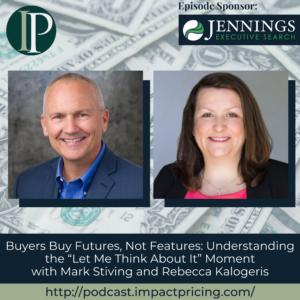
In this episode, we explore why buyers hesitate, stall, and say “let me think about it” — even when the value is clear. Mark Stiving and Rebecca Kalogeris break down the real driver behind purchase decisions: confidence — the balance of payoff, probability, and anticipated regret.
If buyers are betting on a future, your job isn’t to explain features; it’s to increase their belief that the future you promise will actually happen.
Listen in to understand why buyers buy futures, not features and how to close the confidence gap without lowering your price.
Podcast: Play in new window | Download
Why you have to check out today’s podcast:
- Understand why buying is closer to gambling than logic; and what that means for pricing.
- Learn the three drivers of buyer confidence and how to increase them without discounting.
- Discover why more information often reduces clarity instead of increasing commitment.
Catch Up on the #BuyerDecisionSeries:
- Episode 1: Buying Is a Prediction of the Future
- Episode 2: Buyers Buy Futures, Not Features
- Episode 3: What Buyers Actually Pay For
“Buyers buy futures, not features.”
– Mark Stiving
Topics Covered:
00:00 – Buying Is a Prediction. Every purchase is a bet on the future — and we’re surprisingly bad at making predictions
02:30 – Buying as Gambling. Why customers are placing bets without knowing the odds — and what sellers misunderstand about that
04:00 – Confidence = Payoff + Probability. The two core levers behind every buying decision:
06:30 – Belief Beats Information. Why more facts don’t necessarily increase confidence — and why belief often wins
08:30 – The Confidence Threshold. Buyers must cross a psychological line before they commit — and most sellers don’t know where that line is
10:00 – Anticipated Regret: The Hidden Variable. What happens if I’m wrong? Will I get blamed, embarrassed, or fired?
11:45 – The Real Buyer Disconnect. Sellers talk about features. Buyers are trying to predict their future.
13:00 – Mic Drop Moment. The insight that reframes everything: buyers buy futures, not features
Key Takeaways:
“Predictions are really hard — especially when they’re about the future.” – Referencing Yogi Berra, discussed by Mark & Rebecca
“Confidence isn’t just value. It’s payoff, probability… and anticipated regret.” – Mark Stiving
“There’s a confidence threshold you have to cross before you’re willing to buy.” – Mark Stiving
“If I don’t believe it, no amount of facts I’m reading are going to help me.” – Rebecca Kalogeris
Resources and People Mentioned:
- Yogi Berra
- Buyer Disconnect (Mark Stiving’s Upcoming Book)
Connect with Rebecca Kalogeris:
Connect with Mark Stiving:
- LinkedIn: https://www.linkedin.com/in/stiving/
- Email: [email protected]
Full Interview Transcript:
(Note: This transcript was created with an AI transcription service. Please forgive any transcription or grammatical errors. We probably sounded better in real life.)
Mark Stiving
Buyers buy futures, not features.
[Intro]
Advertisement
Today’s podcast is sponsored by Jennings Executive Search. I had a great conversation with John Jennings about the skills needed in different pricing roles. He and I think a lot alike.
If you’re looking for a new pricing role, or if you’re trying to hire just the right pricing person, I strongly suggest you reach out to Jennings Executive Search. They specialize in placing pricing people. Say that three times fast.
Mark Stiving
Welcome to Impact Pricing, the podcast where we discuss pricing, value, and the disconnected relationship between them. I’m Mark Stiving, Chief Educator at Impact Pricing, and we offer programs to help you get paid more.
Our guest today is, once again, me and Ms. Rebecca Kalogeris. Welcome, Rebecca.
Rebecca Kalogeris
Thank you, Mark. Excited to be here.
Mark Stiving
All right. So last time we talked about, we started talking about buyer disconnect. We’ve got a bunch of these to do if we want to.
Rebecca Kalogeris
Yes, we definitely do. So we talked about buyer disconnect, which you define as the gap between how buyers perceive value and how sellers think buyers perceive value.
And we also talked about how, and this was super interesting because it’s so true but not something like I’d ever like put a fine point on it, was that a buying is really active prediction. Like everything we buy, it’s a prediction because none of it delivers value yet.
And with that, you left us wanting more because you were like, you know what, another big piece of this is confidence.
So let’s talk a little bit about confidence as it relates to buy or disconnect.
Mark Stiving
Well, and so let’s bring it back to predictions and confidence for a second.
First off, what’s the Yogi Berra quote? Do you remember it?
Rebecca Kalogeris
Predictions are really hard, especially when they’re about the future.
Mark Stiving
Exactly. And so when we think about that, predictions really are hard. I mean, if you try to predict who’s going to win a ballgame or you try to predict what’s going to happen in the economy or you try to predict, I mean, you start thinking about things we predict and we’re horrible at it.
Rebecca Kalogeris
The weather.
Mark Stiving
The weather.
And so why would we be good at predicting if we’re buying? Right? It’s hard. It’s really hard.
And yet we’re putting out our hard-earned cash in order to get something and hope our predictions are right. And so it’s pretty fascinating from that perspective.
And what gets you to put your cash out to buy something?
And what it is, is over time, we’ve got to build up enough confidence that we can say, hey, I think this thing is really going to do what I need it to do. I’m willing to make a bet. I’m willing to go to the casino and put money down to say, yes, this is going to happen.
Because otherwise we wouldn’t make that bet. We wouldn’t put our money down.
So I guess I never thought of it this way. Brand new thought. Buying is gambling.
Rebecca Kalogeris
Right. We’re playing the odds and we’re trying to get enough information that the odds feel very much in our favor.
Mark Stiving
We really are. Now, the difference between this and going to the casinos is the casinos know what the odds are. They’ve got it all built out. Here, what we’re trying to do is change the odds in our favor. We’re trying to say, what is it that I need to know? What is it that I need to believe in order to make the purchase?
And that’s really what we’re talking about.
Rebecca Kalogeris
Well, that’s really interesting because you said, what do I need to know?
And then said, what do I need to believe? Those feel related but different to me, right?
Mark Stiving
They’re very different. They’re very different. So I’m going to use the blank word. I’m going to use the generic word confidence for a second. Right. What we really need is confidence that our prediction is correct. That’s what we’re after. How can we be confident that when I buy a new car, it does what I want it to do? How can I be confident that when I buy, what did we talk about last time besides cars?
Rebecca Kalogeris
Shoes.
Mark Stiving
Shoes.
Rebecca Kalogeris
Aslan shoes.
Mark Stiving
Great example, right? How can I be confident that when I buy this new pair of shoes, I’m going to get a compliment from my friends?
Rebecca Kalogeris
Or that they’ll actually be as comfortable as they say.
Mark Stiving
Or that they’ll be comfortable as they say. Oh, man. And so we’re always trying to say, what’s the confidence level in order for me to make the purchase?
But now, let’s break confidence down a little bit. Because confidence isn’t just a single term or single concept. We’re going to break confidence down first into two terms, and then I’m going to add a third one later.
But the first two I wanna bring out, okay, any statisticians are about to get excited about what I say here?
And the two terms are payoff and probability.
Payoff and probability.
So payoff, you could actually think of payoff as value, right?
What is the value I’m gonna get from this when it does exactly what I think it’s gonna go do for me, right? And so that’s the payoff. How much am I gonna get when this thing really works out?
And then the probability is, what’s the odds that it’s really going to do what I think it’s going to do? And what we’re doing is when we first start to make a purchase decision, we really don’t have a brilliant idea about payoff or about probability. We just have guesses.
And so over time, what we’re doing is we’re gathering more and more information, and we’re trying to decide, hey, what’s really going to happen if I buy this? Is it really going to solve my problem for me? And then we’re also trying to say, what’s the probability that it’s going to do it? It’s not just what will happen, but will it actually happen?
And so think of this as two different things. One is, let’s say I want to buy a new CRM. I’m a new company. I’ve never bought a CRM before. I’ve been living in Excel. I want to buy a CRM. So what do I think it’s going to do for me? What’s the payoff? Well, if I do this payoff, then it’s probably gonna help me win new clients, it’s gonna help me have higher customer satisfaction with my current clients. So I’ve got these payoffs that I’m gonna have, isn’t that awesome?
But what if it’s really hard to use and my employees won’t use it? What if people don’t fill the fields out correctly and it doesn’t really deliver what we think it’s gonna deliver? And so as I’m looking at CRM websites, I’m looking to say, hey, what is it that they can do? And then I’m also looking for case studies. Who’s done this before? What’s the implementation look like? How’s this gonna work? And so what we’re trying to do is we’re trying to, as buyers, we’re trying to guess at both the payoff and the probability. Now, we don’t really break it down that way in our minds, but we’re doing that. We’re trying to figure out both of those.
Rebecca Kalogeris
And I think payoff probability makes sense. But again, I want to go back to the no believe because I feel like that makes a big difference as a buyer.
Like there is a point where if I don’t believe it for whatever reason, no amount of facts I’m reading are going to help me. And almost vice versa, if I just believe it, because sometimes we are. Someone said something, it just feels right. Almost no facts will dissuade me, right?
My confidence isn’t going to be moved. It doesn’t seem to be moved as much by facts, as weird as that sounds, as the belief. Or at least I can’t overcome belief alone with just facts. Does that make sense?
Mark Stiving
Yeah, so let’s make sure we understand what the word belief means.
So belief, I can put it in both probability and payoff terms for you.
So belief is, what is the payoff? Do I actually believe this is going to be fantastic if I buy this? So let’s talk about the lottery for a second. Do I believe that I’m going to make a billion dollars if I win the lottery? It says it right there. I believe that they’ve never cheated anyone. I believe the payoff is a billion dollars.
And so that’s a belief that we have to have, but do we really believe it? And then what’s the odds I’m going to win it? What’s the probability I’m going to win that billion dollars? And again, there’s a belief about probability. What do I believe my chances are that I can win?
And so I take all of that into account and I say, am I going to buy a lottery ticket today or not? And that’s exactly what we do when we buy something as well. We may have a really strong belief that something is true or something is not true.
And the question that you’re really bringing up is how do we influence that belief? How do we as sellers influence the belief of buyers? Now, I have to say this book that I’m working on, or this concept, Buyer Disconnect, I’m focused almost 100% on how do buyers think and buyers behave, but I can answer that question to some extent, and buyers are more likely to believe you when you’ve done it before.
How many times have you heard the saying, give me a referral from someone who looks exactly like me and has done this before?
Rebecca Kalogeris
Right.
Mark Stiving
Right? What they’re looking for is belief.
Rebecca Kalogeris
Yes.
Mark Stiving
And so can we deliver that to them? And the answer is almost always no.
But when we get to a later law, I’ll help you understand what we could be doing to help buyers believe that we can solve their problems.
Rebecca Kalogeris
Nice. Right, so we have confidence is a balance of payoff and probability. And we have to raise confidence in order to make the purchase decision.
Mark Stiving
Yes. And in fact, the way I think about this whole process is you can imagine that there’s a confidence threshold. I have to get beyond some certain point before I’m willing to make the decision to buy something. And so that confidence threshold is really a combination of that payoff and probability.
And over time, I’m gonna build more and more confidence. As I learn more about the product, as I see more companies that do it, as I’ve heard more case studies, I’m gonna start to believe it more. And so what we’re doing is we’re building up payoff and probability beliefs.
We’re building up confidence. Now there’s one more term of confidence that we haven’t brought up yet, and I love this one. It is an anticipated regret. What happens when my prediction is wrong?
And so you can easily see this in B2B. Do you get blamed? Do you get fired because what you said we need to go buy didn’t work? Do you get made fun of? You could see this with your friends. You bought a really awesome pair of shoes. You thought everybody was going to love it, and instead your friends make fun of it because they look horrible.
And so you have this regret, I can’t believe I bought those. And so before we make the purchase decision, our confidence has to include, can I live with the consequences?
Can I live with the negative things that might happen if my prediction isn’t true?
Rebecca Kalogeris
So then when you think about buyer disconnection, it really is, is it the interplay between predictions and confidence? Is that what we’re?
Mark Stiving
Not really. So when I think of buyer disconnect, I think of it from a seller and a buyer perspective. What does a seller believe and what does a buyer believe?
Because one of the things that happens all the time in sales is that we think we’ve explained our product to our customers. We think they understand what we can go do for them.
And so, you know, I’m going to jump into one of our laws. We’ll probably touch on this later as well. But our buyers, they’re trying to make a prediction of the future, which we talked about last time.
And so what that says is that we as sellers need to help them make predictions of the future. But you know what we actually do as sellers? We talk about our features. We talk about the present. We might talk about generic benefits that you might get. But we’re not truly helping buyers make predictions about the future.
And so buyers, here’s a mic drop moment for you. Buyers buy futures, not features. And so what is it that we’re selling? So when I think of buyer disconnect, that’s what jumps to my mind all the time is that we’re selling features, they’re buying futures.
And so we just aren’t communicating to them in a way that really matters to them, in a way that helps them make a decision. That’s what we’re after. And so what’s so fascinating is you brought this topic up a couple different times. Oh, I need more information. Oh, I need more information. And the truth is you don’t. When I give you more information, it often confuses you. What can I do with that? What’s that going to do for me?
And so what we really need isn’t more information. We need to understand our buyers’ problems and the futures thereafter so well that we can help them figure that out. That is what I really believe buyer disconnect is.
Rebecca Kalogeris
I cannot wait to explore this in more detail.
Mark Stiving
It is going to be fun, but I think we should probably wrap up today.
Hopefully people are finding this interesting and we’ll come back.
So finally, if you have any questions or comments about this podcast, or if your company wants to learn more about buy or disconnect, feel free to email me, mark at impactpricing.com.
Now, go make an impact.
Advertisement
Thanks again to Jennings Executive Search for sponsoring our podcast. If you’re looking to hire someone in pricing, I suggest you contact someone who knows pricing people contact Jennings executive search.
[Outro]