Pricing AI is hard. Selling AI is hard. Marketing AI is hard. Most companies blame the technology. The real issue is how much change they are asking their buyers to accept.
There is a continuum. At one end sits optimization AI, capabilities that help buyers do an existing job better. Faster, more accurate, less manual. The buyer’s world does not fundamentally change. They just do what they already did, better. At the other end sits transformation AI, capabilities that ask whether the job should be done by a person at all. The buyer is not improving a workflow. They are replacing it, restructuring it, or making it irrelevant.
Small bites are easier. Big bites are harder. That sounds obvious until you realize most companies treat them exactly the same way.
Optimization AI is the easier case because the problem underneath it is already named. The buyer knows what job they are doing, what good looks like, and what it costs when things go wrong. They can picture the future your AI creates because it looks like a better version of something they already understand. That clarity makes everything downstream easier. Buyers can see the value, build the business case, and commit.
Transformation AI is harder for one reason: the problem is not yet named clearly enough for the buyer to picture the future. They are being asked to commit to something they cannot fully see, solving a problem they have not fully articulated, producing a result they cannot yet measure. That is not a technology problem. It is a clarity problem.
Salesforce illustrates both ends simultaneously. Einstein, their optimization AI, has held a stable pricing model for years because the value it delivers maps onto something buyers already understood. Agentforce, their transformation AI, has changed pricing structure roughly four times in two years. Same company, same team, same customers. The difference is which side of the continuum each product sits on.
The data makes the contrast vivid. Einstein’s optimization capabilities are stable, widely trusted, and adopted with low implementation friction. Agentforce tells a different story. Clientell AI’s research puts adoption at roughly 5 percent of Salesforce’s customer base, even as deal volume has climbed toward 29,000. This shows that companies are buying the transformation promise faster than they can figure out how to deliver on it.
That gap between deal volume and deployment success is exactly what happens when the problem underneath a capability has not yet finished taking shape. Buyers commit to the future. Then they discover nobody has named it clearly enough to build toward it.
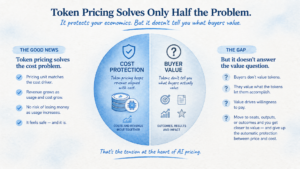
Pricing is where the confusion shows up first. Transformation AI produces unstable metrics because the value is not yet visible enough to price. But the same lack of clarity makes messaging harder to write, deals harder to close, buyers harder to commit, and success harder to deliver. It is one problem showing up everywhere in the go-to-market.
The fix is the same regardless of where the confusion surfaces. Name the problem specifically. Document it in the buyer’s own terms. Make the result visible. Once the problem is clear enough for a buyer to picture the future, everything else stabilizes. Pricing finds a metric. Marketing finds a message. Sales finds a business case. Buyers find a reason to commit.
Before you debate pricing models or brief the sales team, ask one question: are we asking for a bite our buyer can actually see themselves taking?
Share your comments on the LinkedIn post.
Now, go make an impact!
 Tags: buyer, Buyer Disconnect, buyer future, buyer outcomes, customer problems, customer value, pricing, Product Myopia, product strategy, value, Value Creation, value-based pricing