AI did not break per-user pricing. It revealed that per-user pricing never made sense in the first place.
For years, SaaS companies leaned on per-seat pricing because it was easy. It matched how software was sold, how budgets were approved, and how buyers were counted. One human. One login. One price. Clean and familiar.
The problem is that per-user pricing was always a proxy. It was never the thing buyers actually valued. It was a convenient stand-in for work getting done.
AI removed the disguise.
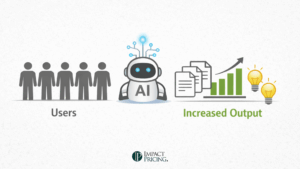
AI doesn’t add more users. It reduces the need for them. It automates tasks that used to require human labor. When that happens, pricing tied to headcount starts working against you.
Here’s a simple example.
Imagine you sell customer support software. A client buys 20 seats and pays $50 per user per month. That is $1,000 per month in revenue. You introduce an AI assistant that helps employees resolve tickets faster and handle more volume. As a result, the client needs only 10 employees to deliver the same or better level of support, so they buy only 10 seats.
From the buyer’s perspective, this is a win. Costs go down. Service improves. Productivity increases.
From your perspective, revenue just got cut in half.
Nothing about this scenario is hypothetical. This is already happening.
The AI created more value for the customer. Your pricing model captured less of it. That is not an AI problem. That is a pricing metric problem.
Per-user pricing only works when the number of users reasonably tracks the value delivered. The moment your product makes people more efficient, that link breaks. AI just breaks it faster and more visibly.
This is why so many AI features feel hard to monetize. Companies bolt AI onto an existing per-seat model and are surprised when revenue stalls or shrinks. They blame AI costs, infrastructure, or buyer resistance. In reality, the metric is misaligned with value creation.
If your customer gets more value with fewer users, per-user pricing is pointing in the wrong direction.
That does not mean per-user pricing is dead. It means it has limits. In environments where buyers think in seats, budget in seats, and compare alternatives by seat, it can still work. But once AI becomes a productivity engine instead of a productivity tool, the cracks show.
AI forces a question many companies avoided for years.
What are you actually charging for?
If the answer is “number of people using the software,” but the real value is “amount of work completed,” “issues resolved,” or “outcomes achieved,” your pricing is out of sync with reality.
AI did not cause this mismatch. It exposed it.
Share your comments on the LinkedIn post.
Now, go make an impact!
 Tags: ai pricing, pricing, pricing foundations, pricing metrics, pricing skills, pricing strategy, pricing value