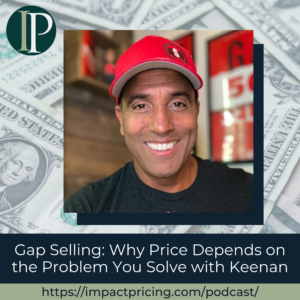
 Keenan is the founder and CEO of A Sales Growth Company, where he helps organizations move beyond product-driven selling and into problem-centric sales strategies. He’s also the author of Gap Selling, a framework built around one powerful idea: understanding the gap between where a buyer is today and where they need to be.
In this episode, Keenan and Mark Stiving unpack a truth most teams say they believe; but rarely execute: buyers don’t pay for products, they pay based on the size of the problem and the cost of not solving it.
If you’ve ever wondered why deals stall, why buyers default to “no decision,” or why price suddenly becomes the issue; this conversation will challenge how you think about selling, pricing, and what actually drives someone to act.
Podcast: Play in new window | Download
Why you have to check out today’s podcast:
- Understand why buyers don’t change unless the problem feels urgent enough and how to surface the real cost of inaction.
- Learn how gap selling uncovers the true drivers behind buying decisions by connecting root causes, problems, and impact
- Discover why pricing power comes from problem size not product features and how that changes the way you sell and price.
“Value is delivered by the size of the problem—and the cost of not solving it.”
– Keenan
Topics Covered:
01:07 – What Gap Selling Really Means. How shifting from product pitching to problem diagnosis changes win rates, deal size, and sales outcomes
05:05 – Why Everything Starts with a Problem. The hidden truth: every buying decision is driven by a problem—whether the buyer realizes it or not
09:47 – The Different Levels of Problems in Sales. How surface-level needs hide deeper drivers—and why most salespeople stop too early
10:37 – Root Cause vs. Problem vs. Impact. A powerful framework to uncover what’s really driving the need to change
13:56 – What Actually Motivates Buyers to Act. Why root causes don’t trigger action—but impact does
19:30 – How Deep Should You Go in Problem Discovery? Knowing when to keep digging—and when you’ve found what truly matters
20:26 – A Real Example: Breaking Down Root Causes (Obesity Case). How complex problems reveal multiple layers—and why that matters in selling
25:04 – How Trust Is Built Through Problem Clarity. Why buyers trust you more when you understand their problem better than they do
27:33 – Pricing Based on the Cost of Inaction. Why price isn’t about your product—it’s about how painful it is not to solve the problem
Key Takeaways:
“People don’t change unless their current state is untenable.” – Keenan
“Gap Selling is a selling methodology that helps salespeople improve their win rate, shorten sales cycles, improve their average contract value and close more deals faster.” – Keenan
“Understanding the size of the problem of not solving it is crucial for pricing.” – Keenan
Resources and People Mentioned:
- A Sales Growth Company – Keenan’s company; focused on modern sales strategy
- Gap Selling – Framework for understanding buyer problems and driving sales
- Gap Prospecting – Keenan’s extension of gap selling into outbound and pipeline generation
- Status Quo Bias – Why buyers avoid change unless impact is high
Connect with Keenan:
- LinkedIn: https://www.linkedin.com/in/jimkeenan/
- Website: https://salesgrowth.com/
Connect with Mark Stiving:
- LinkedIn: https://www.linkedin.com/in/stiving/
- Email: [email protected]
Full Interview Transcript:
(Note: This transcript was created with an AI transcription service. Please forgive any transcription or grammatical errors. We probably sounded better in real life.)
Keenan
We all say price is delivered by value, but value is delivered by the size of the problem they’re dealing with and the cost of not solving it.
[Intro]
Mark Stiving
Welcome to Impact Pricing, the podcast where we discuss pricing, value, and the confusing relationship between them. I’m Mark Stiving, and I help companies see value through their buyers’ eyes.
Our guest today is Keenan. Here are three things you want to know about Keenan before we start. He is the founder and CEO of A Sales Guy, focusing on modern sales strategy and gap selling. He’s passionate about helping sales teams shift from product pitching to problem-centric selling.
And he’s the author of Gap Selling, a widely recognized framework that challenges traditional sales thinking.
Welcome, Keenan.
Keenan
Thanks, appreciate it. And we just dropped today. You’re the lucky guy. Gap Prospecting just came out today.
Mark Stiving
Nice. Nice. I can tell you what, I understand gap selling just from the title. I’m not sure I’m going to get Gap Prospecting, but let’s give you a chance to tell us after you’ve told us what does gap selling mean?
Keenan
So gap selling is a selling methodology that helps salespeople improve their win rate, shorten sales cycles, improve their average contract value and close more deals faster.
So that’s really what it’s about. And the general premise is it’s built on the psychology of change.
So people don’t change unless their current state is untenable. Now, of course, it’s relative good on Einstein is relative to the cost of change in the cost of an action, but it all comes down to a psychological element.
So what gap selling does is it helps salespeople help buyers reflect. on their current environment in a way that gets them to stop thinking about, I want to buy a product, I need a new phone, or I need lip balm, or I need a new car. It’s like, stop. Let’s talk about this. Why? What is wrong now that’s telling you you need this?
And if a salesperson is really good at that, by default, they become a trusted advisor. And then when they make recommendations or they position their product, it is a much more custom fit.
And when the buyer feels more confident buying, because they understand that they don’t buy, they can’t live with the cost of inaction.
Mark Stiving
Okay. I hate to say this, but I’m a hundred percent behind what you just said.
So, before we dive a little bit deeper, because I love talking about problems and the thought of problems. Tell me what is gap prospecting then?
Keenan
So Gap Prospecting just takes the problem-centric approach and moves it one step forward in how you build your pipeline.
So Gap Selling has a prospecting section in it, but it’s a piece of the whole thing. So we just expanded on that.
In Gap Prospecting, it operates pretty much from the start of when a customer says, I’ll have a call with you. Okay, so you have to do the proper discovery. They have agreed to meet with you and have a conversation.
And gap selling teaches you how to engage in that conversation in a way to get the key elements of gap selling. Current state, future state, the gap, define it, blah, blah, blah, and avoid with it.
Yeah, prospecting takes the concept of problem centric selling and moves it to the front end. So instead of discovery, now it’s a hypothesis. How do I leverage problem hypothesis to get you to open an email, to take my cold call, to give me 30 seconds on a cold call, to engage with me on LinkedIn?
How do I take the hypothesis in a problem centric manner so that you’re like, okay, and filter through the noise, get through the noise and the biases.
You know, I get this stuff all the time, but this one, this one’s different. I need to react to this one. I need to look at it. I need to respond.
Mark Stiving
Nice, nice.
So one of the things, by the way, one of my books I wrote was called Selling Value, and we talk a lot about problems and results, which is really similar to what you talk about in that respect.
And the only thing I said about prospecting is prospect with the people that you think have the problem.
Keenan
Yes. Yes.
But in today’s world, it’s so busy and no one opens anything that it’s pull your prospect to now. It’s just a piece of it. You actually have to have a message that can break through, right?
Look, we start the book. Literally the book starts. The first word is boom. That was the sound of the yellow pages. My boss dropped on my desk in my very first sales job.
Well back in those days I could make there was no such thing and people listening who are cold calls You will get this when I started cold calling in the early 90s.
There was no such thing as a connectory because everybody picked up the phone. I mean if they weren’t home or if they weren’t at their desk, whatever. But 99, okay, you could expect someone to pick up the phone 50% of the time so you didn’t have to worry about people picking up.
Now, people never pick up the phone, right? So you have to do something that when they do, you can’t afford to lose that. So it’s all about the message. It’s all about how you, what we call creating intrigue and then driving interest. It’s all about how you do that, or you’re dead in the water.
So it’s not just who you go after anymore, it’s how you go after.
Mark Stiving
Nice, absolutely brilliant. And I’d love to chat with you about that sometime so I could learn more, or maybe I’ll just read the book, who knows?
Keenan
Yeah, you can read all you want.
Mark Stiving
But I want to dive deep into problems. I got to say, it’s probably my favorite topic.
And it wouldn’t surprise me if you and I came about this from two different directions and we ended up in the same place.
So I came to problems when I was thinking about product management and how do we decide what the next product is we’re going to build or what features we’re going to build.
And to me, it’s all about, well, what problems are we going to go solve for the customer?
Keenan
Yes.
Mark Stiving
And so then I finally got that into, oh, well, that matters in sales and that matters in pricing.
And, you know, that matters everywhere.
How did you come to this realization that problems are just so important?
Keenan
I don’t know. I just know. I just knew because again, it came from my observation.
I can’t even say recognition. It was just my observation that you’re buying something because you have a problem every single time.
Every time.
Now, the problem could be subconscious, the problem could be frequent enough that you’re familiar with it, and the solution is instantaneous, so you don’t think about it. But it doesn’t change the fact that everything we do is problem-based. I am driving down the street and I get hungry.
Do I stop at McDonald’s or do I keep going? Well, the problem is I’m starving. Then the impact is, is my blood sugar low? Am I losing concentration? Is the pain too much? Any one of those could be that.
And I ask myself, should I stop? Well, subconsciously or consciously, I say, I don’t know. Do I have to be somewhere on time? Do I have the time to stop? Do I want to spend the money? Can I wait till I get home? All of those are potential solutions.
But it still stemmed to the fact that I have this problem right now. How do I want to solve it? And the way I solve it, the human mind goes back and forth between what is the solution and how bad is it? And what happens if I don’t solve it? What’s the solution? How bad is it? What happens if I don’t solve it? You go like this until finally say, fuck it, and you make a decision.
In sales, if you can help the buyer see that in a more broad sense, you’re a better salesperson.
Mark Stiving
Okay, so I’m almost with you on that. I slightly disagree in something. And that is, it seems to me that buyers almost never articulate their own problems.
So if we use the, you know, I’m hungry, I’m driving down the street, it’s like, oh, there’s a McDonald’s. I think I’ll go to McDonald’s.
And I never really step back to say, why am I hungry? And when’s the next meal? And it’s just like, I think I’m gonna go to McDonald’s. There’s a great solution.
Or I could just say, hey, I think I need a new car. And I’ve never really articulated, oh, well, you know, I’m averaging $3,000 a month in repair bills, and I don’t have access to my car, and, you know, my kids aren’t safe, and whatever those things are, I just assume them and go out shopping for the solution that I think I need.
Keenan
What’s the question?
Mark Stiving
Do people really articulate their own problems?
Keenan
Oh, 100%.
Now, they don’t go as deep because I argue that the human brain cannot go get a solution without a problem. Just can’t. It’s a physical impossibility.
Now, it doesn’t always have to be conscious. Right.
But there is some emotional firing inside the body that says, I don’t like where I am.
Here’s my solution. So I think it always exists. I don’t think it’s always as pressing and as. Intensely conscious as you said, but what you just described is what I like to call the window into the sale
So when someone says I need a new car, I promise you they think they know why they need a new car
Either they just don’t like the one they have because their friends make fun of it
Maybe they’ve just had six years and it feels old, right? So that’s all they mean whether it’s right or wrong that feels old says I don’t like where I am current state I want to move into a future state
What great salespeople do, or a great life coach, or a great partner, or a great friend, is they stop pulling on that thread. Like, why do you want a new car? Oh, mine’s old. OK, but does it still work? Yes. Because it’s old, how does it affect you? I don’t know. I just don’t like how it feels. Walk me through that feeling. And then, like, are you going on dates? You know, do guys or girls not want to get in your car? No. Are you married? Yes. Does your wife care? No.
Have you thought about how much it would cost in a payment? Yeah. And that’s $600 a month, right? Yeah. No. Well, if you don’t like, if everything else is fine with your car, it works, da, da, da, what would you do with that $600 if you just saved it? Oh, good point.
And if you save $600 for 12 months, you know that $7,200, oh, good point.
Do you go on a vacation? You know what? You know, you’re right. I’m not going to buy that car.
So it’s not that they don’t know. It’s that they don’t flush the entire thing out. And that’s where you’re right.
Mark Stiving
Okay, let’s talk about levels of problems for a second. And I’m sure you’ve thought through this, but I often like to use the story, Ted Levitt in the 1960s said, nobody wants to buy a quarter inch drill, they want to buy a quarter inch hole.
And then I like to say, nobody wants to buy a quarter inch hole, they really want to buy the ability to hang a picture over their fireplace. Nobody really wants to buy the ability to hang a picture, they want a nice looking living room.
And so we just keep going down the path that says, hey, there’s this layers and layers of problems. How do we find the right layers of problems?
Keenan
I have a very distinct process for that, but I’d like, I’d like you to tell me how you do it.
Mark Stiving
I actually don’t have a great answer other than the, no, no, no. The answer I give to that is we’re going to look at different layers. We’re going to look deeper and deeper, but we need to find one that resonates with the buyer, but it resonates with enough buyers that we can treat it as a marketing message.
We can treat it as a, as a tool that we can go look for. There is a potential problem we can go look for.
Keenan
So the way I break that down, what you call layers, I call elements, I guess.
So what I do is I break problems down into root cause, problem, impact. Okay.
And you could make a circle with an arrow. I don’t care how you do it. Right. But they’re connected. So in my world, root causes are broken processes or tools, right?
So in using your drill example, either you don’t have the tool. So you could argue that’s a broken tool or it’s a bad pride. Don’t have the tools in the process of putting a hole in wood is pretty bad. You know what I’m saying? So it’s a tool. So there’s my root cause.
My business problem is whatever it is I’m trying to accomplish. Okay. So in this case, let’s say I’m trying to build my daughter’s a dollhouse for her birthday. The business problem is I’m not going to be able to give my daughter her dollhouse. Okay.
Another one could be I am a contractor, right? And I can’t finish a job.
So the business problem is that job’s going to be late. Okay. Notice the business problem is not a broken processor tool. You see the difference, right? It’s the outcome of that broken process.
So it’s going to be late. And then the impact is, which there could be a lot of those. I’m not going to get paid. I’ll get paid less. I’ll get poor customer satisfaction. The customer won’t use me again. They could tell other people about me. I might not get referrals. Those are all the impacts. You see what I did there?
So, and then go back to the other one, I’m gonna miss my daughter’s birthday, that’s my business problem, so therefore, she’s not gonna get the joy of getting her dollhouse, I’m gonna feel guilty about myself, I’m gonna feel like a failure dad.
So what I say is, the root causes of what exists that makes the thing manifest the problem, the problem is the thing that jumps out at me and says, you gotta fix this, because you don’t fix root cause unless they manifest into a problem, and then the impacts are the motivation to get you to fix it.
And that’s how I break them down. So if you’re just really clear and differentiating between a root cause of problem and an impact, there’s your layers. And now it’s just trying to get the person or persons to be real clear with what the root causes are. Why are you in this situation?
Because you’re in this situation, how is this manifesting itself? And because it’s manifesting itself, how is it impacting you?
Mark Stiving
Nice, nice. I think I would interpret those in my language. I don’t ever use the language or talk about this and what you just said is a business problem, but I would often think of that as the symptom, right?
So if I were thinking, my close rate’s not high enough. Right? So that’s a symptom, but there’s actually a problem that’s causing that.
And so you’re going into root causes, I would just call those problems, I think. And then the outcomes or impacts, what you call, I think of as results.
So I think we’re, you know, once again, we’re identically lined up here, which is pretty cool.
Keenan
Let’s kind of flip. If you say that symptom is my, Is i’m not closing the win rate i’m not closing enough deals and then you said the problem is um, uh, I can’t get people to pick up. No, um, my my discovery is terrible. My discovery is terrible, right?
Okay that I mean you can label it that but the reason I flipped it is because what the what I care about is that I’m missing quota or my win rate’s too low. That’s what I care about. I don’t care if I have a shitty discovery. That’s why it’s a root cause.
So psychologically, we flip that because at the end of the day, this is interesting. Watch what I do here, Mark. Your product or service solves the root cause. It can never solve the business problem.
And people live with root causes all day long, all day long. A drippy faucet, less than airtight windows, those are all symptoms. What are they symptoms of? A bigger problem. But they may not manifest themselves into a problem big enough to fix until they get bad enough.
So that’s the only reason I would challenge you a little is flipping that. So you’re on the right track, but the key is labeling them on how people are going to be motivated to move. The one they move least on is the root cause, which is another way of saying symptom. The other one is the, um, the, the, uh, what’s the one I’m looking for? The manifestation of the root causes people are looking at that got my attention, right?
Like, Oh, I just got my first heating bill in a while and it’s tripping. Okay, before it didn’t bother me when it cost me $1.50 or two more, now it’s bothering me. Then the impact is when I go, wait, that’s $300 I was gonna save for X, Y, Z, I can’t do this anymore, I’m not doing that another month. I’m moving, see what I’m saying?
So just from a motivational perspective, root cause of the least motivating, problems of the middle, impacts of the most motivating.
Mark Stiving
Yep. Okay. I understand how you’re thinking. So what I typically do, and I’d love to hear your thoughts on this, is that companies, you know, pick a product, a CRM, right? There’s a hundred different features in a CRM that a salesperson would want to talk about.
And we both know that we don’t want to talk about features, but any given feature was put there to solve a problem. And so the reason I go through this process the way I do is I say, hey, look, give me a feature. Now, what problems does that solve?
Can we now articulate the different problems that that solves? And if I solve those problems, what result might I get? And so you might think of those as outcomes. Now, I think you take impact way beyond where I take results, but I like it.
Keenan
No, you’re logically playing in the right road and I don’t want to get caught up in semantics. So I do the same thing you do. And the way I do it though is if a root cause, what I like to say is, okay, watch this. If you’re eating processed food every single freaking day and you’re not exercising, okay, those are two bad processes, right?
You’re eating the wrong food, which is a process, that’s a bad, right? And you’re not exercising, that’s the root cause. What problem does that cause?
Mark Stiving
Obesity. It depends on how you want to define the word problem, but you’re absolutely right. It’s obesity, it’s unhealthfulness.
Keenan
Yes, it’s obesity, right? Or being unhealthy, prediabetes, you know what I’m saying? But that’s the problem, right? So the reason I call it root cause and not other one a problem is because when I go to solve it, as I’m selling something, I attack the root causes first. You say attack the problem first, but I just like the word root cause because that’s what it is, the root cause. What causes the problem, right? What’s causing the problem?
That’s sort of more of a nomenclature that I’ve grown up using. It’s, okay, what’s your problem? Okay, what’s causing it, right? So I like to go back to root cause. Plus, it’s easier for people to understand, because when we do our training, they really struggle with this. They want the root causes to be the problems, and I’m like, The root cause of broken process and tools. Just think that, right? Just stay there.
But just because someone has a broken process, a tool does not mean it always manifests into a problem that somebody is willing to fix. Those are the key. That’s, that’s how we, because we’re adding the psychological piece. I have to get people to sell by. So I have to, because you see salespeople do it all the time. Okay. Status quo, Mark, do you see it? Why do people lose to the status quo? Because the sales team is selling to all the root causes and never stop, and using your language, they’re selling to the problems and not getting to what’s after problems for you.
Mark Stiving
You can call it problems, that’s results, but you can say problems, that’s fine.
Keenan
Yeah, so in your case, they’re selling to just the problems. In mine, I use the word root causes, but those root causes have not manifested into a result or a business problem big enough to change. So that’s like, oh yeah, they gotta buy it because they have a leaky faucet. Oh, and it’s staining the tub, so they gotta buy.
And I always say, so what? That’s what I say. So what? It’s a leaky faucet staining the tub. So what? So what? And they’re like, oh, well, they don’t want a leaky faucet in the stain tub. I was like, did you ask them that? No. Then why do you think they care? I walked into Buddy’s house in college. It was worse than that. And then, so then I go ask. Then they go back and say, why is this leaky faucet in the stain tub really bothering you? Then they come back, oh, I’m like, what’s the answer? They’re selling the house and it’s bringing the property value down.
Okay, how much are they trying to sell the house for? See where I’m going now? I got you. How much are you trying to sell the house for? How many viewings have you gone and you didn’t get an offer? Are you unable to move into your new house to make an offer till you get this one sold? So now this is impact. All of this state and leaky fucking faucet is all about the fact that they can’t move into the house and fucking, Beat it before I retire in golf because of that stupid thing. Guess how much they’re going to pay me to fix that now?
Mark Stiving
Keenan, I got to ask you a question. Do you ever get excited?
Keenan
All the time.
Mark Stiving
Okay. Okay, I want to push back on something else just because I want to understand this and learn it. Not because I disagree on this one. So let’s go back to the obesity problem, right? And so we’ve got, I’m obese, and so I’ve got root causes, and one of my root causes, I don’t exercise and I don’t eat healthfully.
Now, it turns out that those may not be the real causes, right? It may be that I don’t have a car, so I can’t get to the grocery store. It may be that all the grocery stores around me are closed down and all I have is convenience store crap or McDonald’s to eat. So there could be other root causes. And this is when I start thinking of levels of problems or levels of whatever you want to call it. And so how do you think through that process?
Keenan
So great point. So I stick to my labeling, right? Particularly with root cause, broken processor tool. So if I’m eating poorly and it’s because I’m eating like shit, I didn’t go far enough to say, why are you eating like shit? I’ll go further. Is it because you live in a food desert? Is it because you can’t afford it? Is it because you like the taste? I’ll keep going down that road. but it still stays in the root cause column, and it’s just logical understanding. I eat like shit.
Great, okay. Talk to me more about that. What do you eat? Are you able to get to the grocery store? Can you not have food, better foods? Do you not like the taste of better foods? Walk, I have you say, walk me through why you’re eating primarily crappy food. I’ll probably say it nicely, right? Then walk me through exercise, right? Are you just coming out of an injury? This is not uncommon, by the way.
Are you coming out of an injury, and therefore it’s difficult to walk? Is it difficult to exercise? Or do you just feel that walking a day won’t make a difference? Or are you just depressed? Again, all of these things, though, notice, are broken processes or tools that I’m just trying to keep pulling the string till I understand. One you didn’t say, I very easily could have said, do you have a genetic disposition? I mean, look, for a lot of people, obesity is genetic. I’m lucky. I’m almost 60 years old. I don’t do very much, and I’m thin.
My sister wasn’t so lucky, right? She had to work harder to keep. So there could be a genetic disposition. Could be a thyroid issue. Again, broken process, broken tool, thyroid. So everything you’re saying is 100% accurate. I just still leave it in the root cause, because I’m still trying to pull the strings to get to the exact root cause diagnosis. Then what I do is I take that over to the business problem. And now I start trying to evaluate, OK, Make it up. Food desert, you just got over being hurt, and you have a thyroid issue, and you have a genetic predisposition.
That’s a lot. Let’s talk about what obesity means now. So now I’m moving into the business problem, like, how much do you weigh? How much weight have you gained over time? You see what I’m saying? What is your fat count? Are you pre-diabetic? So now I’m trying to quantify the impact of everything I just learned in that root cause. And watch what I do, because you’re right.
Every thread I pull helps me realize this problem is going to be way bigger than I realize, or not so big. But when I add in thyroid, genetic disposition, living in a food desert, doesn’t work, used to be hurt, I already know this poor cat is big, right? So then I already know to start asking questions about that. So then I find out they’re 500 pounds. They put on 200 pounds in the last three years, which is an astronomical amount of weight. They’re 100% pre-diabetic. They can’t get out of the house, like all this stuff.
So then I know, already know now, what do I know now? The impact. So bro, you’re at risk of cardiovascular disease. You’re at risk of a heart attack. You are at risk of having full bone diabetes. And, and, and, and, and, and, there’s your impact. And you could die pre-early. Are you okay with not with these impacts or do you, are you ready to change? You see what I did there? So it still cycles itself.
Mark Stiving
Got it. Got it. And so why is it the companies with great salespeople, the buyers still don’t understand all the value that they’re going to get? Is it because they don’t do what you just said? Salespeople don’t do it.
Keenan
Right there, right there. Salespeople don’t do it. They don’t have the business acumen. They don’t think about it. They quickly run to pitch. And then what we’ve created, we actually talked about them getting prospecting. What they’ve created, Mark, is if I keep selling product-centric to you long enough, you’re done thinking you’re going to get any problem assessment out of me. You’re going to see no problem evaluation value.
So what you’re going to do is you’re just going to resort to a product-centric buying process. So that’s where RFPs came from. It’s like, I’m not going to help you try to solve my problem. I’m just going to tell you what I need for features. And you’re going to deliver those features. And I’m not going to talk to you. That’s what we’d gotten to the good buying. I’ve actually written an ebook on this.
Good buying actually allows the salesperson to come in and you try to give the salesperson as much information as possible to see if they’re able to solve your problem. And if they can’t, then you flick them, right? Like I over inundate people selling to me with my problem and I say, you better make sure you can get this right. I just told you everything I’m struggling with. I told you the root causes. If I’m missing something, you’re the expert. Ask me, I’ll tell you, I’ll go figure it out because I’m going to be pissed if I buy the wrong thing.
So you better damn well know what you’re selling me and don’t say you didn’t know because I am an open book. I want the best solution possible and the only way to do that is to make sure that we’re working together, that you understand my situation, what I’m trying to do, who my customers are, blah, blah, blah, yada, yada. And most can’t do it, they lack the business acumen.
Mark Stiving
Yes. So that’s actually two different directions I want to take it. So one of the things I find fascinating about salespeople is that if we help our buyers understand their problems better, suddenly they trust us. And in fact, what they trust is that we know how to solve their problem.
Keenan
So you’re a genius, Mark. 100% correct. I think that’s pretty cool. I think that’s pretty cool. So, I like to use, I think you’ll appreciate this because we’ve all been there. The metaphor I like to use is most people do not like being bothered when they shop retail shopping. But I say to most people, have you ever gone to a Home Depot or Lowe’s looking for something, right? For a home project.
And every once in a while, it’s usually an older gentleman who’s retired and just loves people. He goes, hey, what you looking for? And you’re like, nothing, I’m good. He goes, no, really, what you looking for? And you go, I’m looking for I’m looking for a, you know, an XYZ screw, you know, three quarter inch long, blah, blah, blah. Okay, yeah, they’re on aisle five, but let me ask you, what are you working on? And you’re like, ugh, I’m working on my daughter’s dollhouse.
Really? Why do you need a, you know, a three inch quarter, blah, blah, blah? Well, I’m trying to fasten the, is it a balsam? Is it a balsam dollhouse? Yes. You get this, you run the risk of splitting the wood. So those are over here, but I’d like to recommend wood glue reinforced with staples. That would probably help you better reduce the risk of splitting the balsam wood and having to start over, having to order a new wall, blah, blah, blah. When that happens, what do you think most of us do? We’re over the moon, Mark. Oh, my God. Thank you. We love the guy.
Like, oh, my God. Thank you. Thank you. Thank you. Thank you. That, to your point, that’s just reemphasizing your point. That’s the credibility we get when somebody understands what we’re doing and offers something we didn’t think about that saves us time, trouble, money, or whatever.
Mark Stiving
Yeah. I have never walked into a Home Depot and known what I was doing. So I always look for help. That’s like the one store where it’s like, I got to have help.
Keenan
Okay. And then that’s even better. Some people don’t help you. They just tell you what I have. Other people start asking questions. How about that? Right.
Mark Stiving
Oh yeah. Huge.
Keenan
Yes. And the ones who ask questions, the ones you appreciate the most, right?
Mark Stiving
Yeah, absolutely. There’s no doubt. No doubt.
Keenan
That’s my point.
Mark Stiving
Kenan, this has just been so much fun. I wish I could have gotten your energy level up just a little bit as we talked through this. So since you know I am a pricing guy, I told you that before we started, I am going to ask you a pricing question. So what is one piece of advice, pricing advice, you would give our listeners that you think could have a big impact on their business?
Keenan
Understanding the size of the problem of not solving it. That price is like we all say price is delivered by value, but value is delivered by the size of the problem they’re dealing with and the cost of not solving it. I say it all the time. I have a, I don’t have one with me, but I have a little. liter of water, and that liter of water sitting outside my house, I’d be lucky if I could sell it to you for a dollar, right? At the grocery store, I could probably sell you, you buy it for a dollar.
At the 7-Eleven, you’re on a trip driving somewhere, you don’t want to go to the grocery store, I can sell it to you for $2. Sitting at a baseball game, I can sell it to you for about $5, right? In the desert, and you’ve been there for a week, and you’ve been out of water for two days, I could sell it to you for everything you have.
So the pricing is in relationship to value, but value’s a tricky word. Don’t get caught up on value. Value is measured by the size of the problem of the audience you serve if they don’t solve it. So in this case, let’s use 7-Eleven, they can charge more money because most people going in there do not wanna stop at a grocery store, go back down one of the aisles, most likely only get it warm because they’re trying to get somewhere, going to work, on a road trip.
I don’t want to pay that price of going to the grocery store. So I will pay you 7-Eleven for the convenience of not having to go to the grocery store. That’s the problem. No 7-Eleven, I gotta go to the grocery store, warm water, cheaper. No, I’ll pay you. So that’s how you do it. What problem are you solving? What’s the cost of that problem if they don’t solve it? Some ratio in there is how much you charge and what your price is.
Mark Stiving
Beautiful. In case you care, here’s my definition of value.
Keenan
You do, of course.
Mark Stiving
Value is the result of solving problems. So it’s pretty much exactly what you just said.
Keenan
Can I give you one little added piece that I know you’re saying, it’s just implied? Go ahead. from the buyer’s perspective. Always. Oh, absolutely. Absolutely. People are shooting that. It’s like, what’s your value proposition? You spout out. No, no, no. The buyer decides, not you.
Mark Stiving
Yep. Always, always, always. Kenan, this has been a blast. I’ve absolutely loved it. Thank you very much for your time. If anybody wants to contact you, how can they do that?
Keenan
LinkedIn, just put in Kenan dot, because they wouldn’t let me leave the last name field blank. So just put Kenan dot. You can’t miss me.
Mark Stiving
Perfect. And to our listeners, thank you for your time. If you enjoyed this, would you please leave us a rating and a review? And if you have any questions or comments about the podcast, or if you want to see value through your buyer’s eyes, email me, [email protected]. Now, go make an impact.
[Outro]