
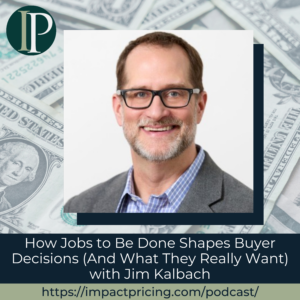
 Jim Kalbach is the Chief Evangelist at Mural, where he helps teams uncover what customers actually need—not just what they say they want. Known for his work in Jobs to Be Done, experience mapping, and innovation, Jim has spent years helping organizations see beyond their products and into how buyers really think, decide, and act.
In this episode, we unpack a simple but often overlooked truth: buyers don’t start with problems—they start with solutions. Jim walks us through what’s really happening beneath the surface—from how buyers recognize (or miss) their own problems, to how they search, evaluate, and eventually decide when to stop looking.
Along the way, you’ll learn how identifying unmet needs doesn’t just improve your product—it sharpens your messaging, builds trust faster, and gives you a clearer path to pricing around real value.
Podcast: Play in new window | Download
Why you have to check out today’s podcast:
- Understand why buyers struggle to explain their own problems and how removing the solution from the conversation reveals what they actually need.
- Learn how Jobs to Be Done helps you predict buyer behavior by uncovering the unmet needs driving their decisions.
- Understand the moment buyers stop searching and how aligning with their real problem builds trust and increases conversion.
“Understand the problems first—and then price around that.”
– Jim Kalbach
Topics Covered:
02:08 – Why Buyers Struggle to Express Their Problems. Learn why buyers default to solutions instead of articulating real needs—and how that limits insight.
05:57 – The Jobs to Be Done Mindset Explained. Discover how removing the solution from the conversation helps uncover true customer problems.
10:06 – The Layers of Problems in Sales. Understand how to navigate from surface-level needs to deeper value-driving problems.
12:43 – Why Buyers Are Predicting the Future. Explore how every purchase is a bet on future outcomes—and what builds buyer confidence.
14:37 – Identifying Unmet Needs in the Market. Learn how uncovering unmet needs improves product-market fit, messaging, and adoption.
18:45 – Building Trust by Understanding Problems First. See how recognizing a buyer’s problem before they articulate it creates instant credibility.
21:22 – Shifting from Product Thinking to Human Problems. Why focusing on the human problem—not the product—makes selling and pricing easier.
25:47 – Core Principles of the Jobs to Be Done Framework. Break down the key idea: temporarily remove the solution to better understand the job.
27:29 – Pricing Around Value Creation. Why pricing should be anchored in the problems you solve—not the product you sell.
Key Takeaways:
“Try to understand the value that you can create by shifting your attention to the problems that you solve.” – Jim Kalbach
“The power of jobs to be done is let’s not see things only through the lens of our own solution.” – Jim Kalbach
“Jobs to be done is trying to predict the future by creating a solution that fills an unmet need.” – Jim Kalbach
Resources and People Mentioned:
- Jobs to Be Done (JTBD) – Framework for understanding customer behavior by focusing.
- Henry Ford – Referenced for the “faster horse” analogy, illustrating how customers describe needs based on existing solutions.
- Theodore Levitt – Known for the classic insight: people don’t want a drill, they want a hole—used here to illustrate layers of customer problems.
Connect with Jim Kalbach:
- LinkedIn: https://www.linkedin.com/in/kalbach
- Website: www.jtbdtoolkit.com
- Jobs to be Done Playbook: https://experiencinginformation.com/jtbd-playbook/
Connect with Mark Stiving:
- LinkedIn: https://www.linkedin.com/in/stiving/
- Email: [email protected]
Full Interview Transcript:
(Note: This transcript was created with an AI transcription service. Please forgive any transcription or grammatical errors. We probably sounded better in real life.)
Jim Kalbach
Try to understand the value that you can create by shifting your attention to the problems that you solve. So understand the problems first and then price around that.
[Intro]
Mark Stiving
Welcome to Impact Pricing, the podcast where we discuss pricing, value, and how buyers decide. I’m Mark Stiving, and I help companies see value through their buyers’ eyes.
Our guest today is Mr. Jim Callback. Here are three things you want to know about Jim before we start. He is Chief Evangelist at Mural, I want that title one day, where he’s been for over 10 years and he’s known for helping teams collaborate around customer insight and innovation.
He is a noted author and speaker on innovation, design, Jobs to Be Done, mapping experiences, and the future of work.
Oh, he’s a jazz bassist and co-published a book on walking bass.
Welcome, Jim.
Jim Kalbach
Thanks for having me, Mark. Great to be here. Looking forward to our conversation.
Mark Stiving
Knowing that you’re in jazz, I can already tell you that you and I think very differently because I need a beat and a rigid, and give me the boom, boom, boom.
You’re probably much more free-flowing. Let’s see how this goes.
I often start my podcast out with, how did you get into pricing?
But you really aren’t in pricing, so it’s tough to say that. But you’ve been spending years trying to figure out how buyers decide.
And so let’s jump into a really interesting thing I’ve seen recently that I’m really curious about.
Why do you think it’s so hard for buyers to understand their own problems?
Jim Kalbach
Interesting.That’s a good question. I think in part, I’ll just throw this out there. I think in part because they’re not being asked to express their problems when we come to them with a solution. Right.
So I actually think the solution is part of the red herring. And that’s one thing that I’ve learned. through my work with Jobs to Be Done and Jobs to Be Done is really focused on the word value.
You mentioned, you know, your podcast, it talks about value and that’s really what Jobs to Be Done is about. And with the Jobs to Be Done framework.
One thing that we do is we put any sense of a solution aside.
So we do not talk to people about us or any technology for that matter. We only want to focus on them. And I find when you frame the conversation that way, that we’re not talking about a thing. We’re not talking about the brand I represent. We’re talking about your problem. They actually are able to express what their problem is.
And that’s what the Jobs to Be Done framework allows us to do. It allows us to talk about problems without talking about solutions. I think part of the problem when you ask, you know, why are buyers, why do they find it difficult to express their own problem?
I think it’s because they’re trying to express their problem through a solution that’s in front of them.
But when you take that away, people are surprisingly able to talk about their own problems.
Mark Stiving
Okay, so let me push back a little bit just to explore this if you don’t mind.
So it seems to me, think about us as buyers for a second and not as sellers.
As buyers, we say, you know what, I need a new car.
And we never step back and say, oh, you know, if I don’t get a new car, then my car might break down while the kids are in the car and we’re traveling to such and such.
So we don’t really articulate the problems, we jump to the solution.
And then we go to a dealership or a salesperson and say, hey, we need a new car.
Jim Kalbach
Correct. Yes, exactly.
And a car is a solution, right?
I think it’s up to us, the providers of a solution, to figure out the solution that the customer, the individual that you’re serving needs, right?
And what you don’t want to do is show them a solution. Right. Because then they’re going to react to the solution. Right. I’ll just give you an example to stick with cars and transportation.
There’s a famous quote, I think it was Henry Ford. Usually it’s attributed to him where he said, if I asked people at the time what they wanted, they would have said a faster horse. Right.
And that’s why I said with my first answer is because they know what a horse is. Right. And in your example, people know what a car is. Right. But if you take those things out of what you’re asking them, and that’s really what Jobs to Be Done is, it’s a way to query your market about what they need, independent of a solution. Then you get very different answers. They’re not going to walk into a dealership and say they need a car. They need a car because that’s what they know as a solution. Right.
But what do they really need? I mean, obviously they need to get from point A to point B, but it’s probably much more nuanced than that. Right.
If you’re a family person is about, you know, bringing your family around and things like that. And the thing is, if you frame it, if you frame the problem independent of a solution, you may not always, but you may end up with a different solution. Right.
So that’s why I’m saying, I think, when you introduce a solution and hold it up and say, hey, there’s a thing, do you want this thing?
Then they’re going to react to that and not necessarily talk about their own problem.
Does that make sense?
Mark Stiving
A hundred percent. A hundred percent.
But what I find so fascinating is that buyers come in and say, hey, can I buy a car from you?
Jim Kalbach
Yeah.
Mark Stiving
And we’re asking salespeople or selling companies to say, oh, no, no, no.
Before I can sell you a car, let me find out what you really need.
And that’s hard.
Jim Kalbach
It is. It is very hard. And to some degree, the effectiveness of Jobs to be Done isn’t at that moment. It’s at what is the solution that we should even be offering. Right.
So it backs things up way ahead of that sales conversation.
However, I have been working since I published the book, The Jobs to Be Done playbook in 2020, I have worked with sales teams to use this Jobs to Be Done mindset for discovery. Right.
So if you’re a car salesperson, you’re probably just going to want to make that car sales and there’s nothing wrong with that. Right.
But imagine you’re in software or a large solution provider of software systems, right. A large provider. And you have lots of things. You don’t just have cars. You have all different kinds of cars and all the different kinds of modes of transportation.
What you can do is take a step back. and not say, hey, we have A, B, C, D, E, F, G and H. Right. Which one do you want? But rather use the Jobs to Be Done mindset as a way to frame discovery as what do you need? What do you really need? Right.
So I think it’s more about solution selling. Right. You know, a car dealer is not necessarily in the business of solution selling. But if you’re in the business of solution selling, this Jobs to Be Done mindset of let’s not talk about the solution. Let’s understand the problem first so that I can match you to the solution. Right?
I think that’s where Jobs-to-be-Done comes into a sales conversation, for instance. But yeah, if you’re sitting there and all you have are cars around you, you’re going to want to sell cars for sure, right?
Mark Stiving
Yeah. No doubt. Well, and I think it’s true. Let’s talk about a CRM for a second because it’s just, it’s a standard B2B thing we all have.
And so your CRM is not working well. So you go to a Zoho or HubSpot or Salesforce and you say, hey, I need a new CRM.
Jim Kalbach
Yeah.
Mark Stiving
You don’t go in and say, here’s my problem.
Jim Kalbach
No, you don’t.
No, you, you won’t. You won’t.
So the front door might be, Hey, cause your storefront says CRM on there, but let’s assume that your CRM can be configured in all kinds of ways. And there’s different tiers of pricing and there might even be components of it that you can add on.
And it’s more than just the CRM and maybe it’s even more than just the CRM. Right. Maybe you even have references or consulting, right? And their education, there’s all kinds of things around a CRM that you could offer.
Before you offer different packages, as a salesperson, you can assume this mindset shift that comes with Jobs to Be Done. And that’s really what Jobs to Be Done brings with us. The power of Jobs to Be Done is Let’s not see things only through the lens of our own solution. That when I look at the people that I’m serving, I don’t see them as consumers only. Right. I see them as, well, now there’s an individual over there that has a problem.
Let me understand their problem so that I can better serve them. Right. It’s that kind of mindset shift that you need to think about. And we assume this mindset shift, like I said, by removing the solution from our language. And it’s only temporary. It’s only temporary, right? You’re going to get to your solution.
Don’t worry about it because your brand is up above the door front and you’re going to ultimately have a form for them to sign that, you know, that’s you.
But in the middle there, we can temporarily suspend belief and say, what if I just focus on their problem a little bit better? Right. I can better than match what the solution should be. Right.
Again, you know, a lot of the work that I do with Jobs to Be Done is way earlier than that. It’s much more strategic about like, should we even be in the CRM business or should our CRM also have consulting? Right. So it’s more of a Jobs to Be Done is Historically, it’s more of an innovation approach to what is the thing we should even offer, right?
And what it’s trying to do is make that sales job easier. Because if we can understand people’s unmet needs and create a solution that fulfills those unmet needs, the thing should sell itself. That’s the theory.
Mark Stiving
Absolutely. By the way, we agree 100% so far. I’ve not heard a single thing you said that I disagree with, which is pretty cool.
Jim Kalbach
Yeah, that’s great.
Mark Stiving
But I want to push on something else now for a second. And I don’t care if you do this before we’ve built the product or design the product or after we’ve got one, doesn’t matter to me.
There are, I’m going to use the word layers or levels of problems. So the example I love to use, Ted Levitt said, nobody wants to buy a quarter inch drill, they want to buy a quarter inch hole, but nobody actually wants to buy a quarter inch hole, they want to hang a picture over the fireplace.
Actually, nobody wants to hang a picture over the fireplace, they want a better looking living room.
So we’ve got these layers of problems. And so how do you, how do you sort through the layers and pick the right layer to play with?
Jim Kalbach
Yeah, it’s a great question. And I have a, now since I wrote the book, I’ve ironed out a six stage process that I teach to in our online courses and our live courses.
And that’s the first question that you have to deal with. Anytime you’re talking about a problem or a human goal, Jobs to Be Done, when we use the word job, it essentially means an objective that somebody has, right? They want to accomplish something. We’re using the word ‘job’ in the sense of a goal that somebody has, right, to accomplish.
Anytime you talk about human goals, you’re gonna have that abstraction leveling that you talked about, right? It’s not a hole, it’s a picture. It’s not a picture, it’s a more attractive home. It’s not a more attractive home, it’s a better home life with my family. It’s not that, it’s love and happiness.
You always end up at love, happiness, and self-actualization if you just keep asking why you go up, right?
And by the way, if you ask how, you go down, right?
So you get more specific if you ask why and how. So the first thing that we need to do in Jobs to Be Done is frame our field of reference. How high do we want to operate or how low do we want to operate?
And then we declare what I call a focus job. And in Jobs to Be Done, a focus job could be make a hole in the wall, but a focus job could also be hang a picture, right? A focus job could be have a more attractive living room, right?
Which is much, much broader because there’s many different ways that I could think about that. So part of the answer to that question is what’s strategically relevant to us right now? Right.
If you manufacture drill bits, if that’s what the business I’m in the drill bit business, right. Having a better home life is probably too high for me strategically. Right. So you need to bring your strategic lens to the table, but you also want to find a focus job that is relevant to the people that you serve.
So it’s kind of this Venn diagram between what’s strategically important to us and what’s important to the people that you serve. And then there’s a little bit of exploration that you need to do. You need to go up and down.
Oh, and by the way, if you go left and right, there’s other things like, well, it’s not just hanging a picture. I also have to put up a shelf and I need a rug. So there are what we call related jobs.
So the very first thing you have to do is kind of scope that landscape, which is very exploratory. There’s no right or wrong answer. You just need to name the things and then have a discussion about where do we want to start and then go out and smack that up against the market. by interacting with people and they’ll tell you whether you’re right or wrong, but you need to frame your field of vision at first.
So that’s the first step.
Mark Stiving
Nice. Nice.
So you actually hinted at this at the answer you just gave, but I want to bring up a next topic if I could. And that is something I find fascinating is that buyers are always buying a prediction of the future.
So they’re never buying value today, they’re buying value tomorrow, which is pretty cool. And so if you think about what they’re really doing is they’re trying to build up enough confidence to be able to predict the future and believe in it.
And so how do we help buyers?
What is confidence and how do we help them get more of it?
Jim Kalbach
Yeah, it’s interesting you frame it that way because I often frame Jobs to Be Done as a way to help you if you’re talking about an innovator, like what should I offer, right? It helps you predict why people will adopt your solution, right?
So Jobs to Be Done is in the prediction business as well. And the theory holds that people hire a solution that gets a job done for them.
Specifically, it gets a job that represents an unmet need, right? So it’s not a job that I can do well, like, you know, if I have dozens of solutions to do this job and it’s easy for me to get done.
What it tries to do is be very specific about what is the aspect of that that is still unmet, right? So Jobs to Be Done, I think, does help you predict the future by creating a solution that fills an unmet need that the market itself hasn’t yet found out.
You wanna be ahead of that market, right? And what I want to know right now is in the field that I’m working in, what are the unmet needs that customer has and how can I create a solution that addresses that need?
Because the theory holds they will pull that. You’ll get a market pull if I can address an unmet need.
So it’s really all about pinpointing that unmet need.
Mark Stiving
Yeah. So when I think about buyers, I think of several different decisions they make.
And I want to pull back to the one that you seem to keep coming back to, which is, how do I help companies build the right product solutions so that, you know, it’s there for buyers?
And so if I put myself in the buyer’s shoes, I’ve got three basic steps I’m going to go through. The first step is, am I going to even start searching for a solution, right?
Does the problem feel bad enough?
The second step, which is the one that I love that you’re hinting at a lot, and that is, okay, I’ve looked at a whole bunch of different options.
When do I stop looking for more options? So let me just leave it at that and toss you that question.
Jim Kalbach
Yeah, well, you know, this idea of understanding the unmet needs in the market before you even bring something to the market also informs everything else downstream, including things like marketing language, right?
So imagine you’re looking for a solution for CRMs and then you come to my website and I’m reflecting back to you what is a big unmet need.
And I know this from the research that I did in Jobs to Be Done has a process for identifying that. And then you go, huh, how’d you know that’s what I want? Right.
So that’s the prediction business that we’re in is we’re trying to find an unmet need, not only create a solution for it, but then reflect that back to them through marketing and sales language as well, too. Imagine if you’re a salesperson, you go, I bet you struggle with this.
And the customer goes. Yeah, how did you know that? And you go, oh, well, guess what? My thing fulfills that, right?
So it’s really about matching. I mean, we talk about product market fit, right? That’s really what it’s about, is that I want my solution.
And by solution, I don’t just mean the object or the software or whatever it is. It’s also the how do you go to market and how do you sell it and how do you service it? We want that to fit the unmet need in the market.
Again, that’s the theory behind Jobs to Be Done is that if we know unmet needs, we can better create things, market things and sell things.
Mark Stiving
Yep. Yeah.
And so when I think of this, I think a every buyer is different. And so what we’re looking for is can we put a solution in the marketplace where my solution is close enough to what that buyer needs that they say, hey, I’m not going to find anything closer. I’m going to stop looking now.
Jim Kalbach
Yeah. Yeah. Right. Exactly. I mean, again, there’s no guarantee with Jobs to Be Done. Nobody can predict the future. I don’t have a crystal ball. You don’t have a crystal ball, right? Yet a company needs a strategy and a strategy is a prediction of the future, right?
Jobs to Be Done is trying to predict the future. So there’s no guarantee, but what we want to do is we want to constrain our risk of failing and we want to constrain of putting something out that people go, I don’t need that thing. Right.
And we also want to constrain our risk of using the wrong marketing language or using the wrong sales language as well too.
So what Jobs to Be Done does is it, it reduces risk. It reduces the risk of failure, but there still is a risk of failure. And we’re kind of constraining the space in which we then create a solution and go to market with it.
Mark Stiving
Well, and you’re not going to serve everybody. So of course there’s going to be some failures.
Jim Kalbach
Yeah, exactly. Exactly. And there might be people that come up to that magical web page that I was talking about for CRM and go, no, that’s not my problem. Right?
So, you know, we’re trying to find where in a group of people, a segment of the market that we’re trying to serve, where the biggest unmet need is.
But we’re not going to hit, you know, people are going to have different configurations around that or different configurations of unmet needs there.
But what we’re trying to do is maximize our ability to predict that.
Mark Stiving
Now, one of the things you said in the previous answer I wanted to highlight and bring up another point on, and that was if a salesperson walks in and says, Oh, I wonder if you also have this problem.
And the buyer says, oh yeah, I do. What I find fascinating is that if the buyer didn’t know it, hadn’t articulated it before they were asked, what just happened was they built a lot of trust in the salesperson.
Jim Kalbach
Totally.
Mark Stiving
Totally. It’s like the salesperson now understands me.
The salesperson’s solution probably can solve my problem.
Jim Kalbach
Yeah. Oh, no, that goes a long way for trust. Again, and this is the theory of Jobs to Be Done. There’s lots of wrinkles and things that can go wrong, but the theory is that if I know in advance with a high likelihood of what the unmet need is of that customer, and I reflect that back to them, I’ll not only increase my chance of sales, but I’ll build trust.
Absolutely.
Mark Stiving
Yeah.
And so there’s some sales techniques out there that, that they’re out there saying, Hey, we want to discover the problems. We want to listen closely and ask. And, and I think they do that because what they’re trying to do is discover the problems so they can say, Hey, we solve that problem.
But I think what you and I just said, which is slightly different, and that is we want to help our buyers understand their own problems better.
So then they build more trust in us.
Jim Kalbach
Exactly. I mean, there’s almost a learning function there that sales people have, right?
Particularly in matching problems with solutions, right? That’s your job, right?
As a salesperson is you should match a problem with a solution. And if I can better understand that problem, I’ll build more trust, like you said, but also probably at a higher likelihood also be able to match a solution. that not only truly fills that unmet need, but then will increase my chances of sales.
So that’s the theory. And, you know, the clouds aren’t going to part and suddenly make your sales motion, you know, work, right?
This is all about nudging in a certain direction. And the direction that Jobs-to-be-Done is rooted in is human centric. It’s about, you know, yeah, I have a warehouse full of things. I have a sales target and I have my spreadsheets and my contracts in front of me. It’s like, yeah, that’s all fine and good.
But if we can understand the human on the other side of what we’re trying to do better. Right. We increase our ability to operationalize all of those things. And it might just be a nudge.
You know, we’re not going to take you from, you know, red to black or from, like I said, the clouds aren’t necessarily going to part. It’s what you’re striving towards. And the thing about the Jobs to Be Done framework, and it is a framework, it’s a framework for listening and understanding is it can guide you through problem identification and problem analysis without mentioning your product at all, ever. not just to your buyer in front of you, but through the whole process.
Because what I find is a lot of organizations are so wrapped up in their own brand, price point, go-to-market motion, technology, supply chains, whatever that is, that they’re almost blinded by all that stuff to really look at what the problem is.
So the job speed on framework, the interviewing, the analysis, it forces you to put all of that aside. It’s only temporary. I call it an out-of-body experience, right?
Your company will pull you back in. Your solution will pull you back in. Your sales targets will pull you back to reality. You’re not gonna forget those things. It’s basically like, what if I just put that aside for a moment and I really think about the human problem?
That’s the thing, it’s the human problem. It makes all that other stuff easier, in my experience, right?
Mark Stiving
Yeah. So, Jim, I’m going to pile on with the way I talk about that and teach you real quickly.
First off, I define value as the result of solving problems. Yep. And if I want to talk to you about value, I don’t have to talk about a product, right?
Only thing buyers care about are results and the problems they had. And so one of the lines I use all the time is nobody cares about your product. What they care about are the problems they have and the results they’re going to get.
Jim Kalbach
Yeah, agreed. No, the mindset is there and Jobs to Be Done exists next to other things that do this. It’s just one way of consistently and with a lot of rigor and detail and specificity.
It’s just one way to assume that mindset shift. of putting our own solution, what we’re trying to sell aside temporarily and looking at the problem. It’s just one way to do that.
For my money, it’s one of the better ways to do it. The Jobs-to-be-Done framework consistently helps you do that.
And it’s ultimately, for me, it’s a mindset shift. But if you can assume that mindset shift with another framework or another set of tools like you just mentioned,
Then use those Jobs to Be Done. Isn’t going to replace all of those other things. It’s just one way to do this.
Mark Stiving
Yep. Understood. So when we talk, I’m going to jump back to your territory now, and this is we’re designing products. Okay. And so when I think of designing products in my head, I use something I call a value architecture.
And the example I love to use is LinkedIn. where LinkedIn, you know, it’s resume storage and search. That’s what it is. And yet they’ve gone out and they’ve defined four market segments. One of those segments is salespeople. One of them is recruiters. We just talk about those two because it makes life easier.
And then once you dive into one of those segments, then you build a product portfolio. You build a set of features and packaging so that you can solve different problems for that segment. So this is how I think about it. I would love to know how you think about the exact same thing.
Jim Kalbach
Realistically, practically, you probably are going to have some kind of segmentation like that around function. You just mentioned a bunch of job roles, right? So function. Very often we say, particularly in B2B and particularly in software, we often think about the function or the role that we’re targeting.
And that’s not necessarily wrong by default. That goes into that first step that I described earlier in our conversation around scoping your focus job, because you also it’s not only the job to be done, it’s also the who, you know, who wants a hole in the wall?
You know, is it a professional contractor or a hobby, you know, a handyman homeowner? Right. That’s very different. Right. In terms of how are you going to go about creating a solution for that?
So very often we do need some kind of high level segmentation, but theoretically, we can also define segments by the jobs they’re trying to get done.
So there are techniques within the Jobs to Be Done framework and it is a broad framework and there are different techniques and methods. If you go Google it, you’ll find all kinds of tools and techniques and practitioners. I still call it all Jobs to Be Done because it’s bound by this, this mindset. that you have of removing the solution from the equation.
But one of the techniques in particular with a quantitative survey, you can actually create segments not around the role description, not what’s on my business card or what’s on my LinkedIn profile, but on what my unmet need is.
So one definition of a market segment is a group of people that have a similar unmet need. The problem with that though is, there’s one big problem with that, is that we don’t necessarily have data on who those people are, so it’s hard to target them in terms of marketing and that kind of thing.
But it is an alternative view of looking at segmentation. So Jobs-to-be-Done, the broader practice of Jobs-to-be-Done, comes with this alternative way to segment your market.
Mark Stiving
Yeah. Nice. I need to jump back to something you just said, because you’ve said this several times, and it’s the first time I’ve ever heard someone talking about Jobs to Be Done say this.
And that is, it seems like you defined Jobs to Be Done as taking the product out.
Doing everything without thinking about the product.
Jim Kalbach
Yeah.
It’s one of the tenants of Jobs to Be Done, I think. And it’s one of the ones I mentioned it so many times because I think that’s one of the hardest ones to actually do in practice.
But it is one of the core tenants of Jobs to Be Done is that you’re not focusing on the solution at all. at all.
And if you ever take one of my courses, and by the way, it’s not just a solution like my CRM, it’s like, you don’t mention any technology or solution. We don’t use the word email. Email is a solution, right?
So if I’m trying to dissect my job to be done, I’m not going to describe it through the lens of any technology. The benefit of that, by the way, is a timeless way to look at things. That the job speed on analysis that the framework helps you think through has this timelessness to it and longevity to it. In fact, one of the questions that I ask folks to do is think about what did they do 50 years ago? Right?
So if the job of a CRM is to manage relationships with customers, I’ll just frame it that way. Now you can ask yourself, what did they do 50 years ago?
And I want to describe that fundamental core process of getting that done through that lens. Right? Because we don’t want the technology that we have today to color our solutioning, because guess what? In five years from now, we’ll probably be doing it in a different way.
But if I’ve described it in a fundamental way, I’ll be future-proofing my thinking.
Does that make sense?
Mark Stiving
Absolutely.Absolutely.
Jim Kalbach
So this separation is one of the core tenets, and it’s something that I find is the hardest for folks to actually do in practice.
So that’s why I named it so many times here.
Mark Stiving
Not a problem. This has just been fascinating. Thank you so much for your time today. I normally ask the final question and I’m going to ask it anyway, even though we didn’t talk about pricing at all today.
And so here’s the hard question for you.
What is one piece of pricing advice you would give our listeners that you think could have a big impact on their business?
Jim Kalbach
On pricing, well, I did do a project where we use Jobs to Be Done to inform pricing. It’s around value. And I’m so glad Mark, that you keep using the word value is try to understand the value that you can create by shifting your attention to the problems that you solve.
So understand the problems first and then price around that.
Mark Stiving
Absolutely love that answer. I hope everybody just memorized it. That was so good.
So Jim, if anybody wants to contact you, how can they do that?
Jim Kalbach
Yeah, go find me out on LinkedIn, Jim Kalbach. I love to connect with folks on LinkedIn. And if you’re using, particularly if you’re using Jobs-to-be-Done or something like it, I love to hear stories as well too.
So happy to connect out on LinkedIn.
Mark Stiving
All right, thank you. And to our listeners, if you have any questions or comments about the podcast, or if you want to learn more about how your buyers value your offers, email me, [email protected].
Now, go make an impact.
[Outro]