If buyers are predicting the future… and confidence determines when they act… what are they actually paying for?
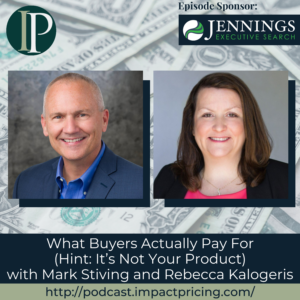
In Episode 3 of the Buyer Decision Series, Mark Stiving and Rebecca Kalogeris explore the next piece of the puzzle; and challenge a common assumption about value.
Because what buyers pay for may not be what you think.
Discover what buyers are really evaluating; and why understanding it can completely change how you talk about value and pricing.
Podcast: Play in new window | Download
Why you have to check out today’s podcast:
- Understand what buyers are really paying for—and why it’s rarely the product itself.
- Learn the Second Law of Value and how it reshapes the way pricing conversations work.
- See how B2B buyers think about results through revenue, cost savings, and risk.
- Recognize the hidden personal outcomes buyers consider—even in business decisions.
- Build the next layer of the Buyer Decision framework introduced in Episodes 1 and 2.
Catch Up on the #BuyerDecisionSeries:
- Episode 1: Buying Is a Prediction of the Future
- Episode 2: Buyers Buy Futures, Not Features
- Episode 3: What Buyers Actually Pay For
“Value is the result of solving problems.”
– Mark Stiving
Topics Covered:
00:22 – Recapping the First Two Episodes. Buying is prediction, and confidence determines when someone acts
01:32 – Confidence Threshold in Buying Decisions
02:11 – Introduction to Laws of Value
02:42 – Umbrella Law: Buyers Trade Money for Value
03:14 – Law One: Buyers Make Predictions
04:02 – Law Two: Value is the Result of Solving Problems
05:02 – Confidence Components: Payoff, Probability, Anticipated Regret
06:07 – B2B Results: Incremental Profit + Reduced Risk in B2B
08:22 – Results in B2C: Functional, Social, and Emotional Value. Consumers buy outcomes like better performance, social perception, or emotional satisfaction
10:43 – Why Individual Buyers Still Matter in B2B. Even business decisions include personal outcomes like reputation and career impact
12:50 – What Comes Next: Quantifying Value. How sellers can help buyers understand the payoff they expect
Key Takeaways:
“Value is the result of solving problems.” — Mark Stiving
“Individual buyers inside companies still care about how decisions make them look and feel.” — Rebecca Kalogeris
Connect with Rebecca Kalogeris:
Connect with Mark Stiving:
- LinkedIn: https://www.linkedin.com/in/stiving/
- Email: [email protected]
Full Interview Transcript:
(Note: This transcript was created with an AI transcription service. Please forgive any transcription or grammatical errors. We probably sounded better in real life.)
Mark Stiving
Let’s focus on the payoff piece. Because if you think about it, the payoff in confidence is really just value. What do I think I’m going to get in the future if I buy this? What are the results likely to be?
[Intro]
Advertisement
Today’s podcast is sponsored by Jennings Executive Search. I had a great conversation with Jon Jennings about the skills needed in different pricing roles. He and I think a lot alike. If you’re looking for a new pricing role, or if you’re trying to hire just the right pricing person, I strongly suggest you reach out to Jennings Executive Search. They specialize in placing pricing people. Say that three times fast.
Mark Stiving
Welcome to Impact Pricing, the podcast where we discuss pricing, value, and the results-oriented relationship between them. I’m Mark Stiving, Chief Educator at Impact Pricing, and we offer programs to help you get paid more. Our guest today is, once again, me, but I have Rebecca with me. And we’re going to do a third episode in this concept that’s leading us towards understanding buyer disconnect. So welcome, Rebecca.
Rebecca Kalogeris
Thanks, Mark. I’m excited to talk more about this.
Mark Stiving
Oh, me too. This is my favorite topic right now. I got to tell you.
Rebecca Kalogeris
It is. I did. And I think that you have teased a little bit about what we’re going to focus on in your opener today. So it’ll be good.
Mark Stiving
Oh, so what did we talk about in the first two episodes? Do you remember?
Rebecca Kalogeris
We did. We talked about buying really being a prediction of the future, right? We don’t know for sure. We don’t have it when we buy something. We don’t have the hole when we buy the drill. We don’t know the value fully. And then we also talked about confidence, right? That part of the buying decision is you have to have confidence. There’s a level of confidence you need to act when you make a buying decision. And those are really the kind of the areas that we focused on. And the last two.
Mark Stiving
Yeah, and I don’t remember, did we bring up the confidence threshold that says we have to become so confident before we can actually say, yes, I’m gonna make this purchase?
Rebecca Kalogeris
Let’s, you know what? It’s a really good point, so we should make it again, whether we did or not.
Mark Stiving
Great idea. Excellent. So the real key point is that if we believe that buying is a prediction of the future, buyers are predicting the future. and how confident are they in that prediction? And if they’re not very confident, they’re not gonna buy. And once they become really confident, then buying becomes easy. And you can imagine that there’s this threshold that says, oh, when I reach this level of confidence, now I’m ready to buy. And so we can imagine the buyers are sitting there learning and studying and imagining to the point where they can get their confidence up past some level of threshold.
Rebecca Kalogeris
Absolutely.
Mark Stiving
Okay, so I want to take a quick step back. Thank you very much for that summary. In the book, we actually, this is later in the book, but we actually define six different laws of value. And these laws of value are really about how is it that buyers are perceiving value or interpreting value. And there’s an umbrella law that doesn’t even count as one of our six. Anybody who knows me has heard me say these words before.
Rebecca Kalogeris
If you had a tattoo, this is what the tattoo would be.
Mark Stiving
It would probably be that buyers trade money for value, right? Buyers trade money for value. And then I usually follow that up with which buyers, how much money for what value. And so think of that as the umbrella law of all of business, of all of pricing, of all of value, that is the umbrella law. But then we step down to say, Hey, I want to really understand from the buyer’s perspective, how do they think about value?
And what we talked about in our very first episode is buyers are making a prediction of the future. That happens to be law one, right? So the very first law is, we know that buyers are making predictions. They’re not, they don’t know the future. And so, they’re uncertain every time they buy something. I’m pausing for you to say something brilliant. So don’t feel any pressure.
Rebecca Kalogeris
No, but I mean, I think that’s exactly right, right? We, we don’t know for sure. We hope it will do what we want. We hope it will deliver the value, but we don’t know.
Mark Stiving
Yep. And so that makes sense as a law because it happens. Oh, in every single purchase. Yes. So today we’re going to talk about law two and I apologize for naming it law two before we talk about it, but here’s what law two really is. value is the result of solving problems. Now notice that I pause and emphasize the word result because that’s truly where value lies. Value is the result of solving problems. If there is no problem, no value exists.
One of my favorite lines, bald men don’t buy combs. So I haven’t bought a comb for 30 years. And so the question becomes, how do we dive deeper? What does that value really mean when we think of it as the result of solving problems? Can I tie that back to last week’s or our previous session for just a second? In our previous session, we talked about confidence. And confidence has three really big components to them. It has the payoff. What do I think I’m going to get? It has the probability, what are the chances I think I’m actually going to get that? And then it had anticipated regret.
So today, let’s focus on the payoff piece. Because if you think about it, the payoff in confidence is really just value. What do I think I’m going to get in the future if I buy this? What are the results likely to be? And so by the way, we could use many different languages here. We hear a lot of people call these outcomes instead of results. I tend to use the word results. We hear people say the words jobs to be done. So what’s the job that needs to be done there? Great, so that’s simply a result. What are we trying to get accomplished?
And so think of this as the payoff piece. What do I get when I win here? And so the next piece to results is most of our clients, most of our work is in B2B. And so when we think about a result for a business customer, it is almost always measured in incremental profit. So a buyer buys something from us because they think they’re going to make more money after they bought it than before they bought it. Can we quantify what that result is? Can we help them quantify what that result is?
And so that company is truly buying a result and that result is incremental profit. Incremental profit comes from one of three different places. It comes from increased revenue, decreased cost or reduced risk. And they actually go in that order of importance. Companies love to buy increased revenue. CFOs, COOs like to buy decreased cost. And there’s not a soul on the planet who really wants to buy reduced risk.
Rebecca Kalogeris
Some IT guys out there.
Mark Stiving
That may be an exaggeration, but if you think about it, insurance, we buy insurance to reduce risk. Yes. And nobody wants to buy insurance. No. We do it because we have to. We do it because we feel like it’s important or we want to protect our family. But no one’s excited about, oh my gosh, look at this. I’m going to reduce our risk.
Rebecca Kalogeris
The anticipated regret is what’s so high there, right? Not the payoff. You’re just like, oh, if I didn’t have it, I’d feel terrible.
Mark Stiving
Yeah. And so if we’re out trying to sell results and we’re selling them to businesses, we really want to be thinking hard, very hard. about how are we helping our customers increase their profit by increasing revenue and decreasing costs. If we can’t do it in one of those two ways, then we can fall back on reduced risk. We can always talk about reduced risk, but truly the value, the quantified value is gonna come in costs or revenue, almost always.
And so that’s how we wanna think about results when we’re selling B2B. Okay, right now you’re thinking through, I can just see it in your eyes, Rebecca. You’re thinking to yourself, yeah, but what about B2C? What are the results in B2C?
Rebecca Kalogeris
Right, I was. I was like, I bought a sweater. I mean, I like the sweater, but yeah. That’s pretty cool. I was not expecting to get something specific, where I was like, I bought the sweater, I wore it, fell in love with the guy because he saw the sweater. I mean, like, there’s not that kind of result.
Mark Stiving
Oh man, you married him, you divorced him, you got half his assets. Whoa!
Rebecca Kalogeris
Wow! The power of the sweater. He got half my assets, it’s more likely, right?
Mark Stiving
But if we think about B2C, once again, value is the result of solving problems. But that result is no longer an incremental profit. That result typically falls in one of three other buckets. Those results come in as very functional. So a functional result, I need better gas mileage in my car, right? So that’s a functional result. It could come as a social result. So this makes me look good to my friends. I worry about how I’m perceived in the world.
And then, the last one is, it could be an emotional result. An emotional result is, I’m really happy when I eat chocolate, right? So we could take those three basic outcomes and say those are results we’re trying to sell. Now, I love B2B because I can put a number on things. In B2C, it’s really hard to put a number on any of those three things. But we still want to understand that’s the payoff.
If we’re selling to a consumer and we need them to become confident, what we’re doing is we’re saying, what’s the result that we’re trying to sell? That’s the payoff, right? Because confidence is the payoff times the probability, and we want to help them with the payoff. And so that sweater, you look fabulous in that sweater. Can I just say that, Rebecca? I mean, just amazing.
Rebecca Kalogeris
Why, thank you.
Mark Stiving
And now it was worth it, right? Yes. So now we got at least some little piece of payoff, because maybe Mark cared. Now, one of my favorite things when we’re selling B2B is these three B2C results still matter. Individual buyers inside a company are individuals. They’re acting like B2C buyers. How does this make me look? How does this make me feel? Is this going to get me promoted?
And so these are the functional, emotional, and social aspects for individuals inside companies. We can’t ignore those three B2C factors. But in the end, that person, that individual employee gets their project approved or financed by showing incremental profit. And they put together a business case to say, here’s why we need to buy this. And so we still need to focus on the B2C aspects, but what most companies are not doing is focusing on truly that incremental profit piece.
Rebecca Kalogeris
So when you say that part of it is helping them quantify the payoff, right? Talk a little bit about how we can’t just be like, and you’ll save $10,000, because no one believes you, right? You’ll get that sweater and you’ll be married in a week. But how can you help them? Or what is our role as the company, the seller, in helping them realize and see the payoff potential?
Mark Stiving
Okay, Rebecca, can I say that is an absolutely fantastic question, and can I ask you to ask that on our next episode?
Rebecca Kalogeris
I knew you were going to say that.
Mark Stiving
We’re kind of out of time, and the answer to that is huge.
Rebecca Kalogeris
All right. You know what? Then this way we’ll do another one.
Mark Stiving
What a teaser.
Rebecca Kalogeris
Right? Come back if you want the answer to the good questions.
Mark Stiving
All right. So to our listeners, thank you so much for your time. If you enjoyed this, would you please leave us a rating and a review? And if you have any questions or comments about the podcast, or if you want to get paid more for the value you deliver, email me or Rebecca at [email protected] or [email protected]. Now go make an impact.
Advertisement
Thanks again to Jennings Executive Search for sponsoring our podcast. If you’re looking to hire someone in pricing, I suggest you contact someone who knows pricing people contact Jennings executive search.
[Outro]