If buyers need to believe the value before they buy…why don’t they trust ROI when we show it to them?
In Episode 5 of the Buyer Decision Series, Mark Stiving and Rebecca Kalogeris explore how to actually help buyers quantify value in a way they believe.
Because the real value conversation doesn’t start with spreadsheets or ROI calculators — it starts by helping buyers connect their problems to measurable outcomes they already care about.
Discover how guiding buyers to use their own assumptions, their own numbers, and their own logic transforms value from something you claim… into something they trust — and why that trust is what ultimately increases the confidence needed to say yes.
Podcast: Play in new window | Download
Why you have to check out today’s podcast:
- Discover why buyers don’t trust ROI; even when your numbers are right and how this skepticism silently kills deals and drives unnecessary discounting.
- Learn how to guide buyers to calculate value using their own numbers so the outcome feels credible, defensible, and worth paying for.
- Master a simple framework to connect features to real business impact; turning vague problems into measurable results buyers can justify internally.
Catch Up on the #BuyerDecisionSeries:
- Episode 1: Buying Is a Prediction of the Future
- Episode 2: Buyers Buy Futures, Not Features
- Episode 3: What Buyers Actually Pay For
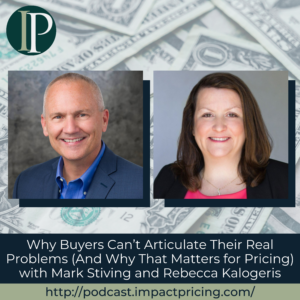
- Episode 4: Why Buyers Can’t Articulate Their Real Problems (And Why That Matters for Pricing)
“Buyers believe it more when they use their own numbers than when you tell them the answer.”
– Mark Stiving
Topics Covered:
00:00 – Why Buyers Don’t Trust ROI (Even When It’s True). The core problem: telling buyers the value doesn’t build confidence — it often creates skepticism.
01:30 – The Value Table: Turning Features into Business Impact. A simple framework — Feature → Problem → Result → KPI — to connect what you sell to what buyers actually care about.
03:30 – The Hardest Step: Defining the Real Problem. Why companies (not just buyers) struggle to articulate the problem — and how the “curse of knowledge” gets in the way.
05:00 – From KPIs to Money: Where Value Actually Comes From. How to link metrics like churn or productivity to real financial impact (cost savings or revenue growth).
06:30 – Step 2: How to Quantify Value in a Live Conversation. How to guide buyers through their own logic — starting from their problems and moving toward measurable outcomes.
08:00 – Let the Buyer Do the Math (And Why It Works). Why using their assumptions and their numbers makes the value more believable than any pitch.
09:30 – Why Smaller Numbers Increase Credibility. Using conservative estimates builds trust — and still leads to compelling value.
10:30 – Why ROI Calculators Backfire (and What to Do Instead). Big, polished numbers feel manipulative — buyers trust what they help build.
11:15 – The Real Goal: Build Confidence, Not Just Prove Value. Quantifying value isn’t about proving ROI — it’s about making buyers believe the decision is right.
Key Takeaways:
“When we can articulate problems to our buyers, they trust us more.” — Mark Stiving
“If we could solve this problem for you, what do you think that’s going to do for your employee turnover?” — Mark Stiving
“The buyer…once they’ve done the math and used their own numbers, they believe this way more than if you walked in and said, we’re going to save you a million dollars.” — Mark Stiving
“We show that we understand their business, which is key.” — Rebecca Kalogeris
Connect with Rebecca Kalogeris:
Connect with Mark Stiving:
- LinkedIn: https://www.linkedin.com/in/stiving/
- Email: [email protected]
Full Interview Transcript:
(Note: This transcript was created with an AI transcription service. Please forgive any transcription or grammatical errors. We probably sounded better in real life.)
Mark Stiving
It is equally hard for companies to articulate the problems. They have something called the curse of knowledge. So companies or individuals can say, ‘oh, we have this feature and here’s what it does for you. And we automatically jump to this, to the solution, the benefits, the value, because it’s so obvious to us. It just isn’t obvious to our buyers.
[Intro]
Advertisement
Today’s podcast is sponsored by Jennings Executive Search. I had a great conversation with Jon Jennings about the skills needed in different pricing roles. He and I think a lot alike. If you’re looking for a new pricing role, or if you’re trying to hire just the right pricing person, I strongly suggest you reach out to Jennings Executive Search. They specialize in placing pricing people. Say that three times fast.
Mark Stiving
Welcome to Impact Pricing, the podcast where we discuss pricing, value, and the quantifiable relationship between them.
I’m Mark Stiving, Chief Educator at Impact Pricing, and we offer programs to help you get paid more.
Our guest today is Rebecca Kalogeris. Okay, it’s actually me, but Rebecca’s here to help interview me.
Rebecca Kalogeris
I was like, ooh, ooh, yay!
Mark Stiving
So, Rebecca, welcome.
Rebecca Kalogeris
Oh, thanks, Mark. I’m excited to be here again.
Mark Stiving
What are we going to talk about today?
Rebecca Kalogeris
All right, so we have been talking about a lot of the concepts that are in your upcoming book, Buyer Disconnect, right?
So we’ve been talking about buyers trade money for value. We’ve been talking about buying as a prediction of the future. We’ve been talking about confidence.
Today, we’re actually going to talk about a concept related to that, but it’s actually in your book, Selling Value, which is not necessarily an oldie, but it’s an existing book, and it’s great.
And really what we’re going to dive into is how, as salespeople, do we have value conversations that help buyers quantify those payoffs, those results that we talk about as being so important for them to understand in order to raise that confidence to the level of which they’ll make the purchase?
How do we as sellers shape their thinking in that way and help them understand that when they are, as we talked about in the last episode, not necessarily great at describing all their problems?
Mark Stiving
That sounds like the question that we promised to answer last episode, but we didn’t.
Rebecca Kalogeris
Yes. Uh-huh.
So thank you for the patience. It was that brilliant question, brilliant, that you said I asked in episode three.
Mark Stiving
It really was.
And we couldn’t get to the answer to this until we talked about problems.
And so today, let’s figure out how we’re going to answer this. I’m going to give you two steps to the answer.
Rebecca Kalogeris
Great.
Mark Stiving
The first step, I’m going to call the value table. So what I want everybody to do is start thinking about value in the following way. I think of it as a table, four columns in this table, but think about value in the following way. You’ve built a feature, you built a product and you built it because it solves a problem for the customer.
So the first column, what I want you to write in is your feature or your problem. Think about this as a reason why someone’s gonna buy your product. A reason why someone’s going to buy your product over your competitor’s product.
So you put features into your product because it helps your customers.
The second column then is what’s the problem it solves. So why did you build that feature? I can tell you right now, that’s a hard column to fill out. We had this whole conversation last week about how hard it was for buyers to articulate problems. It is equally hard for companies to articulate the problems. They have something called the curse of knowledge.
Rebecca Kalogeris
Yes.
Mark Stiving
So companies or individuals can say, ‘oh, we have this feature and here’s what it does for you. And we automatically jump to this, to the solution, the benefits, the value, because it’s so obvious to us. It just isn’t obvious to our buyers.
And so what we have to do is really and truly take a step back and say, what is that problem that we’re solving? Because as we discussed last week, when we can articulate problems to our buyers, they trust us more. They believe that we understand their problems, their specific situation. So we do, we want to articulate the problems that we’re solving.
The next column is the results. So remember value is the result of solving problems.
So we just talked about problems. What are the results somebody is going to get? Now you may recall when we talked about results, we talked about value, we said in B2B it’s incremental profit and it comes as either increased revenue or decreased costs.
Rebecca Kalogeris
Yes.
Mark Stiving
Those are the two places we want to look for it. But what I really want you to do right now in a value table is look for a KPI in your customer that you’re going to help move. I don’t care if it’s cost or revenue yet. I care that it’s a KPI that matters to them.
So that KPI could be productivity. It could be churn rate. It could be conversions, you know, whatever it is that they’re going to use to measure the effectiveness of that feature or capability. What’s a KPI you’re going to help them move?
Rebecca Kalogeris
So not only should it be important, but they should measure it today, right?
Mark Stiving
Ideally, they’re already measuring it. This is something, this is a result that they would like to have. They just haven’t turned it into dollars.
Rebecca Kalogeris
Because I think it would be hard if it wasn’t something they measured today, right?
Yes, they may think it, but there’s like a burden. There’s an obstacle in their way of being able to measure that, believe it and see it.
Mark Stiving
Yep, exactly.
And what you’ll find is that if you’ve listed a hundred different features in your product, you’ve probably got somewhere between six and 12 different results that you deliver.
And so you could aggregate all these into saying, oh, we impact productivity. We impact employee turnover. We impact, right?
And so these are results that buyers truly care about. And now we can start, before we move into the quantification piece, we could easily say, oh, you’re worried about employee turnover.
Well, let me tell you about these features we have that help you solve employee turnover.
And so now we’ve taken results and pulled them back into our product. which is pretty cool. It’s a nice way to sell.
Okay. The question was the quantification question. And actually I don’t want to quantify it yet. Here’s what I want to do is I want to say, if you’ve got a measurable KPI, so we’re going to call that employee turnover.
Can you then calculate how much incremental profit a buyer would make if they could reduce employee turnover?
And so this is where business acumen comes into play. And you start saying to yourself, oh, employee turnover, I’m going to reduce employee turnover. Therefore, I’ve got less overtime I’m paying people that have to cover it. I’m reducing recruitment costs because I don’t have to recruit anybody. I’m reducing training expenses because I don’t have to train a new person.
And so you could potentially identify that there’s, you know, $50,000 for every employee you don’t turn over.
And that’s a real number. Now my recommendation when you create a value table is you’re guessing at these. I’m totally okay with you guessing. Because what I really want is for you to think that way first.
If you hadn’t thought through all these, it’s really hard to do this in front of a customer. So you just think through it.
Okay, now let’s do step two of what I said was gonna be a two-step process. How do you do this as a salesperson in front of a customer?
So what we’re going to do is we’re going to start with, why are you buying something like this? Right.
And they’re going to articulate odds. Odds are good. They’re going to give you a high level problem. We could start pushing into what are some lower level problems? What are some nuances of the problems? We want to gather all the problems that we possibly could, that they’re hoping to address.
If you’ve done your job well, you already know that if I solve this problem, I’m going to move these KPIs.
So we could ask a buyer, if we could solve this problem for you, what do you think that’s going to do for your employee turnover? Oh, it’s going to reduce turnover by 2%, 5%. Now, they don’t know the answer to that, but they could guess. You could just say, look, give me a guess. What do you think it’s going to be?
And they say 5%. And if you want to be really good, you say, okay, let’s make it 2% because you’re still going to find the numbers huge.
And then the last step is if we actually reduced employee turnover by 2%, how much money would that save your company?
And really good employees can know how to figure that out. Even if they don’t know how to figure that out, you do. You know how to ask them the questions. Oh, what does it cost you in overtime when someone leaves?
What does it cost you in recruiting costs to find a replacement? What does it cost you in training expenses to bring a new person up to speed? And so we start asking these questions and we’re not giving them any answers. We’re not doing any of the math.
What we’ve done is we’ve pre-thought out, how do we get to the answer? And the buyer, go ahead.
And the buyer, once they’ve done this, once they’ve done the math and used their own numbers, they believe this way more than if you walked in and say, we’re going to save you a million dollars if you buy this. Because they now see where it came from and they’re using their own numbers.
Rebecca Kalogeris
And they know what assumptions they make, right? But I do have a question, because you kind of jokingly said, don’t worry about it, use 2%, because the numbers will be so big. It doesn’t matter.
Because this is one of the things that I’ve struggled with, and I know you hate ROI calculators. But in that same way, if I create an ROI calculator, the results that the buyer gets when they use it are insane.
Nobody would use it. So how do we find that balance here? Same thing. There are numbers. There’s pieces.
But do we still run that same risk of at the end, it just looks unbelievable?
Mark Stiving
I’m going to say yes, maybe. But here’s the real answer. The reason I hate ROI calculators and the reason ROI calculators don’t work is because when you give me a big number, I feel like you’re just tricking me. I feel like you’re lying to me. You’re doing something Right. I haven’t thought through the whole process, but when I sit and talk you through this and I’m not using an ROI calculator, I’m not using a tool that says, Hey, let me, let me convince you to go this way. I’m just asking you questions about your own problems, your own business.
And what happens when we solve these problems for you? Are these problems worth it? Right.
And so, this is how we quantify value and we raise confidence.
Well, absolutely. Because we show that we understand their business, which is key. So can I ask the next question? Oh, no, no, no, no.
Bring this up on our next episode, because I think Law 3 leads directly into what I want to add to the story that we just told.
Rebecca Kalogeris
Love it. Right? Join us next time for Law 3.
Mark Stiving
I’ll make the tease this way. How do you do this when there’s competition involved?
Rebecca Kalogeris
Ooh.
Mark Stiving
Ooh.
Rebecca Kalogeris
Right?
Mark Stiving
Ooh. Okay. What a great tease.
Rebecca Kalogeris
That is a great tease.
Mark Stiving
All right, Rebecca, thanks again for a great episode. I love talking to you about this stuff.
Rebecca Kalogeris
Me too. Super fun.
Mark Stiving
All right, and to our listeners, thank you for your time.
If you enjoyed this, would you please leave us a rating and a review? And if you have any questions or comments about the podcast, or if you want to get paid more for the value you deliver, feel free to email me, [email protected]. Now, go make an impact.
Advertisement
Thanks again to Jennings Executive Search for sponsoring our podcast. If you’re looking to hire someone in pricing, I suggest you contact someone who knows pricing people contact Jennings executive search.
[Outro]