CFOs hate losing money on a customer. When the usage report shows an account costing more in compute than it pays, the reaction comes fast: raise the price, cap the usage, or let the customer go. It feels like basic financial discipline.
That instinct comes from hardware. Every unit carried a margin, so every customer did, too. A customer who cost more than they paid meant someone made a mistake in pricing, discounting, or both.
Insurance companies see it differently. They lose money on customers every day. A homeowner pays $2,000 a year in premiums and files a $300,000 claim after a fire. On its own, that policy is a disaster. But, judging a single policy misses how the business works.
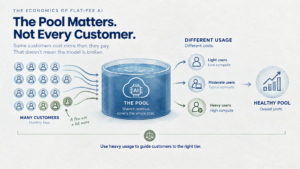
So insurers price the pool. Most policyholders file small claims or none at all. A few file enormous ones. The premium is set so the whole group covers the whole cost, with profit left over. The profit lives in the distribution.
A flat-fee AI product works the same way. A customer paying $50 a month is buying coverage for whatever they end up using. Most will use a modest amount. A few will use a lot. Losing money on them is built into the model, the same way paying claims is built into insurance.
AI companies also have an advantage insurers would love. Insurance claims are random. A homeowner with no claims for twenty years is just as likely to have a fire next year as anyone else. AI usage is more predictable. A customer who ran your product hard last month will probably run it hard next month. You can see your heavy users coming.
That turns an insurance problem into a segmentation problem. Heavy users get more from the product, and most of them value it more. Usage caps on each tier sort customers into the right plan. A customer who hits the cap every month is telling you they belong in the next tier up. Insurers would pay a fortune for a signal that clear.
So a CFO has the right concern but is focused on the wrong level. A handful of unprofitable customers is normal for any flat-priced product. The pool is what matters. Raising prices for everyone to fix a few punishes the many and can wreck a model that was working.
Insurers live with unprofitable customers they can’t predict. AI companies can see theirs coming. That makes a few whales a segmentation opportunity, not a reason to panic.
Want to learn how to successfully monetize your AI offering? Check out my latest book, Pricing AI.
Share your comments on the LinkedIn post.
Now, go make an impact!
A note on process: Every idea, argument, and opinion is mine. Claude made the writing better.
 Tags: AI economics, ai pricing, customer segmentation, pricing, Pricing AI, pricing strategies, pricing strategy, pricing tiers, Usage-Based Pricing