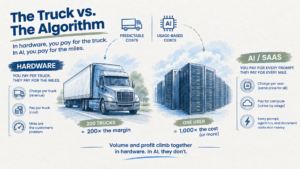
In hardware, your biggest customer is your best customer. A fleet manager who buys 200 trucks generates 200 times the margin of someone who buys one. Every truck costs about the same to build, and every truck carries its own price. Volume and profit climb together.
That works because hardware’s pricing metric and cost driver are the same. You charge per truck. You pay per truck. What the customer does with the truck after it leaves the lot costs you nothing. A customer who drives 200,000 miles a year pays the same and costs you the same as one who drives 2,000.
SaaS was different. A per-seat price treats every user as identical, and every SaaS company knows users vary enormously. Some log in once a quarter. Others live in the product eight hours a day. With near-zero marginal cost, the gap was irrelevant. Power users cost a few extra cents in server time, and nobody noticed. In fact, more usage meant less churn and a better chance for upsell.
AI keeps the SaaS pricing and brings back the hardware costs. Now power users cost real money. Every prompt, every agent run, every document processed burns compute. The price says every seat is the same. The cost says some seats are a hundred times more expensive than others.
The industry calls these customers inference whales. These users behave exactly as every seller hopes customers will, and that is the problem. They love your product, use it constantly, and cost more to serve than they pay. Anthropic ran into this with Claude Code. Its $200-a-month plan attracted a small group of users who ran it nearly around the clock, so the company added weekly rate limits to contain them.
Engagement used to be pure good news. Higher usage meant stickier customers, easier renewals, and more expansion. In AI, engagement under a flat price means the cost line grows faster than the revenue line.
It also breaks ARR. Two customers paying $100,000 a year look identical in ARR. One might run at 85% gross margin while the other runs underwater. ARR tells you how much you collect. In AI, it says very little about how much you keep.
Hardware companies were protected because the buyer paid for the truck and the miles were the buyer’s problem. SaaS companies were protected because the miles were essentially free. AI companies charge for the truck and pay for every mile.
Want to learn how to monetize your AI offering successfully? Check out my latest book, Pricing AI, co-authored with Michael Mansard and Wolfgang Ulaga.
Share your comments on the LinkedIn post.
Now, go make an impact!
A note on process: Every idea, argument, and opinion is mine. Claude made the writing better.
 Tags: AI economics, ai monetization, ai pricing, pricing, Pricing AI, pricing metrics, recurring revenue, saas pricing