Grammarly doesn’t know if it works.
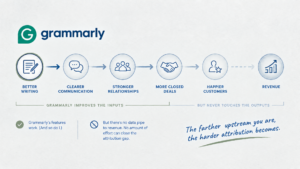
It knows its features work (and so do I; that’s why I use it), and both of us believe that better writing leads to clearer communication; clearer communication leads to stronger relationships; stronger relationships lead to more closed deals and happier customers.
But Grammarly can’t prove it cleanly. The CRM measures closed deals, and the support platform measures customer satisfaction. Grammarly sits upstream of all of them, improving the inputs that flow into those systems, but never touching the outputs those systems measure. No data pipe runs from Grammarly to revenue. No amount of effort can close that attribution gap.
This problem isn’t unique to Grammarly. Almost every product has it, and it’s caused by where the product sits.
The CRM Version
Consider a CRM. Sales teams use it to manage pipelines, track activity, and forecast revenue. The whole point is to help reps sell more. And it probably works.
But can a CRM vendor prove their product moved the win rate? The rep closed the deal. The product was good. The champion was persuasive. The competitor stumbled. The timing was right. Yes, the CRM captured all of that activity, but that isn’t the same as causing the outcome. Too many variables sit between CRM usage and closed revenue for any clean attribution claim to hold.
The CRM vendor knows this. So they price on seats, not on revenue influenced. They talk about outcomes in their marketing and their sales conversations because outcomes are what buyers care about. But they charge for access because access is what they can defend.
The Attribution Problem
Outcome-based pricing requires two things: a direct link to the buyer’s profit, and clean attribution that the seller caused the result. Most products can satisfy one of those conditions some of the time. Very few can satisfy both reliably enough to build a pricing model around it.
The further a product sits from the moment profit gets measured, the harder attribution becomes. Grammarly sits very far upstream. A CRM sits closer but still not close enough. On the other hand, Fin (Intercom’s AI support agent) sits close enough to charge per resolved ticket because resolved tickets reduce support costs directly and the attribution is clean. That is the exception, not the rule.
Most products live in the middle, genuinely moving outcomes that they cannot cleanly prove they moved.
What Companies in This Position Should Do
Stop feeling guilty about it. Outcome-based pricing is the holy grail because it aligns seller success with buyer success most directly. But chasing it when the attribution chain is too long does not make the pricing more value-based. It makes it less defensible.
The better move is outcome-based selling. Think in outcomes. Talk in outcomes. Help buyers see exactly what changes in their world when the problem is solved. Build the business case around the result, even when you charge for something different. A Grammarly salesperson who helps a buyer calculate the cost of unclear communication, proposals that miss the mark, emails that erode relationships, is selling on outcomes. The pricing metric does not have to match the sales conversation.
Outcome-based selling is available to every company regardless of where their product sits in the attribution chain. Outcome-based pricing is available to the few whose product sits close enough to profit to defend the claim.
Know which one you have. Use both as far as you can take them.
Now, go make an impact!
A note on process: Every idea, argument, and opinion is mine. Claude made the writing better.
 Tags: outcome pricing, outcome-based pricing, outcome-based selling, pricing, pricing attribution, pricing metrics, pricing strategy, profit attribution, value, value attribution, value-based pricing