What happens when competitors offer for free what you charge for?
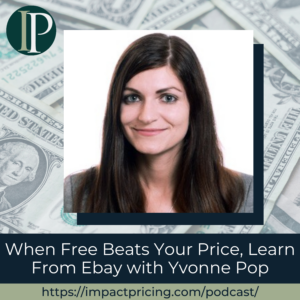
Yvonne Pop, Director of Global Markets Pricing and Monetization at eBay, shares how eBay rethought its marketplace pricing by looking at who receives the most value, who is most willing to pay, and what makes customers choose one platform over another.
In eBay’s UK business, the answer meant a major shift: stop charging certain consumer sellers and focus monetization on the buyer side instead.
In this episode, Yvonne reveals how to rethink pricing when free alternatives threaten your business, why customer perception can matter as much as the price itself, and how to balance sophisticated pricing with simplicity and trust.
**The next opportunity to meet Yvonne Pop in person will be at EPP 20 Years Global in Amsterdam on 17–18 November. Register here to secure your ticket.
Podcast: Play in new window | Download
Why you have to check out today’s podcast:
- When free wins: Learn why eBay stopped charging certain sellers and shifted where it captures value.
- Price the right customer: Discover how buyers and sellers value the same marketplace differently.
- Psychology beats assumptions: See why what customers think they pay can matter more than what they actually pay.
“Do not ever ignore the human customers behind it and the human psychology.”
— Yvonne Pop
Topics Covered:
02:00 – Managing Change in Pricing. Learn how Yvonne approaches pricing transformation through governance, standardized processes, and organizational change management.
04:00 – Who Should Pay for a Marketplace? Discover why eBay must consider both buyers and sellers when setting fees, while balancing supply, demand, and transaction value.
09:00 – When Free Beats Your Price. Yvonne shares eBay’s UK case study and explains why charging consumer sellers created a barrier to listings, even when the platform offered valuable services.
11:00 – Why eBay Shifted Where It Captures Value. Learn why eBay stopped charging certain consumer sellers and focused on charging buyers who valued access, security, and customer service.
15:00 – The Trade-Off Between Sophisticated Pricing and Simplicity. Explore why more precise pricing can capture more value but also create confusion, undermine trust, and hurt sales.
21:00 – How Price Changes Force a New Buying Decision. Mark and Yvonne discuss why communicating a price increase makes customers reconsider whether a purchase is still worth it.
22:30 – The Pricing Advice Every Professional Should Remember. Yvonne shares her biggest lesson: understand your customers and never ignore the psychology behind how they perceive price.
Key Takeaways:
“The more you speak to customers, the more you realize many times perception actually influences what they think.” – Yvonne Pop
“How something is explained and perceived can influence customers’ understanding of what they’re paying.” – Yvonne Pop
“…the more sophisticated you get, you’re able to capture more value specific to the item, to what it is. But then the harder it’s to communicate to the other side.” – Yvonne Pop
People and Resources Mentioned:
- eBay – Global online marketplace where Yvonne leads global markets pricing and monetization.
- Facebook Marketplace – A free alternative discussed in the context of competing for consumer sellers.
- EPP (European Pricing Platform) – Pricing and revenue growth management community where Yvonne will speak about change management in pricing transformation.
Connect with Yvonne Pop:
Connect with Mark Stiving:
- LinkedIn: https://www.linkedin.com/in/stiving/
- Email: [email protected]
Full Interview Transcript:
Read the full transcript for more insights from Yvonne Pop and Mark Stiving.
(Note: This transcript was created with an AI transcription service. Please forgive any transcription or grammatical errors. We probably sounded better in real life.
Yvonne Pop
Really, really getting to know the customer. And I would say not ignoring the psychological side of pricing. I think this is something I’ve learned in my career. Like I think models are incredibly important, like the data. This is the bread and butter of what we do as pricing professionals.
However, I would say do not ever ignore the human customers behind it and the human psychology.
[Intro]
EPP Advertisement
Every year, the best pricing and commercial strategy minds in the world find each other in one place. This November, that place is Amsterdam. EPP is celebrating 20 years by bringing 1,000 pricing and RGM leaders together for its global summit, November 17th and 18th. If pricing is your profession, this is where you belong. Register at pricingplatform.com.
Mark Stiving
Welcome to Impact Pricing, the podcast where we discuss pricing, value, and how buyers decide.
I’m Mark Stiving, I help companies turn hidden value into willingness to pay.
Our guest today is Yvonne Pop.
Here are three things you want to know about Yvonne before we start. She is the Director of Global Markets Pricing and Monetization at eBay. I’m sure that’s a tiny job.
She has 15 plus years across e-commerce, financial services, consulting, pricing, and monetization. And she’s gonna be speaking at EPP. Well, she’s gonna be on a panel talking about change management strategies that accelerate pricing and RGM transformation.
Welcome, Yvonne.
Yvonne Pop
Thank you, Mark.
Very happy to be here today to share a bit about what I find incredibly interesting to be working in a pricing and revenue management role, specifically for a marketplace platform.
Mark Stiving
It’s going to be fun. But before we jump in, because I know what you really want to talk about, I’m going to ask you two questions before we get there.
Question number one, how’d you get into pricing?
Yvonne Pop
I stumbled into it is how I would put it. So I don’t know how many people get into it, but I started my career back in the day in strategy, actually in the pure strategy consulting side, moved to do strategy inside the corporate, but always wanted to do something a lot more hands on.
And I ended up from strategy to leading a sales operations team, which I would call is kind of the pendulum swing of getting into the messy side of operations.
And thinking what I want to do with my career between these two things, I realized, okay, I love the commercial aspect, but I also love the more analytical part that I was missing more from the strategy world.
And that’s how I found pricing. Speaking to a lot of mentors at the time and sponsors, they directed me in this direction and I’ve been, let’s call it, stuck there since and loving it.
So I find it like an incredible space where you have to be commercial, you have to be analytical, you have to understand data and models, but then you also really have to understand psychology. So for me, this has kept me really interested and still keeps me very nice.
Mark Stiving
I think your description of pricing was absolutely perfect, right?
Because it really is strategic and it’s very hands on all at the same time. So that’s pretty cool. OK, second question before we jump into what you really want to talk about.
Tell us what you’re going to talk about at EPP.
Yvonne Pop
So at EPP, I am going to talk about how do you do change management in pricing.
And specifically, I want to focus on what we did for one of our segments of customers, which are very large enterprises, and how we implemented a whole governance system, standardized processes in the background, and had to take an entire organization that was used to doing things very, I would call it ad hoc, into figuring out how to operate in this very streamlined way and with a structure and in a very consistent way, looking at things one by one, which has been, yeah, it’s driven a lot of things.
It’s also meant a lot of hand-holding of people throughout this.
Mark Stiving
Nice. So that’ll be, that’ll be fascinating. That’s November 17th and 18th, I think.
Yvonne Pop
Yes, precisely in Amsterdam.
So I’m really looking forward to it. And I don’t know, I hope many of your listeners as well can join us there. There’s a range of very, very interesting topics.
And I have to say, I’m very, I’m looking forward to this event, probably even more so as a participant as much as a panelist. So I think there’s going to be a lot to learn.
Mark Stiving
Well, since you said all that, I am launching one of my newest books right there. And so that’ll be fun as well. I’m excited.
Yvonne Pop
Oh, really? Cool. Yeah, I’m very happy. I need to come find you and make sure I grab a copy, so perfect.
Mark Stiving
Yes, exactly. Exactly.
All right. So now the thing you really want to talk, which by the way, so do I, because I find it fascinating. In the world of eBay, I asked you the question before I hit record, who do you price for? So, describe to me the problem and why that was an interesting question.
Yvonne Pop
Yeah, we see it at eBay as a platform, we see it in the middle of a transaction between a buyer and the seller.
But what we actually monetize is just the ability to make that transaction happen, is how I would call it.
So basically, we charge fees on this piece of it. And we have to look at the holistic customer landscape to really understand how this works. Cause this is when it gets really interesting because eBay touches buyers and it touches sellers.
And when you touch sellers, you touch people who are cleaning out their garage and twice a year, maybe an instant item or two to all the way to big brands who sell directly and use eBay as another channel.
And then we need to look at a lot of dynamics, right? Because when you look at the commission fees you can charge, you can really impact the viability of these transactions. Then you have to be very careful. So we need to have a very good understanding of supply and demand and where your constraints, but also your headroom is in terms of the value you’re delivering.
Mark Stiving
Okay, so that’s perfect answer. Now let’s pretend that I am a seller who just cleaned out my garage. Right. Do you worry about if I use eBay or if I go to a competitor to put my products up?
Yvonne Pop
A hundred percent.
So, and this is where we really want you to come on eBay. And so we had to spend a lot of time to really understand what are the barriers, like pretty much what would make someone go to eBay versus go to a competitor, like let’s say Facebook marketplace, right?
So over time, we’ve been a platform that traditionally charges fees to sell. And one of our main value propositions has been trust for you as a seller clearing out your garage. Because it’s always been, okay, you can go to Facebook marketplace and put this list there for free, but you’re going to have to trust in handling however you want the transaction with your buyer.
You’re going to have to trust that they’re going to pay. You’re going to have to trust that they’re going to show up.
At eBay, we’re going to charge you a fee, but we’re going to take care of that for you because we’re offering secure payments. We’re going to offer protection. So there’s a value proposition around this.
Mark Stiving
Okay, I dearly love that answer. Now, the question that I would ask is, do sellers know that? Right, so I’m gonna clean out my garage. In fact, I’m getting ready to move, so I really am getting rid of a ton of stuff right now. We tend to give it away as opposed to sell it.
But if we were gonna sell it, I don’t know that I would know to go to eBay instead of going to Facebook Marketplace.
So how is it that sellers know that I get the secure transaction, I get the protection of using eBay?
Yvonne Pop
That’s one piece where I think very openly, I think we could be doing more marketing out there to get the word out.
So it does come to the fact that either this is a topic on seller’s minds and it is something they’re looking for.
So you kind of have to rely on the fact that either people already know or they don’t. And this is why sometimes new customer acquisition to getting new people to come and sell.
It’s a trickier problem, I would put it. Not one I’ve had to solve thankfully, but it’s definitely something that does come up.
And it is a problem a lot of other people are trying to solve here. I think…
Mark Stiving
Right.I was going to say, because the real point in my mind is we’re talking about value. And so the value is the security of the transaction, the security of actually getting paid, the whole process.
And I think that’s hugely valuable. But buyers only pay for value they can see. And so what we have to do is make sure our buyers know that they’re getting this somehow.
Yvonne Pop
That’s it. And that actually brings me a little bit to a very interesting case study that I was planning to talk about today. And this is what we did in our UK business. So we’ve already done this last year.
So it’s been something natural yet because we have all these value proposition, but at the same time. It’s not necessarily something that’s for many consumer sellers, just like it’s not on your mind. It wasn’t on many other people’s minds.
And then on top of that, what has happened, we’ve had other competitors also come on the market, not Facebook marketplace, who started offering free selling to sellers while still offering the trust element.
Cause there was a twist here. They were actually charging buyers. So this is actually a point where I wanted to talk about it, that this is where as a marketplace, you have to always learn and to look where you’re delivering the value and for whom and in what segment.
So going back to maybe something I said in the beginning, we look a lot at supply constraint and demand constraint. And when it comes to consumer sellers specifically, because the items tend to be very kind of one off, unique, et cetera. we see a very strong correlation between getting more of that supply and literally getting more sell-through.
So pretty much if we get more consumers to release their listings on eBay rather than giving it away, we are going to see more business. Simple as that. It’s like quite a clear correlation there.
And so actually, this is one of the cases where buyers value a lot access to these very one-off unique items, And sellers just want the convenience to sell and not worry about things. And this is where we had to do a paradigm shift as a business.
And for the first time ever, what we did in the UK business is that we actually decided for consumer sellers, this is a segment where we cannot put the fee and the monetization on the seller anymore. Because we do offer this value, but maybe the way we communicate it, the way it’s understood, et cetera, doesn’t remove the barrier. to come and sell. And actually we’re offering more value to buyers who come here to find those items.
And we’re offering value to buyers because buyers value more a secure transaction and customer service. And the fact that if something goes wrong, we have quite good policies in place to protect them, et cetera.
And so there it’s actually easier to justify charging a fee then it is to convince sellers to pay for that very specific segment.
Mark Stiving
Okay, I think that was absolutely brilliant.
Now, I’m going to say what you said, though, slightly differently, if I may, and that is the value to anybody is partially how can I buy it somewhere else, right? What’s it cost me to buy somewhere else?
And so you have competitors that are giving away the seller value for free, which means your seller value went down to zero or really close to zero. And yet you could still identify the fact that there was huge value from the buyer side.
And so now we can go capture some of that value. And if I put myself in the buyer’s shoes for a second, if I’m out searching for a one of a kind item and I find it, I actually don’t even care what the price is. The fact that you charged me a fee is almost irrelevant. Right? Because the price was probably ridiculously high anyway.
Yvonne Pop
Precisely. Or if it’s something that’s very everyday someone just wants to get rid of, it’s either high or low, to be honest. It could be on either end, but then also the kind of commission on the low is not going to change it that much either.
So kind of either way, there’s a much higher willingness to pay that extra fee on that side.
Mark Stiving
Yeah. And okay, so now here’s an interesting thought. Do you tell the buyer they’re going to pay a fee or do you bundle the fee into the price the buyer sees?
Yvonne Pop
We tell. So we absolutely share this. So it is standard. It is a requirement. So we do call out.
Of course, you show total price, but we do actually call out. like the line item for what the fee is. With, of course, all the appropriate, like, if people want to click the links and what this fee is there for, the value proposition associated with it, etc.
But it is something that is very kind of, very openly shared and disclosed, not just by us, but across the industry as a practice.
Mark Stiving
Nice, nice. Okay, fascinating so far. Now, every time I’ve ever been on eBay, I get inundated from the big companies. Right.
And so it feels like you do a way more business with big companies, or at least a lot of big companies are much better at using eBay than the small people are. And so how do we manage this with big companies? Are we still charging the big companies the fees?
Yvonne Pop
So these are the sellers segment that we still monetize. Cause like I said, we’re looking again, the value proposition and what do you offer to whom and what are they looking for? What are they paying for?
And at the end day, when we move, as we move from your everyday consumer who just wants to maybe get rid of a couple of items, make some money in the process. And we move to the professional sellers and the professional business is there. It’s pretty much like for any marketplace that you pay for velocity and access to a buyer base.
And that’s pretty much what we’re offering, right? So this is kind of the fundamental marketplace value proposition, which is, you know, at least we have buyers. And you have to treat the fees you pay, et cetera, the same way, especially the more sophisticated the business is, what they pay for any other sales channel, including, let’s say, their own advertising to get people on their own websites, the fees on other marketplace platforms, et cetera.
So it all goes into, let’s call it a much more sophisticated and objective economic equation.
Mark Stiving
Yes, so you’re acting a lot more like Amazon in that case.
Yvonne Pop
A hundred percent. Exactly. Exactly. So we’re pretty much like Amazon and all the other platforms. And a lot of these very large sellers sell on both and on even more platforms.
And they have their equations, value propositions are of course different because Amazon does a lot of fulfillment. It’s a little bit different thing, but people kind of look at velocity. What do you get? How much am I willing to pay here, there? And they do their math. So it becomes a lot more. Yeah.
Mark Stiving
Nice. And I can see for those companies, price fees are very important. They’re going to, although they probably will go with multiple channels, right? So they probably use you and Amazon.
Yvonne Pop
Most of them do, Mark. Exactly. So most of them, they’re not exclusive. They sell on all channels. It’s more, and depending, some platforms have more access to bigger, smaller buyer bases than others in different geographies.
So that’s why I’m saying that it becomes, in a way, it’s a bit more commoditized, I would say, what you’re offering. So that’s why I’m saying the equation becomes, a lot more objective and a lot more complicated and sophisticated because I’d say us and any other major marketplace, we price by the different category kind of in line with margins for that business, et cetera.
And if you look at it across the industry and at our published rates, us and competitors, we were quite close in the same ballparks.
Mark Stiving
Okay. So all the fun stuff happens down at the small scale. So now if I’m selling or yeah, if I want to buy a very rare item, do you charge a higher fee?
Yvonne Pop
So actually we do not.
So I will say at the moment we have a standard fee. It is a percentage, we publish that and it applies across all the categories. There is some variation by the price tranche, so slightly different percentage depending on the item price. But as I said, it’s published and at the moment the price across kind of no matter what the item is.
That said, we are living in a world where pricing is getting more and more sophisticated. There’s a possibility these are all things one could explore, but that’s not something we do at the moment.
Mark Stiving
And I’m going to guess that your fee percentage goes down as the price goes up.
Yvonne Pop
Correct.
Mark Stiving
Exactly. But it might be interesting to go the other way.
Yvonne Pop
So you are saying to actually. That’s yeah, there could be. I would say that might be a possibility in specific use cases, but not necessarily everywhere, because at some point.
People start comparing where else could I go with this item. And there’s also psychological thresholds you start to hit. This is how I would put it. So at some point it’s like, yes, it’s a very valuable item. It’s a percentage, et cetera.
But especially if we’re talking people selling one item, there is a sticker shock psychologically that it’s like, okay, if I’m going to pay more than like I know a thousand, two thousand in commission on this, Am I willing to do it?
So I think that’s something that in pricing as professionals, we need to also be very careful of higher prices. I’ve done this for a long time and I’d say elasticities and things, you do borders, but then every once in a while, if you’re not careful, you might hit what you call an inflection point where your line doesn’t just, yeah.
Mark Stiving
Yeah, so the reason I think that, and I could be totally wrong because you know your business way more than I do, But the reason I think that is because if something’s really rare, then it’s going to be much more expensive.
And if I can only buy it in one place, if I’ve been looking for it and I finally found it, the fee is irrelevant. Right? My guess is the seller underpriced it.
Yvonne Pop
At the same time, when you kind of talk of a marketplace at scale, you have a lot of items that might have a high price, but they’re not necessarily super rare.
So I think it’s also what percentage of your transactions are really in that category. And can you really create a pricing strategy that you can apply at the marketplace scale that wouldn’t damage the rest of the 20, 90% of your business that is not those items. So it’s just a matter of how. Yeah.
And when you have your business like eBay with very public price commissions, etc. Simplicity is also very important. I think this is something, it’s always a tension, right? Because the more sophisticated you get, you’re able to capture more value specific to the item, to what it is. But then the harder it’s to communicate to the other side.
And if you’re dealing with buyers or consumer sellers, simplicity is very, very important. Because, yeah, confusion can lead to a lot of loss of trust and loss of sales.
Mark Stiving
Okay, ready, I just solved your problem for you.
Yvonne Pop
Yes.
Mark Stiving
We’re going to sell insurance.
Yvonne Pop
Okay.
Mark Stiving
And so if I’m buying something that’s very rare, I’ll insure it.
Yvonne Pop
Yeah.
Mark Stiving
So that’s okay. Sorry. I find this stuff fascinating. I love thinking about value and people’s willingness to pay. It is.
Yvonne Pop
I know. How do you extrapolate it at scale? And then where do you, what do you optimize for exactly? Cause it’s, It’s a debate internally, like even I have with my team and with Stakeholder all the time. And how much do we go versus simplify versus what’s best? How do you communicate it? So it never stops this.
Mark Stiving
Nice, nice. All right, Yvonne, we are running out of time, but let me ask you a final question.
What is one piece of pricing advice you’d give our listeners that you think could have a big impact on their business?
Yvonne Pop
Really, really getting to know the customer.
And I would say not ignoring the psychological side of pricing. I think this is something I’ve learned in my career. I think models are incredibly important, like the data. This is the bread and butter of what we do as pricing professionals.
However, however i would say do not ever ignore the human costumers. Behind it and the human psychology iI’d say to me that’s been the biggest learning and how something is explained and perceived.
Actually many types trumps potentially the underlying thing of what you value and this is because. If the more you speak to customers, the more you realize many times perception actually influences what they think and what they think you’re charging may have nothing to do with what you’re actually charging.
And so really understanding that and how you communicate pricing on a psychological level is almost even more important than the pricing you set.
Mark Stiving
So I could almost agree with that.
I’ll certainly agree that it’s very important. I can’t agree that it’s more important than the price we set, but I’m with you that it’s really important.
But I want to give you a quick example. I caught myself the other day, I was shopping for something, I picked it out online, and then they were going to charge me shipping. And I just thought, no, that’s not fair. And I didn’t buy it. Right.
Yvonne Pop
That’s a perfect example, but no, no, this is exactly an absolutely spot on perfect example. Yeah. Right.
And I give one example because this is again, public sharing only public things. eBay, like a few years back, back when I started at eBay in 2019, 2020, they did a transition from working with PayPal for payment processing to actually doing everything in house.
And now we charge one fee marketplace fee that just includes everything, all the services we offer. When we were trying to set pricing and figure out this, we did a lot of customer research. And a lot of that research had to do with asking people, so how much do you think you pay PayPal today?
And we had the data too of how much they actually paid. And I can tell you the distribution of what they thought went like this with people thinking they paid more or they paid less or they paid differently. It was fascinating.
Mark Stiving
Nice. We do not know how much we pay for things.
Yvonne Pop
Yeah. I think that’s another important learning I had from that. Yes.
Mark Stiving
Yes. So what ends up happening in my mind, what I think happens is that you give me a price for a product and I make a yes or no decision and then I forget about it.
Yvonne Pop
Yeah.
Mark Stiving
Right. You could look at all my subscriptions and I couldn’t tell you how much I pay for Netflix at this point.
Yvonne Pop
Sadly the same.
Mark Stiving
So, oh well. And that’s actually another hint for subscribers real quickly. And that is every time you raise prices and you tell people that you raised prices, which you have to do, you force them to make another yes or no decision.
Yvonne Pop
Absolutely. And that’s another thing that, yeah.
Mark Stiving
And so if you never change prices, they just keep paying you.
So, Yvonne, this has been fascinating and fun. Thank you so much. If anybody wants to contact you, how can they do that?
Yvonne Pop
The best would be through my LinkedIn.
So I would say easiest one ever is just to search for my name, Yvonne Pop, last name like pop music. So I come up, I’m one of the first people.
So and very happy for people who want to connect to each other.
Mark Stiving
Nice. And we will put the URL in the show notes.
To our listeners, thank you for your time. If you enjoyed this, would you please leave us a rating and a review? And if you have any questions or comments about the podcast, or if you want to find the value your buyers can’t see, email me, [email protected].
Now, go make an impact.
[Outro]