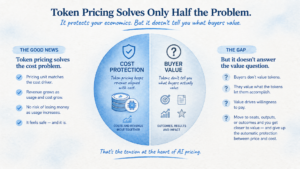
Part 1 covered the cost problem. AI products have real marginal costs, but most companies price them with pure SaaS instincts built for a world where marginal costs were irrelevant. The floor is gone, and most companies have not noticed.
Part 2 is about something harder: the value problem.
Hardware: Value Stood Still
Hardware companies and their buyers both had Product Myopia. The seller thought the value was in the tractor. The buyer thought the value was in the tractor. Neither was right. The value was in better crops, more efficient farming, and a more productive operation. But because both sides anchored on the object, the conversation stayed there.
It did not matter much. A tractor’s value was stable. A tractor that plowed fields this year plowed fields next year. The pricing metric didn’t need to track a moving target because the target wasn’t moving.
Pure SaaS: Stable Value, Forgiving Economics
Pure SaaS sellers were never great at connecting pricing metrics to value. Most defaulted to seats, a proxy for access rather than value. The best companies worked hard to find metrics that correlated with the value buyers actually received. Most companies settled for something good enough and moved on.
Three things made this survivable. Zero marginal costs made bad metrics financially forgivable. Value was relatively stable, so even a sub-optimal metric held reasonably well over time. And the competitive landscape moved slowly enough that companies could experiment their way toward better answers without getting punished for the journey.
The shift from seats to usage took years. Companies had time to watch and adjust. A pricing consultant could come in, do the work, help a company find a better metric, and that metric would hold long enough to justify the engagement.
AI: Every Stabilizer Is Gone
AI products stripped away every one of those stabilizers at once.
Costs are real, as Part 1 explained. But the value problem is more disorienting than the cost problem, because at least costs are measurable. Value in AI is changing faster than companies can keep up.
The type of value being delivered is shifting. Pure SaaS improved known jobs. AI is questioning whether those jobs should exist at all. The move from usage metrics to output metrics to outcome metrics is happening now, while companies are still trying to serve existing customers on contracts signed under the old models.
The competitive landscape compounds the problem. New entrants arrive constantly, each with a different pricing model, resetting buyer expectations before anyone has established a norm. And LLMs are creating a DIY dynamic where buyers can potentially bypass SaaS vendors entirely, building their own solutions. The competitive alternatives are not just other vendors. They are the buyers themselves.
So the value a given AI product delivers today is different from what it was six months ago. And it will be different again in six months. In pure SaaS, you could nail the right pricing metric and ride it for years. In AI, even a perfect answer today may be obsolete before the ink dries.
The Old Solution No Longer Works
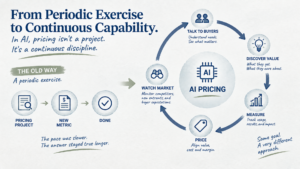
In pure SaaS, pricing was a periodic exercise. When a company felt stuck, it brought in outside expertise, did the discovery work, landed on a better metric, and moved on. The pace of change made that approach possible. The answer stayed true long enough to justify the effort.
In AI, that model breaks down. By the time a pricing project concludes, the value landscape may have already shifted. A metric that was right at the start of the project may be wrong by the end.
AI pricing has to become an ongoing internal capability, not a periodic exercise. Companies need to build the habit of continuously talking to buyers, documenting what value looks like right now, watching how the competitive landscape is shifting, and revisiting the metric as the product and the market evolve. That is a different kind of discipline than pure SaaS ever required, and most companies have not built it yet.
The companies that treat AI pricing as something to figure out once and move on will keep falling behind. The ones that build continuous value discovery as a core competency will at least be asking the right question at the right pace.
My new book, Pricing AI, co-authored with Michael Mansard and Wolfgang Ulaga, goes deep on exactly this. Sign up here to be notified the moment it launches.
A note on process: Every idea, argument, and opinion is mine. Claude made the writing better.
Share your comments on the LinkedIn post.
Now, go make an impact!
 Tags: AI economics, ai monetization, ai pricing, ai value, pricing, Pricing AI, saas pricing, value, value metrics