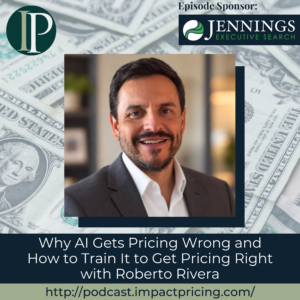
Roberto Rivera is the founder of Pricing Nerd, where he builds AI-powered pricing workflows for B2B companies. With more than 25 years in pricing and experience working alongside some of the field’s early pioneers, Roberto has focused on turning pricing expertise into scalable AI-powered workflows.
In this episode, Roberto explains why simply asking AI “What price should I charge?” produces unreliable answers. AI needs more than business data. It needs the context and pricing skills required to interpret that information correctly.
Podcast: Play in new window | Download
Why you have to check out today’s podcast:
- Learn why AI needs pricing skills and business context, not just more data, before it can produce useful price guidance.
- Discover how to make AI pricing recommendations more trustworthy and defensible using deterministic methods, formulas, and supporting evidence.
- See how AI can help uncover hidden value and margin leakage, from customer value modeling to forgotten contract clauses.
“AI can compile all that information… but at the end of the day, the human and the situation they’re in, they’re going to go with their best judgment.”
— Roberto Rivera
Topics Covered:
01:30 – From Pricing Consultant to AI-Powered Pricing. Discover how Roberto’s 25+ years in pricing led him to build AI-powered workflows designed to help B2B companies turn value into margin at scale.
04:00 – Why AI Gets Pricing Wrong. Learn why asking AI “What price should I charge?” isn’t enough — it needs deep business context and a clear understanding of what pricing actually means inside your organization.
06:00 – Context Isn’t Enough: AI Needs Pricing Skills. Roberto introduces the second critical ingredient for AI-powered pricing: skills that teach AI how to interpret business information and apply pricing frameworks.
08:30 – The 48 Pricing Skills AI Can Learn. Explore Roberto’s concept of pricing skills, from value-based pricing and willingness to pay to customer value modeling and contract analysis.
11:00 – Where AI Stops and Human Judgment Begins. Learn why AI can process pricing frameworks and massive amounts of information, but humans still need to weigh relationships, politics, sensitivities, risks, and accountability.
19:00 – What Happens When Humans Override the AI? Learn how AI can turn pricing overrides into a learning system, using previous adjustments to improve future recommendations.
21:00 – AI as the Smart New Hire for Your Pricing Team. See how AI can combine information from marketing, CRM, ERP, contracts, and customer data to create a defensible pricing recommendation and help less-experienced sellers learn.
26:30 – Don’t Wait for Perfect Data. Start With One Painful Problem. Roberto’s advice for getting started with AI: don’t try to “boil the ocean.” Pick one painful, repetitive pricing problem and use AI to solve it.
29:30 – Roberto’s Final Pricing Advice: Just Start. Why messy data, complex businesses, and internal politics shouldn’t stop companies from experimenting with AI.
Key Takeaways:
“Skills are a massive component of giving the AI the power to not only know about your business, but interpret your business in a way that’s going to produce good and solid price guidance.” — Roberto Rivera
“The beautiful thing that we have, Mark, is that we’ve been in the space for 25, 30 years… and we know what good looks like.” — Roberto Rivera
“You don’t let perfection kind of limit what you think you can do and just begin to experiment and go for it.” — Roberto Rivera
Connect with Roberto Rivera:
- Email: [email protected]
- Website: https://www.pricingnerd.com/
- LinkedIn: https://www.linkedin.com/in/robertorivera-pricing/
- Book: AI for B2B Pricing: Turning Value into Margin at Scale
Connect with Mark Stiving:
- LinkedIn: https://www.linkedin.com/in/stiving/
- Email: [email protected]
Full Interview Transcript:
(Note: This transcript was created with an AI transcription service. Please forgive any transcription or grammatical errors. We probably sounded better in real life.
Roberto Rivera
In addition to that context that you need to be able to provide so you can teach AI your business, the other piece you need to do in parallel is give it the skills it needs to learn how to interpret that information that you’ve given it access to.
Skills are a massive component of giving the AI the power to not only know about your business, but interpret your business in a way that’s going to produce good and solid price guidance.
[Intro]
Advertisement
Today’s podcast is sponsored by Jennings Executive Search. I had a great conversation with John Jennings about the skills needed in different pricing roles. He and I think a lot alike. If you’re looking for a new pricing role, or if you’re trying to hire just the right pricing person, I strongly suggest you reach out to Jennings Executive Search. They specialize in placing pricing people. Say that three times fast.
Mark Stiving
Welcome to Impact Pricing, the podcast where we discuss pricing, value, and how buyers decide. I’m Mark Stiving. I help companies turn hidden value into willingness to pay.
Our guest today is Roberto Rivera.
Here are three things you want to know about Roberto before we start. He is the founder of Pricing Nerd, love the name, building AI-powered pricing workflows for B2B companies.
He spent more than 25 years in pricing. I went through his list on LinkedIn. Oh my gosh, he’s worked at every pricing firm you could imagine.
He recently wrote AI for B2B Pricing,Turning Value into Margin at Scale, and I believe it’s about to release because he showed us his author’s copy the other day.
Welcome, Roberto.
Roberto Rivera
Thank you so much, Mark, for having me. It’s an honor and a pleasure.
Mark Stiving
That’s going to be fun. I hope so. Well, I hope it’s going to be fun. We’ll find out.
So let’s start with this. How did you get into pricing if you can remember that far back?
Roberto Rivera
I can. I actually can. I captured it in the book as well, in the acknowledgments, because it’s so vivid on my mind.
But I was doing my MBA class at a college not too far from where SPG had its headquarters back in the day when they were first starting.
And my marketing professor that was my pricing professor invited Reed to come in, Reed Holden, co-founder of SPG (Strategic Pricing Group) to come in and talk a little bit about pricing to the pricing, MBA pricing class.
And that was, you know, Reed is very charismatic. I’m sure you, you know, and a lot of the folks in the pricing space know he’s a great speaker. He really grabs your attention and it really sparked the curiosity from that moment on.
And I was very lucky that I was very close to where the SPG offices were. And I put in my resume after I graduated with my MBA. And I was very fortunate, very lucky to be hired and being brought in as their first analyst, supporting the consulting team, supporting the senior consultants.
At that time, SPG was very small, but very senior.
So as an analyst, it was just a great opportunity to learn and contribute and get into the pricing world. And that’s how it all started. That was back in 2000.
Mark Stiving
I have to say, I am jealous of anybody who’s gotten to work with Tom Nagle. I’ve known him my entire career, known of him my entire career, and I finally met him a year ago at PPS.
He was on the podcast a year and a half or so ago, fascinating, love talking to him.
So I’m always jealous of people who get to work with him.
Roberto Rivera
Yeah, it’s just an amazing experience working with Tom and Reed, George Cressman.
I don’t know if you know George as well, but it was such a, how you call it, like a brain, like a think tank of early pioneers in value and value-based pricing that came together.
You know, 30 years ago and I was able to join them, you know, 25 years ago. And the SPG family remains very well, very strong.
Everybody has gone different routes, different ways, but we all seem to connect and get in touch and we try to see each other once a year. And that’s another, you know, piece of the story of the book. was Tom was in town. He’s now living in Miami. He was in town visiting Boston and we all wanted to celebrate having Tom around.
And so we put together a little party through Lisa Thompson. I don’t know if you know Lisa. And we met at her house and I said, okay, I’m going to be meeting Tom. I’m going to, I have an early version of my book. And if it passes the sniff test from Tom, I’m going to keep going.
So that’s how this came to be early in the summer. A great conversation with Tom really is what got this book where it is now.
Mark Stiving
Nice. Well, let’s chat a little bit about what’s in the book. First off, I’m going to ask you the same question I asked you before I hit record.
And that is, tell me what the book’s about and you get one whole sentence.
Roberto Rivera
All right. So AI for B2B pricing, turning value into margin at scale is really how AI helps organizations all the way from establishing value and the list price to getting to the invoice price and to ultimately getting to that pocket price and pocket margin by leveraging the power of AI, by automating certain pieces, not necessarily automating, but informing certain pieces that help the organization keep more of the value it creates into its pocket.
Mark Stiving
Okay. So first off, I love the topic. And so what you’re doing is using AI to help companies learn how to price better or to set better prices.
So aren’t you worried that AI changes so often and has so much more capability that tomorrow it’s going to be different and your book’s going to be obsolete?
Roberto Rivera
I do worry about that, but not necessarily for the changes of the technology. It’s more worry about how am I making sure I am utilizing those changes in the best way possible.
So a big way of thinking about AI for purposes of setting better prices, of defending value more effectively, you have to harness it, you have to put a structure around it. and give it as much context as you want.
And that’s not going to change whether you have a new LLM that’s five times more advanced than the current LLM version, you have a new Astro version of ChatGPT that’s better than the Fable 1 version of Cloud, that context window, that information that enables the AI to make better decisions because it knows your business better at a deeper level, I don’t think that changes.
I don’t think that changes regardless of how quickly the technology changes. I think the context window can be a little bit bigger. There’s some issues with LLMs being able to remember what you’ve taught them.
So if they can remember things better and more clearly, those are going to be the things that I’m going to try to stay on top of and try to harness as much as I can.
Mark Stiving
So I love the concept that says what we’re really trying to do is teach AI of some sort about our business, right? What our context is, what our business is.
Let me toss out a theory that I’ve had of AI recently, and I’d love to hear your thoughts since you wrote this book. And that is, you could go ask Claude today, hey, what price should I charge? And it’s going to be horrible.
The answer is horrendous. And I’ll argue – first of all, I hadn’t thought of the fact that it doesn’t understand my business very well, so I think that was a great answer. But I’ll give you a different answer that I also think is true, and that is AI doesn’t really know what pricing means.
And I say that because as I look at all the different pricing professionals, all the different people who write about pricing and talk about pricing, we don’t agree what pricing means, right?
We don’t agree what definitions of terms are and what the right process looks like and how are you actually going to optimize this.
And all AI can do is read all the stuff that we’ve written and try to make sense of it. And I don’t know that anybody could make sense of it. Yeah, yeah.
Roberto Rivera
Yeah, so in addition to that context that you need to be able to provide so you can teach AI your business, the other piece you need to do in parallel is give it the skills. Give it the skills it needs to learn how to interpret that information that you’ve given it access to.
So skills is a massive component of giving the AI the power to not only know about your business, but interpret your business in a way that’s going to produce good and solid price guidance.
So a major skill, you know, I break up the book into what I’m calling the value to pocket operating system and through every stage from value to list price, there’s a skill or there’s a set of skills that need to be there to really help the AI understand your value positioning in the marketplace, how you quantify value. That’s where the Tom Nagel work comes in, EVE, economic value estimation, customer value modeling.
So you have to train the AI to be able to understand how your organization creates value for customers and how to quantify that. That’s a core skill all the way to the bottom of the waterfall of being able to implement a contract clause that it was part of the agreement that you made with a customer but once the contract was signed it was filed away and nobody remembered to check that there’s an escalation clause. that if the price of gas goes up to $4 a gallon, you should be able to charge for freight charges or for delivery charges.
But everybody forgets that, you know, once the contract is signed. But the AI now has the skill to read through contracts and understand which clauses impact pricing. And you should be monitoring those clauses continuously because if things change and if you don’t act on those clauses, you’re leaving money on the table. You’re leaving margin where you could have recouped some of that.
So it’s all a series of skills, maybe 30, 40, 50 pricing skills. I have 48 in my website, pricing skills that any good pricer should have in their back pocket and know how to apply them. Those can be put into the AI as well.
Mark Stiving
And so I want to, when you say the word skills, are we talking about a skill that a pricing person should have? Or are we talking about a skill the way AI and I can teach Claude a skill?
Roberto Rivera
Well, I’m talking about more in the context of AI, of this notion of skills. It’s kind of like a fundamental piece of how you get the most out of your AI, whether it’s Claude, whether it’s ChatGPT, you have that skill.
But I think it also applies to all of us, right? There are certain concepts, frameworks that we know are best practices for how to set pricing. You know, whether it’s value-based pricing, whether it’s, you know, using big data to calculate pricing power and willingness to pay, you know, and kind of testing those models. We know there are some really interesting capabilities out there that If we’re in a pricing role and we want to contribute to our organization’s pricing capabilities, we should know those skills.
And that’s where we go to PPS. That’s where we go to, you know, these type of forums, you know, podcasts and stuff like that to pick up. on that knowledge and LinkedIn, you know, rich in articles on how to do this, how to think about this for pricing.
And those are all skills that humans, all of us that are in pricing and want to do well in pricing should really learn and absorb and apply as much as we can.
Mark Stiving
Nice. And so I want to go back to the point I made a second ago. It seems to me that what you just described is you’re going to show people how to do pricing the way you know how to do pricing. I’m sorry.
You’re going to show people how to teach AI to do pricing the way you know how to do pricing. Yes. And I’m going to tell you that I do pricing differently than you do.
Roberto Rivera
Yeah, and I’m saying what you should do is rely on the best practices out there.
You know, what are the best frameworks out there that are tried and tested and documented? And, you know, there’s books written about it.
And there’s there’s a lot of context to use as a starting point. You also know that pricing is messy. Pricing is very contextual. It’s relationship-driven. It’s situational.
Mark Stiving
It’s political.
Roberto Rivera
It’s sensitive. It’s all these things, and there’s an art and a science to pricing.
All I can do is give the AI and myself the best practices and the science, and also convey, hey, where’s the art piece? So users understand that if we’re talking about value-based pricing, that’s one thing.
Are we talking about how much of that value we want to capture with this particular customer in this particular negotiation when we have missed, you know, three, we’ve been late on three shipments in the last five months and it’s cost them millions of dollars because we haven’t been able to deliver.
That context is going to be the judgment and the accountability of the human that AI will never be able to replace.
So AI can compile all that information. It can give you all the tricks and then how to communicate and how to position things. But at the end of the day, the human and the situation they’re in, they’re going to go with their best judgment, balancing the politics, balancing the sensitivities, balancing the risks, balancing all these elements to make the best possible decision for the company and the customer.
Mark Stiving
Yeah. So I’m going to slightly change topics on you. I’ve been using AI for three years now, dearly love it. And then at the exact same time, I hate it. And I hate it because I’ve been using it for three years. It knows it should know the way I think, and yet it’s constantly wrong.
I find it amazing that it really doesn’t think like I do, even though I’ve been using it for three years. So first off, why is that? Is it just that I don’t use it well enough? What do you recommend people do? And actually, I’m going to tell you one more quick story or quick anecdotal way to think about it.
When I ask it pricing questions, I know that it’s wrong because I happen to know the answers. And yet when I ask it something random, right? I’ve got a skin rash. What’s my skin rash? I tend to believe it. And so it’s this dangerous thing that says, look, I know you’re wrong when I know the topic, but when I don’t know the topic, I believe you.
Roberto Rivera
Yeah. Yeah. So there’s a couple of ways to improve that.
And one is, I think AI has gotten better at remembering. It doesn’t remember every conversation, but it can be taught through a skill And through, you know, you, you need to kind of create the skill and you need to give it context of how you think, how you write, how you process the world.
You know, if you feed it more information is going to know more about how you think, and it’s going to be more effective. It’s getting better. Every model seems to be a little better. Although, you know, I think there’s some debate on that because some people are saying, I think Cloud was a little bit better a few months ago than it is right now. It’s really slow now and it’s it doesn’t seem to be as good. But anyway, so I don’t know what’s going on behind the scenes, but it is that you can make it better.
You can make it work better for you if you are willing to kind of spend the time training it. Not everybody has the time for that. The beautiful thing that we have, Mark, is that we’ve been in the space for 25, 30 years, for however long, right? And we know what good looks like, right? And that is such a fundamental piece that you can train an AI because you know what good looks like.
You know, you have the scar tissue of implementing stuff that didn’t quite work and that memory is not going to go away. You know that you’ve tried something before, it didn’t work and if AI says try this, you know it’s not going to work because you’ve done it before.
So that’s what gives us folks, you know, 30, 25 years in the field, the ability to say, Hey, can we build something? Because we know what good looks like. That’s going to help the next generation of pricers. So they don’t have to kind of figure out too many things on themselves.
Although I would encourage them to also learn. what good looks like by making the mistakes we made, right? So that’s kind of where I go on the medical side. Hopefully, you’re not relying on just, but you can triangulate.
Mark Stiving
I just use medical as an example. It’s true with everything, right? Yeah. I bought a raincoat the other day and I asked you what raincoat should I buy and it told me and I bought it. I trusted it.
Roberto Rivera
Yeah, well, you’re going to learn and you’re going to make some mistakes and you’re going to adjust because that’s how we all learn. We all make mistakes along the way.
Mark Stiving
I think the point that I try to pull away from AI, and I don’t know if you mentioned this or teach this to people as you talk, and that is use it as a first pass answer, but don’t necessarily trust it. I rarely trust what I get.
Roberto Rivera
Yeah, so my take is, how do you make it trustworthy?
And the way you make it trustworthy is you don’t let it, when it comes to pricing, right? You don’t let it guess. You don’t let it go and search the web and give me the answer, right? You’re gonna teach it. You’re gonna be very deterministic. When I’m asking you what should be the price for widget X, AI, the AI that you’ve now trained with skills and you’ve given it the information and the context it needs, it’s going to use a deterministic method of inputs and formulas and math to come up with an answer, and an answer that makes sense for the business. And that’s how you begin to trust it. Right.
Because it can and because it’s so powerful and computation is so cheap, it’s going to give you different perspectives. Right. It’s going to give you the price based on this math is X. The price based on this math is X. And it’s also supported by the 10 most recent deals that we closed.
And it’s all supported by how this customer buys and how much value we have produced for this customer over the last six months.
So it’s beginning to build from different areas, a briefing or a repertoire of information that the seller, the commercial team, the pricing team, the deal desk team should be able to trust. Now, again, whether the team says, I’m gonna trust this fully and I’m gonna go with this answer, that’s up to them, up to their judgment, up to the information that they have.
But what you want to do is make it as effective as possible. And if it’s not as effective as possible, and that price needs to be overridden by the human, the learning system that you build into the AI kicks in. So the AI is going to learn that this particular recommendation for this customer didn’t fly last time.
So the next time it’s asked to provide a recommendation, it’s going to remember that there were some adjustments that had to be made, and it’s going to hopefully account for some of that. So that’s my long-winded answer to that.
Mark Stiving
I actually love the answer. In fact, what I like the most about that answer was if I had to give a price to a customer for a product at a specific point in time, I love the idea that the AI gave me the price, but I can ignore that.
That doesn’t matter. It actually gave me the entire justification for why it created that price. To me, that’s fascinating because I now don’t have to go search for all the different pieces or say, I wonder if this was important.
Then I could imagine that I could say to myself, look, AI didn’t consider the fact that it’s my brother-in-law. Exactly.
So I change the price and AI should come back and say, okay, why’d you change the price? Yeah. Oh, because it’s my brother-in-law. He’s going to get a good deal from me, period, right? Exactly. And so now the AI can learn.
Roberto Rivera
Yeah, absolutely. It’s such a big piece of being able to provide value, right?
You can think of the AI as the really, really smart new hire that It’s going to learn your business really quickly. It can now gather information from the marketing side of things, CRM side of things, ERP side of things, contract side of things, put it all together in one place, provide really good context, really good, good arguments for why the prices, you know, this should be a defensible price. but it’s also going to be open to learning.
The other piece I love about AI in this context is that it doesn’t judge you. If you’re like a new seller for an organization, large B2B organization, you might be a little hesitant to go to the experienced seller down the desk because he’s really busy trying to get a deal out. and you don’t want to bother that person, but you can surface that guidance from the AI and you can learn from how AI thinks and whether that makes sense.
And if you don’t know an answer and you want to know more about why the AI developed this recommendation, you can begin to have a chat with the AI so you can learn more about the business, learn more about, and it’s easy, the cost of asking questions It’s not going to cost you reputation. It’s not going to cost you.
There’s no judgment there. It’s all math and it’s all logic that’s helping support you. That’s another reason why I think AI has a role in supporting commercial teams and deal desk teams and pricing teams.
Mark Stiving
It’s nice. Nice.
Okay. So first off, I want you to know that I love what you just talked. You know, I loved our entire conversation. The fact that we’re going to use AI to help develop the skills or automate what pricing people could do relatively quickly. And so I think that’s all awesome.
Now I’m going to push back on the very beginning of this whole trail, and it’s the part where I spend almost all of my time thinking, writing, etc.
And that is, companies are absolutely horrible at knowing the value that they deliver to customers. And so it seems really hard for me to say, hey, we’re going to give you a price at the end until I’ve figured out the beginning. I’m just going to let you pontificate on that for a second.
Roberto Rivera
Yeah, so again, it boils down to having the framework, right?
If you want to do value-based pricing, you need to be able to quantify the impact that your solutions, that your organization, that your ability to hold inventory, to do rush deliveries, whatever it is, right?
That impact has on your customer’s business. AI has the skill to help you get started down that path. It can create a value model. Whether you like it or not, right?
Because it can say, okay, you can unleash it a little bit more for the purposes of value-based pricing, right? Not for the purposes of a deterministic pricing based on this segment, this data, what should be the price, but for purposes of value-based pricing, you can ask the AI, How does AI procurement, and this opens up a new kind of worms, right? How does AI procurement value my offering, my solution, right?
And AI is going to have an answer for that, right? It’s going to go and search Reddit forums. It’s going to go out and search industry publications.
It’s going to go out and search your website, your competitor’s website, and it’s going to come back with, hey, this is where I think customers procurement would rank you from a value and price perspective.
And these are the really strong value drivers that customers look for when they purchase these type of solutions. you know, less rework, less downtime, less waste, whatever those things are.
And if you’re not communicating that value to the marketplace, the AI is going to tell you that your price value relationship is off relative to your competitors.
So then you have a choice. You have a choice of, okay, do we want to be more proactive and start getting better at understanding how I deliver value to customers?
Hey, we just invested millions of dollars in this new ERP system that cuts errors by X percent. How come the AI is not gathering that? Because we’ve been able to reduce our shipment errors by X so customers don’t have to return stuff and they don’t have to wait for new deliveries to show up. There’s a lot of value in that.
And if the AI is not capturing that, it doesn’t understand that it’s up to you to say, Hey, we need to, we know we’re producing a lot of value for our customers. We need to start putting that on paper and sharing that with customers and making that part of our value based pricing process, which is such a, you know, foundational starting point for managing pricing and margins and stuff like that.
Mark Stiving
All right, Roberto, this has been a lot of fun. We’re gonna have to wrap it up.
Let me ask you the final question. Yeah. What is one piece of pricing advice you’d give our listeners that you think could have a big impact on their business?
Roberto Rivera
The one piece is don’t wait for everything to be perfect, right?
Companies say our data’s too messy, our business is too complex, our people are not on board with everything we wanna do from pricing, it’s too political. Those are just excuses that I think keep people from really leveraging this new amazing technology that we have at our disposal that can be life-changing and can be game-changing for organizations.
So I would encourage people to go for it, you know, just take a piece.
Don’t do, we have to boil the ocean. You have, you know, take a piece that’s really painful. you know, reconciling invoices to shipment records, to contract clauses, you know, painful work that produces reconciliation variances and stuff like that, that can be automated and can be made a lot easier by using a technology like AI.
So don’t let perfection kind of limit what you think you can do and just begin to experiment and go for it.
Mark Stiving
So would your book help me do this in the following way? You said you listed 48 different skills. What if I just want to automate one skill? Do you teach me how to do that?
Roberto Rivera
Yeah, the book gives you a framework for how to go about all the different skills that you can, that AI could help you execute to help you improve margins and drive your pricing process. It’s up to you to, you know, which one you want to start with first.
Probably the easier is, Hey, if we can just get contracts, we just get invoicing out the door better. So we don’t have to like re-invoice and rebuild customers. If we can just fix that, that’s going to save tons of time from finance headaches and pricing headaches and stuff like that.
And it’s like a low hanging fruit type of stuff. A lot of value there. The book focuses, you know, a couple of chapters just on that piece to help you think about that.
Mark Stiving
Perfect. Roberto, thank you so much for your time today. If anybody wants to contact you, how can they do that?
Roberto Rivera
So best way, my email, robertoatpricingnerd.com. I think it’s an easy email to remember. I’m happy to answer any questions, share more insights about the book and kind of where my thinking is on AI and how I’m keeping up with all the changes out there that are fascinating.
Mark Stiving
Nice. And to our listeners, thank you for your time. If you enjoyed this, would you please leave us a rating and a review? And finally, if you have any questions or comments about the podcast, or if you want to see value through your buyer’s eyes, email me, mark impactpricing.com.
Now, go make an impact.
Advertisement
Thanks again to Jennings Executive Search for sponsoring our podcast. If you’re looking to hire someone in pricing, I suggest you contact someone who knows pricing people. Contact Jennings Executive Search.
[Outro]