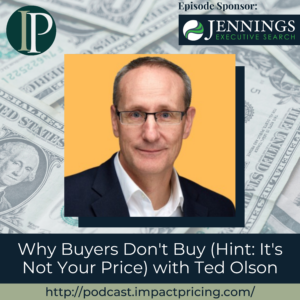
Most sales conversations assume buyers make rational decisions. Ted Olson argues that’s exactly why so many deals stall.
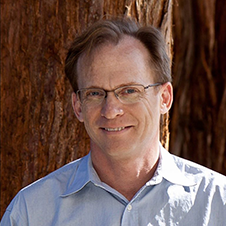
Ted Olson is a sales strategist who helps founders, consultants, coaches, and sales teams use behavioral science to improve how buyers make decisions. He is the author of Feel Good About Selling and the upcoming book, Distinct, where he explores what happens between a buyer saying, “This makes sense,” and actually saying, “Yes.”
In this episode, Ted and Mark challenge one of sales’ biggest assumptions: why buyers hesitate. Is it fear or a lack of confidence? Their lively debate uncovers what really drives buying decisions and how sellers can help buyers confidently say yes.
Podcast: Play in new window | Download
Why you have to check out today’s podcast:
- Learn why buyers hesitate and why it often has nothing to do with your price.
- Discover how great salespeople build buyer confidence instead of pushing harder to close.
- Understand what “We’ll think about it” really means so you can reduce hesitation before objections show up.
“Indecision is fear-based. Status quo is fear-based. If you can address that fear, you can double your close rates.”
— Ted Olson
Topics Covered:
02:05 – Are Buyers Rational? The Psychology Behind Every Buying Decision. Are buyers driven by logic or emotion? Ted and Mark debate how buyer psychology, perceived value, and decision-making influence pricing more than most companies realize.
05:45 – Buyers Buy Futures, Not Features. Learn why listing more features rarely wins deals. Discover how buyers imagine future outcomes and why too much information creates uncertainty instead of confidence.
09:10 – Why Buyers Say, “We’ll Think About It”. Is it really about price? Ted explains why buyer indecision is usually driven by fear and uncertainty, not budget or competition.
13:30 – Buyer Confidence vs. Buyer Fear. Mark introduces his Buyer Confidence Framework—payoff, probability, and anticipated regret—while Ted argues that every hesitation can be traced back to fear.
17:15 – Handle Buyer Objections Before They Happen. The best salespeople don’t overcome objections—they prevent them. Learn how anticipating buyer concerns early makes closing feel natural.
23:00 – Stop Building Trust. Start Building Buyer Confidence. Ted introduces his new sales philosophy: Always Build Confidence. The goal isn’t getting buyers to trust you—it’s helping them trust their own decision.
26:20 – Why Buyers Push Back When You Try Too Hard. Learn how psychological reactance causes buyers to resist pressure, urgency, and traditional sales tactics—even when your solution is the right fit.
30:05 – How to Become the Obvious Choice. Ted shares the PACE Framework (Positioning, Authority, Conversion, Expansion) and explains how experts become the first choice before pricing is even discussed.
32:45 – What Really Shapes Willingness to Pay? Does willingness to pay come from ROI alone? Ted explains how context, experience, status, and perceived risk dramatically influence what buyers are willing to spend.
Key Takeaways:
“If we think about pricing purely rationally, we’ll miss the mark 100%.” — Ted Olson
“Buyers buy when they feel safe enough to buy.” — Ted Olson
“When I train sellers, I don’t think about making them better sellers. I think about making them better decision-making coaches.” — Ted Olson
People & Resources Mentioned:
- Matt Dixon & Brent Adamson – Authors of The JOLT Effect, referenced for their research on reducing buyer indecision and limiting information overload.
- Alex Hormozi – Mentioned in relation to identifying every reason prospects hesitate to buy.
- Charlie Munger – Referenced for his perspective that value can be viewed as reward divided by punishment (or risk).
- Zig Ziglar – Mentioned during the discussion about helping buyers understand their own problems more clearly.
Connect with Ted Olson:
- Website: https://tedolson.com
- LinkedIn: https://www.linkedin.com/in/tedolson/
Connect with Mark Stiving:
- LinkedIn: https://www.linkedin.com/in/stiving/
- Email: [email protected]
Full Interview Transcript:
(Note: This transcript was created with an AI transcription service. Please forgive any transcription or grammatical errors. We probably sounded better in real life.
Ted Olson
Indecision is fear-based. Status quo is fear-based. You know, we think about it. We’ll let you know. They’re not thinking about it rationally. They’re not going to let you know. Those are just, I can’t do this right now. I can’t handle this.
And I would argue that underneath that is unaddressed fear. If you can address that fear, you can double, double your close rates.
[Intro]
Advertisement
Today’s podcast is sponsored by Jennings Executive Search. I had a great conversation with John Jennings about the skills needed in different pricing roles. He and I think a lot alike. If you’re looking for a new pricing role, or if you’re trying to hire just the right pricing person, I strongly suggest you reach out to Jennings Executive Search.
They specialize in placing pricing people. Say that three times fast.
Mark Stiving
Welcome to Impact Pricing, the podcast where we discuss pricing, value, and how buyers decide.
I’m Mark Stiving, I help companies understand and shape their buyers’ willingness to pay.
Our guest today is Mr. Ted Olson.
Here are three things you want to know about Ted before we start. Ted Olson helps founders, consultants, coaches, and sales teams apply behavioral science and buyer psychology.
He is the author of Feel Good About Selling and is preparing to release Distinct, How Experts Become the Obvious Choice.
And Ted spent more than two decades studying how buyers actually make decisions and translating behavioral economics into practical sales and marketing frameworks.
Welcome, Ted.
Ted Olson
Thank you, Mark. Great to be here. Looking forward to talking with you.
Mark Stiving
I’m very much looking forward to this. Any of my normal listeners would know that I’m not a huge fan of behavioral economics, but I am an addict at understanding how buyers make decisions. And so I think this is just going to be an absolute blast of a conversation.
So let’s launch with an easy question. Are buyers rational or irrational?
Ted Olson
I would say it’s a yes and, but I would say when it comes to pricing and decisions, there’s a lot more happening in the primal brain than most people realize.
And if we think about pricing purely rationally, we’ll miss the mark, 100%.
Mark Stiving
Well, I would certainly agree that there are many, many, many ways that we can present pricing in a bad way, and it just turns people off. We don’t win the deal at all.
So there’s no doubt there’s psychological aspects involved here. But my gut says that companies are horrible at actually understanding the value side, right?
If we can split a purchase up just for the sake of argument for our conversation today, let’s call it value and emotional. Is that okay? I mean, I don’t wanna belittle the emotional side, but I want the side that’s non-value related.
Ted Olson
Sure, yeah. I think of, I mean, I’m a Charlie Munger fan, so I think of value as reward divided by risk, or he would say reward divided by punishment, right? That is value.
And I think most folks spend the time on the reward side and then, you know, show numbers, show data, show specs and stats and payoff.
And all of that is good, but if you haven’t addressed the risks, None of that matters or it falls short.
Mark Stiving
Yeah, I totally agree.
But part of the problem with defining value that way is me as a pricing guy, I’m trying to figure out what the price is and price is part of the penalty. Right.
And so if I were doing an ROI calculation, what I would say is the reward is my incremental profit. The price is the cost or the investment.
And so that’s how I do this ROI. And so I can’t include price in that calculation if I want to figure out what the price should be.
Does that make sense?
Ted Olson
You’re the pricing expert.
And I’ve heard a little bit about, I’ve heard that a little bit before. Where my mind is going is It is possible to make price a no-brainer. It is possible to create an offer that you would be silly not to take up.
And that requires a series of emotional and primal brain thinking to pull that off. If we try to do it just rationally, it won’t land.
But you can make the rational argument that, hey, I can save you, you know, 10x. but you need to do this, this, and this. Well, this, this, and this may have a series of things that could put that person at risk, could make them feel uneasy, could make them look bad, and then trying to push that with urgency tactics.
Basically, the marketing playbook that I see run is reward, reward, reward, and then if that doesn’t work, discount.
And that is so silly.
It’s like if you stop and just think strategically about how people make decisions and how you can make them feel safe.
When I train sellers, I don’t think about making them better sellers. I think about making them better decision-making coaches. I think about helping them understand how buyers actually experience the process and what it’s like to be on the other side of them so that they can see that for themselves and change their behavior, change their words, change their language, change their approach almost entirely.
Typically, it’s like, yeah, all of that stuff the way you used to sell, some of it’s still effective.
Most of it actually needs to be tossed out and we need a completely new approach.
Mark Stiving
Yeah, what’s funny is as I’ve read some of your content, I actually don’t think we disagree as much as I’m gonna pretend that we disagree.
So one of the ways I think of buyers making decisions, a purchase has three different phases associated with it.
And those three phases are, I call them notice, decide and commit.
So I have to notice I have a problem, I go out and figure out what’s the best solution to my problem, and then am I actually going to buy the darn thing?
Am I going to put the money down and buy it? And when we get to that last phase, one of the things that really plays a big role, I call it anticipated regret.
And I’ve heard you say the word safety. Is it a safe decision?
And so I think we’re probably perfectly aligned in that aspect of that decision. How can I actually make this final decision?
Ted Olson
Yeah, I was talking with a, I was actually training a group of salespeople, and they said, hey, Ted, how would you handle this objection? They always like to do that to sales trainers. How would you do this? How would you do that?
And he said, I’m at the end stage. It’s been months of preparation, and there I am in front of the board, the CEOs there.
And at the end, they said, wow, you’ve really given us a lot to think about. We’ll get back to you. And so he said, how would you handle that objection? How would you handle that response?
I said, I wouldn’t get that response. He’s like, well, what do you mean? He’s like, well, I’m getting the sense that you went there and you just showed up and you threw up. You just threw everything at them.
And I’m a big fan of Matt Dixon, Brent Adamson from Challenger Sale, from Jolt Effect. And I don’t know which one of them said it, but it wasn’t me, but it’s this idea of limiting the flow of information. I think they both say it.
Definitely in the Jolt Effect. Definitely recommend that book for any buyer, any seller out there. I’m sorry, any seller out there. Buyers too, if you want.
But this idea of limiting and controlling the flow of information so that you don’t overwhelm the buyer.
Because if you overwhelm the buyer, no matter how great the value is, you lose that deal because they get frozen. It’s too much to, they may even lose the value.
And that’s going to create too much risk because you made it unsafe.
If you say, hey, you know, typically in your situation, there’s three considerations, you know, Mr. or Mrs. CEO, or, you know, folks at the board.
One, two, three. Those are the big three. If you want any more, I’m happy to provide it.
Mark Stiving
Yeah, so here’s how I think about what you just said. And by the way, I agree 100% with it.
And that is that buyers buy futures, not features. So every time you give me a feature, every time you give me a product, what I have to do is I have to translate that into what does that look like in my future?
Ted Olson
And so if you give me more and more- Yeah, that sounds like, Todd, what’s his last name? He’s always talking about history. I think you’ve had him on your show before. Oh, yes.
Buyers buy when they can predict. I would reframe that a little bit because I think it’s a bit more primal. Buyers buy when they feel safe enough to buy, right?
And that prediction does speak to that, which is why at the beginning I say, you know, is it rational? Is it emotional? It’s yes and, it’s both. But we spend so much time on the rational thinking rationally that it just makes sense. It makes sense to you, but you have to understand it from the buyer’s perspective.
Mark Stiving
God, what’s so funny is I think the opposite, that we don’t spend enough time on the rational.
Ted Olson
Say more.
Mark Stiving
So if I were to define value for you, I define value as the result of solving problems. Okay. And I think so few people, so few companies even understand what problems they really solve for their customers. How could they possibly help customers figure out what the value is? And yet we worry about, you know, am I presenting it with a nine on the end?
Or am I using good, better, best? Or, right, it’s really, hey, have you really understood what your buyers care about? Because they’ve got a problem that they’re trying to solve.
Ted Olson
Sure, sure. And that smart pricing you were talking about, I think there’s a different word for it, but ending in nines and ending in fives. Yeah, yeah.
And the options. you know, providing people options. Those are helpful tactics and those are rooted in behavioral science. People get it. They’re much more likely to remember the first number versus the last number.
You know, the Apple, I call it Apple pricing, you know, good, better, best. I think those are impactful, but I don’t know if that’s complete, Mark, to push back to say that.
Because I’ve done discovery calls, deep discovery calls, and I’ve done discovery events, going into an organization, spending weeks uncovering, unpacking what’s going on, and showing them the true problem that needs to be solved, and then putting a figure against that.
And that didn’t necessarily move the needle. It didn’t get the deal done.
There are other things that need to happen than just showing people that this is the problem.
And it is, I would say it’s three things. I would say number one, you have to identify the problem. So congratulations, you’ve just landed there. Like a lot of sellers never get there.
They’re still tip of the iceberg. They never get underneath the surface.
Step two is what is the business impact of that product, of that problem?
So yeah, so you’re losing, you know, 50 people a year in your organization. How does that impact the organization from a morale standpoint, from a business standpoint, from your customer’s perspective, from your reputation?
Once you calculate all that, that’s step two.
Very few sellers get there.
Step three is prioritization. And I only know only the top 1% get there.
So hey, just because you’ve identified a problem, just because you know that it’s costing the organization doesn’t mean it’s the closest crocodile. It doesn’t mean that that’s the most important thing.
There are CEOs who are like, we’re okay with that fire right now. That’s fine. We’ll deal with it.
So a seller has to tie that prioritization to one of the top three things in the organization.
If that doesn’t happen, the value or the price doesn’t matter because it’s not important. It might matter later when it becomes important, which is why it is so that prioritization component is an emotional component.
Hey, we’re too busy right now, overwhelmed right now, focused right now. Those are emotions. That’s not rationale.
I mean, you can make the argument, hey, this is what we rationally need to focus on as a business, but they’re worried about their survival. That’s fear.
And if you can’t help them survive, then your value doesn’t have the value that it needs.
But if you can tie your solution into the problems they’re trying to solve, your value becomes almost a no-brainer.
Like, this just makes total sense.
Mark Stiving
What I love about what you just said is the first three quarters of it were words that could have come out of my mouth, right? I mean, they were absolutely beautiful.
And then you got into the fear part. And by the way, I don’t disagree with the fear part. What I disagree with is that, and I think we think the same thing, we just say it differently, is that that’s psychology, right?
I don’t think it’s fear, it’s prioritization. The CEO said, these are the three important things, go work on them, go fix them.
And so where the CEO came up with them and where the VP took it and ran with it, and where the director took that direction and ran with it, it’s these are the priorities, what are we going to drive?
And so I totally love the word prioritization that you came up with. I just don’t know that I buy the fear side.
Ted Olson
So let me put it another way, and I agree with what you’re saying. I’m not disagreeing, and maybe we are saying the same things in different ways.
I remember, and this might come from Hormozi, Alex Hormozi, from one of his books. And he talks about this idea of list every single reason. This is a great exercise for anybody who sells anything. List every single reason why somebody wouldn’t buy from you. Like that’s an important exercise because what you’ll realize as you’re doing this exercise, just how much fear is actually there.
And once you do the exercise, now you can go back to your message, to your product, to your marketing, to your sales motion, and you can say, hey, are we addressing this? Are we addressing this?
Because it’s not just that they’re afraid of the price, it’s that they’re afraid of looking bad. They’re afraid that it’s gonna take too long. They’re afraid it’s not going to work. They’re afraid they won’t get adoption.
They’re afraid that because you’re new, that you haven’t been proven, tried and tested.
So are you addressing that on the front end? Because if you don’t, it’s going to hurt conversions, it’s going to hurt downstream.
So that would be one way of saying, is it all about fear?
No, but is there a lot of fear there that is probably not being addressed and therefore costing you deals?
100%.
I just did an analysis of a large organization, 200, well, midsize organization, 200 employees. They’re trying to figure out what are they losing deals to?
As we looked at, okay, you’re losing deals to indecision. Overwhelmingly. It’s not price, it’s not competition, it’s indecision.
Indecision is fear-based. Status quo is fear-based. You know, we think about it, we’ll let you know. They’re not thinking about it rationally. They’re not gonna let you know. Those are just, I can’t do this right now, I can’t handle this.
And I would argue, that underneath that is unaddressed fear. If you can address that fear, you can double, double your close rates.
Now, I’m quoting Jolt Effect here, which is top sellers who address indecision, and I would say who addressed the fear.
Average close rates for SaaS, 26%.
Average close rates for top sellers, 57%. That’s not a bump.
That’s a different category. What’s your thought there? Push back.
Mark Stiving
So I actually love everything you say except the word fear, if I can say that.
Here’s why. I think that last decision requires confidence, right?
If I’m going to lose to indecision, it’s because my buyer didn’t have the confidence to make that decision, to make that commitment.
And so I think of confidence as having three big components to it. Those three big components are the payoff, so think of that as the value, the probability, what’s the likelihood that I think I’m actually going to achieve that, and then the one that you’ll love is anticipated regret.
If this goes wrong, how bad do things look? Am I going to lose my job?
Is the company going to go under? And so addressing those three aspects help buyers gain the confidence to make that final commitment.
Now, would I call any of those fear? I might go with anticipated regret and call that fear, but I would say the big thing you described was uncertainty. Careful or uncertain. And so if I’m uncertain, I’m less likely to make the decision, less likely to make the commitment.
Ted Olson
Yeah, I think where we align with one another is probably around this idea of anticipated regret. In my sales framework, I talk about this idea of when it comes to objections.
The first thing when it comes to objections is avoid them, meaning that you’re probably creating them, right? So most objection handling techniques are actually tactics to undo the mistakes that you made. The next thing is actually anticipate them.
And that’s where I would maybe add another layer to your anticipated regret. I think we need to anticipate those regrets way earlier.
So front end, we need marketing to provide the air cover to anticipate those regrets so people come in feeling safer.
And let me say it in other words, people come in less fearful and more open.
So you could reduce fear with humor, right? That lowers fear.
You can reduce fear with one of my favorites, costly signaling. So years ago, remember we used to buy cameras, like the expensive ones in the store and you have to go to a camera store? We’re old enough to remember that.
Nowadays, it’s all on your phone.
So I went to buy a camera and I went in there with the intention of buying a top of the line camera and thinking maybe I could haggle down the price a little bit.
You know, sales guy, always thinking I can try and get a better deal.
And the salesperson looked at me and said, hey Ted, I love what you’re trying to do, but based on what you’re telling me, you don’t need this top of the line model.
In fact, this one at half the price will do exactly what you want. Now I bought that immediately. because he reduced all fear, he reduced all what you call anticipated regret, because I’ve just saved half my money and that cost that seller something.
They put skin in the game when they did that. That was a signal to me that they’re safe. I can trust this person, and that gave me the self-confidence to just make the decision. It was a no-brainer decision. If we spent our time just on that alone when it comes to pricing, we would sell more.
So that’s, I think, another layer to this idea of anticipated regret. How far can you back it up in the sales process? And I’m arguing right out of the gate.
Mark Stiving
Yep.
So by the way, I love that story. I love the costly exchange.
Can I give a different interpretation to what just happened?
Ted Olson
Please.
Mark Stiving
So my viewpoint of the world is that salespeople have to build trust. Absolutely. And they build trust by helping buyers understand their own problems better than the buyers understood their problems.
Ted Olson
Yeah, that’s a Zig Ziglar kind of a way of thinking about it. And he’s not wrong. I agree with you. I would say that that’s not the buyer’s job. The buyer’s job is not to build trust.
It’s to build self-confidence in the mind of the buyer.
Mark Stiving
Totally with you. Totally with you.
Ted Olson
So we grew up in a world of always be closing, right? ABCs. My ABCs, and I’ve been thinking about this, I was like, oh my goodness, about two years ago, maybe even longer now, we need a new ABCs for selling.
And it’s exactly what you’re saying. Always build confidence. That’s what a seller needs to do. And it’s not confidence in you.
Mark Stiving
No, not at all.
Ted Olson
It’s confidence in themselves to make the decision. So when that seller said, hey, Ted, you don’t need that. You only need this.
I had the self-confidence to say, oh my goodness, absolutely right, and I’m off to the races.
I think that is often missing. I think the second one, we want to throw out another one, is psychological reactants, one of the most misunderstood components of selling.
You may have the best product in the world. You may have identified exactly what your buyer needs. You may have quantified. So identify, quantify, prioritize. You’ve got all three.
But if you don’t understand psychological reactants, meaning the triggers that could unintentionally subvert your effectiveness, you will lose.
And I don’t know, maybe only the top 1% know it, even understand what that actually means.
So psychological reactance is this idea of, if you have kids, And you tell them it’s bedtime, right? Young kids, tell them it’s bedtime.
Every single night, it’s like, ah, you know, it’s like, it’s like brand new. It’s like, you know, or it’s time to brush your teeth.
Nobody wants to be told what to do. No one wants to be forced into a corner and trapped. And most sales approaches, that’s exactly how they’re built. Corner them. Sell me this pen is literally a cornering exercise.
And when a wild animal feels trapped, In a corner, what do they do? They lash out, they assert their freedom, they fight back, and that’s what’s happening in buyers.
So it’s almost like you could put all of the rationale or even the emotions to price to one side.
If you’re triggering psychological reactance, all of your value is going out the window and they’re like, yeah, I’m just gonna go with somebody else entirely.
Mark Stiving
Nice. And I’ll just leave it at that. You know what I really want to ask you about? Go. I want to know about your new book. Yeah. Tell me how I can be the only expert.
Ted Olson
Oh, so this is the idea of, yeah, making yourself the obvious choice.
And, you know, I’ve read a lot on behavioral science, and I love these books.
Like, I could probably list 10 of them right now.
But they’re all very, they give great examples. And the examples are, you know, of Red Bull and Liquid Death and Dyson. It’s like, hey, those are great examples, but what about the experts?
What about folks like Mark Stiving who are trying to grow their business?
And I have the good fortune of working with some of the world’s top consultants. And I have seen them struggle with selling.
I’ve seen them struggle with marketing.
So the idea for this book was What if I created them, what if I basically told their story, right?
You are the hidden gem out there, but nobody can see you, understand you, and even if they do and they get to you, you have a hard time closing them and then winning that client.
What if I wrote a book specifically around that? And then the idea became, well, what do you need to do to do that?
Like, what are the go-to experts doing? And the one word that came to my mind was, they are distinct. They do things differently. They’re not out there chasing everybody and being louder.
I didn’t want to write another, here’s how to attract your clients book. Oh, that’s certainly a piece of it.
But how do you make yourself so distinct in the market that people come to you?
People ask you to have a conversation. That’s what the book is about.
Mark Stiving
Okay.
And so how do you do that? You’re not giving me the pointers here. I got to walk away with the gold.
Ted Olson
So the goal would be, yeah.
So I have a framework and the framework is called PACE. P-A-C-E. PACE stands for how are you positioned in the market? Right. Very important.
And most are positioned poorly in the market. They’re just, they sound like everybody else.
You know, you’re using AI to write your copy and guess what? You sound like everybody else. You’re using AI to write your pitch or your pitch decks and you sound like everybody else.
And you’re not understanding what’s truly unique about you.
So that’s positioning. Authority.
So the book is broken into four sections and I’m in the thick of it right now. It’ll be ready by September. That’s my goal. That’s when I launched Feel Good About Selling in 2022. September something in 2022.
I’m going to try and do the same thing in 2026.
So the next is authority. So a lot of people actually undermine their authority by the language they use.
My favorite is you are a consultant who charges, you’re at six-figure engagements, you’re charging $700 an hour, and your domain name is something, something, something, something, something, hyphen, something.net. You know what I mean?
It’s like, spend the 10 grand and get yourself something that has some gravitas.
Put out materials that are worthy of who you are. Come up with a framework that’s uniquely yours.
So mine is the PACE framework.
So that’s authority. And then conversion, so C stands for conversion. You’ve positioned well in the market, you’ve got authority, you’ve got people coming to you now because you’re an authority in the market, how do you convert them?
So now we’re going back to some sales basics, leveraging, basically, I would say it’s expert level selling, but you can do it even if you’ve never sold before.
So that’s everything from how do you start a sales conversation, how do you lead them forward, how do you move them down the path, And then lastly is expansion.
So now that you’re positioned well in the market, you’ve got authority, you’re converting well, how do you expand?
And how do you expand in a way that you want to expand?
So, you know, the gurus out there will say, do this, do this. It’s like, well, what do you want? What are your life goals?
One of my favorite examples comes from Luke Nettie. He’s on LinkedIn, check him out, he builds websites.
And I think he only has five clients at a time. And I love that because the reason he only has five clients at a time is because one of his priorities is time with his family.
And when he takes on more clients, he loses that time.
And then what happens is, so now his family is suffering, but then quality can suffer.
So I think we have this idea that we should just suddenly take on all these clients if we can.
But the reality is if you can’t continue to execute quality, now your authority starts to drop. And if you don’t have all four of the PACE framework, it’s like a table and your table’s gonna tilt and it’s gonna rock and that doesn’t feel good for your potential buyers.
So that’s a little bit of the outline of the book.
Mark Stiving
Nice.
And so do you feel like you’re changing topics or are you just applying what you know to a specific market segment?
Ted Olson
You know, I think that when it comes, so there’s a lot of behavioral science that I’m going to insert into the book. That’s leverageable from the expert standpoint.
And I don’t believe that’s being done very well today. Most behavioral science lives in marketing. And it’s traditionally used to, I think in worst case scenarios, manipulate.
In the best case scenarios, it would be to intrigue, right?
In selling, it’s almost non-existent.
And you have to look for it. And so what I’m trying to do is give the expert, the coach, the consultant, the small business, the behavioral science that they can leverage in a practical way.
Because, hey, it’s great that Red Bull is using the red sneakers effect. How do I do that?
It’s great that these organizations are using tools like the isolation effect. How do I do that?
And so I’m trying to bring it down to a level that people can grab onto and say, oh my goodness, I get it now.
And now I also see where I was doing it probably in a way that was hurting my deal. It was pushing my prospect away, or I was undermining my own value.
So that’s the idea.
Mark Stiving
Nice, nice. So I’m gonna ask, I have two more questions I wanna ask you.
One of them, I’ve never asked anybody before, and I don’t even know my own thoughts on it very well, but I’m gonna ask a weird question.
And that is, what is willingness to pay? Because willingness to pay is not a constant.
Ted Olson
Yeah, willingness to pay.
I feel like behavioral science has got a good answer on that.
So when you go to the movies, your willingness to pay for popcorn changes dramatically, right?
Like if you walked into the grocery store to buy, you know, a bag of popcorn, you’re gonna wanna spend five or six bucks.
But if you walk into the movies and it’s a bucket of popcorn, what is it, like 15 bucks now?
It’s like, it’s some insane amount of money.
I would say willingness to pay is probably tied to experience.
So a gallon of, not a gallon, a thing of ice cream cost anywhere from three bucks on sale to seven bucks, right? 6.99 or something like that.
And you could feed your whole family, you know, an ice cream and an ice cream cone for less than 10 bucks. But when we go out as a family, so I have four kids, and if we go out as a family, I’m spending, you know, five bucks a kid, you know, that’s 20 bucks plus me and my wife, you know, it’s 30, 40 bucks with a tip for ice cream.
The willingness to pay is because of the experience.
This is off the cuff, Mark, so I think that’s a great question, but I think context is going to dictate the price.
And a lot of what good selling does is it lays out the context.
Hey, here’s your context, right? You’re losing here. You have an opportunity to impact here.
You have an opportunity to make an impact over here.
Yeah, so that would be my one thought.
Another one that just sprung to mind I think can be helpful is value is, most people think of value as ROI.
I can give you five value statements that only one is ROI.
So if I’m talking to the C-suite, absolutely ROI. But another thing they care about, time, saving time.
Another thing they care about, mitigating risk, fear, right? Another thing they care about is leverage. How else can I use this?
So they’re thinking strategically. And then the other one, brand and reputation. How can this make us better?
Status, right?
So all five of those, and that comes from a seller, and I can’t remember their name. I didn’t come up with that.
So I quote them if I could, I just can’t remember. You know, you read so many sales books over the years, you’re like, I don’t remember who said what, but very little of it is original.
But I think that’s important when it comes to thinking about value and willingness to pay.
Because one more story, and I don’t know where we’re at for time, but I used to fix cars for a living. And it’s where I learned to sell.
And one of the things I learned was from an owner of a Mercedes-Benz. His car, when it went over a bump, it went, and it needed like a weird part, a bushing that I couldn’t get.
And so I said, Hey, I’m just going to lube it up for now. Hopefully that’ll, that’ll help.
It’s probably not going to be perfect, but you know, come back and we’ll let you know when the parts and I’ll put it in. You’ll be fine.
He was pissed. He’s like, no, just keep it and let me know when it’s fixed. I don’t want to pull into the club, right?
Here we go, ready for status. I don’t want to pull into the club going over the security bump and having going, in my S-class. That was a lesson learned, right?
So willingness to pay is like, I’m willing to wait, Ted, charge me whatever you want.
Let me know when it’s done. As long as I don’t pull into that club and my car goes, I’m happy.
Mark Stiving
So I want to remind you of something I said earlier, and that is value is the result of solving problems.
This guy had a problem that he wanted solved.
Ted Olson
100%.
Mark Stiving
Absolutely right. This has just been an absolutely fascinating conversation. I’ve enjoyed it immensely. Thank you so much.
If anybody wants to contact you, how can they do that?
Ted Olson
Yeah, reach out on LinkedIn. I’m fairly active there. You can also go to my website, tedolson.com.
Mark Stiving
Excellent. And to our listeners, thank you for your time today.
If you have any questions or comments about the podcast, or if you want to understand and shape your buyer’s willingness to pay, feel free to email me [email protected].
Now go make an impact.
Advertisement
Thanks again to Jennings Executive Search for sponsoring our podcast. If you’re looking to hire someone in pricing, I suggest you contact someone who knows pricing people. Contact Jennings Executive Search.
[Outro]