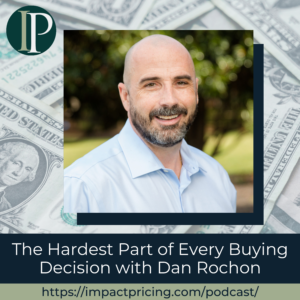
Dan Rochon is the creator of the Teach to Sell methodology and host of the No Broke Months podcast, where he teaches professionals how to build trust and influence without pressure.
Buying isn’t usually the hard part. Committing is.
In this conversation, Dan explains why buyers often hesitate at the final moment, even after they’ve decided what they want. Mark challenges Dan’s ideas on buyer psychology, emotion, and trust, leading to a fascinating discussion about what really happens between deciding and saying yes.
Podcast: Play in new window | Download
Why you have to check out today’s podcast:
- Discover why commitment is the hardest part of every buying decision.
- Learn how trust helps buyers overcome fear and hesitation.
- Understand why buyers don’t just compare prices—they compare risks.
“Logic makes you think. Emotion makes you act.”
— Dan Rochon
Topics Covered:
02:10 – Why Buyers Don’t Decide With Logic Alone. Dan explains why emotion drives buying decisions long before logic justifies them.
04:04 – The Emotional Side of Every Buying Decision. Why even B2B buyers are motivated by trust, confidence, and how they’ll be perceived.
08:13 – Every Purchase Is a Prediction. Mark shares his buying framework and Dan explains why people move away from pain faster than they chase desire.
12:14 – Are You Selling an Aspirin or a Vitamin? The difference between solving painful problems and fulfilling aspirational desires.
14:05 – The Hardest Part: Saying Yes. Why buyers hesitate at the moment of commitment—and how to help them move forward with confidence.
17:17 – Teach to Sell, Don’t Pressure. Dan introduces his trust-based approach to guiding buyers instead of convincing them.
23:41 – Ask Better Questions, Build More Trust. How deep, thoughtful questions uncover what buyers really care about.
25:01 – Ethical Influence vs. Manipulation. The simple mindset shift that separates helping buyers from persuading them.
29:22 – Dan’s Pricing Advice for Every Business. How awareness, positioning, and the right buyers make premium pricing possible.
30:51 – The One Mindset Every Sales Professional Needs. Why serving the buyer’s goals—not your own—is the foundation of ethical influence.
Key Takeaways:
“It’s about identifying what their pain is and what their desire is, then demonstrating that you are the bridge.” – Dan Rochon
“The difference between manipulation and ethical influence is whose goals you’re serving.” – Dan Rochon
“Leadership is to teach somebody else how to think so they can get what they want.” – Dan Rochon
Connect with Dan Rochon:
- Website: https://teachtosellbook.com/
- LinkedIn: https://www.linkedin.com/in/danrochon/
Connect with Mark Stiving:
- LinkedIn: https://www.linkedin.com/in/stiving/
- Email: [email protected]
Full Interview Transcript:
(Note: This transcript was created with an AI transcription service. Please forgive any transcription or grammatical errors. We probably sounded better in real life.
Dan Rochon
So logic makes you think, emotion makes you act.
And when you understand that as a service provider, and then you understand and say, well, how do I get into that emotion? It’s about identifying what is it that their pain is internally and externally. What is it that their desire is internally and externally, and then demonstrate that you are the bridge in between that pain and that desire.
[Intro]
Mark Stiving
Welcome to Impact Pricing, the podcast where we discuss pricing, value, and how buyers decide.
I’m Mark Stiving, I help companies understand and shape their buyers’ willingness to pay.
Our guest today is Mr. Dan Rochan.
Dan Rochon
Thank you. Thank you very much.
Mark Stiving
I just found that button on Riverside. I’m going to use it every week from now on. That was awesome.
Dan Rochon
Mark, you’re supposed to say that you’re using that for me specifically.
Mark Stiving
Oh, no, no, no, no. What it really is is I have an audience full of people here that just applauded you.
Dan Rochon
Thank you. Thank you, audience members.
Mark Stiving
So here are three things you want to know about Dan before we start.
He is the creator of the Teach to Sell methodology, which helps professionals lead conversations without pressure. He hosts the No Broke Months podcast on decision-making, influence, and trust in high stakes environments.
And he’s on a mission to help a million people sell without selling by teaching influence, decision-making, and trust-based communications.
Welcome, Dan.
Dan Rochon
Thanks, Mark.
Mark Stiving
Hey, how was that intro? Was it close?
Dan Rochon
I love the applause was my favorite part of the intro.
Mark Stiving
I meant one of the details.
Dan Rochon
Oh, the details, who cares? As long as people clap for me. Yeah, the details are great, Mark.
Mark Stiving
Nice, nice. Good, good.
So just to set this up real quickly, as a pricing guy, I focus a ton on willingness to pay. How much is a buyer willing to pay for something?
And when you really start to think about willingness to pay, that comes down to, well, how the heck are they making a decision?
And so that’s really where we want to start or launch our conversation today. What’s the big misunderstanding that we as companies have, that salespeople have about how buyers make decisions?
Dan Rochon
Well, first of all, before we get to the actual decision making point is the understanding, because I think this is relevant to the question, that there’s always somebody that will pay a million dollars to do whatever it is that you do.
Now, that being said, there only may only be one, right?
And so to be able, how do you get to that one? It’s about envisioning is the level of awareness of whatever my product and service is, is it wide enough?
And two is the value of my product or service worth it.
So for example, I’m a big football fan.
So Washington Commanders, that’s my team. They’ve always been my team. And I bet you that there’s a million dollars that somebody would pay to sit on the bench during a football game, a live football game and call the place.
Now, I don’t know if they would sell that, right. You know, cause that’s a little bit, you know, tricky. Right. But I know that there’s people that would pay a million bucks. And so why is that?
Because when I say the Washington Commanders, you know, I’m talking about, I know I’m talking about the net is wide enough. There’s enough people to have an awareness of that. Then is the value.
Well, the value of that for me, I’m not taking a million dollars of my life earned savings from my RRAs and investing on that on a two plays, but, if I had, you know, a billion bucks in the bank, Mark Bezos may say that in a second.
I mean, in fact, he may even buy the team who knows. Right. So it’s about understanding that there’s always a customer or a client that’s going to pay you the price that you want to charge. How do they make that decision? It’s going to be emotion.
So logic makes you think, emotion makes you act.
And when you understand that as a service provider, and then you understand and say, well, how do I get into that emotion? It’s about identifying what is it that their pain is internally and externally.
What is it that their desire is internally and externally, and then demonstrate that you are the bridge in between that pain and that desire.
Mark Stiving
Okay. I love that answer for many, many different reasons, mostly because I could disagree with something.
Dan Rochon
I told you, I’m going to throw tomatoes at you if you disagree with me today.
Mark Stiving
That’s okay. That’s okay. So we often hear this, by the way, I’m an engineer at heart, which means you have to know that I love logic. Sure. But I get it that, and I’ve heard a million times, decisions are made emotionally and justified logically. I would agree with that. And so to me, that makes a lot of sense.
And so I would have put logic at the end. By the way, you’re in real estate, right?
Dan Rochon
Well, I may, yeah, maybe, maybe I misspoke. Logic is emotion first, logic second.
Mark Stiving
Oh, okay. Okay. Dang it. I can’t disagree.
Dan Rochon
I’m taking my tomatoes. I’m putting it back in the crate. Yeah.
So it is, decisions are made emotionally and then they’re justified logically.
Mark Stiving
Yeah. Okay. I could buy that.
And so, I’m going to struggle with this for a little bit.
In the world of B2C, I could absolutely see decisions being made mostly emotionally and justified logically.
In the world of B2B, although individual employees act emotionally, just like a B2C consumer would, The company itself structures itself so that, hey, we don’t want these emotional decisions to be made.
We want, you know, we’re going to put an RFP together. We’re going to put a buying committee together. We’re going to do these things to force logic to drive the decision as opposed to emotion.
Dan Rochon
Yeah, well, it’s only part of the story.
So let’s say you’re on a committee and you have a boss and your job on that committee is to make a buying decision.
And you’re going to make that buying decision based off of the numbers, as you just mentioned, logically. All right. If you stop there, then you may perceive that that decision is being made logically.
Yet we don’t stop there because if you’re the head of that committee and you have a boss, how do you want to be perceived from your boss?
You want to be perceived from your boss that you’re somebody who’s valuable, that somebody who’s smart, somebody that’s a doer, somebody who could get stuff done. Is that logic?
Or is that emotion, right? You want to be able to be perceived within your organization as somebody that other people could feel good about. Okay.
So it’s still the driving force of why are you using that logic to be able to make a buying decision as an entity? All right. There’s still emotional components of it, whether that be a boss or whether that be colleagues, or may that be subordinates or that be the marketplace, you still want to look good.
Mark Stiving
Yeah.
So by the way, I agree a hundred percent. And when I say employees act like B2C buyers, that’s exactly what I mean. Right.
I’m buying because I want to feel good. But in the end, I’ve got to justify my decision with a business case.
Dan Rochon
Right. And that’s why they go together. Right.
But it’s about like, why are you doing what you’re doing? Why are you going to give your, your boss good numbers?
Mark Stiving
Yep.
Dan Rochon
Right. You’re going to give your boss good numbers good again, because you want to look good.
Mark Stiving
I want to be promoted, man. I want to make more money.
Dan Rochon
There you go. Well, that’s a desire. That’s an external desire.
Then it would be, if I was leading you, I’d say, well, Mark, what causes you to want to be promoted? Tell me about that. If you get promoted, then what does that do for you and your family? All right.
And when you get that promotion, does that give you more money, more time, more prestige? And if you have more prestige, what does that do for you? Okay.
So now it’s, if I’m your leader, then I’m leading based off the emotion. I say, okay, well, Mark, if you want that promotion, you got to make sure that we have a 20% margin on the decisions that you make. Logic.
Okay. But I’m still driving a decision based off of what Mark’s needs are. If I was leaving you.
Mark Stiving
Yep. I think we’re totally in agreement on this. Dang it.
Dan Rochon
I really want to disagree with you. Let’s do it, man. I’m ready for it, man.
Mark Stiving
Well, so I want to toss out one of my million philosophies on buying and see how it ties into what we just talked about.
And one of my ways of thinking of this is that all buying is a prediction of the future.
And so every time I buy something, what I’m doing is I’m trying to change something in my present so that I have a different future.
So I’m predicting some future. And so I make a decision based on how confident I am about that future. And so confidence has three big components.
And I want to talk about one of the components, which you just brought up. But the three big components are, what’s the payoff? So am I going to get promoted or not? What’s the probability? So how likely am I going to get promoted?
And then the last one, which you brought up, which I love, is anticipated regret. If this doesn’t go well, how bad is this going to look for me? Right? Am I going to get fired? Is something bad going to happen?
Well, let me toss it out. What do you think of that philosophy? Does it match the way you teach, the way you teach selling?
Dan Rochon
All right, tell me the three again. The payoff, the anticipated regret, what was the middle one?
Mark Stiving
Probability. How likely is the payoff going to come?
Dan Rochon
Got it.
I think that your structure works very, very well. It’s the first that I’ve heard that structure before, so I have to sort of unravel it in my brain, right?
But I would think that ultimately, what causes a consumer to make a buying decision? That, Mark, is probably the way an engineer, right, would process that, okay?
And I would anticipate that maybe 15% of the population processes in that case, right?
So it is still, like, it’s the minority, though it’s relevant to 100% of the population, okay? But to be able to, like, communicate it in a way that you communicate, I would say that there’s a small segment of the population that would communicate it like that, even though it’s relevant and true.
I think the larger population, when you look at that, it’s like, what’s going to cause me to buy?
It’s either going to be something that is just pure fun, right? Like I’m just going to do this because I want to increase the value of my life.
Or it’s going to be something that’s going to be functional, make my life easier. Or it’s going to be something that’s going to bring me joy. That’s an emotional, internal desire.
Or it’s going to be to be able to avoid a pain. All right. So something, I got a rock in my shoe and I can’t get that rock out. I need new shoes. There’s a physical pain. Okay.
So if you understand the way that people make decisions, they make decisions to get out of pain first and to be able to get into desire second, depending on whatever the context is of this.
So if you can imagine you’re sitting in a room right now and a lion jumps through the window, how fast are you running? Like really fast. Okay.
So you’re avoiding, you’re avoiding the pain. Okay. Now, if there is a 10 acre field, 10 miles from your house that has diamonds in it or gold bars, it’s just like this blue, you know, this big, like all types of gems.
And, you know, are you going to be able to sprint from here for 10 miles? You’re not going to be able to sprint at the same level that you just ran away from that lion because you’re not, you physically can’t do it. You have to do so slower and consistently.
So people move towards desire, slow and consistent. People move away from pain fast. Okay.
So I don’t know if I’m answering this from the perspective of the consumer or the, or the salesperson or the, or the leader, but it’s just, it’s the way people make decisions.
So when you understand that, right. And you can identify what is this person’s pain? What are they feeling? What’s the external pain? What do they want? What’s their desire? Now I am the bridge or my product or service is the bridge to be able to get from that pain to that desire.
And that’s the way people make buying decisions.
Mark Stiving
Nice. So I often hear what you just said, talked about in business as, are you selling an aspirin or a vitamin?
Dan Rochon
Yeah. I hadn’t heard that either, but I love it. I love it. I’m learning all kinds of stuff.
Mark Stiving
Well, we come from different worlds, so it’s okay.
Dan Rochon
I know. I know. Yeah. Yeah.
Mark Stiving
So I love the idea that says, but when you started listing your three reasons why buyers buy something, right.
Two of those three, I love and I agree with, I’d never thought of fun before. I think fun is pretty interesting.
I usually think B2C buyers buy based on functional, emotional, or social.
Dan Rochon
Yeah, but emotional fun is emotion, right? Like if I’m a consumer and I’m going to, you know, to the amusement park, I’m paying a lot of money to do that and that’s to have fun or maybe to look good to my kids.
You know, I mean, there’s a lot of different motivating factors behind that.
Mark Stiving
Yeah. Yeah. Okay. Okay. We’ll tie it in there. That makes sense. That makes sense.
So,you’re in real estate, right? I brought that up, but I didn’t hear your answer.
Dan Rochon
Yeah. I’m in real estate sales and coaching and leadership.
Mark Stiving
Yeah. Okay. So the reason I wanted to bring that up is because I just bought a new house.
Dan Rochon
Hey, congratulations.
Mark Stiving
Thanks. I want to tell you the story real quickly.
So it’s a new construction, right? We’re moving back to Ohio. And so we do all the shopping and figure out what we want to buy and blah, blah, blah.
And eventually they send us the contract.
And the moment that you have to sign the contract is a different moment than any other moments, right?
So before I give you my thought, what’s your thought on that specific moment of, okay, I am now signing.
Dan Rochon
I call that the knocking the knees.
So I don’t care underneath the table. So I don’t care how often you’ve bought or sold a home. There’s still a little bit of anxious as I’ve, I’ve bought and sold hundreds of properties and I still have that little shaking of the knees underneath the closing table. Am I making the right decision?
And most buyers and consumers, it’s about, you know, they’re, scared about a relocation, or they’re nervous, or they’re anxious, or they’re eager to get going, they’re concerned about the transition, they’re worried about their kids’ school, apprehensive about a new job.
I could go on and on and on, right? But it’s understanding what’s the emotional need of Mark when he’s signing that paperwork.
So as a service provider, as a real estate broker, I’m going to consult with you on that before it happens, not after or not during.
That’s what Teach to Sell is, by the way. It’s about the predictable problems. I know when Mark is signing that paperwork, you and your partner, wife, whoever, right, or yourself, right?
I know when you’re signing that paperwork, there’s going to be a little bit of like, huh, is this the right decision? Am I going to regret this? Am I making a mistake? That’s not the time for me as a real estate broker to consult you. The time for me to consult you is before it happens and not after.
Because if I tell you that you’re going to have that experience before it happens, and you’re there signing, you’re going to have that thought for a second, be like, Oh, you know what?
Dan told me I was going to experience this and I am. So this is completely normal. And then that’s going to help you.
Two things are going to happen is you’re going to help you to be more comfortable and confident about your buying decision.
But it’s also going to allow for you to develop trust, you know, with me as your leader, as your guide. If I was in that role, you know, as a real estate broker, that’s the way I take on my, my real estate sales.
Like I’m there to lead my clients, to help them understand what their experience is going to be. Okay. And that’s, again, that’s what Teach to Sell is.
Mark Stiving
Yeah. I love the way you described that.
Notice we brought up regret again. And I think regret happens mostly at that moment or just before that moment that says, am I really going to go through with this? Am I really going to commit to this?
Where we’re not focused so much on regret while I’m shopping for a house or I’m shopping for the best solution. Regret happens after I’ve, I’ve made my choice and now I got to commit.
Dan Rochon
Well, it’s commit or quit, right?
Like, so you always have three decisions. You always have the three decisions, which I’m going to commit to an action, or I’m going to quit, like not do the action, or I’m going to get meager results.
Now, because I don’t anticipate and I don’t believe that getting meager results is what I want to be able to help somebody get.
Like, I believe that I have a greater value to the marketplace.
So I’m completely fine if you ultimately, if you consider all your options, say, you know what, Dan, I don’t think this is right for me. Great. Quit.
Or. Hey, you know what? I’m having some fear. I’m a little bit excited. I’m a little bit anxious. I don’t have certainty for the future.
So I have the role, you know, to be able to sit there and say, well, Mark, let’s talk about that. And again, talk about it before it happens. Okay.
So that now you’re in a position to say, well, I may have a little bit of discomfort, a little bit of unease, yet I’m a hundred percent all in. I am doing this. I am moving to Ohio. Okay.
Like my family deserves to move to Ohio and regardless of if I’m afraid of that or not, this is what’s happened. Now you have that faith and now you as the consumer, your process becomes easier and easier to make decisions.
Mark Stiving
Nice. Nice. Absolutely love that. Tell me about Teach to Sell.
By the way, I love that title. I think it is awesome.
Dan Rochon
Thank you.
Yeah, Teach to Sell is a book that I authored. It’s the second book that’s being published by Postal Press distributed by Simon & Schuster.
And what Teach to Sell is, it’s about being able to guide people. You know, it’s not about pressure, right? You know, selling is not about pushing features. It’s about guiding buyers to outcomes that they care about.
It’s about positioning your product as the bridge between their current frustration, that’s the pain, and their desired result.
So that buyers feel confident that they’re making the right decision and they’re not being sold to. And that’s what Teach to Sell is.
It’s about ethically influencing others to be able to guide them to get what they want so that they can achieve the goals that they desire.
Mark Stiving
So I think that’s the absolute right answer. Do you study, say, the challenger sale? Do you know how it’s different? Have you thought about that?
Dan Rochon
Do I challenge their sale?
Mark Stiving
No, no, no. Have you heard of a sales technique called the ‘challenger’ sale? I have not. Okay. Got it. It’s pretty big in high tech and B2B space. Sure. I was just curious. Okay.
Dan Rochon
If it’s big in your industry, then I give it kudos.
Mark Stiving
No worries. No worries. No worries.
No, I was just, I was just curious because I, I’m trying to understand what you’re teaching that’s unique and interesting. So I dearly love the topic and the thought process.
Dan Rochon
Thank you. It’s about understanding that you have to use rapport as influence, build connection before you’re discussing price or features. you know, marrying their tone in their emails or their calls. These are just tactics, right?
And understanding that trust reduces frictions around pricing objectives.
So I want you to do me a favor. And so this is for your audience. If you’re not driving a car right now, unless it was one of those Tesla automated cars, I want you to pay attention to me.
And I want you to think back to a time in your life where you had a favorite teacher, a favorite coach or a favorite guide.
And I want you to think back, close your eyes if you can, and see that person walking into the room, hear their voice, feel the way you felt when they believed in you.
Now imagine, so if you have your eyes closed, go ahead and open your eyes. Imagine that that person walked into your room today and they gave you advice.
The question is, would you follow it?
My belief. And when I’ve asked that question of thousands and even tens of thousands of people that I haven’t gotten a single no of, I wouldn’t follow if I trust them, right?
If I believe that they have a competency, whatever it is that they’re guiding me on. And so that’s a demonstration of teach to sell that maybe for you or I, You know, for me, 30 or 40 years ago, for you, five or 10 years ago when we were in school, you know, that somebody guided us and they didn’t teach us algebra or math or how to play football or cheerlead, but they probably did that too. They helped us solve a problem. Okay.
So they helped us with our lives. Okay. And that ultimately is how you ethically influence, because that person you thought of just a moment ago, they cared for you so deeply that they remained embedded in your psyche and your DNA and your, who you are all the way until you just heard me ask you the question to identify them.
Mark Stiving
Okay. You just emotionally captured me.
But now I’ve got to ask the logic question, how do I do that, right? So I’m a salesperson, I’m meeting someone for the first time, I want them to learn to trust me. How do I do that?
Dan Rochon
I’m going to give you three steps. One, two, three. These three steps is called the CPI communication model, consistent predictable income.
Step one, be in rapport.
Rapport is a connection of two individuals of our energy. Okay. It’s understanding that I can connect with you energetically. You can connect with me energetically, and I could do that by really just paying attention to you. And when I pay attention to you at some point in my body, I have this feeling of connection. That’s when you know you’re in rapport.
Step two, after I feel that connection in my body, when you and I are connecting, ask adept questions.
And adept question is designed to be able to uncover what’s really the deep meaning of whatever it is that is bothering you, or whatever it is that you want to achieve, or whatever the case may be.
So step one is to be in rapport.
Step two is to ask in-depth questions.
Step three, actively listen. What are you listening to? What are you listening for? You’re listening for the energy that’s connected between you and I.
So let’s say that there’s two consumers. One’s a husband, one’s a wife.
And you say to that husband and wife, you say, Hey, let’s go back to your, you’re married, Mark. I think you’re married, right?
Mark Stiving
Yes.
Dan Rochon
What’s your wife’s name?
Mark Stiving
Carol.
Dan Rochon
Carol, Mark. And I say to Carol and Mark, I say, Hey, you’re talking about signing that contract for that new home build.
And I’m the representative at the new homes. I say, Carol, Mark, do you want to buy this home? And Carol says, woo, yes. And Mark says, uh, yes. Okay.
So, step one, be in rapport. Step two, ask adept questions. Step three, actively listen.
When I’m actively listening to Mark’s, uh, yes, then I’m going to immediately say, what’s causing you to say no, Mark?
Not a single time have I said that has that person responded to me and said, well, I just said yes. What happens is they stop dead in their tracks and they think, and then they answer the question of what’s actually, they’re saying no, and they don’t even realize that they physically, verbally said yes. But they energetically said no. 100% of the time, when I’ve asked that question, when I’ve seen that, that person responded with, well, here’s what my concern is.
Not a single time did they say, well, I just said yes, because it was a tepid yes, it was a reserved yes, it was a fearful yes. It wasn’t a yes at all, because I’m actively listening.
Mark Stiving
Nice, and so your thought here is that, by the way, this is something I would be horrible at,
Dan Rochon
Well, I don’t, I don’t like that affirmation, but I’ll roll with it.
Mark Stiving
Your thought here is that I build trust by essentially connecting with the individual.
Dan Rochon
Connecting with the individual, but that’s the only piece of it because they remember there’s so depth questions. They’re deep diving questions, right? Absolutely.
Mark Stiving
Absolutely. That’s where the great questions.
Dan Rochon
Right.
But it’s not just great questions. It’s, it’s tell me more about that. What’s important to you about that? When you achieve that, you know, what does that do for you and your family when you’re in Ohio? Okay.
Are you closer to your grandkids? Are you able to be able to get help from your kids? Are you able to be able to interact with your family or your friends? What does that do for you? Right? Those are the deep dive of questions.
They’re not the questions of three bedroom, two bath with granite countertops. And that’s where a lot of salespeople get stuck at. They get stuck at the surface level questions. They don’t deep dive asking in-depth questions.
Mark Stiving
Yeah. So it shows that you care about your buyer’s outcomes.
Dan Rochon
That is what ethical influence is. That’s what Teach to Sell demonstrates. It’s about ethically, if you want to know how to ethically influence, that’s Teach to Sell.
And so what’s the difference between influence so you can have manipulation? And you can have ethical influence. They’re both influential.
The difference is, am I influencing Mark for Mark and Carol’s goals? Or am I influencing Mark for Dan Roshan’s goals?
Because if it’s about me, it’s going to be manipulation. If it’s about you and your beautiful wife, it’s about ethical influence.
So it’s about the way that you frame the conversation of, you know, who’s going to benefit from the outcome now. If I can’t help you, then I’ll just say, I can’t help you.
Mark Stiving
Yep.
Dan Rochon
You know, and that’s fine.
And that you only have the right to be able to do that. So if you have enough business in the pipeline, which is entirely different conversation, right.
You know, which I go through that in the book as well, you know, how you get all those people in your pipeline, but that’s how you earn the right to say, no, I, Hey man, I can’t help you.
Mark Stiving
Can I just say, I think that what you just said is probably the most important thing we talked about today. Thank you.
And that is the attitude with which we’re going to do this conversation. I thought it was an applause. Oh, hang on one second.
Dan Rochon
Oh, sorry, Mark. I’m sorry. I slowly stepped right. You had such a brilliant point and I just stepped right on it. Go ahead. Sorry.
Mark Stiving
No, no, no.
So, so I think the attitude with which you go into the conversation makes all the difference in the world. Am I here to help you or am I here to make money for myself?
Dan Rochon
Yeah. Yeah. It’s vital.
Mark Stiving
Yeah, I think that that’s huge.
Now, when I teach how to build trust, I actually do it differently. I have a different process or different thought process. I don’t disagree with anything you just said, though.
I mean, I think everything you said was brilliant. But when I think about it, I think about it as I’m going to help my buyer understand their own problems better than they understand their problems.
Dan Rochon
My definition of leadership that I talk about in the book is leadership is to teach somebody else how to think so that they can get what they want.
If you’re in a sales role, you’re really in a leadership role.
And so we go back to the real estate as an example. I’ve never had a buyer hire me. They didn’t want to buy a home. I’ve had many buyers early in my career that hired me and did not buy a home because they let their fear get in the way.
And once I discovered that, then I realized that, okay, my job as a service professional is to help Bob and Jane to be able to let that fear get out of their way because we wouldn’t be having this conversation. if they didn’t ultimately want to buy them, unless something changed, they lost a job or something like that, that’s circumstance, right?
But they’re not going to hire me if they don’t want to do it. So my job is to help to discover the value and the benefit of taking the action and helping to guide them through that fear in despite of it.
Mark Stiving
Yeah, I absolutely love that.
I think we talked about this slightly, but my three phases of buying are notice, decide, and commit. Someone has to notice they have a problem, and then they say, I’m going to go figure out what’s the best solution to my problem. And then I’m going to go make, I’m going to sign the contract. I’m going to make the commitment and actually buy the thing.
And so I think, at least in my world in B2B, we often think because they are deciding, right, because they’re searching for a solution, that they’ve already committed to the solution.
But that actually isn’t true. Right. The fact that they’re in the process says that something caused them to put in that effort. Yeah. They need help to get over that commit phase.
Dan Rochon
Right.
And understand we go back because a lot of what I’m talking about is like business to consumer and you’re talking business to business. And I’ll go back to the beginning. If you’ve lost the app, if you turn it in as a midstream, go back to the beginning of the conversation where we demonstrated already that even, you know, there’s people that you still helping people, you know, you still have a desire to look good and all that type of stuff, right?
So when you’re talking to somebody, they very likely have identified that they either have a problem or they have a goal.
And that doesn’t matter, B to C, B to whatever, right? And now, are they ready to make the buying decision? Maybe, maybe not. Is money going to be an issue? Maybe, maybe not.
Is result and outcome going to be the issue? Maybe, maybe not.
But all those are sort of, they’re relatable. Okay. Because if you told me, Dan, if I can help you get $10 million of revenue in the next 30 days, if you invested a million dollars into this product or service, if you could demonstrate to me with certainty, like a thousand percent certainty that it’s going to happen.
Okay. I’ll go borrow a million bucks from the bank today. Why would I not do that? Okay.
So understanding that it’s not always money decisions because of the value is extraordinary enough. The money decisions go away and people figure it out. Okay.
So again, it’s just understanding the way that people make decisions.
Mark Stiving
Yup. Dan, I could sit here and talk to you for hours.
This is just fun, I gotta say. Really enjoying it. But we’re out of time, we’re gonna have to wrap it up. Can I ask you the final question?
And we haven’t, we barely talked about pricing today, but I’m gonna ask you a pricing question. Sure. What is one piece of pricing advice you would give our listeners that you think could have a big impact on their business?
Dan Rochon
Consider what, you know, we’ve already said, you know, consider about like, is your funnel wide enough? Do enough people have the awareness?
If enough people have the awareness, then do you have a system or a model to be able to get, you know, the right people, like sort of shaking it down the funnel, the decision makers, the people that have the need, that have the money.
Do you have enough people at the top of the funnel to be able to get enough of the right people at the bottom of the funnel?
And then you basically, you shake that funnel and you There’s a gentleman, a great marketing guy named Perry Marshall, who has a book called the 80 20 something.
And he talks about racking a shotgun. And the story that he says about racking a shotgun in that book is that if you’re in Las Vegas and you hear this like ratchet of a shotgun, it’s going to gain a few people’s attention in that card room because they know what that sound is.
And you’re going to see the poker players when they hear that shotgun rack, you’re going to see a bunch of eyes go up and then some eyes won’t go up because now you know who your consumers are. Okay.
So those eyeballs that go up in that poker room, that’s your consumer. Okay.
So now as you, as a business professional, B2B, B2C, whatever the case may be, you’ve got to figure out how do I rack that shotgun to be able to get the awareness of my consumer, of my actual target and what’s the action to do.
And that would be my advice for you.
Mark Stiving
Nice. Nice. Love it.
Dan, if anybody wants to contact you, how can they do that?
Dan Rochon
I invite for you to visit www.teachtosellbook.com to become a part of the tribe and the mission to be able to help a million people to have no broke months and to be able to understand how to ethically influence. So that’s teachtosellbook.com.
Outside of that, Google my name, Dan Rochon.
If you find a hockey player with missing teeth, that is not me. I’m the other Dan Rochon. Make a friend with me on social and I’d love to be able to connect with you.
Mark Stiving
All right, Dan, thank you so much.
And to our listeners, thank you for your time.
If you enjoyed this, would you please leave us a rating and a review? If you have any comments or questions about this podcast, or if you want to get paid for value that your buyers can’t see, email me, [email protected].
Now, go make an impact.
[Outro]