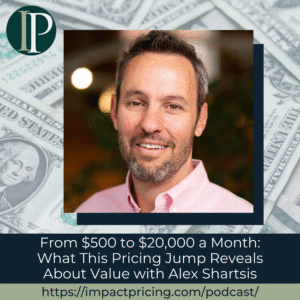
 Alex Shartsis is a pricing and go-to-market advisor who helps founders charge what their products are actually worth. He is the CEO of Silverwood and Skyp, working with early- and growth-stage companies on pricing discipline, packaging, and monetization.
This episode explores why charging too little early is one of the most expensive mistakes founders make, including the story of raising a customer from $500 a month to $20,000. Mark and Alex discuss when to raise prices, how early sweetheart deals quietly damage businesses, and why price often signals quality in AI and SaaS markets.
Podcast: Play in new window | Download
Why you have to check out today’s podcast:
- Understand why early underpricing creates long-term trauma in customer bases, teams, and investor conversations.
- Learn when to raise prices (and when not to) especially with early customers and pilots.
- See why price often acts as a signal of quality in markets where buyers can’t easily judge value (AI, software, experimentation budgets).
————————————————————————————————————————
Private invitation to access ValueIQ (for Impact Pricing listeners)
Use ValueIQ to quickly analyze pricing pages, spot positioning gaps, and pressure-test pricing decisions.
Activate access here.
————————————————————————————————————————
“If you can charge for value early and be disciplined about it, you’ll have a much better journey—you’ll look better to investors, and you’ll be running a more viable business much sooner.”
– Alex Shartsis
Topics Covered:
02:00 – From $500 to $20,000: A Pricing Wake-Up Cal. Alex shares the deal that pulled him into pricing—and why willingness to pay is often far higher than founders expect.
06:10 – Founder Discounts and Early Pricing Mistakes. How “sweetheart deals” happen, why they feel harmless early on, and how they quietly break pricing discipline.
10:45 – Should You Raise Prices on Early Customers?A nuanced discussion on fairness, trust, investor expectations, and when price increases actually make sense.
15:30 – Building NRR Into Pricing (Without Repricing Customers). Why limits, packaging, and expansion paths matter more than simply charging more later.
18:45 – AI Changes the Cost and Pricing Equation. Why the old “software has no marginal cost” mindset no longer holds in AI-driven businesses.
22:30 – Price as a Signal of Quality. When buyers use price to infer value—and why this shows up strongly in AI and experimental products.
26:15 – Credit-Based Pricing: Temporary Fix or Long-Term Problem?. A candid debate on credits, customer confusion, and what it signals about unresolved value models.
29:10 – Final Advice: Charge for Value Earlier. Alex’s closing guidance for founders—and why pricing discipline creates better businesses, not just higher revenue.
Key Takeaways:
“If you can charge for value early and be disciplined about it, you’ll have a much better journey—you’ll look better to investors and you’ll be running a more viable business sooner.” — Alex Shartsis
“Most early-stage founders charge too little, and it quietly creates problems that don’t show up until much later.” — Alex Shartsis
“Price often becomes a signal of quality when buyers can’t easily judge value—especially in AI and software.” — Alex Shartsis
Resources and People Mentioned:
- Carta – Carta’s ERP for private capital combines software and services to deliver connected clarity and control across equity, fund, and portfolio management.
- Google Maps – Example of usage-based pricing evolution
- Tesla – Used as an example of starting high and expanding market access over time
- Porsche – is referenced as a real-world analogy for how premium pricing shapes belief, not because Porsche has radically different parts, but because the brand and price tell a story buyers trust.excellence.
- Kyle Poyar – is referenced in the context of “reasonable use” pricing.
- Steven Forth – comes up during the discussion on credit-based pricing models, especially in AI-driven products.
Connect with Alex Shartsis:
- LinkedIn: https://www.linkedin.com/in/shartsis/
- Skyp: https://skyp.ai
- Silverwood: https://silverwood.ai
Connect with Mark Stiving:
- LinkedIn: https://www.linkedin.com/in/stiving/
- Email: [email protected]
Full Interview Transcript:
(Note: This transcript was created with an AI transcription service. Please forgive any transcription or grammatical errors. We probably sounded better in real life.)
Alex Shartsis
If you can charge for value early and figure that out and be disciplined and strong about that, you will end up having a much better journey. You’ll look better to investors, but also you’ll actually be running a more viable business earlier.
[Intro]
Mark Stiving
Welcome to Impact Pricing, the podcast where we discuss pricing, value, and the challenging relationship between them. I’m Mark Stiving, and I run bootcamps to help companies get paid more. Our guest today is Mr. Alex Shartzis. Here are three things you want to know about Alex before we start.
He is currently the CEO of Silverwood, where he advises founders on pricing and go-to-market strategy. He’s also the CEO and co-founder of, he says, Skyp. It’s spelled Skype without the E, where they focus on go-to-market as well. And he also hosts the Seed to Sequoia podcast.
So welcome, Alex.
Alex Shartsis
Thanks for having me, Mark. Excited to talk to you.
Mark Stiving
Hey, how’d you get into PR? Do you think of yourself in pricing and how’d you get into pricing?
Alex Shartsis
Yeah, definitely. I mean, it’s hard not to, when you start a company and run it for seven years called Perfect Price. So, yeah, I got into pricing in my first job after business school or second job, I guess, where I, we ended up raising prices on everybody and it was kind of my idea.
I was a salesperson, but. We had big companies like fox interactive and youtube and facebook as customers and we had little companies that you’ve never heard of as customers and somehow some of the little companies were paying more than the big companies and i was like well this this doesn’t make sense at all and there was one company that was paying us something like 500 bucks a month and i raised the price to twenty thousand dollars a month and they paid it.
I renegotiated a deal with Fox interactive for seven figures, you know, during the 2008 downturn. And it taught me that pricing is actually kind of a big deal. Like you can, you know, if this company was paying 500 and they were happy to pay 20 grand a month.
And that was something a 24 year old kid could make happen. Like maybe pricing is important.
Mark Stiving
Maybe. So I’m sure they weren’t happy to pay more.
Alex Shartsis
It was amazing. Was there were, I mean, I basically, I think at this point it’s been long enough. It was MTV. I went to them. I was like, Hey guys, like Fox and all these other people are here paying us millions of dollars.
Like, we can’t keep supporting you for 500 bucks. Like, it’s nice that you got a great deal from the guy who was here before me, but like, we’re done here.
And they were like, Oh, you’re right. Like we, you know, this is a really important service to us. And it wasn’t that I ever implied we’d cut them off. It was more that I was just like, look, this isn’t fair to anybody. Right. It’s like not, you know, that company was sort of like a center point of the industry trying to enforce copyright.
And so they had a lot of incentive to make sure the company was successful. That was the era of user-generated content moved on to other words. But, you know, like they were like, Oh, yeah, we should, you know, not pay our fair share of it, like that’s a reasonable ask.
And they went and got the budget happily paid.
Mark Stiving
Yeah. So I’m really curious when you did that, was your justification just that, Hey, other people are paying way more? Or was your justification? Look how much money we’re making you.
Alex Shartsis
That’s a good question. Did we make people money? That’s not really how they thought about it. I mean, I think the justification was we changed our pricing tables. Right.
So I think a lot of companies are really, really undisciplined about pricing and especially at an early stage, you know, the founder gives people a sweetheart deal. Somebody told me a story once at no-tell they bought his company. He was running kind of like ops for them and they were not profitable on any unit method. measurable, like not on the building, not on the lease, not on the individual floors, not on the individual leases.
Like there was, because people had just been so indisciplined about how they priced those deals that nobody had a holistic view of the fact that they were losing money every possible way you could lose money. And I think that was the case at this company too, like the founder or the head of BD had just, you know, desperately wanted MTV as a customer at one point and not really been assertive or principled about their pricing. And so they got him as a customer, but they got him as a customer for an amount of money that was completely meaningless.
And I mean, you know, they weren’t as pressured by VCs, but I see this happen a lot with younger founders where their VCs are like, oh, we need more customers. Right. And so I was just like, yeah, this is a new pricing. Sorry, not sorry. What you’re getting costs $20,000 now. There was no list before.
So it wasn’t like, it was like, Oh, we’re changing. It’s like, Oh, now we have a price list. It’s not 500, it’s 20,000. And you know, it didn’t happen overnight. I mean, it took a month, month and a half of discussion, but they were like, yeah, okay.
This is, you know, this is worth it. We got the budget. I think the other thing to bear in mind is these companies are really wealthy, right? So when you talk to a car dealership or a car manufacturer, e-commerce company, they don’t have a lot of willingness to pay because there’s not a lot of extra money floating around. It’s a low-margin business.
The media is about as high margin as it gets, right? And so, you know, if the value is there, like they can find the money. Like it’s, you know, and that’s something people in pricing forget that like, you know, willingness to pay is also a function of being able to afford to pay.
Mark Stiving
Yeah. I think a big chunk of that is, do they have the value? And that’s why I’d asked, ‘Hey, are we making the money or not?’
Alex Shartsis
Right. Yeah. And that one, that one is, I mean, I think it’s a better way of getting value, right? That was like, people are uploading your content to YouTube and Facebook, et cetera. We’re stopping that.
So like the ROI is there for them, but it’s much more fear-based, you know, like, Oh, our business is going to go away if we don’t continue to support this company kind of a thing.
Mark Stiving
So you brought up a topic that I actually don’t know what I really think about it. So I’m going to ask you, let’s say that we’ve got a new startup company.
Most of the time, founders are going to come in at a relatively low price because they’re trying to win deals or at least build a reputation, build up a set of users. And over time, they start to raise prices.
Do we go back and raise prices on the people that we had already brought in in the beginning or not?
Alex Shartsis
Yeah. So that’s a great question. I want to address the second, just like the question of like, should you go lower high early? Cause that’s also a super relevant one. And I think the counterintuitive answer is the right answer, but in terms of that, like, no, the short answer is you generally should not. Concrete example of this, I was really early to using Carta like, Perfect Price, my company, started using Carta when we started in 2013, 2014 cause I was like, why would you ever do this with paper?
Like I’d been through like waiting for, you know, as an employee waiting to get my stock for like six months, cause the board hadn’t gotten around to it. It was like, Oh, this is great. I even had one company who tried to not give me the stock that they had promised me because you know, they forgot.
And it’s like, yeah, that stock ended up being worth six figures. Like maybe don’t forget. So I was like, Oh, this is great, this is a great tool. And I think I was paying like a thousand bucks a year for it.
And so a number of years later, a friend of mine asked. One of our advisors, he started a company. He’s like, Hey, you know, which do you recommend? I was like, Oh, he’s Carta. So what do you pay for a thousand bucks? So he calls him up and it’s like 5,000 bucks. And he’s like, Oh, my friend, Alex is like, he sent me to you and he’s only paying a thousand.
And they were like, yeah, he’s been a customer for five years. Like you pay 5,000. He gets to pay 1000. Like if it’s a big enough market, you don’t need to raise your prices on your original customers. Like if the market’s large enough. And so I think investors actually generally frown on that. Like if your growth is coming from raising prices on early customers, like that’s not really growth.
Like if it’s a venture business, you should be able to go find new ones and just charge more. I think that the caveat is if you add more features. Right.
And you change the package and they want to upgrade, then yeah, they should pay more. Right. So if you’ve been a customer for five years and you’re going to subscribe to this new feature, like I don’t need to give you favorable pricing. on the new feature, right?
You can pay what everybody else pays, but your core functionality is the same. I’m sure there are, like, I think Google, you know, Google apps, like I’ve been on Google apps for one of my, like, you know, instances since like 2010.
And I think we pay like a dollar or two a month where. You know, they’re constantly like, Oh, if you want this feature upgrade. Right. And it’s like, I’m good. Like I’m good with my, with my early user pricing. But I think in general, it also just creates a lot of trauma in your user base. And so, so I did this at a company. It was an EV charging company where again, they’d been very undisciplined about early pricing. I mean, not a lot of discounts sold through channels where they didn’t have, you know, clarity into who was paying, who was taking what discount. Like it was, it was a mess.
And we redid the whole pricing infrastructure basically to just make it all digital. So instead of sending invoices and stuff, somebody would somewhere put in an email and a credit card and we wouldn’t have to deal with it.
But in that there were a bunch of people that had all these sweetheart deals that were like, well, I don’t, I don’t want to pay, you know, this wasn’t a lot of money. It was like 10 or 20 bucks a month.
And I think the key was communicating it clearly to them, the ones that we could find. I think on some level, like, yeah, if you’re using our service basically for free, cause the founder three years ago, gave it to you for free, but you’re consuming a lot of resources, a lot of customer support, et cetera, then it’s okay to raise the price, right?
If it’s a customer you should otherwise fire, then it’s okay. But it consumed two or three months of the team’s time to clean that up. So. Yeah.
Mark Stiving
So I’m going to push back just a little bit. Not that I disagree with you, but I have to take the other side. If I don’t raise prices on my original customers, that flies in the face of the NRR I want to show my investors.
Alex Shartsis
Right. So I think it does, unless you’re adding new services or products.
So in your original pricing, your original pricing model needs to have NRR baked into it. Right. So if you’re like, oh, it’s all you can eat for 5,000 bucks a month or a thousand bucks a month or 50 bucks a month or whatever, right. All you can eat forever. Right?
Like that’s, you’d never do that because you can never grow that customer. You just put some limit on it up to a thousand things, up to 5,000 things. Right?
So at some point when they hit the limit, you can be like, oh, you hit the limit. Like we don’t do that pricing table anymore. Let’s negotiate a new price. So I don’t consider that raising the price on your existing customer. I consider that like they hit the limit and you’re negotiating the new pricing versus arbitrarily going to them and being like, yeah, we said you could use it for free forever or for 50 bucks forever.
But like, we need to charge you a thousand bucks now because you’re using a lot of it. I think the only other way out of that mess is the reasonable use stuff that Kyle Poyar and others talk about a lot, where it’s like, Oh, you can, you can use it unlimited, but reasonably. Right. So at some point we can come to you and be like, well, that’s too much. Like you got to pay.
Mark Stiving
It’s like your AT&T minutes or AT&T techs or digital.
Alex Shartsis
I did, who was it? I’m blanking on who did this, but somebody did it recently. And Google maps did it a long time ago, right? It was just free for everybody. Everybody used it. We, I was a triplet. We baked Google maps into everything because it was the best product.
And then one day we got a call from Google. That’s like, Hey, notice you’re using maps and you sent like 30,000 requests today. Like we need to charge you something for them. Right?
And it was like, but it’s like in the product, you know, like we built everything around it. We use the APIs and to me that was a little bait and switch, but it was also really effective. Right?
It was a great way to see the market if you’re Google and you don’t need money anyway. Right. And then go back and turn it into a pretty big business.
Obviously, a bunch of people immediately are like, Oh, let’s go look at MapQuest or whoever else was in the market and see what else, you know, what the options are and what they cost.
But like, you know, inertia is a tough thing to overcome. And a lot of people just paid Google what they asked for. So I don’t think we disagree.
I think, so I dealt with the founder, one of my advisees who had a sort of fortune 100 pilot show up on his doorstep, pre-funding, pre-everything. And before we engaged, he had said he’d do a proof of concept for 5,000 bucks.
And I was like, what exactly did you tell them you would do for 5,000 bucks? And he was like, I didn’t say anything else. I just said 5,000 bucks. I was like, great. They get two. Two what?
I don’t know. We’ll figure out what it is, but they get two of them. Right. And it should burn through them in about three weeks. And then they can pay you whatever that multiplies out to you for however many they need. Right?
Like, I think, I think that you just, you don’t want to give stuff away that’s unlimited. Even if the customer asked for it, they could come up with a limit. You can make them a big number. We don’t, we don’t care, but like there has to be some limit on it.
So it forces that out of our conversation. And so you establish some link to the value, right? Like if you don’t know their value drivers and their value metrics out of the gates, cause they can’t tell you what to limit or where the threshold should be done, like you don’t know enough to commit to a long-term pricing contract.
Mark Stiving
Yeah. So in the world of pre AI SaaS companies didn’t really have costs. So it didn’t bother them to say, yeah, you can have unlimited usage for free or for some price forever.
And it didn’t hurt them, but AI is really changing that story.
Alex Shartsis
Yeah. And the cost of sales. I mean, I think the cost of sales is massive today. Right. I mean, you, even if you AI the daylights out of it, if you’re dealing with like, you know, multi thousand dollar a month contracts, like there’s a real cost of serving those customers beyond the software costs.
So it’s harder and harder to find customers. It’s harder and harder to retain them. And so, yeah, I mean, I think it comes down to fairness, right? Like it’s one, it’s one thing to have a few early customers on a really low price point, but well, two things, fairness, and then also running the business. That brings me to my other point, which is, or running a real business.
The trend now is for companies to price really high at first, sort of like the Tesla approach, where it’s like, we’re going to make this roadster that’s only for billionaires, right?
And then we’ll take the profits from that and go invest it in something that mere millionaires will be able to afford. And then one day, maybe we’ll make a car for everybody.
And I think that, you know, you look at one of the hottest spaces. Answer engine optimization right now with a bunch of sort of leading companies like AirOps for doing this stuff. I forget the names of the company. There are a bunch of companies more than I can count now, but the ones that were sort of at the top of their class of YC that debuted, like they were charging five grand a month. For total snake oil, like none of that shit worked. It was just like a great sales job. And people were like, Oh, I really need this. These guys are the best ones. Here’s 5 grand. They got to 30 million ARR, you know, in a few months.
And you know, it was like four people built it for four months and all of a sudden they’re doing, I mean, it was just great. Like, it’s good for them. But like the reason why they got there was like, they found the people that were willing to pay a bunch, took their money. Right?
And, you know, when you pay a lot, you think you bought a great thing. Right. I mean, my dad, when he was shopping for, probably listened to this podcast, he was shopping for luxury cars at one point. And he was like, Oh, it has like, you know, whatever this feature, I’m like, Subaru has that feature too. Like just cause it’s an Audi or a Mercedes, like, and on Subaru, the features of $50 out on, not a thousand dollar out on. Right?
I mean, there’s this notion that like, Oh, I’m paying for this thing. It must be amazing. And it’s like, it’s the same third party component that every car manufacturer buys from, you know, AC Delco or whoever, and sticks it on their car.
And it’s just that Mercedes will get you to pay five grand for it. Porsche will get you to pay 10 and Subaru sells it for 50 bucks because that’s probably closer to what it’s worth.
Mark Stiving
So I’m going to go back to the AI example you used. It’s a price is often a really good indicator of quality, right?
Or people, I’m sorry, let me say it differently. In products that we can all evaluate and understand, price is a great indicator of quality. But when we think about products that we can’t really judge the quality of, so wine is my favorite example, we often use price to say, ‘Oh, I’m going to buy a $40 bottle of wine, or I’m going to buy a $20 bottle of wine.’
And that means something to us, even though we have no idea how good the wine actually is.
Alex Shartsis
Well, so I mean, wine is, so we’ll come back to the startup thing, but there was a time where I had friends who worked for a company that bought a winery. And there’s a long story here, but the winery, they had to sell all of it because they sold the winery to somebody else.
And they had to sell all their wine because they were enforcing trademark. And there’s a whole story there, but so they’re selling this wine for a dollar 50 a bottle. You’d buy a case. It was whatever, 20 bucks or something in case.
And the wine itself, you know, you could see it. I was a well-known niche, but like well-known winery to go online. It was worth 40 bucks a bottle. And so the whole quality thing, I was like, so my friend’s like, Hey, I’ve got a drive up there to go buy the wine. Do you want any? And I was like, sure. I guess we might use it to make like whatever for a dollar. Like it’s cheaper than a two buck check at that point. So anyway, so we buy a couple of cases. We tell her to buy a couple of cases. We give her 40 or 50 bucks, whatever it was. The wine is incredibly good. Like it’s incredibly good wine.
And I later meet a friend who worked for the same company who was a winemaker. And I was like, Hey, did you get in on that thing? He’s like, yeah, I took my pickup truck and filled the pickup truck bed. That wine is really good. And it was like, they were selling it for less than the bottle costs to buy wholesale. Like, are you crazy?
Like I bought, I have a whole room in my basement full of that wine because it was like the best. And so my point is like, I, in my head, I was like for a buck 50, like it can’t be that good, but they wouldn’t sell it for a buck 50. If it was good wine and it was great wine and like all the tells were there of like, yeah, there’s a market for this in the second hand, you know, like it was, it was just this sort of weird, like blip and value.
But I think the same thing is true in pricing. Like if you go out and you say, Hey Mike, my product’s worth 50 bucks. Right. People just won’t, they’ll be like, I don’t think it does what you think it does. And I’m not going to buy it. Right. It’d be like, Oh, it’s 5,000 bucks. You know, it’s like, oh, it must be good. I mean, if anybody paid 5,000 bucks for this thing, like these guys must be, they must be onto it. And obviously you can do a lot for 5,000 bucks. You can’t do for 50.
Mark Stiving
Well, so here’s the lesson that I wanted to pull out of the story.
And that is we do this for wine because we don’t know how good the wine is. And what you just said is this works really well for AI because nobody actually knows what AI anything does for them today.
And so if I charge you $5,000 and someone else is charging you $50, obviously mine’s way better than theirs. Even if it’s, it could be worse. You just don’t know.
Alex Shartsis
Yeah. And I, I think that that comes to like just a different kind of pricing angle, which is like, where’s the budget coming from? Right?
Like I think when things come from operating budgets that are proven that are well trodden, like if I’m buying steel from a factory in wherever, like I know what I pay for that steel I’ve forecast. My steel budget, I know how much steel I need. Right? And if you show up and you have the best deal ever, and it’s three times more, like that’s too bad for you.
Like I’m never buying your steel because you’re three X my budget. And like, unless you can show some like value, I use a third as much or a quarter as much. Like there’s not even a conversation. I think when you deal with some of this AI stuff, which is dangerous for people. You’re in this experimental budget where it’s not tied to results, it’s not tied to a specific budget to solve a specific problem.
It’s like, Oh this, you know, we want to be in track GPT more. You’re saying that if I pay you 5,000 bucks a month, we’ll be able to do that? Like, great, like, here you go.
And if you’re a big company person, you’re like, oh, this is the best one, so I’m just going to pay the 5,000 bucks. Right. Versus like taking a risk on the one that’s 500, that’s probably just as good.
So yeah, it hits on this other thing about like that buying process and where’s the money coming from, which people forget when they’re setting a price.
Mark Stiving
So what I hate about what you just said, by the way, I don’t disagree with it. I just hate it. Yeah. And that is that everything I do, I focus on where’s the value.
In fact, earlier you heard me say, how much more money did you make them? Right?
And so where’s the value? And as soon as we start using price as a signal of quality, we’re no longer talking about what’s the value.
We’re talking about what can I get somebody to pay me?
Alex Shartsis
The value is a really tricky one. I mean, we’re going to use my own company as an example, because it’s a space that every, I mean, everybody sends sales emails. It’s something that probably most listeners is podcast.
At least I’ve had to do at one point or another in their careers or somebody on their team does. Right. And it’s, there’s a lot of players in the space.
You know, you would think from a pricing standpoint that there would be a, um, you know, like nobody would have any pricing power and everything would be bordering on free because it’s software.
Our average selling price is 1300 bucks a month. Part of that’s an indicator of value. Part of that’s people have budgeted for this. They’re like, yeah, I have a budget for sales email tools or sales tools and it’s 10,000 bucks. And of that, like this is for, you know, sending emails.
But I think what’s really interesting in the value, like obviously we’re justified that price on like, well, if you’re, if you’re selling a $50,000 subscription, Right?
And you get one meeting out of this that turns into a subscription every month. Like it paid for itself many, many times over. Right. So there’s that aspect of it, but there’s, you know, that’s different for everybody, right? Like we have one customer that’s like, Oh, some of our deals are 300 grand and some are 3 million. And it’s like, they pay the same thousand bucks everybody else does. Right?
So there’s that like value-based component of it, but. It’s interesting, like, I don’t think you could go into this market and be like, our email software costs 20 grand a month. Like, I just don’t think, you know, even though you could justify it. I’m like, well, if you close one $50,000 sale, it’s worth it. Right.
Or if you close one $3 million sale, it’s worth it. I think that people would question the value. It’s like, oh, it’s not, I don’t need the Porsche of email software. Right. Like it’s a different mentality in that because it’s more of that. Like, it’s like buying steel. It’s like, I have a budget for this problem. Right? It’s part of my operating budget. I’m not experimenting here. Like I’m experimenting, but I’m not like experimenting, experimenting.
Like I’m, I’m solving this job to be done and you know, it should cost about X.
Mark Stiving
Yeah, let me pretend that I understand your business, which I don’t.
And let’s say that I’m talking to a customer who they sell to, you know, billionaires, and a typical transaction is $5 million.
If I could craft a product, if I can craft an email outreach that reaches those people, and it’s a different way of doing outreach than it does when I’m trying to reach someone who’s going to, you know, win a $50,000 deal, then someone would pay me $20,000 a month for that.
The question is, where’s the value, right?
So what’s different between this product and somebody else’s product?
Alex Shartsis
I’m sure people will do that with our product. What they do is they create a services business and charge $20,000 for it and then use, pay $1,000 for our software to deliver the business.
And maybe they do a little bit of value out or maybe they just make it look pretty.
But yeah, I mean, I, I see a lot of this where it takes that form where it’s like, we wrap it in humans, but really we’re just paying some AI tool or some software tool to do the work. Right. And so the customer that has higher willingness to pay feels like the job is being done for them by humans. Right?
And they know that, you know, people budget much more for human labor time than they do for software. And so they’re happy to pay that premium. And it’s like, yeah, and they can justify it. They’re like, if I close one of these things, it’s worth millions of dollars. So sure. I can pay you $20,000 to find me the right one and send the emails. Right?
And you know, they don’t care if you’re etching them in stone and, you know, the method doesn’t matter to them.
What matters to them is the emails, get them customers.
Mark Stiving
Yeah. Yeah, absolutely. And so I guess that if I’m wrapping services around what you do, I would probably be very industry specific so that I could talk like I am delivering to you a real solution, not this platform that can do anything.
Alex Shartsis
Right.
Yeah, I think that’s a big risk for founders in general, in early stage companies, when you’re selling across a bunch of different industries, the buying processes are different.
Willingness to pay is different. The key features, like everything is very different. And I think that with, I mean, one way to solve that is to, you know, sell to service providers who then sell to that industry, because you can have a more candid discussion with the service provider about what they need in the software.
But also you lose a lot of margin, right? Cause you know, if you’re selling to biotech versus car dealerships, right. It’s a very different pricing profile for those two businesses.
It’s very easy to price discriminate. It’s much harder if you’re just selling a horizontal tool and they’re marking it up and selling it.
I’m sure there’s somebody, you know, selling clay at a biotech for a hundred times what somebody is selling clay to car dealerships for, but there are a lot more car dealerships than there are biotechs.
So it’s sort of a balance. I think that, uh, you know, pricing is not only maximizing the value on a customer by customer basis, but also on a, on a market basis. Right. And so charging a low price to a lot of people is also a good strategy.
Mark Stiving
Yep. Yeah. Excellent.
We’re gonna have to start wrapping this up, but before I ask you the final question, I want to ask, what do you see that’s changing in pricing or go to market in the fact that everybody’s using AI now?
Alex Shartsis
I mean, I think if we stick to like pricing, I think this whole explosion of credit-based pricing is a new thing. I don’t know if you’ve seen it a bunch or talked about it a bunch, but like the credit based pricing, people don’t want to think about your pricing model.
Like nobody cares. No, I don’t care. And your biggest customer doesn’t care. They don’t want to think about it.
And I think we’ve shifted into this, like, you know, basically cost plus model. I don’t even know what to call it, but it’s a nightmare and it’s going to go away. Like, I think it’s changed for the worse and I don’t think it’s going to last.
We don’t price with credits. Everything’s just flat fee. We probably lose money, leave money on the table.
Maybe we overcharge sometimes, but like, I just don’t, I believe firmly that people don’t want to think about credits when they’re buying software or forecasting its use.
And so.
To me, that’s like the biggest thing that’s changed.
Mark Stiving
I see it all the time. I argue with my good friend Steven Forth with about it all the time. But let me share my thoughts on credits real quickly if I can.
And so, credits actually do two different things for us.
Actually, three if you think about what you just said. Look, I want to sell tokens and so I’m going to sell tokens on Cost Plus and so I’m going to sell you credits.
And yeah, I hate that, right?
But the other two things it actually does for us is one, is it’s a billing model. So you could sell credits today and not change your pricing model, right?
So you could say, look, you want to pay for a thousand of these upfront, then great. We’ll give you a thousand. You want 2000 upfront? Great. We’ll give you 2000. And so that’s still selling credits.
The other thing it does is it becomes a currency.
So let’s pretend for a second that you sell emails, and then you also sell text messages, and then you also sell voicemail calls.
And each one of those is a different cost and a different value, but you don’t want to put a different price on each one.
Now what I do is I sell you 1,000 credits, and this one costs 100 credits, and this one costs three credits. And so it’s almost like an internal currency that we create.
Now, I think the reason credits are becoming so big is because nobody knows today or AI has changed dramatically the way buyers get value from our products.
And so we don’t get it. And so we’re using credits kind of as a backup until we start to learn what does value really mean to our marketplace.
Alex Shartsis
Yeah, I don’t, I mean, you know, it’s a hot take.
The credits definitely serve a purpose and it’s a tough pricing problem to solve. But I think that generally feel like that example of like, Oh, this one’s three credits. This one’s a hundred credits. That’s how you end up with a surprise a week later where it’s like, Oh, how did we run out?
It’s like, Oh, we were using the thing that costs a hundred and we could have been using the thing that costs three. Right.
And we had no idea because nobody paid attention. I think that’s where you run into other problems like customer churn, satisfaction issues and things like that.
But I. I think we’ll get through it and it’s definitely the best of a lot of bad options. But I think it reflects a lack of understanding of the value equation and it puts a lot of the onus on the customer and people are going to be strategic.
You know, I mean, we do this, we use the cheap cloud models or the cheap open AI models to manage credits. And then when it’s important, we’ll use the more expensive one. And would it be better and easier to use the more expensive one all the time? Probably.
But like. You know, you end up investing a lot of time and energy in managing your cost structure and your provider’s pricing model versus doing work that’s actually beneficial. But, you know, it does have its advantages.
Mark Stiving
Yeah. Alex, this has been fascinating. I’ve got to ask the final question.
What is one piece of pricing advice you’d give our listeners that you think could have a big impact on their business?
Alex Shartsis
I think if you’re an early stage founder, you should charge more, almost like 99% of early stage founders charge too little.
And there are a bunch of reasons for that. I talk about them a bunch, you know, you really want customers, but I think it’s a huge unlock when you have early customers that are actually paying market for what you do, because it gives you both the ability to reinvest that in making them successful.
The ability to go find more of them right on a unit of profitable basis. And it frees you up from having to raise. Investor money, too many founders find themselves with 20 or 30 customers that are all bleeding them dry because it costs way more than they’re paying to support them.
And then they go out to VCs and now they have this other customer, which is an investor. And sometimes it works out, but a lot of the time it doesn’t.
So I would say if you can, if you can charge for value early and figure that out and be disciplined and strong about that. You will end up having a much better journey but you look better to investors but also you are to be running a more viable business.
Earlier and that puts you unless you have some strategic reason to give it away for free or sell it really cheap like default to charging for value.
Mark Stiving
Love that answer.
Let me give you two more reasons why I love the answer.
Number one is if you win at higher prices, you’re more confident that you have a great product.
And number two, it forces you to learn to talk about the value of your product, right?
So every new customer is a new chance to talk about value differently.
Alex Shartsis
Yeah, a hundred percent.
There’s so many good things that come from it.
So raise prices on your next call.
Mark Stiving
Love that. Alex, this has been fabulous.
I’ve loved it. If anybody wants to contact you, how can they do that?
Alex Shartsis
So you can find me on LinkedIn. I’m the only Alex Shartsis on LinkedIn, so I’m easy to find there. And then at Skyp, skyp.ai and at Silverwood, silverwood.ai. I’d love to talk to you.
Mark Stiving
Excellent. And to our listeners, thank you for your time today. If you enjoyed this, would you please leave us a rating and a review? And finally, if you have any questions or comments about the podcast, or if your company wants to get paid more for the value you deliver, email me [email protected].
Now go make an impact.
[Outro]