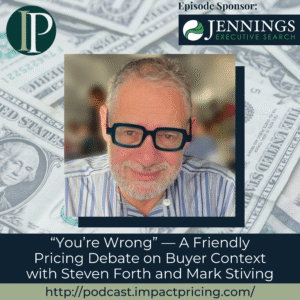
This episode takes a slightly different approach than the usual Impact Pricing conversation.
Instead of teaching a finished framework, Mark brings an early draft of his upcoming book to the table and asks Steven to react to it as a thoughtful pricing peer.
Steven Forth, co-creator of ValueIQ, largely agrees with the direction of the book, but pauses on a key point: how buyer context is defined, and whether the argument separates value and willingness to pay too cleanly.
Mark jokingly tells Steven he’s “wrong,” setting the tone for what follows: a calm, constructive discussion that explores where the ideas hold up and where they still need work.
What unfolds is a straightforward, unscripted book review in progress. The ideas are tested against real examples, refined through debate, and shaped in real time.
For listeners who care about pricing theory and how it actually gets formed, this episode offers a transparent look at how those ideas evolve before they’re finalized and published.
Podcast: Play in new window | Download
Why you have to check out today’s podcast:
- Why buyer context is trickier than it sounds and where pricing frameworks often oversimplify it.
- How value and willingness to pay diverge in real buying decisions using practical examples.
- What this debate changes about how you think about pricing before ideas turn into rigid rules.
————————————————————————————————————————
Private invitation to access ValueIQ (for Impact Pricing listeners)
Use ValueIQ to quickly analyze pricing pages, spot positioning gaps, and pressure-test pricing decisions.
Activate access here.
————————————————————————————————————————
“Most pricing books don’t really deal with buyer context. That’s why this conversation matters.”
– Steven Forth
Topics Covered:
01:11 – Steven’s career update, transition from being a CEO.
08:54 – Why this episode is different. Mark brings an unfinished book draft to the conversation, setting up a rare moment where ideas are explored, challenged, and shaped before they’re finalized.
10:40 – The core question the book has to answer. A turning point in the review as Steven pushes on whether context affects only willingness to pay or fundamentally changes value itself.
17:13 – Testing the argument with real examples. They pressure-test the book’s ideas using real buying scenarios where value stays the same but willingness to pay shifts dramatically.
22:10 – Where theory meets real buyer constraints. A discussion of budget limits, framing effects, and mental ceilings that complicate clean pricing logic and challenge how the book explains buyer behavior.
25:45 – How this feedback shapes the final book. Mark reflects on what this debate changes in the manuscript and why early, honest pushback is essential before pricing ideas turn into published frameworks.
Key Takeaways:
“Value didn’t change, context did.” — Steven Forth
“I agree that context influences willingness to pay, but I’m not convinced it doesn’t also influence value.” — Steven Forth
Resources and People Mentioned:
- Michael Mansard – referenced for his Compass Framework and ongoing work on pricing, value, and attribution.
- Edward Wong – Mentioned in the context of collaborative work on value attribution and pricing research.
- Karen Chiang – Mentioned as leading the services side of Ibbaka as Steven transitions away from CEO roles.
- Tom Nagle – Referenced in discussions around economic value, willingness to pay, and foundational pricing theory.
Connect with Steven Forth:
- LinkedIn: https://www.linkedin.com/in/stevenforth/
- Email: [email protected]
- Subscribe to Steven’s Substack: Synthetic data in pricing: https://pricinginnovation.substack.com/p/synthetic-data-in-pricing
Connect with Mark Stiving:
- LinkedIn: https://www.linkedin.com/in/stiving/
- Email: [email protected]
Full Interview Transcript:
(Note: This transcript was created with an AI transcription service. Please forgive any transcription or grammatical errors. We probably sounded better in real life.)
Steven Forth
Understand your buyer’s context.
[Intro]
Advertisement
Today’s podcast is sponsored by Jennings Executive Search. I had a great conversation with John Jennings about the skills needed in different pricing roles. He and I think a lot alike. If you’re looking for a new pricing role, or if you’re trying to hire just the right pricing person, I strongly suggest you reach out to Jennings Executive Search. They specialize in placing pricing people. Say that three times fast.
Mark Stiving
Welcome to Impact Pricing, the podcast where we discuss pricing, value, and the contextual relationship between them.
I’m Mark Stiving, Chief Educator at Impact Pricing, where we help companies get paid more for the value they deliver.
Our guest today is the one and only Steven Forth. And I’m actually not gonna tell you anything about Steven other than he just retired. Steven, what are you gonna do in retirement?
Steven Forth
Thank you, Mark. So I’m not sure that I’d call it retirement, but what I have done is I’ve stepped down from any and all CEO roles and I am determined not to have another CEO role this lifetime.
You know, I’ve been running early stage or growth stage companies in the tech space since my late twenties. I’m in my late sixties now, and I think, you know, I’ve done that enough.
And also to be a, you know, full disclosure, I’ve, I’ve had some health issues that also made stepping down from CEO roles, you know, kind of imperative.
So it’s a big change. I’ve defined who I am in the world as a CEO for decades. My wife gave me a card where she listed all of the different CEO positions I’d had.
And it’s, yeah, it was quite touching.
But, you know, I, with you, I mean, I do this stuff because it’s fascinating and it’s interesting and I love doing it.
So you would have to pay me not to do it.
Mark Stiving
Yes. So you’re going to go from CEO to thought leader.
Steven Forth
Yeah, I hope it’s more than a thought leader. I really enjoy working with companies on their pricing problems.
And I think that actually really feeds back into the Thought Leader work. So I sort of divide what I think I’m going to be doing over the next few years into sort of three buckets.
So I am going to be working with ValueIQ.
So ValueIQ is the AI part of Ibbaka. And it’s been refocused, concentrated, distilled into an AI native company that is building agents that will help people effectively price and sell value.
Mark Stiving
And that has a real product now.
Steven Forth
It does. It has, and soon to have to, it has an agent out called the pricing intelligence agent. Right now, all it can really do is take a pricing page and use that as a starting point for a pretty in-depth pricing analysis.
So you can use it for your own pricing page. You can use it for your competitor’s pricing page. You can use it for the pricing page of some solution that you may be buying and get very, very deep insights into how pricing works for that product.
Now, we all know that the majority of prices, unless you’re a product-led growth company, are not set through a pricing page.
So we are adding functionality to that agent that allows you to upload a pricing model either as a PowerPoint presentation or a spreadsheet or a document.
Pricing is often embedded in contracts, so it will be able to extract pricing from contracts and then run the same sorts of analysis.
And for people who follow the Impact Pricing podcast, part of the analysis that it does is based on Michael Mansard’s compass framework.
So it will actually go through and do a compass based analysis for you. It will do a pricing SWOT. Strengths, weaknesses, opportunities, and threats. It will go and look at how much it creates a light version of a value model and says how much value this is likely to create for different target customers, for different use cases, generates a lot of information.
And it is sold on a credit based pricing model, which is a debate we still get to have. And at some point, we’re happy to walk through my thinking as I designed the pricing model for this.
Mark Stiving
Excellent. So what else?
Steven Forth
One more agent Mark, before we’ve gone in and this week we’ll be bringing a value sales agent to market. And the value sales agent generates a value model. This time it does the real thing. It generates an in-depth value model. It verifies data, verifies sources, compares it to the alternatives. It’s a pretty robust agent.
And then it allows you to create a specific value for a sales opportunity and gives you the coaching that you need on how to sell value for that opportunity. This is a much more complex agent or set of agents.
But I’m hoping it will help people over the hump when it comes to actually being able to sell value, because you and I know that most salespeople struggle to sell value for a variety of reasons.
So yeah, ValueIQ is a real company with real customers and real products and a very strong team. And I’m pretty excited about what’s happening there. Nice.
Mark Stiving
And then you’re still working with Ibbaka.
Steven Forth
Yes, I’m still working as a consultant and Karen Chiang, who’s been on this podcast as well. Karen is taking over as the leader of the services business, and I am working with them on consulting engagements, which, you know, as I said, I don’t think you can be a thought leader and not engage with the industry and the customers.
Mark Stiving
I’m completely with you. I learn so much almost every time I deal with a client.
Steven Forth
Yeah. People who are either too senior or think that they know too much to deal with customers. I think they’re fooling themselves. That’s where the real insights come from. And then the third bucket is I’ve started my own Substack called Pricing Innovation.
And there was a Substack that went out today that mentioned one of your books. It actually also mentioned the book that you’re currently working on, which we’re going to be talking about in a moment. So I’m working on, you know, content for the pricing innovation Substack. I am contemplating writing some books. And I’m actually going to go to the pricing community and ask what they would be interested in having me work on.
Because I want to do a book on open games. I want to do a book on strategic innovation, but I also think that there’s a real need for a credit based pricing playbook.
Because I think relatively few people understand how to design credit based pricing models and it’s a moving target. It’s a rapidly evolving art.
And then finally, just one more thing, Michael Mansard from Zoura, Edward Wong from Ibbaka and I are planning to work on the value attribution problem in pricing and value.
Whether we can actually solve it remains to be seen. This is a real research project. But we’ll, we’ll get Michael on and we can talk about that at some point.
Mark Stiving
Sounds fun. So I’m thrilled that you’re, you’re not working as in you don’t have responsibilities that you have to go get something done, but you get to still participate, think, cooperate in the, in the industry. So it’ll be fun. And you get to be on the podcast more often.
Steven Forth
Not sure that people want to hear from me that much more often, but yeah, I really enjoy these conversations and I’m always welcome to share my thoughts and experiences.
Mark Stiving
I think our debates are some of the best podcasts that we put out. So those are good.
Speaking of our debates, today we were going to talk about context because Steven has an early edition, an early draft of my next book that I’m putting out which is called ‘Buyer Disconnect, Why They Say, Let Me Think About It’.
And I personally am thrilled with this book, although I’m not thrilled with the structure yet, so we have a lot of work to do. But as Steven was reading it, he said, I don’t think you got the context right.
And of course, anytime Steven disagrees with me, he’s wrong.
But no, this is something I have to listen to closely and we’re going to have a conversation about it. So hit me with it, Steven. What did I do wrong with context in the book?
Steven Forth
So I think the real issue I have is that the book provides a very powerful way of thinking about context from the buyer’s perspective. What’s the buyer’s context? Something that I think is lacking from almost all pricing books that I know of.
And that’s really important. But the book as I read it, says that context influences willingness to pay, but it does not influence the value of a solution.
And that struck me as questionable. Now, as I read the book, you would convince me while I was reading it, while I was in there with my pen and I actually printed it out and I’m marking it up as I read through it. And when I’m inside the book, yeah, all this makes sense, but then I step away, I think, you know, value also depends on context.
And I’m not sure that we can simplify this so much so that context is only what’s determining willingness to pay. But before we go on and debate this, Mark, maybe you can sort of give our, you know, people listening to this some ideas on what you mean by context.
Mark Stiving
Yeah. So I actually define it specifically in the book and I define it as context is anything that influences willingness to pay.
And so it’s kind of weird that I would then go on to say context doesn’t drive value, right? Because I think I’m totally wrong when I say those words in the book.
So I’m totally with you. And so let me give you some other thoughts as to why I’m wrong and why I’m glad you brought this up.
When I think about context, I truly think of it as anything that influences willingness to pay. And if you’ve gotten through law five, and law five is about alignment and how do we as companies build a product offering that’s aligned with the way our buyers are trying to make decisions, then buyers start out with a foundational problem. And that foundational problem is why am I buying something in the first place?
Well, two different people could be buying it for two different reasons. Which means there’s two different willingness to pay. Which means that foundational problem is context, right? What’s the context or the reason that person’s buying?
And then once you jump in and say, hey, here’s why someone’s buying something, then we go to the next layer and say, hey, there’s a problem scope. What’s the scope of the problem that person’s dealing with?
And different people are dealing with different scopes, which means they probably have different willingness to pay, which means it’s context, right? And I don’t even get to context in those two parts of the architecture. Context actually fits best down at the lowest level when we start talking about price segmentation.
And so price segmentation at the lowest level is, I’ve got someone who’s got a really urgent problem and someone who’s isn’t quite as urgent, which one has more willingness to pay?
Well, it’s pretty obvious, the one with more urgency has a higher willingness to pay.
So yeah, I think you caught that correctly, but let’s step back and think about it this way. There are some contexts that are absolutely value-driven or drive value. And there are some contexts that have nothing to do with value.
And that may be the interesting thing to talk about in the book.
Steven Forth
Yeah. And I think that’s a very important thing to differentiate. So Jerry Smith in his book.
Mark Stiving
That was in the post today.
Steven Forth
That was in the post today. Yeah.
When he talks about the four C’s of pricing does separate out value and willingness to pay and is quite articulate about the relationship between them. So I, I like, you know, where this is going, which is there are some contexts that, you know, apply primarily to value.
There are some contexts that apply primarily to willingness to pay, and there are some that influence both. And if this book in the next path through it can clarify that, I think that’s a huge service to all of us because you really need to understand both.
Mark Stiving
Can you think of an example where context influences value, but doesn’t influence willingness to pay?
Steven Forth
So let’s talk about how we think or how I think about value.
So I think about value very much in terms of, you know, Tom Nagel’s economic value estimation models. I realized that value has other dimensions, such as there’s emotional value and community value that are also important.
And, you know, we probably don’t pay enough attention to them. in B2B pricing, but the primary way I think about value in B2B is Tom Nagel’s economic value estimation, which estimates value through a value model that is a collection of value drivers.
And a value driver is an equation, hopefully a fairly simple equation, that estimates the impact of a solution on the buyer’s profit and loss statement, and in some occasions on its balance sheet. So that’s what I mean by value.
So willingness to pay in my way of thinking about this is, a solution creates so much value, how much of that value should a buyer be willing to pay for? And that will depend on things like the strength of the, and you’re going to hate this because most of what I’m about to say is vendor side.
And I think the important insight in the book is, it forces us to think about it from the buyer’s side. But bear with me for a moment anyway. So the things that determine willingness to pay are things like brand strength. People are willing to pay for brands. It’s a perceived risk. It is, you know, is this something that I’m actually going to pay for or do I get to pass it through?
Think of lawyers and copiers. And if you’ve ever examined a bill from your lawyer and seen how much they charge you for copying a page, it’s kind of jaw dropping. And they said, well, that’s, that’s our real cost. And I said, well, why on earth are you paying that much for copying? Well, that’s what we negotiated with our copy lender.
And well, why’d you negotiate such a high price? And they don’t say that, but the reason is because we knew that you were going to be paying for it. Not us. So anyway, and then there’s some other things that I think that influence willingness to pay.
For example, you know, is it part of the solution or is the whole solution in general, people are willing to pay more for what they perceive to be the sort of platform that the solution is built on and not for add-ons.
So for example, you know, many people will pay $2,000 for a good bike. it would be hard to convince them to pay $2,000 for the wheels for a bike. Although a friend of mine pays $3,000 for each set of race wheels that he has and he has like five sets of race wheels. Clearly he cycles a lot faster than I ever will.
Mark Stiving
A different buyer.
Steven Forth
A different buyer. I wish I could solve that fast, but anyway, I think I’m, I’m starting to go in a circle here. So, those are the things that, that’s how I see the world. There’s value created. You need to share some of that value with the buyer that’s referred to as the value capture ratio. It generally is between 3% and 30% and we can have a discussion at another time about what determines that.
But part of what determines is definitely willingness to pay. So now coming back to your question, see, I think the weakness in my thinking here is it’s very vendor centric.
And I think that this book that you’re working on is going to help all of us flip our understanding of context so that it becomes much more buyer-centric.
Mark Stiving
So since you said that, real quickly, one of the things that I think about, by the way, when you write your new book, ask me how to write it with AI, because AI and I have these conversations, really deep, awesome conversations about what we’re really trying to say and what we’re trying to do.
But one of the questions I asked is, how is what I’m doing different from behavioral economics? Because behavioral economics is all behavior side, right? It’s all buyer side, let’s call it irrationalities or heuristics.
And what I’m working on is in a deliberative purchase process, what are the steps, what are the things that a buyer goes through as they’re making a rational, and even if it’s not rational, it’s a deliberative decision as they’re making that purchase. Right.
And so that’s really what I think about when I’m thinking about this buyer side. And then, of course, we flip it over and say, OK, given that’s the case, what should companies be doing? What should sellers be doing?
Steven Forth
So back to the question, I have not answered your question yet. Right. Which is, are there cases where a change in value does not impact willingness to pay?
Or to rephrase it, are there cases where the buyer context changes, and that leads to changes in value that do not impact willingness to pay.
Can I come up with any examples like that? I’m not sure that I can, except buyers have a ceiling price that they are not, you know, generally speaking, not willing to pay more for. Let’s call it a budget for now. Yeah, budget. And, you know, to go back to the cycling story, I like cycling when I’m healthy, I cycle a lot. I believe in the equation, the formal equation, which answers how many bikes should you have, which is N plus one, N being the number of bikes you currently have.
And I understand the constraint, which is how many bikes can you have, which is S minus one, S being the number at which your spouse will divorce you if you buy any more bikes. You’re trying to satisfy that equation.
But I also have a ceiling in that I am highly unlikely to buy a bike that costs more than say $5,000. And my price resistance starts to go up rapidly past $3,000. So no matter what you tell me about how much additional value I’m going to get, Even if it says, you know, even if it’s maintenance value that’s saying, you know, look, if you pay this extra thousand dollars now, you’re going to save $5,000 on maintenance over the next five years.
And you can set that out for me. You can have compelling evidence. And I still won’t buy it because, as you say, it’s a budget, but I also think it’s a framing effect from behavioral economics that I’m just not willing to pay more than that for a bike. Same thing with a book. I mean, I hate to admit it, but I have not yet read the strategy and tactics of pricing edition seven. And I’m going to bite the bullet and buy a copy, but it’s too freaking expensive. I asked Tom about this and he just sort of threw up his hands and said, well, I didn’t price it.
Mark Stiving
Why didn’t he just send you a copy?
Steven Forth
What if I ask, but I, you know, I believe in buying people’s books. I buy all of your books. I appreciate that. I’m sure you would send me a copy, but I, the only book that I’ve picked up a lot of copies of free is Game Changer, but I bought my own copy, but then I was at a professional pricing society conference and they were giving them away.
Like they couldn’t give away enough of them. They didn’t want to carry them back. So I took one for everyone I could think of that should have a copy. Because although I am happy to pay for my own copy, I’m not sure if I wanted to pay for 20 other people’s copies.
But anyway, coming back, so I mean, I am unlikely to pay more than a hundred dollars for a book. There has to be some absolutely compelling reason. And at that price, I will go and see if there’s a PDF online that I can download and print rather than pay more than a hundred dollars. Okay. So.
Mark Stiving
I’m going to answer the other question, because I know how to answer that one. And that is, can I think of examples where context changes and value doesn’t change, but willingness to pay does? Yeah, so that was much easier because I wrote it in the book, right?
So one of my favorite examples is let’s assume that you’re running a company and you’re thinking about buying cybersecurity software for some potential hack and a competitor of yours just got hacked.
So suddenly the value changed zero, but your urgency to solve that problem went way up really quickly. Right. And so that’s an easy example to say, look, value didn’t change, context did.
The other example that we use in the book, but I’m not sure I like it, and it’s my favorite context example, and that is umbrellas are more valuable on rainy days than they are on sunny days.
Steven Forth
Yeah. There’s another example you use in the book, though, which sort of strikes home to me because the part of the market that I’m often operating in is an early stage company, wants to buy a CRM. Its willingness to pay is much higher after it receives its A round. Seed round innovation companies have a very low willingness to pay for anything. You know, dollars are scarce. They’re often coming out of the founders or the founders’ friends and family’s pockets. They’re just not willing to pay a lot for anything. Then they raise an A round, say it’s 3 million or 5 million, or these days there’s lots of $10 million A rounds.
Then their willingness to pay goes up quite a bit. And that’s also an example from the book. So, did the value change? No, not directly, but the willingness to pay did change.
So, you know, I want to draw this out. I want to diagram this. I think that by diagramming the relationships between value and the different value components, and how context determines those and willingness to pay and the different things that affect willingness to pay and how context changes those will help clarify a lot.
And one of the things I’m hoping to do this weekend is to draw some of those sketches for you based on my understanding.
Mark Stiving
Nice. Yeah, I’m struggling to think of an example where value changes and willingness to pay doesn’t.
Maybe the bicycle example. I certainly think budget constraints are there, right?
So I could offer you more value and you’ve got a million dollar budget. There’s no way you can get the board to give you more than a million dollars for this. So it doesn’t matter how much more value we put in. This is what the budget is.
Steven Forth
I think there may be some other ones. Let’s chew on it. And you and I tend to use different, different AIs. So we should both explore it by using our AIs and see what sorts of answers it comes up with.
Mark Stiving
Yep. Nice. Steven, we are out of time. As always, it’s just fun talking to you. I appreciate it when you do this with us.
Steven Forth
I learned a lot.
Mark Stiving
Would you like to answer the final question, even though we didn’t really talk about anything important today? What’s one piece of pricing advice you’d give our listeners that you think could have a big impact on their business?
Steven Forth
Understand your buyer’s context.
Mark Stiving
What a great answer. What a great answer. And to our listeners, thank you so much for your time today. If you like this, would you please leave us a rating and a review? Steven, how can people contact you if they want to?
Steven Forth
Yeah. So right now, the best way is through LinkedIn. I am easy to find. on LinkedIn and I am getting better at reading all of my LinkedIn messages.
Mark Stiving
And very prolific on LinkedIn, too.
Steven Forth
So, you know, there’s a lot to share and you learn a lot by sharing.
Mark Stiving
You do, you do. And so finally, if you have any questions or comments about the podcast, or if you want to get paid more for the value you deliver, feel free to email me [email protected]. Now go make an impact.
Advertisement
Thanks again to Jennings Executive Search for sponsoring our podcast. If you’re looking to hire someone in pricing, I suggest you contact someone who knows pricing people. Contact Jennings Executive Search.
[Outro]