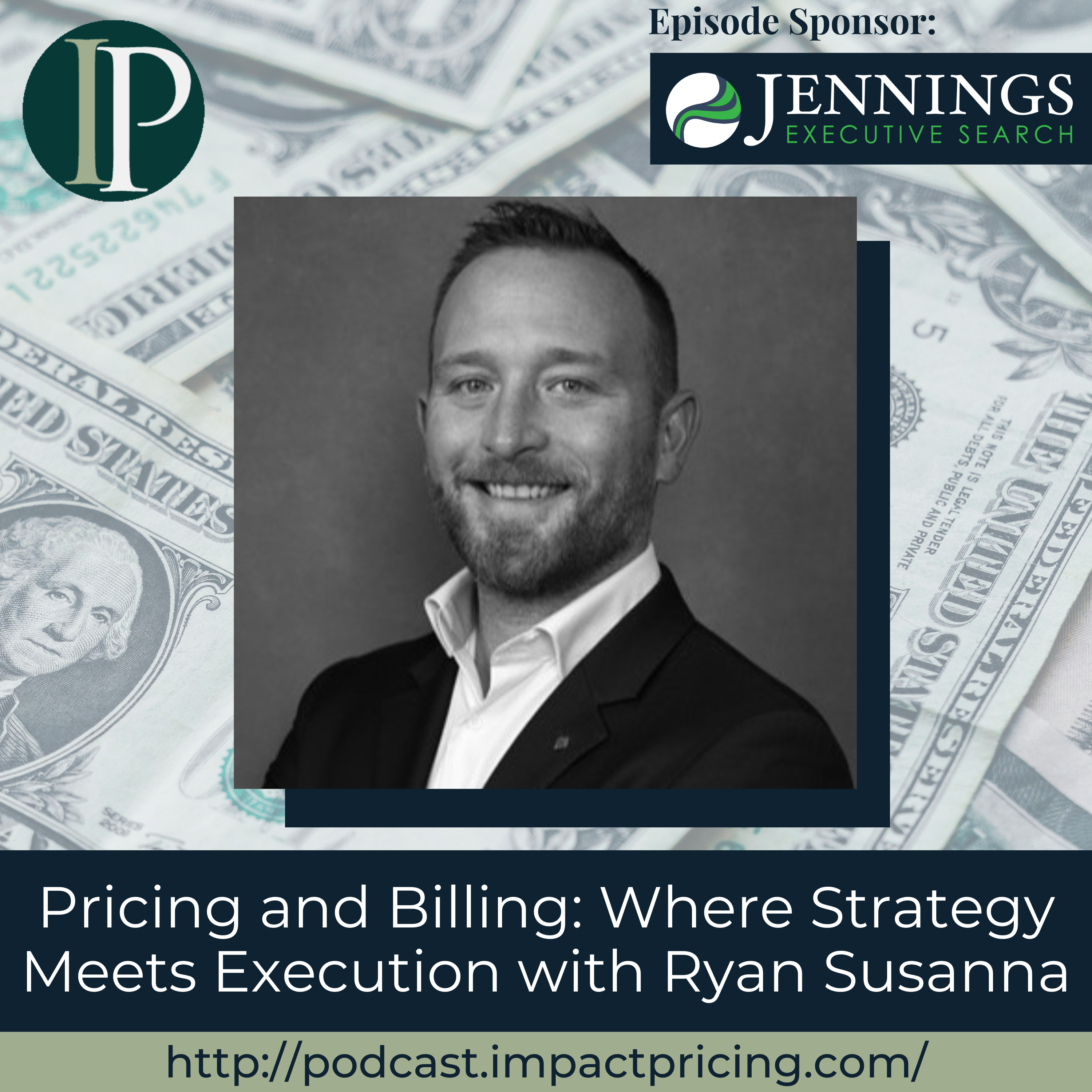
 Ryan Susanna is the VP of Sales at LogiSense, where he helps telecom, IoT, and SaaS companies operationalize complex usage-based and hybrid pricing models. With more than two decades in monetization, automation, and billing infrastructure, Ryan didn’t come up through pricing theory—he came up through execution. His work sits at the intersection of pricing ideas and the systems required to make those ideas real at scale.
In this episode, Ryan breaks down why billing platforms quietly shape—and sometimes constrain—pricing innovation, what usage-based pricing actually looks like in practice, why many AI pricing models default to credits, and the single pricing habit he believes every company must adopt: testing pricing ideas in isolation before scaling them across the business.
Podcast: Play in new window | Download
Why you have to check out today’s podcast:
- Understand why pricing innovation fails after approval—and how billing and monetization systems quietly block execution.
- Learn which modern pricing models die first in rigid systems (usage-based, high-watermark, hybrid, credits).
- Discover how to test pricing ideas safely without risking your entire go-to-market motion.
“Find an isolated way to test your pricing hypothesis before you boil the ocean for your entire motion.”
– Ryan Susanna
Topics Covered:
02:00 – From Physics to Monetization (By Accident). How Ryan’s background in physics, computer science, and sales led him into billing systems—and why monetization sits closer to pricing than most teams admit.
04:00 – “Why Should Pricing Care About Billing?” Mark challenges the assumption that billing is just collecting money. Ryan explains how billing systems determine which pricing models are even possible.
07:00 – High-Watermark Pricing Explained. Charging based on peak concurrent usage—not total usage—and why this better reflects customer value in many SaaS and telco models.
08:30 – Earned Discounts and Hybrid Usage Models. How companies combine multiple usage metrics to guide behavior while protecting margins.
14:00 – Meter Everything (Even If You Don’t Charge for It). Ryan explains why future pricing decisions depend on historical usage data you may not even know you need yet.
19:00 – Credits vs. Value-Based Pricing. Mark reframes credits as a payment mechanism—not a pricing model—and explains why value correlation matters.
23:00 – The Pricing Test Most Companies Skip. Why executives roll out pricing changes globally—and how isolated testing could prevent costly mistakes.
25:00 – Final Advice for Pricing Leaders. Ryan’s core message: pricing strategy without monetization readiness is just theory.
Key Takeaways:
“You could dream up any pricing scenario if you want, but if you can’t operationalize it at scale, you are setting yourself up for failure.” – Ryan Susanna
“Billing systems quietly decide which pricing models you’re allowed to use.” – Ryan Susanna
“If you pick a model and you have the same model forever, then it will not appear hard for you—because it’s what you’ve always done. What’s hard is change.” – Ryan Susanna
Resources and People Mentioned:
- LogiSense – Monetization and billing platform enabling complex usage-based pricing
- OpenAI – Referenced in the context of AI credit-based pricing models
- Databricks – Example of proprietary credit-based pricing (DBUs)
- Slack – Example of active-user pricing metrics
Connect with Ryan Susanna:
- Email: [email protected]
- LinkedIn: https://www.linkedin.com/in/ryansusanna/
Connect with Mark Stiving:
- LinkedIn: https://www.linkedin.com/in/stiving/
- Email: [email protected]
Full Interview Transcript:
(Note: This transcript was created with an AI transcription service. Please forgive any transcription or grammatical errors. We probably sounded better in real life.)
Ryan Susanna
Find an isolated way to test your pricing hypothesis before you boil the ocean for your entire motion.
Ad
Today’s podcast is sponsored by Jennings Executive Search. I had a great conversation with John Jennings about the skills needed in different pricing roles. He and I think a lot alike. If you’re looking for a new pricing role or if you’re trying to hire just the right pricing person, I strongly suggest you reach out to Jennings Executive Search, they specialize in placing pricing people. Say that three times fast.
Mark Stiving
Welcome to Impact Pricing, the podcast where we discuss pricing value and the dynamic relationship between them. I’m Mark, and I run bootcamps to help companies win more business at higher prices. Our guest today is the one and only Ryan Susanna. He’s here to talk about pricing, AI, and the usage economy.
Here are three things you wanna know about Ryan before we start. Ryan is the VP of sales at LogiSense Corporation. He’s actually been at LogiSense for 22 years, and he doesn’t even look that old. He spent more than two decades helping telecom, IoT, and SaaS companies modernize their subscriptions and usage, and he is a recognized voice on SaaS pricing, AI driven monetization, and the usage economy. Welcome, Ryan.
Ryan Susanna
Thank you, Mark. Pleasure to be here.
Mark Stiving
Hey, I’m gonna ask the question, how’d you get into pricing?
Ryan Susanna
Well, I got into pricing by accident. I am a physics and computer science student that stumbled into the sales world and happened to land in the world of billing, which is adjacent and very close to pricing because you could dream up any pricing scenario if you want, but if you can’t operationalize it at scale, you are setting yourself up for failure.
So I got into pricing by accident. I’ll actually say I’m not, I don’t really view myself as being in pricing. I am in monetization, I’m in automation, and pricing just happens to be the things that we were operationalizing and automating.
That being said, I have spent the last couple decades getting deep into the weeds with the pricing ideas and issues, what’s worked, what hasn’t worked. I’ve got to kind of see it all from the inside. And I think the irony is people tell me a lot more detail than if I showed up advertising myself as the pricing experts.
You can get more into detail on this, but when you’re interviewing people about their pricing and you’re talking to the person that came up with the pricing, sometimes they have a defensive approach with that discussion at first because everyone kind of wants to believe they were right. And I feel like maybe I’ve seen that from a different angle than most.
Mark Stiving
Nice. So let me frame our conversation for the listeners. I was speaking at the Usage Economy Summit. LogiSense had invited me there and I’m standing backstage while there was a, the previous speaker was on and I’m talking to Ryan and I asked Ryan, I don’t get it. Why do I really care about a billing system, right?
I mean, I set prices. And so, isn’t it just true that I set a price and then we tell the customer to pay it? Then they pay it. And so, tell me why you guys are so important to me being able to do my job better.
Ryan Susanna
We help your ideas get implemented in the real world and we help identify whether your ideas are working or not.
Working at much greater speed than without a system like ours is sort of how I will start. You know, we focus on iot, SaaS and Telco and you know, we have a bent towards usage-based pricing that really is our specialty. Probably not a surprise based on the markets I mentioned. ’cause you know, usage is not new in Telco.
They’ve been doing it that way for a hundred years now. But now the rest of the world is being eaten by usage-based models in one form or another. You know, typically it’s a hybrid. It’s not an all or nothing proposition, it’s a hybrid structure. But as organizations are evaluating and experimenting with more sophisticated and you know, maybe described as complex models.
There’s a lot of infrastructure required to make those things work at scale without a lot of error or manual effort or audit processes down the road.
Mark Stiving
So you’re gonna have to make this simpler for me ’cause I’m not there with you yet, Ryan. So let’s just talk about Telco ’cause you guys do this all the time, and we all use phones so we can figure this out. Okay? So I’m gonna charge someone by the minute or by the text. So tell me why this is hard. I just don’t get the confusion here.
Ryan Susanna
Well by minute or by text is not hard. What’s hard is change. In fact, if you pick a model and you have the same model forever, then it will not appear hard for you because it’s what you’ve always done.
Mark Stiving
And I built a billing system around it.
Ryan Susanna
Exactly. And using Telco as that example, Telco’s been charging by the minute, graduated by distance or geography forever. Telco today, those days are over. Telco really can’t be successful making money doing that anymore. Telco’s selling minutes to each other cheaper than they did the year before, that business model only works for so long.
So, now with the advent of mobile and the advent of cloud applications and the advent of AI applications, these businesses are needing to be a lot more creative with their pricing, with their bundling, with their go-to market motions. Change is happening at a more rapid pace than we’ve ever seen before.
And when these initial systems for these industries were developed, they were not developed with the mindset of agile change in mind. They were developed with a, you know, rigid waterfall structure. Here’s my model, here’s the four steps that’s gonna go through.
And anytime they want to go make a change to that, it becomes very expensive, very time consuming, and very distracting from the core business of going in winning more customers at a higher margin.
Mark Stiving
So what’s a new pricing metric in Telco? I mean, I’m sure if I thought about this, I would come up with one, what’s a new pricing metric or a pricing model in Telco that was hard for them to do unless they were using you?
Ryan Susanna
So things we often see, this is not an exhaustive list, but top of mind ideas, things like, some pricing models we see in the Telco world have to do with high watermarks. So I’m not gonna bill you for every use, but I’m gonna bill you for the maximum concurrent use of that service at any one given time. That’s one example.
The reason that’s complex is that someone needs to watch the data all month to figure out what was the maximum permutation of. consumption at one time. We see other scenarios. The true pricing gurus may have more sophisticated naming conventions for these, but I’ll call them earned discounts. So if I’m selling you three or four or five different metrics of usage, I may give you a certain allocation of free consumption of a certain metric if you use another metric.
And I’ll use, we’ve got a content delivery network customer of ours that has a similar model where. If you deploy a point of presence, edge of the network on their infrastructure, they charge you for how much bandwidth is consumed. And they charge you for how many individual visitors hit that node at the edge of the network.
Well, they have a relationship between the two where their economics are wildly different based on whether you have a lot of visitors with really high traffic volumes, or sorry. Reiterate that ’cause I think I messed it up.
If you have a low volume of users with a very high volume of traffic versus the inverse scenario where you’ve got a high volume of users or very low volume of traffic, the economics of how they can maintain a high quality of service for those consumers are very, very different.
The value driven to that customer is very, very different. So they have scenarios where if you have a lot of users, you may accumulate some perceived free bandwidth or vice versa. These are not really just usage models, it’s a hybrid structure. It’s how do you envision all of the different levers at your disposal and make them work in unison.
Mark Stiving
Yeah. So here’s what I love about what you just said, and I’m gonna try to restate, let’s do the first one first, right? And the first one you said was, okay, remind me, I just had an adult senior moment.
Ryan Susanna
The high watermark was I think the first.
Mark Stiving
Oh, the high watermark. Yeah. And so, here we are, a pricing person or a pricing team or a value team, we’re sitting around and we’re saying to ourselves, how is it that our customers get the most value out of our product? And they get the most value out of the number of concurrent users they have.
And so, we wake up and we say, we should really be charging by the number of concurrent users. There is no way to do that. We haven’t built it into anything. And so, what you guys have essentially done is said, Hey, we’re now giving you the ability to do something you didn’t have the ability to do before.
Ryan Susanna
Without having to re-engineer your product. That’s the kicker,
Mark Stiving
Right? And so, we’re actually giving you the ability to choose among new pricing models that you didn’t have before.
And then, the second one that you talked about, which I loved as well, in my head, I said rebates, but then when you went on to describe it, maybe it wasn’t rebates. Maybe it was just incentives. But we’re taking different features or capabilities or usages and we’re combining them and saying, Hey, we could give you a discount on this one when you use more of that one.
Ryan Susanna
Yep. And again, this is one we see a lot of new AI companies we see adapting to this sort of model where it has nothing to do with actual pricing. The reason they’re doing it, it has to do with getting users to experience their new offers. So if you try this new feature, I will give you a certain amount of credits free in your account. Same functionality as far as the billing system is concerned, but a very different reasoning and intent from the provider.
Mark Stiving
Yeah, it’s actually really fascinating because what you’re doing, I never think about a billing system, no offense, right? Never ever think about a billing system, but I think all the time about how do my customers get value and how do we capture more of that value ourselves?
And essentially what you’ve said is, Hey, almost any way you can dream up the value, we can find a way to capture that. Right? We can find a way to monetize it. So I thought that was brilliant.
Ryan Susanna
Thank you. Well, I appreciate that. And that second example, actually, we see a lot in the SaaS space as well in that there’s this term going around online, seat-based pricing is dead. I don’t know if I fully agree with that statement, but I see that statement a lot.
One angle we’re seeing a lot of providers move towards is rather than forcing the company to predict how many users they’re gonna need over the next three years of this contract, this high watermark concept of users makes it a lot simpler where I’m gonna bill you for the maximum number of users you had in the system at one time.
And it prevents scenarios where people want to share a login, right? Hey, my QA team, only one person at a time might need this so rather than have them have their own login, I’ll have them share a login. Or Netflix, another good example, right? They let people overlap, share subscriptions for a certain period of time, and then they flip the switch and turn that off.
Mark Stiving
Yeah. And one of the pricing metrics I always found interesting, and I never thought that it was hard to monetize, but Slack does number of active users in a month. And I thought that was pretty interesting.
Ryan Susanna
That’s another good one. We actually see that one in the IOT space as well. If a device does not come online in a given month, I don’t wanna pay for it that month. Similar type of nature for us.
We’re deriving all this information from the usage data, so we take all the usage data right from the raw source, and then we derive the intelligence from the actual data itself. So it’s very easy for us to tell how many unique users logged in. So it’s a common one.
Mark Stiving
Yeah. So that’s an interesting question because you had said I could do these new models without having to re-engineer my software. Sadly, I run into a lot of companies who haven’t put monitors on their usage. Is it true that you have to have the usage data in order to make sense of this?
Ryan Susanna
Well, we have to have access to the root data in some form, right? In cases where organizations are a bit earlier in their journey and they maybe don’t have all of the telematics set up for every type of usage that’s occurring, they may still have log data somewhere that we can parse to pull it. There’s sometimes other ways we can derive it, but it’s a fair statement to say we need some sort of data to be able to meter.
Mark Stiving
Yeah, I think, I try to advise all my customers to make sure you’re monitoring or metering every single feature if you can, because we never know what we’re gonna do with it and how valuable it’s gonna be to us later.
Ryan Susanna
Well, I actually think that’s brilliant advice, and I advise people of the same thing. You know, Hey, if you’re evaluating a usage model, what is the first thing you should do? Well, the first thing you should do is start metering how people are using your product now. So the decisions you make are grounded in real data, not hypothesis and textbook.
Mark Stiving
So you and I are gonna come at this slightly differently because what you just described is I need the usage data so that I can use the right pricing metric or pricing metrics. And by the way, I think that’s spot on. I often really want the usage data because I want to be able to build packages based on which customers are using, which features how much, and so I can. Indicate it indicates to me how much value there is and how I might do market segmentation and packaging for my different customer base. So it’s got two huge, huge values to us.
Ryan Susanna
I would completely agree with that statement. I imagine sometimes you probably get asked to do this based on not having access to that data, and I’m not even sure what your plan B would be. Go interview the customers, maybe some other, much less efficient, less accurate method.
Mark Stiving
So sadly, I do this a lot and I do it based on, I assume you as a, as a seller understand your customers well enough that we can talk about which customers get how much value out of which features and which ones are using it. And as you start to go through that exercise, you actually can tell which companies know their customers and which ones don’t.
Ryan Susanna
And are you getting that more from sales support or customer success or somewhere else?
Mark Stiving
It depends on the size of the company, right? For large companies, it has to come from sales support or customer success. For small and mid-size companies, it’s usually the executives, the people who sold all the original deals.
Ryan Susanna
Interesting. Okay.
Mark Stiving
So, it’s interesting. So, how is AI changing what you guys are doing and what you’re seeing?
Ryan Susanna
Okay, well that’s a big question. Internally for us, it’s changing all kinds of stuff about how we operate our day-to-day lives. I’m sure pretty much every high tech go-to-market motion in the world now is utilizing some form of AI to research customers, research target account data, contacts, who used to do business with you and left for another business and is ripe for a touch point. I don’t think AI, and we’re not seeing any evidence that AI is ready yet to replace core monetization systems.
I’m not saying we will never get there, but I don’t think we’re there today. But I think it’s changing. It’s dramatically changing people’s views of how they should take their own products to market. I think every SaaS company we’re talking about is battling with, should we go with a good, better, best sort of simplified structure?
Should we go with a platform plus with some level of entitlement included, plus, I’ll use the bad word, overage. You’ve got this debate right now about credits versus non-credit based models. I feel like no one had heard of a credit model really until AI. Now everyone’s heard of it and nobody can really well define it, which is interesting.
Mark Stiving
When I bought minutes on my cell phone, wasn’t that credits?
Ryan Susanna
Well, yeah, but they didn’t call it credits. But now they can get away with calling it credits because you knew what a minute was, right? The minute was free. Maybe the rounding rule or minimum connect time was there, but you understood what a minute was.
But the only description I’ve heard of, what does a credit actually mean is that it’s an amount of work completed. Well, how much work? What if the cost to change to do that work changes over time? Does my credit allocation model change? Is the credit allocation model different by market segment or by use of the same feature?
There’s a lot of question marks that come about there, and to be honest, personally, I’m really surprised how successful a lot of these businesses have been with this ambiguity because it’s very confusing to me. And I live this every day.
Mark Stiving
Let me define credit the way I do and I’d love to hear your opinion and see if you think this is accurate because you live in this world so much more than I do. And that is, I don’t think credit is a pricing metric. I don’t think it’s a pricing model. I think it’s a way of paying.
So let’s pretend that I’m gonna create minutes as a credit, or let’s pretend I’m gonna create tokens as a credit, or let’s pretend I’m gonna create gigabytes as a credit. Then all I’ve done is I’ve said, Hey, one credit is 5,000 tokens or whatever that happens to be.
And so, what I’m allowing you to do is buy some number of something ahead of time. Then I’m gonna deliver it and deduct your usage from that. So it doesn’t really matter what it is, it’s just the way we’re doing the billing.
Ryan Susanna
So I would generally agree with that statement. I think to me there’s a really close analogy between a credit model and creating your own virtual currency, Mark Stiving’s Pricing Advisory Dollars, right?
But it’s that translation between the raw level of usage metric events and how they translate into that credit model, that’s where the ambiguity, I believe, lies because most organizations do not publish that. And if they do publish it, it’s usually done so in such a technical way that the average buyer’s got no idea what they’re reading. So that’s where I think I would agree with your statement, but I think the gray area lives even prior to that.
Mark Stiving
So, and by the way, I like your way of phrasing it, that we’re building our own currency, right? So you may recall the company Databricks had DBUs, which was their own currency, right? How many DBUs you wanna buy, which are their credits, right? And so, I agree with that completely. I think credits in the long run are gonna go away. Well, let me say that differently.
I think for platforms like OpenAI, or something like that, they’re gonna probably have credits for a long time. But as companies start to build solutions to problems, they’re gonna start charging for the value they deliver, not for the credits they deliver, right? Because credits are really a cost-plus pricing type.
Ryan Susanna
Bingo. You took the words out of my mouth, but that’s exactly the way I view it. Credit literally is just a cost-plus structure. It does not look at the value or the outcome being delivered to the customer, which I agree with you is it must be the future. There is no other end game possible. It’s a matter of, how do we get there and how long will it take, and who will get there first.
Mark Stiving
I think the reason we see so many credits today from AI companies, or people who are implementing AI, is the uncertainty of value, right? We don’t know who’s getting how much value from what we do, and they’re doing so many different things. And so, we sell based on credits, but as we start to build real solutions and we understand our value more, that’s gonna move more towards value-based pricing.
Ryan Susanna
Makes my heart warm to hear those words, Mark. I’ve been talking about outcome-based pricing for 15 years, and people looked at me like deer in the headlights, right?
Mark Stiving
So, I also don’t believe in outcome-based pricing. If you care, right?
Ryan Susanna
I do care. I do care. But explain to me what you believe to be the difference between the value-based and the outcome-based model. Where’s the breakage in that for you?
Mark Stiving
Yeah. It’s all on what the pricing metric is. I think that if I could choose a pricing metric that is usage-based, that is highly correlated with the value we deliver to our marketplace, then it isn’t outcome-based pricing. It’s still usage-based pricing. Because we can monitor usage. We can’t always monitor the outcomes. And so, I think that’s what’s gonna happen.
Ryan Susanna
Fair statement. But is it also fair to say that you are, value-based is the achievable outcome, but the spiritual outcome is still the outcome-based because you’re trying to tie the value for what you perceive the outcome to be. You just can’t really prove it.
Mark Stiving
Absolutely. And so, to me, the ultimate outcome, if you’re in B2B, which most companies are, the ones that I work with are, if you’re in B2B, value is incremental profit. So, how much more money am I gonna make my customer ,right? To you guys, how much more money are you making your customers because they use your product instead of doing it themselves or someone else’s product, right? So, value is incremental profit.
And so, that’s the outcome I want. No one’s gonna pay you a percentage of their profit. And so, now what’s the next outcome? Well, you take that down a layer, and it’s either cost or it’s revenue, right? I’m gonna reduce your cost, or I’m gonna increase your revenue. And 99% of companies are not gonna give you a percentage of revenue increase or a percentage of cost decrease. So, now we have to go down another layer.
And so, eventually we’re gonna find an outcome that they think ties back to their profitability and that they’re willing to pay you for. And that’s what we’re, when I think of outcome-based pricing, that’s what I’m thinking of is how far below profit do I have to go for a KPI that my buyer is monitoring that we can actually monitor ourselves and charge for, and will make sense.
Ryan Susanna
And you show up at a QBR and put it on a slide for the C-levels.
Mark Stiving
Absolutely right. Absolutely right. But it’s hard. This outcome-based pricing is, I mean, it’s the holy grail. It’s what everybody wants. And what you’re doing is you’re getting paid for the actual value, the true value that you’re delivering, not some proxy of the value you’re delivering.
Ryan Susanna
And it also eliminates the, because the one challenge that I do acknowledge in the concept of an outcome-based pricing model is it encourages the customer to try to fudge the results to decrease their price. Right? Oh, we didn’t really get that outcome here. And you know, yeah, you did. The data says you did. Well, no, you know that that deal churned. Or dunno what the exact examples are yet, but it encourages that. It’s more likely to have friction in that model at some step of the process.
Mark Stiving
Yeah. And the other friction that I really don’t like in outcome-based pricing is, let’s say that my software helped you make another million dollars and you say, no, no, no, it wasn’t your software. It was our sales team, they did a much better job this year.
Ryan Susanna
Yep. Another great example.
Mark Stiving
And so, the attribution of moving the KPI is challenging.
Ryan Susanna
And a lot of competitors in our market actually do charge based on a percentage of revenue. We moved away from that model because we were getting very direct feedback from our market segment of exactly what you’re saying on this podcast. We love to use your product. We love to be better because you’re with us, but we don’t wanna have a tax on our success.
If we’re able to improve something else in our business and sell our product for twice, why would we wanna pay twice the amount for our billing vendor? You’re only doing exactly the same thing. So I completely agree with that statement.
Mark Stiving
Hey, Ryan, as always, this is fun, thank you very much. Let me ask you the final question even though you’re not a pricing guy, you hear a lot of pricing info. What is one piece of pricing advice you would give our listeners that you think could have an impact on their business?
Ryan Susanna
Find an isolated way to test your pricing hypothesis before you boil the ocean for your entire motion would be my number one piece of advice.
Mark Stiving
Isn’t it amazing how companies make decisions and roll them out without having tested it and it has such a huge impact. It is amazing and it relates directly back to what we were talking about earlier of how do you come up with the right model if you aren’t already metering the data of how people are using the product and proving out what segments are getting value out of it.
Ryan Susanna
It’s amazing how many times that we see people have an idea. The execs love it, they roll it out globally in one shot. They don’t think about how it’s gonna affect billing even, right? You mentioned, don’t be offended, you don’t usually think of billing, and I’m gonna pick on that point for a minute, and that we see that all over the place.
Companies are like, listen, we’ve raised a hundred million dollars. We’ve built this massive application. People want it. We’ve come up with a pricing model. We’ve started selling it. But we have no idea how we’re actually gonna operationalize the backend of that monetization. And it sets them back on their journey substantially.
Mark Stiving
Yeah. Yeah. Fascinating. Fascinating. Ryan, thank you so much for your time today. If anybody wants to contact you, how can they do that?
Ryan Susanna
Email or LinkedIn, best ways to find me. So, [email protected], or Ryan Susanna on LinkedIn.
Mark Stiving
Beautiful. And to our listeners, thank you for your time today. If you enjoyed this, would you please leave us a rating and a review, and if you have any questions or comments about the podcast or if your company wants to get paid more for the value you deliver, email me, [email protected]. Now go make an impact.
Ad
Thanks again to Jennings Executive Search for sponsoring our podcast. If you’re looking to hire someone in pricing, I suggest you contact someone who knows pricing people Contact Jennings executive search.
[Outro]