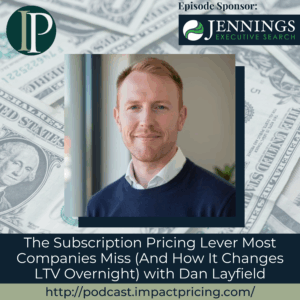
Dan Layfield, founder of the Subscription Index, joins Mark Stiving to unpack the less-visible pricing and monetization levers that drive real growth in subscription businesses. With experience scaling Codecademy from $10M to $50M in revenue and leading product teams at Uber and Diligent, Dan brings a product-led, ROI-first perspective on pricing.
This episode culminates in one of the most actionable subscription pricing tactics you’ll hear: how to price annual plans based on actual monthly retention, not industry norms.
If you work in SaaS, consumer subscriptions, or any recurring-revenue business, this episode offers practical insights you can test immediately.
Podcast: Play in new window | Download
Why you have to check out today’s podcast:
- Learn the annual pricing tactic that dramatically increases LTV and cash flow by aligning plan discounts to real retention behavior.
- Understand why subscription growth is constrained more by monetization systems than acquisition and where hidden revenue leaks live.
- Discover how product, pricing, and payment mechanics quietly shape retention long after customers click “Subscribe”.
“If you know your average retention rate within monthly plans, and most of your users are in monthly plans, you price your annual plan to be like one or two months more than your monthly retention rate.”
– Dan Layfield
Topics Covered:
00:45 – How Dan Got Into Pricing. Dan shares how pricing became a key growth lever while scaling Codecademy and why monetization matters more as products mature.
01:10 – Scaling Subscription-Based Businesses. Dan shares lessons from scaling Codecademy’s subscription business and why pricing becomes critical as companies grow.
05:12 – Subscription Pricing and Retention Strategies. How pricing decisions influence retention length and why subscription pricing must reflect real user behavior.
09:11 – Retention Challenges in Subscription Businesses. The difference between short-term and long-term retention products and why under-12-month subscriptions require different strategies.
11:32 – Subscription Product Strategies. Time to value versus time to success, and how product design affects lifecycle length and churn.
17:02 – Monetization Strategies in Subscription Businesses. What monetization really includes beyond price, from paywalls to upsells, renewals, and payment recovery systems.
19:45 – Checkout Flow Optimization Strategies. Why small checkout improvements deliver outsized ROI and how minor friction quietly suppresses revenue.
23:22] AI’s Impact on Consumer Products. Why AI adoption is slower in consumer subscriptions than B2B SaaS and where future disruption may emerge.
26:30 – Annual Plan Pricing Strategy. Dan explains the monthly-to-annual pricing approach that boosts LTV, improves cash flow, and increases commitment.
29:31 – Key Subscription Product Insights. Final reflections on retention, monetization levers, and where subscription companies should focus first for growth.
Key Takeaways:
“This is one of the few tides that lifts all boats in subscription products. It makes payment processing easier. You collect cash up front. Those users psychologically commit to the product more.” – Dan Layfield
“If you’re retaining users for four months on average, change your annual plan discount rate to be 50%. So they’re paying for six months up front.” – Dan Layfield
“…if you look at any of the big consumer products that discount more than 10 to 20% annual plans, you can kind of guess their monthly retention rate.” – Dan Layfield
Resources and People Mentioned:
- Codecademy – Subscription growth case study.
- Uber Eats – Marketplace product experience.
- Subscription Index – Dan’s subscription monetization resource.
- Stripe / App Store Billing – Payment and dunning challenges in subscriptions.
Connect with Dan Layfield:
- Website: https://subscriptionindex.com
- LinkedIn: https://www.linkedin.com/in/layfield/
Connect with Mark Stiving:
- LinkedIn: https://www.linkedin.com/in/stiving/
- Email: [email protected]
Full Interview Transcript
(Note: This transcript was created with an AI transcription service. Please forgive any transcription or grammatical errors. We probably sounded better in real life.)
Dan Layfield
If you know your average retention rate within monthly plans, and most of your users are in monthly plans, you price your annual plan to be like one or two months more than your monthly retention rate.
[Intro]
Ad
Today’s podcast is sponsored by Jennings Executive Search. I had a great conversation with John Jennings about the skills needed in different pricing roles. He and I think a lot alike. If you’re looking for a new pricing role, or if you’re trying to hire just the right pricing person, I strongly suggest you reach out to Jennings Executive Search. They specialize in placing pricing people. Say that three times fast.
Mark Stiving
Welcome to Impact Pricing, the podcast where we discuss pricing, value, and the linked relationship between them. I’m Mark Stiving, and I run bootcamps to help companies get paid more. Our guest today is Dan Layfield. Here are three things you want to know about Dan before we start.
He is the founder of the Subscription Index and has extensive experience scaling subscription-based businesses. He’s director of product management at Diligent in Austin, and he emphasizes rigorous ROI calculations for projects and subscription businesses. Welcome, Dan.
Dan Layfield
Hey, Mark. Thanks for having me.
Mark Stiving
Hey, it’s going to be fun. How’d you get into pricing?
Dan Layfield
I got into pricing kind of along my work at Codecademy. So I ran growth at a company called Codecademy. Codecademy was kind of a mid 2010s internet darling of the learn to code wave. And pricing was one of the levers we pulled on while we were scaling that business.
Mark Stiving
Okay. Two questions just jumped to mind, but the first one is, is Codecademy going out of business with vibe coding?
Dan Layfield
Not that I’ve heard. I feel like I was there from probably 20, maybe 16 to 2021. I think it’s sold in 2023, maybe. So a lot of the team that I was connected to moved on. I think the learn to code wave will definitely change. Typically what happens in movements like this is vibe coding kind of moves you up the abstraction layer.
So just like once upon a time you had to learn machine code to learn to program, you don’t have to do that anymore. Probably there’s a depth of syntax knowledge that we taught at Codecademy in the 2010s that with vibe coding you don’t have to know anymore, but you probably have to know a lot of the same theories and concepts.
Mark Stiving
Probably true. Probably true. Okay. So back to the pricing question. So you were in charge of growth and that seems like an interesting title. Who, whoever gets a title of growth, is that like a chief revenue officer or.
Dan Layfield
Yeah, I’d say in the more common, in the consumer world, our growth jobs, growth people tend to come in kind of two flavors. They’re either more marketing people. or they’re more product people, I was definitely more of a product person. Growth people tend to be more marketing oriented if the business acquires users, more driven by paid media and acquisition.
Like what happened at Codecademy, if growth is more driven by a free product and the product itself, they tend to be more product people. So, you know, Codecademy, I was there from about 20 people to about 200 people. Growth is honestly a job I just took over when someone had to do it when we were scaling the company.
Mark Stiving
Nice, and it’s good to see that you’re in charge of growth when you went from 20 to 200. Looks like you did your job.
Dan Layfield
I mean, on the revenue side, I probably ran growth from about 10 to 50 million. A lot of that was, you know, made substantially easier that Codecademy had a great brand name, great product. And we acquired a lot of users organically through the product.
What we weren’t good at was converting them to paying users. So we had a very powerful free product when we started, but not great on the business side. And that’s kind of what we built over our journey there.
Mark Stiving
Nice, nice. So tell me, what does Subscription Index do?
Dan Layfield
Yeah, Subscription Index is mostly a blog at this point. So, you know, I ran, I was at Codecademy for five years and I spent two years at Uber. Around the time I was moving down to Austin with my wife, I was at Uber and I kind of got the vibe that like Uber wasn’t going to be remote-friendly for much longer.
So I split off on my own. I did kind of two years of consulting with subscription products. But now I’m a full-time director of product and diligence, so I don’t do a ton of consulting anymore. I really just kind of write down everything that I’ve seen to be effective in scaling subscription products.
Mark Stiving
Okay. I am embarrassed that I didn’t see that you were at Uber because that would be like the whole thing we talked about this whole podcast. I am, I am so fast. I use Uber all the time in my teaching and my instructions. I just find that fascinating. Were you in charge of pricing there?
Dan Layfield
No, I ran the ranking system of the home feed of Eats. So Uber Eats is a three-sided marketplace. There’s the consumer side, the restaurant side, and the courier side. I ran the ranking system behind how restaurants show up on the consumer application, which ends up being like a big kind of influence and balancing point in the marketplace of Uber Eats.
Mark Stiving
Okay, I’m not going to dive in there because that’s not what we were planning on talking about today, but it is.
Dan Layfield
Weirdly, I don’t have a ton to say there because a lot of the pricing was done by a specialized team at Uber, which I wasn’t on, and a lot of that is set dynamically in markets. So, I have almost nothing to say on the Uber Eats pricing side.
Mark Stiving
I think that Uber pricing is fascinating, absolutely fascinating. All right, well, let’s talk about subscription pricing. By the way, when I first left Pragmatic, I had to do something different because I wasn’t allowed to compete with them.
And so, I went out and studied subscription pricing so that I could write a subscription pricing book. And it was called WinKeep Grow. And I just found it so fascinating to deal with the subscription business. And so now you’re dealing, you’ve got the subscription business. Is Diligent a subscription business?
Dan Layfield
Yeah, it’s a big B2B SaaS business, so technically a subscription business, but most of our contracts are enterprise contracts.
Mark Stiving
Nice. Yeah. And so it’s fascinating because it turns out subscriptions really are different than transaction-oriented businesses. I find that totally fascinating. And so the title of the book was Win, Keep, Grow, and everybody has to win customers, but subscription focuses on keeping customers and growing customers.
And so, I always, you always hear about churn. I heard about churn long before I studied subscriptions, but what I never really heard about was expansion or grow. And to me, that’s the most fascinating part of this whole business. I don’t know. Is that what you spend time thinking about?
Dan Layfield
Yeah, definitely. I’d say I kind of bucket subscription businesses into like two broad categories on the consumer side. There’s the companies that have more than 12 months of average retention, and there’s companies that have less than 12 months of average retention. Most of that’s driven by the underlying use case that the product solves for.
So if you think of, like, to build a subscription product, you need to be in a recurring use case. There’s habits that human beings have for long, long, long periods of time, like needing to live in a house, needing electricity, renting cars, financing products, trash removal, etc. But then there’s a big chunk of, I’d say, shorter term habits.
So learning things, getting in shape, going on diets, dating, that kind of thing. They’re kind of like intermittent habits. A good chunk of the biggest companies in the world sit in the longer than 12 month use cases. So Spotify, Netflix, Amazon Prime, those are kind of never ending consumer habits. But there’s also a good chunk of consumer subscription products that are in the other category where they’re under 12 months.
This is where I really think there’s a lot of room for optimization around extending life cycles and pricing more effectively. Because what you want in the subscription business is the longest LTV or lifetime value you can get from customers. What makes subscription businesses harder to run is those cash flows are typically spread out.
So if you were an e-commerce business and you drive people to your site through ads, you’re probably collecting most of the LTV upfront to pay for acquiring for the customer. What makes subscription businesses tricky is that LTV is spread out.
And ironically, like the better you are at retention, the more spread out the LTV is, which makes the cash flow management side harder. There’s things you can do, but it’s a problem that never really goes away in subscription businesses.
Mark Stiving
Okay. I had never thought about this problem that you just brought up until you brought it up. And so I’m going to, I’m going to articulate it in a way that you did not. So if I am on a dating site or I am trying to teach you to speak Spanish or something like that, what I really want is to not be good at my job so that you keep paying me.
Dan Layfield
It’s the pessimistic way of saying, I’d say there is a balance there. You can’t remove the incentive that the companies have to extend the problem. But if you don’t activate enough people early enough to feeling value from the product, the churn in your month one, month two is going to be so bad that probably your business doesn’t survive.
I think it’s tempting to call that out in subscription products. But I would say if you’re running a subscription company, I would try to get people the, you know, to the aha moment of feeling the value of the product as quickly as possible, because that’s going to have the lowest net effect on your churn. I think I’d say a more, I don’t know, optimistic way of extending the life cycle is either nurturing users well within the core habit flow or starting to tack on secondary use cases.
Mark Stiving
Okay, I’m not sure what you meant by the first one. As I think through this problem, I think, okay, I want you to get to value quickly. So time to value, I want to be relatively fast, because I don’t want you to churn out for that. But I don’t want time to success, whatever success looks like, to be too fast. If you can separate those two concepts, right? How long does it take to get to value? How long does it take to get to success?
Dan Layfield
Yeah, it’s a great question. I’d say time to value to me, I’d say the industry term here is kind of the aha moment. So once you sign up for a product, how quickly do users feel connected to the value of your product?
Another way of saying that is like how quickly do they start to get a little bit of that problem solved? So in a dating app, it could be the first time you match with somebody or start a connection with somebody or chat with somebody or something like that. I think getting people to the, I forget the term you use, like the feeling, the solution.
Mark Stiving
I said success, but yeah.
Dan Layfield
That comes down to how long those products are kind of organically. So things I see in subscription product retention numbers all the time is problems just kind of like a certain length of a use case. So if you start a diet, you’re probably going to either. hit your goal or abandon that diet within like a four to six month window.
And that just kind of is like how long humans naturally want to stay in those states of focusing on something. The bigger danger of churn for businesses like that is they fall off really early in the diet and then they churn out of the problem.
Mark Stiving
So you want to make sure you keep them for the four to six months, but then how, what are some tactics or techniques you could use to get them to go beyond six months? Do you, I assume you think about that.
Dan Layfield
Yeah, I’d say a good chunk of those are maybe half on the product side, half on the pricing and packaging side. So inherently, let’s take the weight loss example of, you know, if you lose weight, you want to then be able to maintain your new healthy weight. So you can sell a subscription product that has, you know, a focused diet period and then afterward a maintenance phase to keep you at your goal so you don’t regress backwards.
The other trick that is used in the industry is like being really intentional with the plan lengths. So if this is a four month problem, you might want to sell a six month plan. Or if this is like a two month problem, you might want to sell a five month plan and get the user to commit upfront. Typically when they’re feeling most of the pain in the problem early for a long time, it lowers your net churn.
Mark Stiving
That makes a lot of sense. If I were on the diet program and you were selling a weight loss program, and then you wanted to transition me to a weight maintenance program, is that typically a lower price or are we going to hold price, try to hold the price there?
Dan Layfield
My instincts are you’d want to sell that together. Typically, you want to get users to make decisions when they’re in the moment of maximum attention to that problem or pain from not feeling the solution. So like if you sat me down at a restaurant and I was starving, I might order two entrees.
But if I ate one and then you try to sell me a second one, the likelihood I will buy that second one is really, really low. So you probably sell them packaged together at the beginning and get the user to commit upfront to success and then the support they need for success.
Mark Stiving
Got it. And so I would sell you an annual plan that says, hey, we’re going to help you lose weight. And once you’ve lost it, we’ll have the maintenance program.
Dan Layfield
Yeah.
Mark Stiving
It gets you to go for a whole year. Nice. So how are you, for this type of client lifetime value, is it the same thought process, the same calculations we would use as we do on long-term subscriptions? But by the way, most of my work is in long-term subscriptions. You know, churn is usually 3%, 5%.
Dan Layfield
Yeah, it’s the same fundamental concept. I mean, one of the, I don’t know, the tricky things about subscription products, as you’re probably seeing in your work, is ironically, the better you are at retention, the harder it is to calculate things like lifetime value. So in consumer products, acquisition flows tend to move really, really fast.
So you could spin up a new channel like TikTok, and inherently want to measure the LTV to CAC ratio of that channel. But the better you retain as a product, the longer it’s going to take for that cohort to, you know, quote unquote, bake and finalize. And it’s going to be harder for you to understand what your LTV numbers are. Do you see that in your work?
Mark Stiving
Yeah, I don’t. It turns out that my clients don’t do a ton of LTV work. And it’s because churn’s so low and margins are so high. It’s like, you know, we’re, we’re going to, we’re going to manage. That’s not a big deal. So for your clients, you had mentioned the LTV over CAC ratio. The other ratio that you often see, or the other metric you often see is a payback period.
Dan Layfield
Yep.
Mark Stiving
What’s the trade-off for your type of clients? Is there a trade-off? Is there a preferred metric?
Dan Layfield
Yeah, I would say with most companies that are good at rapidly growing, kind of have one or two flywheels that work really, really well. I think you want that flywheel to turn as fast as possible. Like it, it can be paid acquisition, but it doesn’t necessarily have to be. But if you’re going to use the paid acquisition flywheel, you want that payback period to be as short as possible.
So you can take that cash and reinvest it back in acquisition as fast as possible. So it’s almost like the companies that tend to go really, really fast do so by dominating like one or two major acquisition motions. You don’t have to use that like you can use user generated content. Like there’s other flywheels you can get set up in spinning. But if it’s if the limiting factor of that flywheel is going to be dollar, almost like dollar redeployment rate.
The faster the payback period, the better. And typically the way that works in subscription products is you try to incentivize longer term plans or upsells to speed up the rate in which you recollect cash. You don’t have to wait for it to get spread across, you know, whatever your 6, 12, 18 month LTV period would be.
Mark Stiving
Nice. And back when I was studying this, there was the LTV over CAC should be greater than three. Is that still a metric that you guys use that’s used in your space?
Dan Layfield
Yeah, I would say you want that ratio to be as high as possible. My expertise is not the deepest in the acquisition space. It’s much better in the monetization space. But kind of if you think of, you know, all businesses are arbitrage of some form, whatever that ratio is going to be is going to be one of the chief constraints on how big the business can be and how profitable it can be. If you run like a 1 to 1.5 LTV to CAC ratio or CAC to LTV ratio, you’re just not going to be that profitable fundamentally.
Mark Stiving
Okay, well, let’s talk about monetization. When you say the word monetization, what do you mean?
Dan Layfield
Yeah, great question. If you kind of hyper distill the things products do down to people, like you acquire users, you provide them with value of some form, and then you capture the value in some form. Typically, I would call monetization the capture value stage.
So to me, it’s all the machinery that captures value from users. So how they become aware of the paid product, how they buy the paid product, the pricing structure, paywalls, upsell flows, checkouts, payment processing, churn reduction steps, kind of like the machinery that you use to make money for the business.
Mark Stiving
Got it. And do you include packaging in that?
Dan Layfield
Yeah, I would include packaging that consumer companies tend to have simpler packaging. Not exclusively, but typically speaking, because consumer companies, users have to be able to find the product, understand the product and buy the product on their own. You don’t have the help of salespeople explaining the product to people in calls. So you tend to end up with a simpler structure and consumer products.
Mark Stiving
And so you’ve got much bigger monetization problems than, or at least different monetization problems than B2B companies do, right? So you’ve got my credit card failed on you, or I intentionally turned my credit card off for whatever reason.
Dan Layfield
Yep. Payment processing is a big thing in subscription companies.
Mark Stiving
Yeah. Yeah. And so where do you see the big money? You know, you walk into a new subscription company or new to you, where do you think the big failure is for them without
Dan Layfield
Yeah, great question. I always call this like the vanilla scenario. So if I walk into a subscription company that’s kind of steady state. Typically the areas you want to explore I think of them going bottom up. So start at the cancellation flow. Do they have the cancellation flow best practices set up, which in consumer companies are really once someone identifies that they want to cancel, how are you trying to win them back?
So you’re letting them pause the account or giving them a discount. You’re letting them upsell or downsell plans. After that, I’d say it’s how your payment processing structures work. Most companies are on Stripe or the App Store. Stripe, you have more options than you do in the App Store. Do you have WinDAC processes set up? Are you using a machine learning-based dubbing process? Are you notifying people when cards fail?
Are you trying to auto-update cards after they expire? The longer you keep people in your subscription product, the more payment processing problems you’re going to have. Credit cards last three to five years on average. So ironically, the more you retain people, you’ll start to deal with credit card update issues. After that I’d move up into kind of like early activation of the paid product. So do they know what it is? Do they get hooked into it well?
If people are falling away, do you have the right life cycle stages set up to try to win them back? So if they pay for something and never use it, do you have emails, texts, push set up to try to push them back to the paid product? After that, I’d say checkout flow. Some of the best ROI projects we ever did at Codecademy were really simple checkout flow optimizations.
If you think of your marketing system as, you know, nodes that lead to a single point, every dollar you spend on marketing leads through a single point, which is your checkout page. So do you have a good error copy? Does it load well? Do you have mobile payment methods? If people fail checkout enough times, you’re trying to get in touch with them.
What I would say to companies I’ve worked with in the past is a 1% increase in checkout page conversion is a 1% increase in new revenue, just because 100% of the revenue flows to the page. I’d say after that it is moving up into kind of when do people become aware of the paid product?
So if you’re using a freemium style product, like how often do the free users bump into the paid product and have a good reason to use it? But yeah, each of those is kind of like a, I don’t know, fractal to a certain extent. So the bigger the traffic numbers, the deeper you want to go into each of those problem spaces. And pricing is a big chunk of that too.
Mark Stiving
Okay, Dan, I’m just going to say thank you because you convinced me I never want your job.
Dan Layfield
I guess it’s a, I’d say the game of consumer subscription is like, there’s a million things you can do. How do you sequence them and get them out on the board as fast as possible? It’s almost like a bad habit of product managers is we, you know, a lot of our life is organized on project trackers. So we look more productive, the more stuff we kick off in parallel.
When in reality that might be the exact wrong thing to do. Do you want to get like little things out live so they start producing value? You know, the big projects you kick off that look really, really good internally and are exciting internally. One, they have a ton of risk. Two, they don’t do anything for the customers while they’re being built.
So if you could sequence them anyway as possible, you’d get the smallest, quickest stuff out in what I would call the choke points of the product. So the points where all the traffic goes through. So typically checkout payment processing churn, like a hundred percent of users will go through those flows eventually. And then start to tackle the bigger things.
Mark Stiving
So what I find fascinating about this is that. I would say 99% of what I do is focus on how do customers perceive the value of products. And almost 0% of what you described relies on how do customers perceive value in the products. Most of what you described is internal operations issues.
Dan Layfield
Yeah, those aren’t the only tactics. I’d say there is a lot of value to just kind of messaging and positioning. I think the thing I see in consumer products is like because users have to self-checkout, it has to be simple and easy to understand. Whereas like the B2B space, you can be more nuanced.
Because people consider it longer, they have salespeople to talk to, they take multiple looks, they get demos, etc. Consumer products, like the biggest consumer products in the world, are kind of the simplest. Spotify’s paid plan for a long time was no ads. Like Amazon Prime is free shipping. Like the positioning is really, really, really simple.
Mark Stiving
Okay, I can’t do a podcast without asking this question. Tell me how AI is impacting this world.
Dan Layfield
It’s a great question. I think in the consumer world, it’s still early. I think AI is coming faster into the B2B space. At Diligent, we see huge AI adoption. What Diligent is, it’s a big B2B SaaS company that works in the corporate governance space. We work with the biggest companies in the world.
It’s an excellent product for a kind of board of governance collaboration and management. In spaces like that, we’re seeing big traction in our AI features. You know, we deal with the biggest boards of directors on the planet. They’re very, very curious around what their AI adoption policy should be, how they can do their jobs faster and more efficiently, et cetera.
I think in the consumer space, like you’ll see, I say a slower but eventually a bigger overhaul of the consumer products. Just like every time there’s a new seed change in the tech world, such as, you know, mobile phones becoming a thing. In a sense, there’s a window in which the biggest companies can get disrupted. I haven’t, I don’t think I have a clear thesis on the consumer side there yet.
Mark Stiving
Yeah, so when I think about AI, I always think about it in two different sides. AI and pricing, I should say, right? One is how do you price AI products? And the other is how do you use AI to do pricing? And I think AI products are coming slowly to consumers. And so we don’t really care that much about that problem. And we’re not going to sell it as AI. We’ll end up selling it as a solution to a problem someplace.
So that pricing problem feels like it’s done. It feels like it’s not going to be a huge deal. But I think if you flip back to the other side and say, how do we use AI in pricing? You could probably take any of those categories of problems that you described a few minutes ago and say, how would we use AI to help with the Dunning problem? And I would bet you that there are great solutions to those problems built in.
Dan Layfield
Yeah, I would think so. I think the dunning and payment retry process, if you’re super nerdy about subscriptions like me, it’s something you love within the subscription world. I’d say that most like CEOs and founders of subscription companies, they don’t think deeply about payment retries.
The existing tech stack of tools of smart billing process where you just spread out the retries into whatever cadence you think will be most successful in the card. The Universe of Tactics is now like 10 to 15, maybe even 20 years old. I wouldn’t be surprised if we see a newer implementation there, either in the card retry process or how you reach consumers.
Mark Stiving
By the way, I don’t know the answer. I just have the gut feel that says, hey, there are different ways to approach these problems when we have AI in our back pocket. Awesome.
Hey, Dan, this has been fascinating for me, mostly because I had no idea this whole field existed. And so it’s fascinating. It is fun to think about. But I got to end with the final question. What’s one piece of pricing advice you’d give our listeners that you think could have a big impact on their business?
Dan Layfield
So I’ll tell you my favorite pricing trick. So this works in a very specific scenario within consumer products. And this is for the sub 12 month retention products. We did this at Codecademy, it was like one of the most transformative things we did in the business.
So the trick is basically like if you know your average retention rate within monthly plans, and most of your users are in monthly plans, you price your annual plan to be like one or two months more than your monthly retention rate. So it’s a little bit of a complicated concept. If you go to my blog, it’s subscriptionindex.com. The article is called the Monthly to Annual Plan Pricing Trick. Most of the places I’ve seen implement this, it’s really effective.
So if you’re retaining users for four months on average, change your annual plan discount rate to be 50%. So they’re paying for six months up front. Most products aren’t intentional when they choose the annual plan discount rate. But this is one of the few tides that lifts all boats in subscription products. It makes payment processing easier. You collect cash up front.
Those users psychologically commit to the product more. You see usage go up. And typically, it’s kind of a long tail analysis, but probably in most subscription products, I would say 60 to 30 percent of all the annual plans renew every year. So you go from, you know, average monthly retention being four months to maybe it being close to five and a half months if you factor in the monthly users.
And then you’ll keep 30 to 50% of all those annual plan users every year. So this is one of, I’d say, a top five change we did at Codecademy. I, if you’re a business of material size, I would price test this. Don’t just go into it blind.
But typically you want in a subscription business, especially consumer ones, the more users you get in your annual plan group, the easier life is going to be because those renewals are much, much more dependable than needing to renew monthly their users every year, every month.
Mark Stiving
Okay, two thoughts. The first thought is, that’s brilliant. That is absolutely brilliant. And then the second thought is, as a pricing geek, I sometimes wondered why companies gave really big annual discounts. I now know the answer to that question, right? So we could actually look at the size of the annual discount and make an estimate on what their ARR is then, or what their retention rate is.
Dan Layfield
Yeah. This is my strong guess, even though I have no inside information about Calm or Headspace or Noom or any of the big consumer subscription products. I think when you see, I think this is a trick that all big subscription products eventually figure out. I think if you look at any of the big consumer products that discount more than 10 to 20% annual plans, you can kind of guess their monthly retention rate.
Mark Stiving
That’s awesome. Awesome. Dan, thank you so much for your time today. If anybody wants to contact you, how can they do that?
Dan Layfield
Yeah, it’s subscriptionindex.com. I think I have a free playbook on there if you want to go deep in all the nerdy levers of subscription products. You know, I don’t do a ton of consulting anymore. I write like literally everything valuable down that I see on that site. So if you want to contact me through there or LinkedIn as well.
Mark Stiving
Awesome. And to our listeners, thank you for your time. If you enjoyed this, would you please leave us a rating and a review? And finally, if you have any questions or comments about the podcast, or if your company wants to get paid more for the value you deliver, email me, mark at impactpricing.com. Now, go make an impact.
Ad
Thanks again to Jennings Executive Search for sponsoring our podcast. If you’re looking to hire someone in pricing, I suggest you contact someone who knows pricing people. Contact Jennings Executive Search.
[Outro]