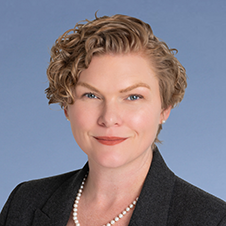
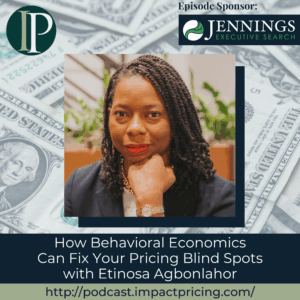
 Etinosa Agbonlahor is the CEO of Decision Alpha and former Director of Behavioral Research at Fidelity Investments. A behavioral economist by training, she helps companies understand how customers actually make decisions—and how that should shape pricing.
In this episode, Etinosa and Mark Stiving unpack the tension between real value and perceived value, why customers don’t react to prices rationally, and how behavioral economics can strengthen pricing strategies. They explore value drivers, ethical nudging, the fear of raising prices, and why most buyers don’t remember prices as clearly as business owners think.
If you want clearer, psychology-backed ways to price, communicate value, and make better pricing decisions, this episode gives you practical insights you can use right away.
Podcast: Play in new window | Download
Why you have to check out today’s podcast:
- Why customers forget your prices—and how that myth makes business owners afraid to raise them.
- How behavioral economics expands value beyond profit into perception, context, and emotion.
- How to raise prices ethically using segmentation, glide paths, and clear communication.
“Understand your customer. Do the pricing research with customers—not just with quant models. Go talk to customers. It’s important.“
– Etinosa Agbonlahor
Topics Covered:
02:08 – Pricing and Behavioral Economics. Mark and Etinosa debate where behavioral economics fits in pricing—Mark sees it as the final touch, while Etinosa argues it shapes value perception from the start.
05:20 – Defining Real vs. Perceived Value. A foundational question: is value measured strictly in outcomes, or also in emotion, context, and comparison? Their contrasting definitions reveal why pricing teams often misread customers.
09:05 – Value Beyond Monetary Price. Etinosa expands value to include convenience, safety, time saved, emotional comfort, and opportunity cost—benefits customers feel but rarely articulate.
10:37 – Value Drivers in Pricing Strategies. Behavioral research uncovers the real outcomes customers care about. Mark connects this to pricing strategy: quantify value drivers to justify stronger pricing.
15:32 – Manipulation in Behavioral Economics. Mark asks whether nudging is manipulation. Etinosa explains that behavioral tools aren’t coercive—intent determines whether they help or harm the customer.
18:02 – Ethics of Choice Architecture. Every pricing page is a designed choice. Etinosa contrasts ethical nudges with dark patterns, while Mark questions how businesses balance their goals with customer wellbeing.
22:22 – Behavioral Economics in Business. Real-world examples show how behavioral insights improve retention, financial outcomes, and long-term customer relationships—not just revenue.
24:20 – Pricing Fears and Customer Perception. The Spotlight Effect is a myth: customers don’t track your prices as closely as you think. The two discuss how clearer communication and segmentation reduce backlash when raising prices.
28:48 – Understand Your Customer. Etinosa’s closing advice: real pricing power comes from customer conversations—not spreadsheets. Behavioral economics begins with understanding actual human behavior.
Key Takeaways:
“Value is all about perception. Once you step into perception, you’re in behavioral economics.” — Etinosa Agbonlahor
“There is no such thing as a neutral choice. Every pricing page is designed—intentionally or unintentionally.” — Etinosa Agbonlahor
“People are not rational. Once you accept that as fact, you can design pricing that fits how people actually behave.” — Etinosa Agbonlahor
“Business owners think customers remember prices more than they actually do.” — Etinosa Agbonlahor
Resources and People Mentioned:
- Richard Thaler – Nobel laureate; originator of transaction utility and foundational behavioral economics concepts.
- Dan Ariely – Author of Predictably Irrational, referenced in discussing irrational decision patterns.
- Weber-Fechner Law – Psychological principle used to design perceptually smoother price increases.
Connect with Etinosa Agbonlahor:
- LinkedIn: https://www.linkedin.com/in/etinosasere
- Email: [email protected]
Connect with Mark Stiving:
- LinkedIn: https://www.linkedin.com/in/stiving/
- Email: [email protected]
Full Interview Transcript
(Note: This transcript was created with an AI transcription service. Please forgive any transcription or grammatical errors. We probably sounded better in real life.)
Etinosa Agbonlahor
Understand your customer. Do the pricing research with customers, not just with quant models that aren’t pulling from how your customers are actually interacting with your product or service. Go talk to customers. It’s important.
[Intro]
Ad
Today’s podcast is sponsored by Jennings Executive Search. I had a great conversation with John Jennings about the skills needed in different pricing roles. He and I think a lot alike. If you’re looking for a new pricing role, or if you’re trying to hire just the right pricing person, I strongly suggest you reach out to Jennings Executive Search. They specialize in placing pricing people. Say that three times fast.
Mark Stiving
Welcome to Impact Pricing, the podcast where we discuss pricing, value, and the psychological relationship between them. I’m Mark Stiving, and I run bootcamps to help companies get paid more. Our guest today is Etinosa. Okay, that’s the last one. I’m going to say the last name. Here are three things you want to know about Etinosa before we start.
She is the CEO of Decision Alpha. She was the Director of Behavioral Research Scientist at Fidelity Investments. That sounds really impressive. She wrote a book called How to Talk to Your Parents About Money, and even more impressive, she was a fellow at the Royal Society of Arts, man. Welcome Etinosa.
Etinosa Agbonlahor
Thank you for having me, Mark.
Mark Stiving
How did you get into pricing?
Etinosa Agbonlahor
So I was working with Fidelity, thinking about wanting to build my own consultancy. And because I’m a researcher, what I do is research. I did basically a year’s worth of research of talking to other business owners, other people who run big consultancies, small consultancies, just across the board to understand What kind of help would make sense? Where should I lean in?
Because every time I mentioned behavioral economics, everyone is like, yeah, whatever. But as soon as I mentioned pricing, it’s like ears per cup. People, we don’t know what we’re doing. We’re guesstimating. We’re not quite sure how to do it. I’ve run my business for 11 years, but I’m still guessing on the pricing, right? So it felt like every time I was speaking to the business owners, there was a clear need around pricing.
And the beauty about pricing is that it’s not just about numbers, right? It’s also about how your customers will interact with their price and how they’re going to view it. Psychology is going to affect that. The behavioral economics is going to affect that. So I thought this is something that is a clear need that people are willing to pay for. and also is uniquely matched to the skills and the experience that I have. So that’s kind of how I got into it, was just the need and the matching of the skills.
Mark Stiving
Nice. You probably don’t know this. I have a PhD in pricing. I studied behavioral economics, but I really care more about the quantitative side, or nowadays I care more about the value side.
Etinosa Agbonlahor
Interesting.
Mark Stiving
And so, I want to throw something out. Please don’t ever take offense at what I say, but I want to throw something out. And behavioral economics feels to me like it’s the last thing we care about. It’s like as a company, I have to build a product with value, but then I want to communicate it the right way and be able to capture a little bit more. And to do that, I use behavioral economics. So do you disagree with what I just said?
Etinosa Agbonlahor
I do, because oftentimes when you think about, I want to create value, who decides what’s valuable? Is it the customers? How do you frame that and how do you have that narrative and understand and unpack how they’re going to interact with what you’re offering and determine, yes, this is valuable, right? Value is all about perception.
And what behavioral economics does is get to the root of that perception, it gets to the heart of, if it’s framed in this way, it’s going to be perceived as less valuable. If you put it into this set with these other choices or with these other competitors, it’s going to be looked at as maybe more valuable, right?
So for me, when you talk about, we want a price to value, we want to get to the heart of value, value is we’re going to talk to customers, we’re going to understand how they perceive it. Once you get stepped into that space, you’re in the behavioral economics domain. So really behavioral economics should be at the start of all of this.
Mark Stiving
Okay, so I’m definitely going to disagree with you, but I’ll agree with you a little bit if that’s okay. I mean, I certainly agree that framing is an important part of how we are going to capture more value. When I think about value, let’s assume for a second there’s something called real value and there’s something called perceived value. So real value would be, if I’m selling B2B, real value is measured in incremental profit.
So how much more money did I actually make your company? So it doesn’t matter how I present it. This is how much money I’m going to make for your company. Perceived value is how do I present it to you? What’s the framing that I put it in? Did I have a nice salesperson or not? All of these have to do with how our customers perceive value.
Etinosa Agbonlahor
Right. So is that real value or is that more that’s the profit that I brought to the company?
Mark Stiving
That’s how I define real value is how much more – the only reason a company buys something is because they’re going to make more money than if they didn’t buy it. And so, you could measure the value in, how much more money did I make?
Etinosa Agbonlahor
I think it goes beyond that. I think it’s not just, how much more money did I make? It’s also how much more money did I save? What was the opportunity cost of going in this direction versus the other direction, right? It’s not just, this is the number. And that’s kind of the beauty of why we try to bring behavioral economics into all of this is that we want to expand the aperture from just
Here’s the profit, that’s it, right? One-dimensional and make it more from, let’s say, a simple engine. You pour the gas into it, it’s one-dimensional. Expand it to be more of a steering wheel.
How you stake the price, how you position the price, what you put it next to, all of that is going to affect what your customers are choosing and is then going to, in fact, impact what you call value. Yes, it will affect your margins, but it also affects things like retention, loyalty, et cetera. It’s expanding the aperture beyond just Did we make a profit or not? I’m going beyond that.
Mark Stiving
Yeah, I don’t think we disagree with any of that. I think the only thing is how we define value would be the only disagreement that I see.
Etinosa Agbonlahor
Yeah, say more about that. So to your mind, value feels more like did I bring a profit? Yes or no. And is that profit in the short term? Long term? Is it just perfect?
Mark Stiving
So I like to use profit in the world of B2B because it’s measurable and I can tell exactly what that is. I don’t care if it’s long-term or short-term. It’s what did you expect? By the way, here’s my definition of value. Value is the result of solving problems. And so, value is always results. And perceived value is expected results. And we can influence the expected results based on lots of different things.
Etinosa Agbonlahor
Okay, I think I see where the difference is. So when we talk about the perceived value, we don’t necessarily mean expected results. We mean the entirety of the value a person is going to get outside of just the monetary value. Right, we also mean the value in reference to some other number.
It might be the value in reference to what other people are pricing, it might be the value in reference to what you paid right before, perceived value in reference to something. That might be the gap, that might be where things are a little bit different.
Mark Stiving
Yeah, so we go to, here we go, let’s talk like we’re academics for a second, right? We’re going to go to Thaler’s acquisition utility and transaction utility, right? And so transaction utility has to do with reference prices. What did I expect to pay?
And oh, I got a much better deal, so I feel really good about this. So that had nothing to do with value, but it certainly influenced the purchase price. That certainly influenced someone’s willingness to pay or someone’s willingness to buy my product.
Etinosa Agbonlahor
So let’s take it… I love this theoretical conversation. So let’s assume that you’re going to go buy a new car, right? You assumed, walking in, that I’m comfortable spending about $30,000. I’m going to end up spending about $30,000 for this car.
With all the discounts, et cetera, maybe you got a great salesperson, you guys had a great conversation and said, hey, it’s the end of the month, let me do you a solid. You come out having spent only $25,000 on the car. Now, in that instance, how do you define the value?
Mark Stiving
So I define value as the result of solving problems. So it has everything to do with the benefit of owning the car. It had nothing to do with the price of the car. So some people define value as the benefit minus the price. I don’t, I can’t price to that. So I price to what’s the total benefit. So I think of value as the benefit, the result of solving the problem. So you gave me a great deal, awesome. The value of the car was identical. It doesn’t matter how much I paid for it.
Etinosa Agbonlahor
In that instance, though, that’s interesting. So to you, the value of the car has nothing to do with what the original reference point was. It’s just, what did I pay for it? The value of the car is $25,000 because that’s what I paid for it. Not that I feel… No, no, no.
Mark Stiving
The value of the car isn’t $25,000. That’s what I paid for it. The value of the car is $700,000 because it drives me to work every day, it takes my kids safely from here to school. It has so much more value than $25,000.
Etinosa Agbonlahor
Do you find that the car, because you got that deal on it, feels more valuable to you now or is it still at the $700,000 you walked into it with?
Mark Stiving
In fact, it probably feels less valuable if you’re going to say, hey, I paid less for it. But it depends on how we define value again, right? If value is the benefit, the benefit is, hey, I’m driving to work, I’m taking my kids, that’s the benefit. If value is – which a lot of people define value as what’s the benefit minus the price I paid. Then I could say, yeah, that was a great value, right, because I paid less. But I can’t use that definition of value in pricing because I’m trying to price something.
Etinosa Agbonlahor
So how we use it in pricing, and I don’t necessarily know that we are different on our definitions of value, if you’re using it in that sense of it’s not just the monetary aspect, it is it’s taking my children safely to school, it is saving me on time, it is all of those other like elements to it.
When we do our research, what we like to do is talk about what we call value drivers, which is getting my spouse to work on time, getting the kids to school on time, all of those different elements of it, and put a number around that, right? What would you pay for that? How do you think about that?
And that helps our clients kind of expand the aperture to understand, okay, when we’re talking about value here, it’s not just you deliver the car under some of the cost that it took to make the car, ship the car, get it to your showroom. minus whatever margin you put on it. It is, this is how your customer thinks about it. These are the other value drivers that are involved in the transaction.
And that then gives you leeway to understand how do I frame it? How do I shape it? What position and what do I lean into in the conversation? So we’re always trying to widen that aperture when we talk about value. It’s not just that we deliver a car and this is the cost of the car minus the margins, right? It is also, this is the benefit of the car to other people. And let’s try and put a number on that and bring those perspectives into the conversation as well.
Mark Stiving
Yeah. So by the way, we agree a hundred percent on everything except the definition of value.
Etinosa Agbonlahor
We have to live here aligned on a definition.
Mark Stiving
We do not have to leave. I’ve had this conversation with so many pricing people and every pricing person has a different definition of value.
Etinosa Agbonlahor
Yeah, because to me, I would have thought it’s intuitive that the value that you get from something is not just whatever you paid for it, that’s what you paid for it, but it is both the quanta, should we say, both the objective and the subjective, right? The value I get from the water bottle on my table is that it keeps me hydrated and it keeps me healthy, right?
What is the price I would pay for remaining healthy on a consistent basis, right? So it’s not just, this is what it costs and therefore the value is what it costs. This is what I paid for it, therefore the value is what I paid for it. It is, this is everything that benefits me. And I’m always looking at those benefits relative to some sort of reference point. right?
It’s a lovely water bottle compared to like a plastic bottle. Maybe I feel better about saving the earth. All of those different dimensions kind of coming to it because we think, at least I think that that’s how human beings who are not PhDs in pricing think about and navigate the world?
Mark Stiving
No, I think we’re spot on. To me, I agree completely that there are things we think in terms of relativity, right? Value is almost always relative to something. It could be relative to the status quo, it could be relative to an alternative, but it’s relative to something. I totally agree.
But when we start playing with behavioral economics, it has – you know, Dan Ariely’s title of his book, Predictably Irrational, is phenomenal because what we do in behavioral economics is we prove that people are not rational. We get people to make less than rational decisions with behavioral economics. And in fact, I’m going to ask you a really hard – well, go ahead, comment on that and then I’m going to ask you a really hard question.
Etinosa Agbonlahor
So it’s less about proving and more about accepting it as fact. And so if I accept it as fact that if I make my customers pay for something every single month and they can see the money living into their account, eventually this utility they get from seeing those payments leave their accounts every so often might be enough that it might drive them to want to stop the subscription versus if they paid once a quarter, right?
The pain of paying. Transaction goes back to what you’re talking about, about transaction utility. If we take that and go, knowing how people make decisions about money, knowing the psychological ramifications or constraints they put around their financial decision making, why don’t I design my price in a way that the money isn’t living in their accounts every so often?
So I take it as fact that people are not rational and they care about seeing the money go out of their account all the time. So instead of saying, hey, I’m going to charge you $100 every single month. Maybe I charge you $400 every quarter, right? Nominal values are the same. We’ve just changed the way that we’re presenting the price to people.
All of that to say what I’m trying to get at is we accept as fact that people are not rational. It’s not about trying to prove that. It’s a fact. We accept it. The fact that now that we accept it, it’s how do we design the world in a way that’s going to lean into and help people make better financial decisions, taking those fallacies into consideration.
Mark Stiving
Okay. Love this. I absolutely love this, right? But by the way, academics try to prove that people are irrational and be able to predict it. But in the real world, right, as business practitioners, we take it as fact, right? We know it works.
Etinosa Agbonlahor
And the reason academics are trying to prove is, of course, neoclassical economics walked around the world for hundreds of years saying people are rational and this is the utility and value is this, right? Utility equals value.
And so our academics are caught up in the web of, we can’t start from that foundation. Here is why. We have the privilege of going, yes, obviously we cannot start from that foundation. What does it mean for helping businesses? What does it mean for helping people? But go on.
Mark Stiving
Okay. Now here’s the really hard question. In the world of behavioral economics, we have the ability to sway people’s decisions. And so let’s consider that a power, a superpower. And we can use that superpower for good or for evil.
Meaning I can get you to make a smarter decision for yourself. I can get you to save money where you wouldn’t have saved money. Or I can get you to buy more ice cream cones where you shouldn’t be buying more ice cream cones. How do you deal with the fact or explain the fact that you could say behavioral economics is really about manipulating people?
Etinosa Agbonlahor
So love that question, first of all. In behavioral economics, we talk about this notion of libertarian paternalism, which is a term that I don’t like at all. But what it basically says is that every time you put something in front of somebody, you frame that choice one way or another, right? If you are, for example, there’s a famous company that rhymes with shamisen that was notorious for using what we call dark patterns to when people would try to quit one of its subscriptions.
And you’d have to go through like six pages and big warnings and very small letters and you know dark patterns right they had framed it and set it up in that way In behavioral economics, we talk about the fact that every time we put a choice in front of somebody, you have designed that choice one way or another. There’s no such thing as a neutral choice.
Every time you have chosen and put a pricing page in front of your customer, you’ve made choices about the number ending in nine. We’ve set it up in this manner, right? There’s no such thing as neutrality. And so what behavioral economists are doing, and we talk about this notion of nudging for good, which is everything that we want to do is to never take choices away from the customer or from the end recipient. It’s always, you can choose this or that.
We’re not going to remove any choices from the table, but we know that if we set it up in this way, you’re more likely to go in that route, right? We’ve created a path in the green, and we know most people are going to walk on the path. You can choose to walk on the grass if you wanted to, but you’re going to most likely walk on the path that we’ve created. And so we always want to nudge for good.
And also, we don’t actually think that it is, it can be manipulative, right? Anything can be manipulated. That’s a fact. There’s no such thing as being a neutral choice architect. There’s no such thing as putting a neutral choice in front of the person. We’re going to suede one way or another. Behavioral economics is saying intentionally we want to suede so that you get a better outcome than you otherwise would have.
Mark Stiving
And I think the problem that we have is better outcome for whom, right? And so if I’m in business, is it a better outcome for my customer or is it a better outcome for me? And as a businessman, my goal is to get my customer to pay me more money. And so is that a better outcome for them or a better outcome for me?
Etinosa Agbonlahor
I used to think that I literally just had a conversation yesterday with somebody who runs massive, massive, the speaking coach I mentioned, big speaking businesses on the platform, Fortune 500, all those great things. And this person said to me, I’m not in this just to constantly make more money, right? We’re at a place where the business is doing fine. It’s sustainable. I don’t even know if I want to change my pricing. My goal is to make an impact.
And I think that a lot of small businesses, at least, come into this and their entrepreneurship journey because they actually care about making an impact. It’s not just how do I, you know, coax as many people as possible to give me as much money as possible forever. It’s how do I make sure I’m actually making a change? How do I make sure I’m actually influencing people positively?
And so, the conversations that we have with small business owners are often less about, this is how you turn the wheel and get as much profit as possible. And more about this is the conversation you want to have with your customer. This is how you put that price in front of them. These are the tiers that you want to consider. This is how you understand the opportunity cost of the price that you’ve chosen.
Just so you know, I could be at this rate, but I’m choosing this rate because that’s sustainable for my customer. And I’ve had the same conversations with lawyers, which we know what the opinion is about lawyers. So just to go back to that original point, I don’t think that every business owner is in it so they can squeeze as much money from customers.
But also, most big businesses understand that they don’t become sustainable by cheating people or by ripping people off or by squeezing as much dollars from people as possible. I worked for a very long time with the Commonwealth Bank of Australia, and I worked in a team. We called ourselves the Financial Wellbeing Team.
Part of the reason we had that moniker was because in Australia at the time, one in every three Australians banked with the Commonwealth Bank. Whether they had a mortgage, a loan, a credit card, whatever it was, most of the country banked with the Commonwealth Bank. And so the bank intuitively understood that healthier customers are more sustainable because from 18 all the way until that person passes away, they are going to be working and being served by that bank.
So ultimately, it matters that a customer is financially healthy. It matters that they can come to the bank when they’re in moments of distress. It matters that at the end of the day, they know that the bank is somebody that they can trust and they can do good business with for the entirety of their lives, because then a loan impairment expense goes down. People pay their loans on time. People can buy into more pricier products.
People can buy investment products because they’re not struggling and being ripped up by the bank for every dollar. So all of that goes to say, most businesses that are in this and do this well and do this sustainably, they’re not in this to rip as many people off as much money as possible. They’re in this to think, how do we make an impact and how do we make sure that we are getting the right level of value for the impact that we make?
Mark Stiving
So I love your answer. Not that I agree with it, but I love it. So here’s what I disagree with. I hope you don’t mind that I disagree a lot.
Etinosa Agbonlahor
Oh, no, no, I like people who disagree. It makes for a more interesting conversation.
Mark Stiving
Here’s what I disagree with, is just because I want to make more money doesn’t mean I’m ripping off customers.
Etinosa Agbonlahor
Of course, not necessarily.
Mark Stiving
It doesn’t mean I want to rip off customers. So if I think about that company that rhymes with Shamazon again, right, there is no doubt in my mind that they do behavioral economics every single day to figure out how to get someone to pay me three more cents. Now, they don’t think of that as ripping people off because, I mean, one of my favorite quotes from Bezos is, your margin is my opportunity. Right?
And so he’s driving costs down in an industry, but at the same time, he’s getting as much as he possibly can while he’s doing it. So you could say he did it for good. You could say he did it for evil. But there’s no doubt he’s using behavioral economics to get those extra few pennies per transaction.
Etinosa Agbonlahor
And so what’s your intuition? What are you saying?
Mark Stiving
All I was saying was that one could argue it’s manipulation, but I think the answer that you gave that I really like the best is there’s no such thing as a neutral choice. There just isn’t. Right. Now, it seems unfair that big companies get to go out and test a whole bunch of different ways to submit choices, and then they present the choices in the way that is best for them and not best for me as the client or the buyer, necessarily.
Etinosa Agbonlahor
I think that with the businesses we work with, the perspective is if we make a buyer happier, healthier, more whole, in the long run, that’s better for us. Right. And this goes back to that conversation we’re having about short-term profits versus that long-term loyalty, long-term retention. And so at the end of the day, it is not, let us set this up in a way that gets this person to pay three cents, but they’re upset.
They know that something has gone wrong or that they’re paying more when they come to us than they go somewhere else. And they’re probably not going to stay with us for that long. Right? If we go to that perceived value conversation with the company we’re discussing, people might say the perceived value of I ordered something yesterday and I got it today. Right?
I know that there’s some sort of, there’s been trade-offs for me to be able to have that experience, but maybe it’s worth it to me to pay a little bit more and to be nudged to pay the three extra cents because I care a lot that I got the thing today. And so again, it’s expanding the aperture beyond just the numbers.
Mark Stiving
I have to say, first off, I’ve so enjoyed this conversation so far. And I feel like we haven’t talked about anything that you said, hey, I want to talk about these topics. So let’s jump in. We got five minutes. Let’s jump into one of them that you brought up. And it’s one of my favorites, by the way. Tell me why people are afraid to raise prices and how we help them get over that.
Etinosa Agbonlahor
So in behavioral economics, we talk about the spotlight effect. And the spotlight effect is essentially this notion that your customers have magnifying glasses and are looking at every single thing that you’re doing with your pricing or within your business, and are ready to flip the table the minute that you change something, right?
There was a study that was actually done that I really, really like, and I talk about this a lot. Essentially, imagine that you’re shopping in your local grocery store. A researcher comes up to you with a clipboard and asks you, hey, that box of cereal you just put into your basket, how much does it cost? How many people do you think remembered how much it costs?
Mark Stiving
Zero.
Etinosa Agbonlahor
Six out of 10 people remembered. And of those six who remembered, half of them were wrong. And when the item was on sale, it was even lower. And so that tells us that, you know, Business owners, pricing teams, we feel like all of our customers are walking around with this magnifying glass just trying to, you know, waiting for you to do something and then that’s it, they’re going to leave. That’s not true.
Of course, there is some sensitivity. We do keep an eye on like the price is changing. What is the reference point? What did we pay the last time? What’s the new price? But in general, business owners are scared to raise prices because they think that their customers are more price sensitive and remember their prices more than they actually do. So that’s one reason.
Mark Stiving
Go ahead. You know what I love about that answer is I work a lot in the subscription world and in subscriptions, if you raise my price, you have to tell me you raised my price. And so there really is a spotlight on it. And so we talk about how to get over that. But I always say, look, new customers don’t even know you raised the price. Who cares? And so if I’m making a separate transaction, you know, once a month, once a quarter, once a year, I have no idea what the last price was. Yep. I love that answer.
Etinosa Agbonlahor
And so what do you do when you have this price raise and conversations with your clients since you’re in the subscription world and you said I could ask you questions, what do you do when you’re having those conversations with them? How do you say, okay, these are the steps I recommend for you to raise your price?
Mark Stiving
Well, it depends on if we’re going to raise prices on new subscribers or existing subscribers, right? So new subscribers, I say, just go do it, right? Existing subscribers is the hard part. How do I get someone to raise their prices? And so the first thing I do is I say, look, I want you to segment your customers. who is it that gets the most value for what they’re paying.
Oftentimes we can tell that based on how much they use the product, whatever that happens to be. And so we start at the top, the people who use it the most, we raise their prices and we start working our way down. And then once we get to a point where churn is unacceptable, we stop raising prices below that point. So people who aren’t using the product never see a price increase.
The second thing I do is I really am very adamant about the communications that they have to use. This is all behavioral economics now, right? But the communications are all around, we haven’t raised prices in three years, we’ve added more value, we’re going to invest in more value. So all things that just make people feel better about the fact they’re about to pay me more. I like to say people hate price increases, but if you communicate it well, they will hate you a little bit less.
Etinosa Agbonlahor
I mean, spot on, that is fair. And what you mentioned is similar to what we do. We use this, there’s the Weber-Fechner law, right? So that when you’re turning the radio dial up, if you turn it all the way and the volume changes all of a sudden, it’s more noticeable. And if you turn it slowly, slowly, slowly, slowly, that increase is less perceptible.
And so we talk about putting legacy customers on some sort of glide path, right? And again, the communication has to be This is the new value we’ve been delivering to you, right? This is all the value you’ve gotten from it, personalizes it better.
This is what we’re going to be doing moving forward. This is a new price. Keep it short. Keep it simple. Don’t apologize. Don’t send a 900 page memo. Just be clear cut about this is why we’re doing it. This is what it looks like, you know, so aligned on the communication part of it too.
Mark Stiving
Yep. Perfect. Perfect. Cool. So this is just fun. I’ve enjoyed this a lot, but it’s time to wrap it up. Here’s your final question. What is one piece of pricing advice you’d give our listeners that you think could have a big impact on their business?
Etinosa Agbonlahor
The most important piece of advice I would give is to understand your customer. Do the pricing research with customers, not just with quant models that aren’t pulling from how your customers are actually interacting with your product or service. Go talk to customers. It’s important.
Mark Stiving
Oh, God, I couldn’t agree with that anymore. Right. Just go listen to your customers. Absolutely. Etinosa, if someone wants to contact you, how can they do that?
Etinosa Agbonlahor
They can find me on LinkedIn. So it’s just my first name and last name, Etinosa Agbonlahor. They can also send me an email. It’s just [email protected].
Mark Stiving
And we will put the URL to the LinkedIn page on our website or our show notes, so you guys will have access to it. And to our listeners, thank you very much for your time. If you enjoyed this, would you please leave us a rating and a review? And finally, if you have any questions or comments about the podcast, or if your company wants to get paid more for the value you deliver, feel free to email me, mark at impactpricing.com. Now, go make an impact.
Ad
Thanks again to Jennings Executive Search for sponsoring our podcast. If you’re looking to hire someone in pricing, I suggest you contact someone who knows pricing people. Contact Jennings Executive Search.
[Outro]