Every AI company seems to want outcome-based pricing. Charge for results. Align with the buyer. Capture the value you create. It sounds like the obvious answer.
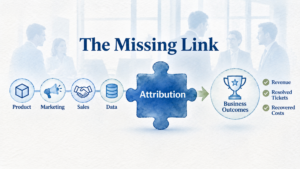
Most products can’t. The reason is attribution.
Outcome-based pricing allows you to charge for an outcome that you caused.
But “caused” is harder to pin down than it appears. Many things contribute to any given outcome. A sales rep closes a deal. The CRM tracked the contacts. The marketing team generated the lead. The product delivered on the promise. All of them contributed. So who caused the outcome?
Attribution for outcome-based pricing is more specific than contribution. It requires that your work was necessary for the outcome to happen. That is a much higher bar than “we helped.”
Most products contribute to outcomes. Very few are required for them.
Intercom’s Fin is a good example. Fin charges per resolved support ticket. Remove Fin from a ticket it handles, and that ticket requires a human or some other solution to get resolved. The resolution is required for the outcome. Fin is required for the resolution. Attribution is clear.
Now consider an AI tool that helps sales reps write better prospecting emails. The emails are more polished. Response rates improve. Deals get created that might not have existed otherwise. That is real value.
But remove the email AI, and deals still close. No one has to send that email for it to happen. The email AI contributes to the path, but the path exists without it. Attribution doesn’t hold, and outcome-based pricing is not available, no matter how much the product improves results.
This is the linchpin test: does the outcome require your work, or does the outcome happen with or without it?
A few categories consistently pass the test. AI that resolves a support ticket autonomously. Software that recovers a chargeback. A recruiter who places a candidate. A lawyer on contingency. In every case, the specific result requires the provider’s work. Remove them, and the buyer must find a replacement or the outcome does not happen.
Attribution doesn’t require sole causation. Fin doesn’t control the internet or the quality of the customer’s historical data. A contingency lawyer doesn’t control the jury. Other contributors matter. What attribution requires is that the provider’s work is a required part of the path, not that it is the only part.
IMPORTANT BUT: Even when outcome-based pricing is not feasible, outcomes still belong at the center of your sales and marketing.
Buyers care about outcomes. That never changes. Your product contributes to those outcomes, and that contribution is worth making visible. The question for pricing is different from the question for selling.
When you sell, connect your product to the outcomes your buyers care about. That framing is accurate and persuasive whether or not you can price on those outcomes. The email AI company should absolutely talk about closed deals. It should build its sales story around the outcomes its product moves toward.
The mistake is assuming that because buyers care about outcomes, every product should price on them. Outcomes are always relevant to value. They are only sometimes the right basis for pricing.
This is my early thinking on this topic, and it may not be complete. I would love to hear your thoughts.
Share your comments on the LinkedIn post.
Now, go make an impact!
A note on process: Every idea, argument, and opinion is mine. Claude (and Rebecca) made the writing better.
 Tags: ai monetization, outcome pricing, outcome-based pricing, pricing, Pricing AI, pricing attribution, pricing metrics, value, value-based pricing