Ask most executives why their customers buy from them, and you will get an answer about the product. Better quality. Faster delivery. Easier to use. Those answers describe features, not reasons to buy.
Here is a test. Ask yourself why a food processing plant buys pest control from Orkin.
The obvious answer is fewer pests. But it’s wrong.
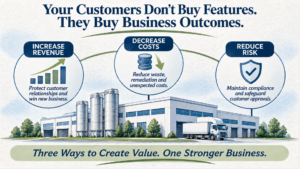
A food processing plant buys Orkin to protect ingredients from contamination, to keep production running and orders shipping on time, and to maintain the audit records that keep their biggest customers from pulling their approvals. Pests are the mechanism. Lost product, missed deliveries, and lost customer contracts are the actual problems.
Those are three completely different business outcomes. And they map directly onto the three ways a product delivers value: increased revenue, decreased costs, and reduced risk. Orkin delivers all three. Their marketing covers two.
The cost story is clear in their messaging. Fewer pest incidents mean less discarded product and less unplanned remediation spending. The risk story is also there. Good documentation and audit support protect customer approvals. But the revenue story is largely absent. Reliable delivery protects existing customer relationships and helps win new ones. For a food processing plant, that connection matters. Orkin’s marketing never makes it.
I call that gap Buyer Disconnect. Your customers have real business problems they are trying to solve. Your product solves them. But if your messaging focuses on what your product does rather than what your customer needs, you are having the wrong conversation. You win some deals anyway, because buyers are forgiving. You leave money on the table because they never fully understood the value you delivered.
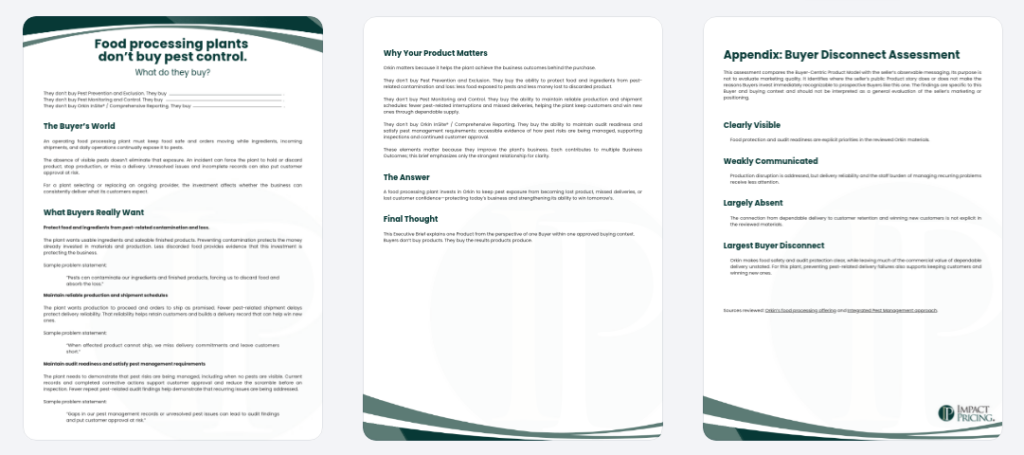
I built a tool to fix this. It is called the Buyer-Centric Product Model. You give it a product and a specific market segment. It works through roughly ten steps and produces a detailed picture of why buyers in that segment actually invest, what business outcomes they are trying to protect or improve, which of your features drive those outcomes, and where your current messaging is missing the mark. The Orkin executive brief attached to this post came out of one run of this model.
I want to test it on a few more real companies. If you want to know what your buyers are actually buying, reach out by email or on LinkedIn and include one product and one specific market segment. I’ll select a few people, and we will run it together, at no cost. It will take us less than an hour.
You’ll be surprised by what you learn.
Share your comments on the LinkedIn post.
Now, go make an impact!
A note on process: Every idea, argument, and opinion is mine. Claude made the writing better.
 Tags: Buyer Disconnect, buyer outcomes, buyer problems, buyer value, buyer-centric marketing, customer value, value, value communication, value proposition