In 72% of cases, executives’ beliefs about what customers value had low, zero, or negative correlation with what customers actually reported.
That is the core finding of “Do You Know What Your Customers Value?” by Vikas Mittal and colleagues in Harvard Business Review. It is based on seven years of research across 72 companies, 24,000 customer surveys, and more than 3,000 hours of strategy meetings. It is worth your time.
The gap is costly. Companies where executives and customers agreed on value drivers outperformed on revenue, gross margins, free cash flow, and market value.
The value drivers are specific and observable. How quickly quotes are delivered. How proactively a supplier communicates project status. How reliably issues get resolved. Companies that focused on the two or three drivers that actually moved customer value improved significantly. One distributor cut quoting time from 18 hours to under 5. Its sales growth outpaced the industry average by 12% over four years.
One more finding stuck with me. Customers are stable in what they care about. Executives are not. They pivot constantly, which burdens employees and confuses customers without improving anything.
Here is where I would take it further.
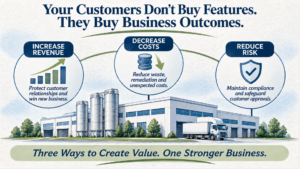
The value drivers in this research, things like communication, quoting speed, and ongoing support, describe what a supplier does. They tell you that customers care about fast quotes. They do not tell you why.
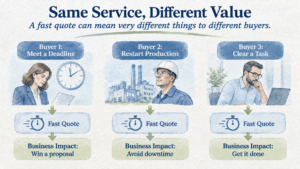
One buyer needs a fast quote to close her own proposal before a deadline. Another needs it to restart a production line. A third just wants to clear a task off his list. The supplier does the same thing in each case. The consequences for the buyer differ significantly, and so does the value.
Those consequences are what make a real price conversation possible. A buyer whose production line is down has a very different willingness to pay than a buyer completing a routine purchase.
The research aggregates across buyers, which is right for deciding where to invest. The next step is to use those signals to find segments: groups of buyers who share the same underlying problem. Then go deep on what that problem costs them. A high score for quoting speed is a signal worth following. It tells you where to start asking questions.
The authors proved that executive confidence about customer value is often misplaced, and that closing the gap pays. Knowing which activities customers rate highly is a strong start. Knowing why they matter, and to which buyers, is where the pricing power is.
Understanding value at the buyer level is where I spend most of my time. If you want help thinking through what your buyers care about and why, reach out. I am always happy to talk.
Share your comments on the LinkedIn post.
Now, go make an impact!
A note on process: Every idea, argument, and opinion is mine. Claude (and Rebecca) made the writing better.
 Tags: buyer value, customer insights, customer value, pricing power, value, value drivers, value perception, value-based pricing, willingness to pay