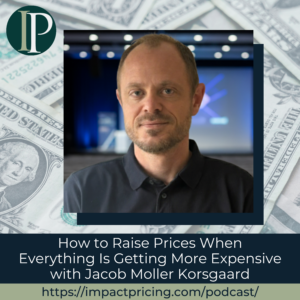
What happens when your costs keep rising, your contracts lock you in, and your customers still expect stability?
Jacob Moller Korsgaard, Director of Pricing at Danfoss, has spent 15+ years in B2B pricing and leads global pricing for Danfoss Climate Solutions. In this episode, he explains why raising prices during inflation is about much more than adding a percentage to your price list.
Jacob breaks down the commercial judgment, timing, contracts, communication, and execution required to raise prices without creating unnecessary disruption in the market.
**The next opportunity to meet Jacob Moller Korsgaard in person will be at EPP 20 Years Global in Amsterdam on 17–18 November. Register here to secure your ticket.
Podcast: Play in new window | Download
Why you have to check out today’s podcast:
- Learn why annual price reviews are no longer enough when costs can change dramatically in weeks.
- Discover how timing, contracts, and distribution channels can make or break a price increase.
- See why successful price increases require more than cost recovery. They require commercial judgment and disciplined execution.
“We need to be prepared for doing more often price adjustment and we need to focus on the execution part so we implement it efficiently and get our margins secured.”
— Jacob Moller Korsgaard
Topics Covered:
02:45– The Commercial Judgment Pricing Teams Need. Why pricing teams need to understand customers, channels, segmentation, product management, finance, and IT to make better decisions.
05:00 – Why Annual Price Reviews Are Gone. Jacob explains why B2B companies need to react faster to cost changes while avoiding market disruption.
07:00 – How Often Should You Raise Prices?The case for an agreed pricing calendar instead of constantly recalculating prices every time costs move.
09:00 – The Contract Problem Nobody Can Ignore. Why price increases fail when contracts lock in pricing for months or years, and why improving contract flexibility matters.
11:00 – Is Inflation Just an Excuse for Cost-Plus Pricing?Jacob explains how rising costs can eventually affect customer value perception and why cost changes still need to connect to value-based pricing.
13:30 – Should You Lead the Price Increase? Why competitive dynamics can create an opportunity to move first, especially when the entire market is facing similar cost pressures.
15:30 – How to Communicate a Price Increase. Jacob shares why Danfoss aims for direct, honest, and consistent communication, while allowing local markets to adapt the message.
19:00 – What AI Can and Can’t Do for Pricing. Jacob explains how Danfoss is using AI, analytics, and pricing software while emphasizing the importance of commercial judgment and good data.
21:00 – The Pricing Advice Jacob Wants You to Act On. Prepare for more frequent price adjustments, strengthen execution, secure your margins, and build the processes and tools needed to implement increases efficiently.
Key Takeaways:
“We need to be prepared for doing more often price adjustment and we need to focus on the execution part.” – Jacob Moller Korsgaard
“If we know that 50% of our revenue is bound in contracts, we cannot change them.” – Jacob Moller Korsgaard
Connect with Jacob Moller Korsgaard:
Connect with Mark Stiving:
- LinkedIn: https://www.linkedin.com/in/stiving/
- Email: [email protected]
Full Interview Transcript:
(Note: This transcript was created with an AI transcription service. Please forgive any transcription or grammatical errors. We probably sounded better in real life.
Jacob Moller Korsgaard
We need to be prepared for doing more often price adjustment and we need to focus on the execution part so we implement it efficiently and get our margins secured because that is going to be key now.
[Intro]
[Advertisement]
Every year, the best pricing and commercial strategy minds in the world find each other in one place. This November, that place is Amsterdam. EPP is celebrating 20 years by bringing 1,000 pricing and RGM leaders together for its global summit, November 17th and 18th. If pricing is your profession, this is where you belong. Register at pricingplatform.com.
Mark Stiving
Welcome to Impact Pricing, the podcast where we discuss pricing, value, and how buyers decide.
I’m Mark Stiving, I help companies turn hidden value into willingness to pay.
Our guest today is Jacob Mueller, Korsgaard . Here are three things you want to know about Jacob before we start. He is the Director of Pricing at Danfoss. He leads global pricing for Danfoss Climate Solutions.
He has 15 plus years in B2B pricing with other experience in finance and sales, and he’s led global pricing transformation, commercial excellence, and pricing technology initiatives across many markets. Welcome, Jacob.
Jacob Moller Korsgaard
Thank you very much, Mark. I’ve been looking forward to talk to you.
Mark Stiving
Hey, did I also read that you’re an endurance athlete?
Jacob Moller Korsgaard
No, that is not correct.
Mark Stiving
Oh, okay.
Jacob Moller Korsgaard
I did a five case to be endurance.
Mark Stiving
For me, it is. Yeah, absolutely. So, let’s start with the easy question. How did you get into pricing?
Jacob Moller Korsgaard
Oh, like so many other people, a little bit by coincidence. I was working more on what we call sales development. I was implementing a new CM software and doing contract management, account planning and so on.
Someone asked me, why don’t you come over here and work with pricing?
And I said, I don’t really know what I should think about that. But I really liked the person who asked me to join his team. So I did.
And then the more I got into it, the more interesting it just seemed to become. And I’ve sticked in the discipline for quite some time now.
Mark Stiving
What do you find fascinating about it? Why do you stick with it?
Jacob Moller Korsgaard
I think for me, you really get the opportunity and the chance to work on a lot of different disciplines and you get exposure both to the commercial side, but also to the financial side and analytics, legal even nowadays. So there are so many people you can talk to and things to learn.
Mark Stiving
Yeah, I kind of think of it as the center of the company. We end up dealing with everybody.
Jacob Moller Korsgaard
Me too. And then some people will remind me, remember, it’s not the center of the world always.
Mark Stiving
Well, so we touch everything, but we have no power. That’s the best part.
Jacob Moller Korsgaard
Yeah. We often call ourselves an enabling function. And I think that’s probably what a lot of people in pricing are.
Mark Stiving
One of the things that we talked about, possibly talked about today, and I really want to jump on this, is this concept of commercial judgment.
And I don’t think many pricing people have heard the word or even know what it means. So what is commercial judgment? What does it mean to you? What do you have to do in the world of commercial judgment?
Jacob Moller Korsgaard
For me, I will not say I’ve heard conceptually that word before as such, but commercial judgment for me is getting closer to the commercial side of the business.
That for me means to understand how are the processes very close to our customers. How does that actually work so that we can support the pricing side of it and it’s not in conflict with how we operate the business.
Mark Stiving
So should I think of it as sales and marketing and product development and how we’re going to package products? It’s like all of these consumer or customer facing functions that we have inside our company.
Jacob Moller Korsgaard
And which sales channels are we serving? There’s often a big difference between working through distribution or OEMs or understanding that whole area of the commercial disciplines is of course crucial for us to do a good job in pricing because we need to be able to differentiate our offer.
Mark Stiving
Yeah. And you know what I don’t like about that phrase commercial judgment is it doesn’t feel like there’s an answer. It feels like hey take a guess. Right. What do you think should happen.
Jacob Moller Korsgaard
But I think it’s actually quite rare and that’s maybe also coming back to what the role of pricing is, it is quite rare that you find people who really understand the commercial side, but also understand the IT landscape or the financial background.
And here we can really play an important role to make these ends meet. But if you don’t understand the commercial side, then we can simply not do our job well enough, and we should be controlling our product management.
Mark Stiving
It’s kind of funny because when I heard the description of commercial judgment for the first time, in my mind, I was thinking, well, that’s what we do in pricing, right?
I mean, obviously we don’t make all the decisions. We don’t make product decisions or marketing decisions or sales decisions, but we have to understand all of that in order to figure out what’s a buyer willing to pay. How do we figure out how we want to price this thing?
Jacob Moller Korsgaard
And then you need to understand customer segmentation and route to market. I’ve just discussed, else you cannot make that judgment.
Mark Stiving
Yeah. So they’re all, they’re all tied together. Nice. Okay.
So now here’s the thing that you asked me, Hey, can we talk about this? And I love talking about anything that my guests are interested in.
Let’s talk about inflation and how is it that we should be thinking about pricing in this world of inflation? Isn’t the answer just raise prices?
Obviously we know that’s not the answer, but go ahead.
Jacob Moller Korsgaard
Well, it’s part of the answer. So of course we need to raise our prices when our costs are going up significantly and then that is, of course, something we have seen during the last two years here.
After a little break that we had after COVID, where it was basically the same situation, that for different reasons, your costs will go up on different raw materials, on freight, on fuel, more or less across the spectrum.
And it has gone up very quickly and dramatically. Terrorist is just one example. It can be all the spikes that we have seen.
So you really need to be able to react quickly and also very efficiently. So the good old days with an annual price review is definitely gone. But for many companies, the answer is not to have a full dynamic pricing.
So if you’re working B2B like I do, you need to also be able to forward your price increases to, for example, your wholesalers so they can also forward it to their customers. So there’s a whole dynamic there you need to understand, maybe back to your commercial judgment.
So we definitely need to be quicker and faster to react, but we also need to do it in a way so we’re not just disturbing the market and creating chaos every time we do it, but have a sequence where we enable that the increases can be followed through all the way to the end user. course always paying for this eventually.
Mark Stiving
So let me ask a couple of questions on that.
First off, how frequently do you think we should be revisiting pricing?
Jacob Moller Korsgaard
That’s an extremely good question that we’re discussing very much in my company.
So there’s a lot of different opinions on that. Of course, some would say you need to do it immediately when the cost hits. You need to recover that and therefore you need to be extremely quick in forwarding increases.
Others are more into we need an agreed calendar with X slots every year so our customers have an idea of when we’re coming and we can plan our processes around that.
And for me personally, I think the idea of a calendar which can look different from industry to industry makes a lot of sense because then you can ensure that your internal processes are more aligned as opposed to constantly being very reactive to the changes that are bound to happen, because the other side of the coin is that when you see these cost increases that comes kind of from week to week, it seems like, then if you wait one week and do the calculation again, you might come to a different result.
So you need to keep on calculating until, but you, you know, you need to act.
So therefore there needs to be some agreed dating on when you do what, so that the organization can follow and you can install a solid product.
Mark Stiving
So one of the things that should be driving timing is contracts. I assume in the world of B2B, you’ve got contracts and contracts have, you know, year long or when’s the contract renewal date, multi-year renewal dates.
Jacob Moller Korsgaard
How do we deal with that? Again, a super complex topic and something that will often come in conflict with the calendar I just mentioned, because yes, in many companies, we do have contracts that says for this specific customer, we have a four month notice or two year agreed pricing period.
So we need to look into how can we in this new reality do some changes consistently to a contract database that will allow us for some more flexibility.
Mark Stiving
Yeah. And it almost seems like it’s a great reminder that we’ve got to change our contracts next time on contract renewal time that says, Hey, we don’t want to get stuck with this, with this issue.
Jacob Moller Korsgaard
Again, part of, I don’t know if that was what you meant with commercial judgment, but It doesn’t make sense if we just push increases, push increases.
If we know that 50% of our revenue is bound in contracts, we cannot change them. So we need to get that done before we can have a high implementation rate.
Mark Stiving
Yeah, nice, nice.
Okay, so I’m going to push back on something pretty hard. Almost everything that you’ve talked about so far implies to me that we’re doing cost plus pricing.
And I am not a fan of cost plus pricing for many, many reasons.
So do you think this is cost plus and do you think it’s the right way to do pricing?
Jacob Moller Korsgaard
To some extent, of course, I’m talking about cost going up and then you can say, okay, you put in a margin on top of that and that would be cost loss.
But again, what I often say when people are asking that question is that, especially in this situation, the inflation is coming and it’s going to sit in the value perception over time.
So with these huge increases we have in cost now, it is going to change the perceived value maybe a bit later. Maybe customers will not accept it in the beginning, but I think even you, you have also forgotten what’s the price of milk three years ago. There is a relation between cost increases and also value-based pricing if you want to ensure that your prices are value-based. And how do you then take that into your value-based pricing logic. That can be done.
Mark Stiving
Yeah, so let me defend everything you said, but not do cost plus pricing. That’s okay. And here’s how I would defend it.
Our costs have gone up, our competitors’ costs have gone up, and one of us is going to lead a price increase, so we might as well lead it.
But in the end, buyers have to choose between us and a competitor, and so it isn’t the overall price that’s driving it, it’s the price relative to the competition that’s driving it. Correctly.
Jacob Moller Korsgaard
And in this situation, we know to a certain degree, at least everyone is hit more or less equally. There’s a local footprint of your production where you might be hit differently, but in totality, we’re all hit by this. So there is a door open to do your price adjustment, do them quickly and let the others follow, especially if you are in a market leader position.
Mark Stiving
Yeah. So I think what you just brought up is a really interesting point.
And that is, are we all hit evenly? And so I could imagine that if you are manufacturing in Denmark and you’re selling in Denmark, then you don’t get hit by any tariffs or any issues like that.
But if you’re manufacturing someplace else and now you’re shipping into Denmark, oh, now I’ve got to deal with tariffs. I’ve, you know, I’ve got to deal with something else. And so there’s definitely a competitive disadvantage or a competitive change. I’m going to say it that way. right, is in terms of who has to get hit with it or not.
And you could imagine, I’ll say it this way, if my competition has to raise their price because of tariffs, I would probably raise my price too, even if I don’t have the tariffs.
Jacob Moller Korsgaard
Correct. I think that is, again, to a large extent what is happening.
But the dilemma that you mentioned there, of course, not only a pricing issue, it’s a supply chain issue. So we have also moved round or or production footprint due to that.
But again, if you know that you have a, in the tariff case in the US, if we just take that, if you have a local producer, they, and we are shipping in from China, we know we will have an extra cost of course.
So we have a competitive disadvantage to some sort, but they, there is also an inflation internally in the US. So it’s going to at least partly even out.
So still, still there’s a room to work on the price.
Mark Stiving
Yeah, interesting. And so do you have a specific formula that you use when you raise prices? How do you tell people that you’re raising prices or do you?
Jacob Moller Korsgaard
We try to be direct and honest in our communication.
So I sit in the global pricing function and we try to accommodate the business with all the tools and processes that are needed, including what we could call kind of the generic letter for when we do a price increase. And then, of course, it’s going to be localized and there will be special things around it.
But to the extent we can, we try to communicate as a company in the same way and be very open on what it is we do.
Mark Stiving
Nice, nice.
One of the questions I wanted to ask, and you just brought it up anyway, and that is, how do you make this decision between a global judgment or a local judgment? How do you decide who gets to raise prices, how much, and how much flexibility we give people out in the field?
Jacob Moller Korsgaard
I’m not going to expose what we do. No, totally okay. Totally okay.
But what I can say is that, of course, that is a discussion we’re having. If I would just think of what would the best way be, in my opinion, we would have more discussions with the regions who has, of course, a better feeling with the market.
It is also this balance that we need to strike between what is hitting us on the cost side and what is going on in other markets where we as a global function need to say, okay, here we might listen a bit more and here we will simply take the decision.
But there is no doubt that in my time I have also overruled some things locally that probably would have made better sense.
Mark Stiving
But it’s kind of funny because when I think of, when I’ve worked with local organizations and try to get them to raise prices or, you know, sell at a certain price point, we often get pushback just like you get pushback from salespeople, right?
It’s like, no, no, no, my market won’t take that. And in truth, they will, they just don’t want to deal with the price increase. Correct.
So it’s definitely an interesting balance. How do you balance those two?
Jacob Moller Korsgaard
I think actually back to kind of the topic around the inflationary times that I think we’re in and we will be in for the years to come. There’s an understanding I would say that we need to raise prices.
If I go back 10 years, everyone was pushing back when we suggested a price increase. So COVID came with what COVID came with, but one of the things we learned there was that there are special circumstances where you can raise the prices a lot, much more than you think. Right. Yeah.
And the spikes that we have now has also opened the door. Everyone understands that there is a need to do it. What we need to be careful on, in my opinion, is that we push the button when we should push the button and we communicate clearly because where I get most pushback from salespeople is that if we’re not respecting the contractual terms or doing something that gives a lot of administration for our customers, for example.
So I think that that is something we need to be observant on. Increasing the price itself is not giving the same pushback anymore.
Mark Stiving
That’s nice. I’m not involved in pricing as much anymore, so I don’t see that, but I’m glad to hear it, that people are getting used to it.
Actually, I’ll give you another analogy. I worked in semiconductors for a very long time, and there we had annual price decreases. Right. So you were always bringing the price down due to yields and pressure, et cetera.
And then I went to work with a life sciences company and they were doing annual price increases. And I was like, this is awesome. We get to teach our customers that we raise prices every year. Right.
And so once customers get used to it, they get it right. It’s like, yeah, I know this is happening. This is just the way the world works. So nice.
Hey, you’re going to be speaking or on a panel at the upcoming EPP event in November in Amsterdam. What’s the panel about?
Jacob Moller Korsgaard
So I think, actually, I have to be honest and say, I’ve just forgotten it while you were asking me, but… Oh, it was about AI.
Mark Stiving
How do we use AI in pricing? Sorry. You looked it up and told me just before the meeting. Yeah.
Jacob Moller Korsgaard
I have until November to prepare for the panel, so I won’t come fully prepared, but at least what I like in the panels is that we have a chance to get a good discussion, not only in the panel, of course, but with the audience.
Especially this time around, I’m looking forward to a big event. I heard it will be because it’s the 20th anniversary. And I heard that there will be a lot of people coming.
So I really look forward to meet a lot of pricing nerds like myself.
Mark Stiving
They’re expecting a thousand people there. And when I look through the people who are speaking, there’s tons of my colleagues that I’ve never met before. I’m looking forward to it.
Jacob Moller Korsgaard
I think it’s going to be a great event.
Mark Stiving
Yeah. Nice. Nice. Well, let me just toss out a teaser. How are you using AI yourself?
Jacob Moller Korsgaard
Yeah. Wow.
So everyone is talking about AI and everyone is doing something. I think we’re starting to get more advanced.
I’m luckily in a position where I can say that we have quite good master data, which is really fundamental to make AI work. What we need to add to that is all the commercial judgments.
That AI cannot come up with itself because AI is super good at using the data you have and just extrapolating on that.
So we need to control it, but we’re using it to an extent now where we have built a system that is helping our sales teams doing things smarter.
We also have more advanced analytics and building our own pricing software in our way. It’s also embedded and helping the users to set the right prices.
So I think very interesting. range of tools we have and are coming with very soon.
Mark Stiving
Nice. Nice.
I use AI constantly for conversations and trying to debate things and learn as much as I can. And what I find is that when I ask it things that I know it’s wrong. It’s wrong so often, it’s embarrassing.
And then the hard part is when I ask it things I don’t know, I trust it. When I know, I probably shouldn’t. So, oh well.
Jacob Moller Korsgaard
But that’s the thing we need to be very careful of. It can really make you efficient in doing the wrong things. So, if we don’t have structure, it’s just going to create a havoc.
Mark Stiving
Yeah, exactly. Exactly. I’m not, I don’t think it’s going to take over the world yet. We got some time.
Jacob Moller Korsgaard
Yeah. I read that news that that was disturbing.
Mark Stiving
Yeah. Yeah. Jacob, this has been fascinating and a lot of fun, but I got to ask the final question. What is one piece of pricing advice you would give our listeners that you think could have a big impact on their business?
Jacob Moller Korsgaard
The topic that I wanted to bring today is just, we need to, if we are not already, we need to be prepared for doing more often price adjustment and we need to focus on the execution part so we implement it efficiently and get our margins secured because that is going to be key now.
And then maybe not doing it too often if you can avoid it, but do the increase, be the leader as you said Mark, and then have processes and tools in place to be very efficient so you don’t disturb the market more than you have to.
Mark Stiving
Yeah. I like the idea of leading price increases if you’re a big enough company, right? If you’re a small company, it’s really hard to do that. Yeah.
Jacob Moller Korsgaard
It makes it more difficult.
Mark Stiving
Yeah. So, Jacob, thank you so much for your time today. If anybody wants to contact you, how can they do that?
Jacob Moller Korsgaard
I suggest they go in and find my LinkedIn profile. That was the difficult name, Jacob Miller Korsgaard, but I’m there on LinkedIn and you can find my contact info.
Mark Stiving
And we will have the URL in the show notes, so it won’t be that hard to find for people.
So, and to our listeners, thank you for your time. If you enjoyed this, would you please leave us a rating and a review? And if you have any questions or comments about the podcast, or if you want to see value through your buyer’s eyes, email me, [email protected].
Now, go make an impact.
[Outro]