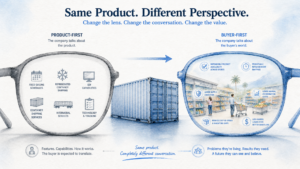
Last week I introduced Product Myopia, the belief that value lives in the product rather than the future it creates. I ended with an assignment: pay attention to the language in your meetings for a week and count how many times people talk about products and features versus customer problems and desired futures.
If you ran that experiment, you probably already know what this post is about.
Product Myopia is not a sales problem. It is not a marketing problem. It is not a product problem. It lives in every function simultaneously, each one reasoning correctly from the same wrong center. And because every function has it, nobody owns it, nobody sees it, and nobody fixes it.
Here is what it looks like department by department.
Product
The product team’s job is to decide what to build. The question driving almost every roadmap conversation: what should we add next?
More features feel like more value. Every release gets longer. Every capability is another reason for a buyer to choose you, or so it seems from inside the building. What few measure is whether buyers actually use what gets shipped. Research shows that as much as 80 percent of product features see little to no adoption. That is not a training problem. That is a value problem. Features were built because someone asked for them, because a competitor had them, or because they seemed important internally. The question of which problem it solves, and whether enough buyers have that problem to justify the investment, never got asked with enough rigor to matter.
There is a second consequence that compounds the first. The more buyers a product is built to serve, the less any single buyer recognizes themselves in it. Generality reads as, “not for me”. The buyer opens the page, sees a thing built for everyone, and quietly concludes it was built for someone else. The product team added capability believing it was adding appeal, and a slice of buyers drifted away with each addition.
This is what happens when you focus on the product and not on the buyer’s future.
Marketing
Marketing segments the market by who buyers are. Industry, company size, role, geography. These are the firmographics that tell the company where to spend and how to reach people. It is responsible, it is measurable, and it helps the company find buyers.
It does almost nothing to help buyers find themselves, because buyers do not experience their situation as a demographic. They experience it as a problem. Segment by who someone is and you can reach them. Segment by the problem they have and they recognize themselves.
But the deeper issue is what marketing says once it reaches them. Most marketing leads with the product. Features, capabilities, what the thing does and how it works. That language resonates with the small slice of buyers who are already experts in your category, the ones who understand enough to translate a feature into a result on their own. For everyone else, and that is most of your market, feature-forward messaging lands as noise. They are not shopping for a capability. They are living a problem.
Marketing finds the right people and speaks fluently to the few who already understand, while saying almost nothing to the many who needed a different conversation entirely.
Sales
Sales answers the buyer’s questions. The buyer asks what the product does and sales tells them, accurately, helpfully, and fluently. The demo covers the features. The follow-up covers the comparison. The proposal covers the price.
And the question that actually gates the purchase never comes up.
That question is not which product is better. The buyer often settles that before the final meeting. The question is whether changing at all is worth it. Whether the result of solving this problem outweighs the cost, disruption, and risk of moving off the status quo. That is the question a buyer is sitting with when a deal stalls, and it is a question about inherent value, about the future the product creates, not about the product itself.
Sales is being responsive and answering the product question. It feels like service. But it leaves untouched the question of whether changing at all is worth it. The deal that looked nearly closed goes quiet, and sales explains it as timing or budget, because nothing in the sales process was ever aimed at the thing that actually stopped it.
Pricing
Pricing builds models around the product. It prices what the company made, ties the metric to what the product is and does, and produces a number that is clean, defensible, and easy to read on an invoice.
Then it sets that clear price beside a value the buyer cannot see well enough to calculate. Price becomes the objection, not because the price is wrong, but because it is the only thing in the deal the buyer can actually measure.
The discount that follows is not a negotiation. It is the company admitting it could not make its value visible, so it lowered the bar instead. And every discount quietly signals to the buyer that the value was never as solid as claimed. The company gives away margin and credibility at the same time.
Leadership
Leadership asks for the roadmap. It wants to see where the investment is going, which is the most reasonable request an executive can make. The roadmap that comes back is a list of what will be built.
Leadership reads the bookings reports, cut by product and product line. The future arrives as a sequence of features to ship. The past arrives as a ledger of products sold. Both ends of the executive’s view are organized around the product. Nowhere on the dashboard is anything organized around the buyer’s problem or the buyer’s future.
So the people with the most power to fix Product Myopia are the least able to see it, because not one instrument on the wall is built to measure it. The leader who demands accountability for value delivered to buyers has no report to point to. The data does not exist, because no one built it, because no one thought to ask for it, because the product was always the center and the center was always what got measured.
This is where Product Myopia parts company with the ancestor it was named for. When Levitt diagnosed Marketing Myopia, the error lived at the top, in a judgment leadership got wrong. The cure was for leadership to redefine the business correctly. Product Myopia is harder to reach because it is not one wrong decision sitting in the corner office. It is an orientation every function holds at once, each reasoning soundly from the same wrong center.
The Common Thread
Five functions. Five competent, well-intentioned teams. One shared belief underneath every one of them: that the product is the center, and that value lives inside it.
Nobody chose this. Nobody held a meeting and decided to suppress the willingness to pay the company had already earned. Every decision that produced the disconnect was rational, made by smart people doing their jobs well, given what they believed.
That is what makes Product Myopia so persistent. It does not feel like a disease from the inside. It feels like running a company.
Next week I’ll show you what it costs. The symptoms you have been treating as separate problems, each with its own initiative and its own budget, that are actually one disease with one cause.
My new book, Buyer Disconnect, goes deep on exactly that work. Sign up here to be notified the moment it launches.
Share your comments on the LinkedIn post.
Now, go make an impact!
 Tags: buyer, buyer outcomes, customer problems, customer value, product features, Product Myopia, product strategy, value, value-based growth