AI is changing how companies create and deliver value. But are businesses making the right pricing decisions to turn that value into profit?
Many companies are rushing to launch AI-powered products, experimenting with credits, tokens, usage-based pricing, and outcome-based models. But choosing a pricing model isn’t as simple as following the latest AI trend.
In fact, some companies may be making a costly mistake: building broad AI platforms instead of focused solutions, making it harder to communicate customer value and justify their prices.
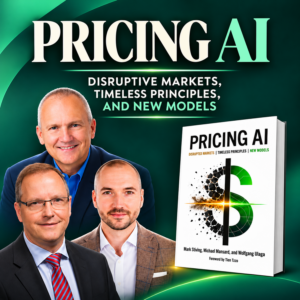
In this special episode of Impact Pricing, guest host Rebecca Kalogeris brings together three pricing experts and co-authors of Pricing AI: Disruptive Markets, Timeless Principles, and New Models to discuss what’s really changing in AI pricing, what fundamentals remain the same, and how companies can build profitable AI business models.
Joining the conversation are:
- Mark Stiving: Pricing expert and founder of Impact Pricing.
- Michael Mansard: Head of the Subscription Institute at Zuora, with deep experience in subscription and recurring revenue models.
- Wolfgang Ulaga: Professor of Marketing specializing in B2B marketing, service business model innovation, and recurring revenue.
Together, they explore why AI requires companies to rethink how they price, package, and communicate value.
Podcast: Play in new window | Download
Why you have to check out today’s podcast:
- The biggest mistake companies make when pricing AI: Why turning a focused solution into a broad AI platform can make it harder to demonstrate and capture value.
- Why traditional pricing fundamentals still matter: Buyers still exchange money for value. Segmentation, packaging, and value-based pricing remain essential.
- The hidden cost of AI: Why AI introduces marginal costs that traditional SaaS companies didn’t have to manage in the same way.
- Are credits really a pricing metric? Mark explains why credits may be better understood as a company-issued currency and raises the question of whether buyers actually benefit from them.
- Why outcome-based pricing isn’t always the answer: Understand the difference between promising outcomes and actually delivering measurable value.
- How to identify who benefits from AI: Michael explains why AI can create value for people and departments beyond the traditional buyer.
- Why AI pricing changes so quickly: Learn how companies are experimenting with new pricing models and why there is no single destination.
- How to build a stronger AI value proposition: Wolfgang introduces the FAST framework: Focused, Anchored, Substantiated, and Tangibilized.
- Why AI must prove its value: Discover why businesses need to demonstrate value clearly, not just claim it, especially as AI agents become part of the buying process.
The Big Question: Are You Building a Platform or a Solution?
One of the most important discussions in this episode is Mark’s distinction between platforms and solutions.
A solution addresses a specific customer problem, making it easier to identify the value being created.
A platform serves many users and solves many different problems, making value much harder to define and price.
As companies rush to build AI platforms, they risk losing the ability to communicate exactly what customers are paying for.
Understanding this distinction could change how you approach your AI product, packaging, and monetization strategy.
About the Book: Pricing AI
Get: Pricing AI: Disruptive Markets, Timeless Principles, and New Models
Written by Mark Stiving, Michael Mansard, and Wolfgang Ulaga, this book helps business leaders navigate the complex pricing decisions emerging from AI.
Rather than offering cookie-cutter pricing formulas, it provides a practical roadmap of the questions companies need to answer when developing AI pricing strategies.
It explores how to understand customer value, account for changing costs, choose pricing metrics, and create coherent monetization models in a rapidly evolving market.
Connect with the Authors:
- Mark Stiving: https://impactpricing.com/
- Michael Mansard: https://www.linkedin.com/in/michaelmansard/?locale=en
- Wolfgang Ulaga: https://www.linkedin.com/in/wolfgang-ulaga-813a6916/
Full Interview Transcript:
(Note: This transcript was created with an AI transcription service. Please forgive any transcription or grammatical errors. We probably sounded better in real life.)
[Intro]
Rebecca Kalogeris
Welcome to Impact Pricing, the podcast where we discuss pricing, value, and how buyers decide. I am your guest host, Rebecca Calagares, for today’s special episode. Today we’ve got not one, not two, but three guests all here to talk about their new book, Pricing AI, Disruptive Markets, Timeless Principles, and New Models.
This book guides leaders on pricing AI before the market settles. It’s not a formula, it’s a way of thinking made even more powerful by the three different perspectives the authors bring.
So let’s start by meeting the three authors.
And the first one is one, as a listener, you know very well, Dr. Mark Stiving.
Mark Stiving
Hi, am I supposed to introduce myself? Because everybody knows me.
Rebecca Kalogeris
Yes, well still. Michael?
Michael Mansard
So Michael Mansard, delighted to meet you. Based out of Paris, heading what we call the Subscribe Institute at Zurich, with one of my colleagues, investor in many companies in the AI space, amongst others, and working very closely with Wolfgang on subscription models, including co-leading some classes with Wolfgang.
Rebecca Kalogeris
Great. Wolfgang.
Wolfgang Ulaga
Yeah, and welcome everybody. My name is Wolfgang Ulaga. I’m a professor of marketing at Business School based in Fontainebleau, but also on other continents in Abu Dhabi, Singapore and in San Francisco.
Spending my time these days between the Middle East and Abu Dhabi and France.
Yes, together with Mike, we’ve been working a lot on training companies on recurring revenue models. learning with managers about these new ways of creating and capturing value.
This is what I mostly do. I work with executives.
I work with MBA students on what we call B2B marketing and service business model innovation. And of course, recurring revenue and AI and pricing AI is squarely focused on these topics.
Rebecca Kalogeris
Absolutely.
All right. So you guys have been deep in AI and pricing.
First things I want to ask is what has AI changed about pricing and what hasn’t changed?
Let’s start with you, Michael.
Michael Mansard
Oh, that’s an easy question. Do we have half an hour?
I’ll start very high level. I would say that what hasn’t changed by the way, is what AI, the AI hype tend to skip by the way. And I think Mark, he probably going to say it better than I do, but. Buyers still buy value, right? They exchange money for value.
Pricing is still segmentation. So is packaging. So is choosing metrics. And most of what we think as cutting-edge AI mechanics is pretty much borrowed, right?
Outcome-based pricing feels like new or felt like new two or three years ago. Well, it’s been done since 1962 by Rolls-Royce and many others. Wolfgang will probably talk about this.
Credits. I recently wrote that in the 1943, it was utilized by the US to actually manage Russians because food was not unlimited. It existed in the 1970s for telecommunications.
So a lot of things we hear about outcome-based credits and so on have been existing for a very, very long time, sometimes more than a hundred years.
So we seem to rediscover a lot of things. Hence the title of the book, And I would say what’s really, really new, very briefly, and we can deep dive, is more about the speed and more about the pace, you know?
And I would just finish with one analogy. We use this expression about old wine, new bottles, but in fact, you may not know, but it comes from King James Bible.
And what’s interesting is they warn it. They say, look, you gotta be cautious. You shouldn’t be putting new wine into old bottles, because bottles back in the day were in wine skins, right? Animal skin bottles.
And why? Because they burst. Because the wine is still fermenting, right? It expands. So my talk track would be, this is what’s happening with AI. It’s nothing new.
It’s just that it’s fermenting and it’s going at a crazy pace. And we’ll discuss it inside out in a minute, I’m sure. But it’s not the practice that’s new. It’s the speed and its magnitude at which it’s happening, which outgrows and makes the bottle explode, if that makes sense.
Rebecca Kalogeris
Yeah, so not really the needs or the techniques that are different, just the speed and the environment at which they’re being applied.
Mark, what would you add?
Mark Stiving
Well, so I think what Michael said was perfect.
And that is the fact that the fundamentals have not changed period, right?
So if you’re in pricing and you’ve been doing pricing correctly, that doesn’t change at all, right? It’s still all about what’s a buyer willing to pay, what’s the value to the buyer. So all of that is the same thing.
The things that have truly changed are the fact that in AI, there’s now actually a marginal cost where in SaaS there wasn’t.
And value is changing so rapidly, the way we deliver value to customers, it’s very, very hard for people to keep up.
And I would say those two things are truly what’s changing and driving what we do. And I feel sorry for Wolfgang because I think we took all the answers.
But maybe Wolfgang’s got something else. Let’s see.
Wolfgang Ulaga
Yes, so I look at it as a marketing course and I hear in sessions all the time, oh, if only I could do value-based pricing, I’m still stuck in the, you know, cost-plus and whatever method.
And so we’ve been teaching and advocating for a long time, we should practice value-based pricing, right? And so when you think about now AI, when AI comes to town, AI and especially agentic AI, gives us a real good opportunity to practice what we preach, to actually go to outcome-based or output outcome-based pricing approaches.
And so from a marketing professor point of view, I’m really excited because now it seems like these things are in reach. We can really now create more value for customers and we also can capture more value back for us.
And so these new pricing strategies and tactics probably will open very new avenues for us to just do what we wanted to do for a long time.
Now, I can only concur what has not changed.
For me, it’s still the old mantra of value first, then ask for price. So that doesn’t change. We see many offers where somebody launches an AI-driven offer because just we can. We have something, we have data, we have an algorithm. You have an agent, the agent can do something. But where the heck is the value for the customer?
So that, in my view, is you can’t steal yourself out of the issue. You have to ask and answer the question first.
First value, then price.
Mark Stiving
Yeah let me add one more thing and I think Michael touched on these but he talked about we didn’t say hey look this is changing and that’s the fact that the pricing language is changing a lot. Right?
So we hear terms like outcome based pricing which we we rarely ever used before and we hear credits which you know existed but we rarely ever hear anymore. And suddenly it feels like those are the goals and everybody’s trying to get there.
And what’s really happening is that we don’t understand. When I say we, I mean the pricing profession doesn’t understand these things very well. We haven’t defined what they mean.
We haven’t figured out who gets the advantage from those and who doesn’t.
So these are debates that are still going on between us as we have conversations.
Wolfgang Ulaga
Yeah. And let me add one thing to that, which is, you know, let’s be also mindful of the fact that we don’t want to go overboard, right?
You know, outcome washing might be a challenge.
Today, everybody and anybody is quick to say, ooh, I sell outcomes. Once you scratch at the surface and you look a little bit deeper, there is more than one that is actually, you know, not really delivering on that promise.
So let’s also be mindful that this should not excite people when it’s not just not there.
Michael Mansard
I would just add four things, just as a summary, four things that changed for real in at least software. One sentence for each, right?
One, I think Mark mentioned it very clearly, now every single AI agent has a bit of material, right?
So software is living its manufacturing moment in a sense, because now we know what a cost really is. Think about cloud. Some people were using cloud for $200 per month, spending $35,000. That was not a good equation and everything has changed for the past year or so.
We got caps, we got thresholds, we got model limitations, we have credits. That is clear.
The second thing that changed is that because of that, a lot of the invoices are becoming Operation reports, right? You pay for the work. That is new.
Frankly, even though it’s not an outcome necessarily, you’re paying for something, you’re paying for work, right?
Third is velocity. We’ve seen more changes in pricing. That was my analysis, Mark and Wolfgang. I think you agreed as well.
I’ve seen more changes in pricing in two, three years than in 20 years. So it’s going very fast. And last is that there’s no single destination.
For a very long time, in many places, you would say, look, there’s 80% of chances that you’re going to do good, better, best in user-based pricing. Now, you have to do topic per topic, offer by offer, segment by segment.
So there’s no easy way out of this.
Rebecca Kalogeris
Nice. So as you guys wrote this book, and as you guys talked to each other about the different concepts and theories, I know you guys had some big aha.
So Wolfgang, what was your biggest aha while writing Pricing AI?
Wolfgang Ulaga
Yeah, so me, when we started to look at some companies and the pricing strategies and tactics they put in place, I’m thinking about Salesforce, for example, just to name a company.
It’s amazing to see the agility and speed at which firms actually today really experiment with pricing strategies and implement those pricing strategies.
I mean, we just follow the one or the other company and every time we look, We see a new pricing abroad. It’s almost like, you know, next time to go to their website and look how it’s being priced, it has changed all over.
So for me, that was kind of a wow moment. And for me, it actually also documents many things.
First, I think it documents the uncertainty with which many companies navigate. We just don’t know. And we have to tiptoe into those areas.
So it documents the uncertainty. And the other thing is probably also the need for a willingness to let go of old, tried and tested practices.
Now, I know it’s a topic of change management and transformation, but yes, for me, what I really learned is pricing has a big dimension of transformation and change management of people, of practices, of processes.
And the willingness to do that is kind of the big success factor here.
Mark Stiving
Nice.
Every time I write a book, it’s because it’s filled with ahas that I’ve had, right?
And so there’s probably a hundred different ahas in this book that I would say, oh my gosh, that was different. Oh, that was really interesting and fascinating.
If I get to choose the one that I think is the biggest and most interesting, I’d have to say it’s the debate I’m still having with Michael and others about credits. Right?
And the fact that, you know, credits felt like this, you know, it started out people were saying credits are a pricing metric. And you just think about it and it’s actually not.
What credits really are is a currency. We’re changing dollars to euros, and then euros can go by Coke, and it can go by McDonald’s.
And so credits are really the exact same thing, but it’s just a company that issued it. And eventually, the company still has to say, yes, it cost you five credits to do this.
And so it’s just a different currency. Now, the debate Michael and I are still having today and just keep watching our content that we put out, and that is, do buyers get any value out of credits? They certainly help sellers. There’s zero doubt in our minds about that.
But the real question is, are buyers getting credits or value? But to me, that was probably the biggest aha I had writing this book.
Rebecca Kalogeris
Michael?
Michael Mansard
So on my end, I would say it’s not how we’re writing the book. It’s how we’re writing the book and doing many other things at the same time, which led to the conclusion, which is in the book, by the way, itself, because things happened almost in real time while we were writing the book.
So credits, as Mark mentioned, was something that was interesting, right? Credit moved from fringe to mainstream in less than a year. So right now, 30 to 40 percent of AI offers have credits embedded.
Is it good? Is it bad? You know, we can make our own opinions, we can have discussions around that. But the fact is, credit was a word that I almost forgot this past decade, right? It reminds us of the old days of telco, right?
Or maybe for people who used Dun & Bradstreet, you bought your Dun & Bradstreet credit in the finance space. So what is that main learning is, I think I mentioned it, but it’s really important. There’s no simple solutions. If someone tells you he has the solution, that’s a lie, right? It’s a mess. There’s no convergence. It’s almost as if everyone is doing heart surgery while driving the ambulance. And I don’t think it’s going to change, right? So I would say that right now, one of the main strengths of companies is their ability to actually honestly disclose and understand that there’s too many moving parts, their technology moving fast, their understanding of value is being understood alongside with our clients, they’re segmenting in real time.
So I would say that pricing is becoming or re-becoming a true cross-functional scientific and design discipline. That requires deep understanding of the customer, but you also need deep understanding of the cost, deep understanding of the value.
And that should have always been the case, but that makes the whole pricing world even more exciting. And that I can prove you in two seconds, right? We mentioned outcome-based.
Outcome-based, that was a trendy word two years ago. That’s still 10 to 15% of offers, right? Maximum.
Token, right? Token is about pricing strategy as well, because you’re actually pricing based on someone else’s cost curve. You have no control about that, right? You don’t control when it goes up, when it goes down.
So I think that’s really interesting because the reality is a spectrum in between. And to be able to price that spectrum, you need a deep understanding of many, many variables. That’s why, again, we see so many changes and so many iterations. Salesforce, Microsoft, SAP, Workday, ServiceNow, HubSpot. They introduced credits in the past 18 months or so.
So I think that’s really interesting. Credit is not going to be the solution for everyone, and we’re not going to discuss it now probably, but it just shows the pace at which companies are adapting pricing.
Back in the day, companies would adapt their pricing once every two, three years if they had to.
Now they do it every two or three months, right? That’s insane. That’s unheard of.
Mark Stiving
And just to add on to what Michael just said, what I love about our book is we don’t have the answers, right?
What we do is we give you ways to think about it and we’re making you think differently than you’ve ever thought before.
And so this is really what every company has to go through on a continual basis to say, how are we going to keep changing our pricing? What are the factors that we’re looking at?
Rebecca Kalogeris
Yeah, I mean, you definitely see companies adding AI offerings before really thinking about the monetization of it, you know, them chasing that.
So, and everything keeps moving so quickly that this is an ongoing question of how to actually monetize and make it profitable.
Wolfgang Ulaga
Just to add on that, what I like about the book then is that it’s a hands-on roadmap of how do you, as Mark just said, how do you think about all the pricing issues where our book brings all the questions together in a place.
It’s putting all the topics on the table and think through the ramifications without giving you cookie-cutter recipes, but orienting you towards what are those questions you must tackle and how do they line up in a coherent, internally consistent fashion?
I think that’s the beauty of that book that we just completed now.
Rebecca Kalogeris
What a great lead into my last question, Wolfgang.
Just to give our audience a little bit of a tease of what they’re going to get in the book, like what what are some of those questions?
What is a question that every company should answer before they really decide on their A.I. pricing strategy?
Mark, we’ll let you go first this time.
Mark Stiving
Yes, I get to go first. I’ll tell you the one that I think is most important, and I see companies totally messing up right now, and that is, are you building a platform or a solution? And so let me define that for you real quickly. A platform is, it’s a product that solves many, many different problems for many, many different users. You could think of Cloud as a platform. You could think of Excel as a platform. You could think of LinkedIn as a platform. They solve many, many different problems for many users.
Most SaaS companies in the past were actually building solutions. So solutions are, we’re going to solve a specific type of problem for a customer.
And it’s actually really easy, I shouldn’t say really easy, relatively easy to assign a value to a solution.
So if I’m Salesforce helping you with CRM, I get it. I know what problems I’m solving. I know how I’m going to help you make more money. What I’m seeing companies do right now, which it frightens me if you want to know the truth, is they’re saying, hey, we’re going to build this chatbot that can answer any question and do anything in our realm of expertise.
And what they’re really doing is they’re taking away their ability to define the value of a solution. And they’re saying, we’re now a platform. And platforms are very, very hard to price.
Platforms start to work their way down towards costs. Competition comes in and says, hey, we can do the same thing. It’s just an LLM, who cares?
So I would truly caution people against that. And I would say, what’s the big thing you’re doing? Are you really solving a problem for people?
Are you trying to build this big platform that can solve many, many different problems for many, many different people?
Rebecca Kalogeris
Nice. Michael?
Michael Mansard
So, on my end, of course, there’s zillions of questions, but I see one which is very important.
It’s more like a train of thought, right? Which is, who do you create value for and how much do you create?
Often, I would say the how much, it’s not easy, but actually even AI can help you articulate how much value you’re creating. Even though companies tend to underestimate how much value they create, but very often they tend to overlook the fact that they create value for a new persona in the organization.
Let me give you an example.
Maybe there’s a company in the engineering space. They’re used to selling to someone managing engineering projects, but all of a sudden their AI creates value for the chief operation officer.
Because the bureau can actually use more resources to be built, so it increases revenue.
Or they actually manage to make sure that every single resource is at the same level as a senior consultant, right? That has intrinsic value that may not have value at the typical buying level at which the company operates at.
So really understanding you know, who benefits from the crime, if I may say, you know, being able to really follow the money on that front, which then leads me to something that our friend Steven Forth calls the 100x variance problem.
Because when you look at that value, you need to ask yourself, Is that value consistent for the same agent, right? Think of an agent that would be able to classify a ticket in the customer service, right?
Then he’s able to research a company and reads the findings and draft the memo, right?
And at the same time, maybe in some cases it leads to creating a lead, right?
So imagine the same agents can have a hundred times the same value within two companies, within the same company or between two companies.
So the ability to understand that value is not a homogeneous thing but it’s linked to context is gonna be really important to really understanding and modeling value.
I think it’s gonna be really important because this is what the end of the day will help you define how you price right and I like to say tell me how you price and i’ll tell you who you are because at the end of the day the way you price, typically changes your actually vision and mission as a company.
So I would say that the work on value, going back and re-understanding what do you really do, which goes back to your question mark on platform and solution, or both, by the way, that’s critical because I think a lot of companies have not yet understood that AI is not just a bolt-on add-on that you put on top of whatever you do, a solution, a service.
It actually can dramatically change your core promise and who you create value for.
And I think that is really, really overlooked.
Wolfgang Ulaga
Yeah, and I want to piggyback on what you just said about promise. So I go back to the workshops we do together and what we observe when managers develop AI driven offers.
And the thing that frustrates us a lot is that people have a hard time articulating the value proposition. It might sound evident, but you know, boy, sometimes we are really almost disappointed after a day of work.
You know, the vanilla cookie cutter value proposition that comes out. And I think it goes back to this issue of A real good value proposition for AI is not easy to articulate.
I use this acronym FAST. Is it focused? Is it anchored? Is it substantiated? Is it tangibilized? F-A-S-T. We talk about it in the book.
And I would say this is what companies must tackle.
Can you come really, really concrete on articulating and dollarizing your value proposition.
In the book, we give good guidelines and roadmaps for doing these type of things. That’s why we often say the book is very hand-on.
But for me, this is super important because it’s kind of a foundation for everything else.
Michael Mansard
Wolfgang, if I may just add one thing to what you’re saying, which is very important.
So let’s imagine, right, you still have a clear value prop now.
So let’s imagine, right, you’re part of the A-League. That’s great.
So let’s imagine, right, let’s take customer service as an example. For example, we all know that in the AI space, many of these companies have started to use a per resolution model.
So 50 cents to $2 per customer ticket resolution.
Now, when you look at this, right, that promise At the Zendesk they have multiple pages to articulate what is a resolution even have decision trees to explain what is a resolution.
Add the same time competition like intercom or many others to have different definitions right and the definition becomes the contract.
So that is clear so imagine right you need to show that you do it but you need to show that you have that value not only you claim it but you can demonstrate it.
Right now you need to demonstrate it to human right you need to show you have a definition and you can walk the walk not just told the talk but now and I think we mention it in the book as well.
Very soon, the buyers will be AIs in many instances. So if you’re unable to articulate and prove the value in a machine-readable format, let alone a human-readable format, then you may just not be findable.
And I think this is really important. So this work around value proposition, but the value proposition that makes sense to a human, to a machine, before selling and after selling, I think that is going to be of the essence.
And because now you actually charge in many cases for what you build, what you produce, what you work on behalf of, that’s going to be a new battleground.
Rebecca Kalogeris
Excellent. All right. Wolfgang, Michael, Mark, thank you very much for your time.
I have to say I had the distinct pleasure of being an early reader for the book. It is fantastic.
And this is not a problem going away. It’s going to keep evolving, but it’s also really important for organizations and software companies to really think this through so that they are not building the technology that’s actually going to end up hurting their bottom line.
So thank you very much.
And now, go make an impact.
[Outro]