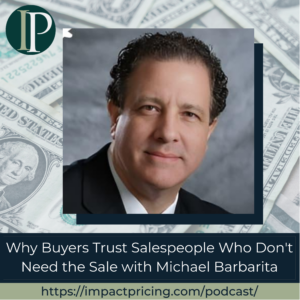
Michael Barbarita is the founder of Next Step CFO, strategic CFO, and author of Powerful Business Strategy. After more than four decades of helping businesses grow through smarter financial and business strategies, he’s learned that the biggest pricing challenge isn’t price—it’s trust.
In this episode, he reveals why buyers instinctively trust salespeople who aren’t attached to the outcome, how transformational conversations outperform transactional ones, and the practical sales strategies that keep buyers focused on value instead of price.
Podcast: Play in new window | Download
Why you have to check out today’s podcast:
- Learn why buyers trust salespeople who don’t appear desperate for the sale and how perceived indifference creates credibility instead of resistance.
- Discover how to shift price objections back to the buyer’s transformation.
- Build stronger offers with upsells, cross-sells, and downsells that protect your value.
“The key is to be perceived as indifferent and transformational.”
— Michael Barbarita
Topics Covered:
01:40 – Why Business Owners Underprice. Why pricing based on your customer’s wallet hurts your business.
04:05 – Sell Transformation, Not Transactions. Keep buyers focused on outcomes instead of products and price.
07:35 – Why Buyers Always Return to Price. The psychology behind price objections and buying decisions.
10:40 – Why Buyers Trust Indifferent Salespeople. How focusing on the buyer—not the sale—builds trust.
13:45 – Buyers Buy Futures, Not Features. Mark explains why customers pay for a better future, not product specs.
16:30 – Can CFOs Really Understand Value? Mark and Michael debate strategy, value, and finance.
19:50 – Finding What Customers Really Value.The questions that uncover why customers actually buy.
22:15 – Michael breaks down his sales framework: Captivate → Fascinate → Educate → Close.
25:30 – The Power of Upsells, Cross-Sells & Downsells. Capture more buyers without lowering your prices.
Key Takeaways:
“You have to get on the same side of the table as your prospect.” — Michael Barbarita
“Packaging and bundling products and services together lets you add more value while increasing the price.” — Michael Barbarita
“No matter what you do, there’s always going to be the price-sensitive people. Instead of losing them, have a downsell.” — Michael Barbarita
Connect with Michael Barbarita:
- Website: https://nextstepcfo.net
- Linkedin: https://www.linkedin.com/in/michaelbarbarita/
- Book: Powerful Business Strategy (Free Download)
Connect with Mark Stiving:
- LinkedIn: https://www.linkedin.com/in/stiving/
- Email: [email protected]
Full Interview Transcript:
(Note: This transcript was created with an AI transcription service. Please forgive any transcription or grammatical errors. We probably sounded better in real life.
Michael Barbarita
Primarily have an upsell, have a cross sell, but also have a down sell.
A lot of business owners forget about the fact that they might be able to reduce some value, no question, but make the sale because of the price.
No matter what you do, no matter what you make transformational, there’s always going to be the price sensitive people. And instead of losing them, have a down sell.
[Intro]
Mark Stiving
Welcome to Impact Pricing, the podcast where we discuss pricing, value, and how buyers decide.
I’m Mark Stiving. I help companies understand and shape their willingness to pay.
Our guest today is Michael Barberita. Here are three things you want to know about Michael before we start.
Michael’s the founder of Next Step CFO. He’s been doing that since 2007. He led a retail chain from 2.5 million to 8 million in revenue in just five years by focusing on practical business and financial strategies.
And with more than 40 years of experience, Michael’s passion is helping owners create transformational outcomes rather than transactional relationships.
Welcome, Michael.
Michael Barbarita
Thanks for having me, Mark. Appreciate it.
Mark Stiving
It’s going to be fun.
So I almost always start the podcast with the question, how did you get into pricing?
Now, it’s certainly not a fair question for you because you’re not in pricing, but pretend I asked you, what would you say?
Michael Barbarita
Well, first of all, you know, I own a ski retail company.
So, and I also own a manufacturer of frozen cookie dough and also a clinic, a health clinic.
So, there’s three diverse businesses and they have to have pricing.
So, you know, pricing is always something that I think business owners do over a lot. But the bottom line is what happens is that business owners get into the wallet of their prospects when they shouldn’t be.
And so, as a result, most pricing is too low, for the most part. I’m not saying in every situation, but for the most part, at least when I’m introduced to my clients, pricing is just too low.
And it has everything to do with them being into the wallet of their customer where they don’t belong or their own wallet or their own wallet.
Mark Stiving
Yes.
So first off, I’m going to agree with you completely that prices are almost always too low. Right. Companies are horrible at that.
But I’m a little confused when you say the phrase they get into their wallet is what you’re saying that they’re they’re mentally thinking about their customers wallet instead of what the value is they’re delivering.
Michael Barbarita
That’s right. Exactly what I’m saying. That’s exactly what I’m saying.
And like I said, also, They also get confused between their customers wallet and their wallet.
Okay, they they also get into their wallet making a cheese I couldn’t afford that so i think. That kind of thinking which is so wrong.
Mark Stiving
People often think that everybody is just like them. And they’re not, absolutely.
Michael Barbarita
They come from different backgrounds, different cultures, different everything.
And so, you know, well, what’s the value that you bring and how do you price that value? That’s the whole, the whole key to the pricing game in my view.
Mark Stiving
Okay. I am so shocked to hear a CFO say those words. No offense.
Michael Barbarita
Well, we’re strategic CFO. So there is a difference.
You know, if a Fortune 500 company was going to hire a CFO and they didn’t understand business strategy, they wouldn’t get the job.
But somehow fractional CFOs get away with that. And I didn’t want to.
So that’s why I wrote my book four years ago, you know, on business strategy. And that’s why I end up saying some of those things. You might be surprised that I say.
Mark Stiving
Nice.
Well, so one of the things that you wrote or that you claim is that you want transformational outcomes instead of transactional relationships. Right.
Can you just tell me what that means?
Michael Barbarita
Yes, I’d love to.
So one of the things that we business owners need to get a grasp on is what is the goal? What is the number one objective of the customer, client, whatever you want to call them?
And once we know that, then that’s really what the, the reason why they want to buy. They want to solve that particular problem or they want to achieve that particular objective.
And what happens is where it becomes transactional.
Is well i gotta think about it well what are you thinking about are you thinking about you know because what are you thinking about no say well your program or your pricing.
Oh god we have a two different conversations i’m talking about what you told me what your major objective is.
That’s what this is about has nothing to do with my program on my pricing. It has to do with a cut you accomplishing a b and c like you told me at the beginning of the discussion that’s making it transformational because.
What they told you their objective was is the transformation they’re looking for.
So therefore you get the person back on the transformation and asking them really what’s there to think about. Because we’re going to accomplish that transformation.
That’s the difference between transformation and transactional. Transactional is always focusing on the price.
Transformational is focusing on the objective.
Mark Stiving
So I never, I never imagined that I would agree with a CFO as much as I do with you so far today.
So in all honesty, one of the things that I’ve been writing about, talking about a ton lately is something I call buyer disconnect, right? Why?
Why does the buyers don’t see the value that the companies sell? And one of the big reasons is because buyers are buying futures, not features. Right?
Buyers are trying to take whatever it is that you’re selling and saying, how is that going to change my future?
And that’s really exactly what you just said. You just said, hey, what we’re going to do is we’re going to walk in and talk about what the future, what the transformation looks like.
And let’s stop talking about the product and the price. Let’s talk about where you want to go and what you want to do. And I just thought that was brilliant.
Michael Barbarita
Yeah. And that’s how I define transformation versus transaction. But it takes a skill to do this, though, Mark.
Because They’ll always want to get you back to the transaction. It’s amazing. They could tell you all their dreams, their goals, their aspirations, whatever their objectives are. And it could be as simple as just having a roof that doesn’t leak.
But they could go through all of that and still go back to the price.
Mark Stiving
Yeah.
So let me ask you a question that I actually don’t know the answer to, which is pretty rare, that at least I don’t have an opinion, strong opinion on.
Why is it that buyers do that? Right.
So buyers have never been trained how to buy. I mean, if you think about things that you’ve bought, not procurement people, right. But, but things that you’ve bought in your life, no one ever said, here’s how to go buy a refrigerator or here’s how to go buy a new car. Here’s how to go buy a pack of gum.
So why do buyers keep coming back to, I want to talk about the product and the features?
Michael Barbarita
I think it’s mainly because they don’t want to make a mistake.
And whoever is in their supporting world, may it be a spouse, may it be a relative or a friend or whoever is in their world of support, they’re going to be critical of it.
If he’s paying too high a price, somebody is going to be critical of it.
So that I believe is a driving force to people keeping going back to the transaction. They feel that if they don’t try to negotiate or if they accept the price that is potentially too high, someone will criticize it within their world.
Mark Stiving
Yeah.
So can they justify it after the fact when someone questions them and says, yeah, they can, if in fact they can tie it to the transformation.
Michael Barbarita
Right.
If they explain to the person, and by the way, the person who is receiving this information, they are people who are in their supporting world. They might not buy it, but that would be the way to sell it because that’s how they were sold. If in fact it was done properly.
Mark Stiving
Yeah.
So while you were talking, something else popped into my mind. What do you think about the fact that I don’t trust the salesperson?
So I think the salesperson’s trying to take advantage of me. So he can say, Hey, when you buy this, you’re gonna, you know, be healthy and wealthy and, and sleep better at night.
Michael Barbarita
And it’s like, well, that salesperson made a mistake. And let me explain what the mistake was. They weren’t indifferent to the outcome.
When you’re in a selling situation and you’re not indifferent to the outcome, then the other person is going to think that you’re for yourself and not for them. You have to get on the same side of the table as your prospect.
And the way to do that is whether you work with me or someone else, these are the steps you have to take in order for you to achieve that goal. That’s indifference.
And if you don’t say enough things like that during the presentation or during your engagement, then you’re not going to be perceived as indifferent. The key is to be perceived as indifferent and transformational.
If you’ve got those two, you’re in good shape.
Mark Stiving
So indifference, I’m going to reinterpret what you just said with indifference for a second.
And what I heard you say is I want to be seen as I’m on the side of the buyer, not on my own personal side. That’s right. I’m going to be helping you solve your problem.
Michael Barbarita
That’s right. And you’re totally disconnected to the outcome, meaning you’re disconnected to the sale.
Because you’re only focused on that person and by being transformational and getting them away from the transaction is total focus on that person.
Mark Stiving
Yes.
And so we’re trying to, we’re trying to get away from the transaction and we’re trying to focus on the buyer’s outcomes.
Michael Barbarita
And you have to keep doing it. Mark, you have to keep doing it.
They’re going to keep coming back and you’re going to keep saying, we’re not talking about that. We’re talking about this. You told me you wanted this. This is the result of working with us.
Mark Stiving
Yeah, very, very nice.
So how did a CFO, by the way, I make fun of CFOs a lot, right? I love them. They’re quantitative. They’re usually super powerful inside a company. They have access to all the data.
But I think they think in a really weird way because they rarely understand what value means. How did you learn to think this way?
Michael Barbarita
Through writing my book, because I did the research that backs up the book.
And so it just opened my eyes to a lot of strategy and different ways of approaching a sales situation or a marketing situation or administrative situation, you know, so because it’s all encompassing, but that’s how I did it.
Because like I said, Mark, if you don’t, and I wasn’t going for a Fortune500 job, I love what I do as a fractional CFO and strategic implementer. But if you’re going to go for a job in the Fortune500 and you’re a CFO, you better know business strategy.
Otherwise you’re gone out. You have no chance. But somehow fractional CFOs get away with that. I don’t know why, but I didn’t want to. And that’s why I wrote my book called ‘Powerful Business Strategy’.
Mark Stiving
So I’m going to push back against what you just said, right? I mean, by the way, I agree that CFOs at large companies have to understand business strategy.
But what they don’t understand is value to the buyer. Because typically there are CFOs over a gazillion different products, and there’s absolutely no way they can be thinking about what is value of this product to this buyer mean.
And so I tend to see CFOs falling back on what’s the margin for this product line? What’s the margin percentage for this product line? Are we moving the margins up or down? And it isn’t where’s the value we’re not capturing from these customers.
Michael Barbarita
Well, then I don’t think they can do a good job.
I think that that’s the critical component, you know, and as I wrote about in my book, you know, there’s five proponents to a compelling offer. And one of them is adding more value. to the product or service as compelling when you can add value we can stack that value.
You know that’s really critical so i don’t think they’re doing their job if they don’t understand the value of the products they’re just looking at the margins.
Why is it good important don’t get me wrong I mean i wouldn’t be a CFO if i didn’t say that or if I didn’t firmly believe that. But that doesn’t mean I mean when a margin is failing i’m looking to add more value or understanding if there is more value to be messaged.
Mark Stiving
Okay. Heaven forbid. I’m going to defend a CFO, but I’m going to defend a CFO for a second.
Michael Barbarita
Oh God. No, not that.
Mark Stiving
Yeah, exactly. No, we have CMOs. We have sales VPs. These are the people who are supposed to understand value to the customer.
My job is to understand what are the, as the CFO, right? My job is to understand what are the investors want? How are we spending our money? Are we, you know, are we capturing the right margins? Are we investing our money in the right ways? I mean, there’s so many different things to deal with. The idea of understanding value to the customer, we got other people to deal with that. That’s not my job as a CFO.
Michael Barbarita
Well, it might not be, but it is for my clients, it definitely is, because they don’t have that kind of structure within their organization where they have a CMO and all those other positions. They just don’t. It’s me and the business owner for the most part.
So they don’t have that other sounding board and I provide that. Yeah.
Mark Stiving
As a fractional, I’m not going to say the word CFO. I’m going to say as a fractional business advisor, it makes a ton of sense for you to understand value. Right.
And the fact that you also understand finance is not a bad thing. Right.
Michael Barbarita
So let’s talk a little… I think that’s a fair assessment, but I want to be clear that, you know, that I do all the things that you mentioned a CFO should do.
But most of the investors I deal with is just a business owner. They’re the ones, the stakeholder. They’re the major stakeholder.
Mark Stiving
Yeah, and they’re looking for someone who understands business in a general rule, right? Right.
So when we start thinking about value, and a lot of what you’ve done is in retail, so I’ll just say B2C type stuff, right?
And the big conversation that we’ve had a lot of when we talked about value was how does a salesperson sell value, which we usually see salespeople in B2B situations more so than B2C, other than a retail salesperson.
So when we’re in the world of retail, how do we communicate value better?
Michael Barbarita
Once again, we have to ask the question, what’s the objective of the customer?
So if we go back to the ski business, there’ll be customers that walk in and says, I want to handle the bumps better. Oh, let me show you why my clients love this ski.
And let me tell you why my clients love this ski for bumps. You go over all the value of that ski relative to bumps. Because that’s what they care about.
If I was to show them a beginner ski, I couldn’t explain the value. You know, somebody who’s more advanced and wants a ski that absorbs the bumps.
You see what I mean? It’s like, you’ve got to understand what the customer wants, what their objective is.
Mark Stiving
Absolutely.
So by the way, I agree completely, but you came up with an example that had my retail salesperson and I get to deal one-on-one with a buyer and I think buying skis is, you know, you’re absolutely spot on.
What if it’s retail in a different way? So what if I don’t have a direct sale? I’m going to the mall and I’m shopping for a new shirt or, you know, I’m going to the grocery store and I’m buying a can of green beans or, you know, something like that where there isn’t a salesperson saying, here’s the one you want to go buy.
Michael Barbarita
Got it. Yeah.
So in those particular cases, it all depends upon the messaging. Messaging on the product itself, messaging on how the person got to your store to begin with. It’s all about that messaging and whether or not that messaging illuminates the value. And it could be generic value of the store itself. You know, why go to that particular store?
So, but it’s all about the messaging and whether the messaging can communicate value. And sometimes I get it, you know, in retail situations, Sometimes the messaging is limited.
And when that is it’s hard to really describe the value, but the packaging better have it.
The packaging better describe the value whether the value is 40 calories and something that you know in a chocolate chip cookie. Or you know it’s a design on a teacup whatever it is It better describe that value and it better address it.
Mark Stiving
Yeah. So how is it that companies, especially, you know, if I’m a CEO of a small company, how do I figure out what the value of my product really is to my customers?
I don’t know about you in your world. In my world, people rarely understand the value of their own products.
Michael Barbarita
Right. You know, one of the critical components of my business in itself is asking the right questions.
And if I’m able to ask the right questions to get their mind stimulated on the value of product versus the price, which is where they are focused on totally, then I’m doing my job.
Believe me, sometimes it’ll take a year or two years to get a business owner to really understand the value of their product.
It will, but you got to keep pounding, pounding, pounding, pounding, because otherwise they’re going to go back to the price. It’s just like customers. They’ll go back.
Customers always go back to the price. They’ll always go back to the price. But it really comes down to asking the right questions. You know, just the question, why would somebody buy your product? And if they say price, okay, what else? Why else would they buy it?
Mark Stiving
I hate the answer of price. I don’t want anybody to.
Michael Barbarita
Oh, I know. No, but that’s the answer you’re going to get. I’m sorry. That’s the answer you’re going to get. Yeah.
So, but I keep digging deeper and deeper and sometimes it takes them a while to figure it out.
And sometimes I say, well, is it because like, if I’m dealing with somebody in the trades, let’s just, for example, is it because, you know, where’s the value in your product is it because you clean up after the job is it because you show up on time is it because you return phone calls. what is it?
And that gets them thinking in a different way. Okay because what I just did in essence in a very high level way was identify the problem the customer has it doesn’t want. with a company in the trades. They worry about getting returned phone calls. They worry about them showing up on time for the first day of the job. They, you know, and they worry about the cleanup afterwards.
Mark Stiving
So can I say that’s the first time you said the word problem and that happens to be in my mind, the single most important thing when we start helping people understand value, whether it’s a buyer or whether it’s a seller, it’s what are the real problems we’re solving?
Michael Barbarita
Yeah. No, that’s part of the transformation. Absolutely. Absolutely. We’re major advocates of that. Major. Nice, nice. We have what’s called the conversion formula.
And it’s a four step formula on how to convert a prospect into a sales presentation or how to convert them into a sale. And it’s a four-part formula. It starts with captivate. That’s the problem the customer has and doesn’t want.
The next step in the process, the formula is fascinate. That’s the solution they want, they can’t find.
The third component of the formula is called educate. You educate them on why your solution is superior to the competition, and then you give them a compelling offer.
Captivate, fascinate, educate, close.
Mark Stiving
Nice, nice.
So, Michael, I’m just going to toss out an open-ended question. What else do you want to talk about in pricing that you think is really important that our listeners should know?
Michael Barbarita
Well, you know, one way to try to overcome any burdens a business owner might have in pricing is packaging and bundling. Okay.
Packaging and bundling products and services. When I was in the ski business, you know, everybody and his brother, all the competition, they package skis, bindings and poles.
But what we did is we took the most popular ski graphics, went to the clothing department. took the matching hat, sweater, parka, and pant, and put that in a package. It was totally irresistible.
They just bought a ski, right, with certain graphics on it, and now we just gave them the clothing to match. It was totally irresistible.
My competition never, it was incredibly successful, and my competition never, ever duplicated that.
But the packaging and bundling is one way, if you could package and bundle products and services together, you can add more value while increasing the price. So that’s one.
Another one is always having a down sell, especially those who, you know, are worried about price. If you always have a down sell, then you should be able to sell anybody something.
So having a down sell, you should have an upsell too. Oh my God, please have an upsell, primarily have an upsell, have a cross sell, but also have a down sell.
A lot of business owners forget about the fact that they might be able to reduce some value, no question, but make the sale because of the price. No matter what you do, no matter what you make transformational, there’s always going to be the price sensitive people.
And instead of losing them, have a down sell.
Mark Stiving
The other thing that’s really nice about having a downsell is it makes the price of the product you’re trying to sell look more reasonable.
It makes it so that, hey, am I willing to give up that value for that difference in price?
No, I’m really not. I’m going to go with this one.
Michael Barbarita
Very true. Very true. I find that to be the case as well.
Mark Stiving
So nice, Michael, I’ve had a lot of fun talking to you. I normally stop with the question.
What’s one piece of pricing advice you’d give our listeners that you think could have a big impact on their business? I think you just gave me two.
If you have one more, I’m waiting to listen.
Michael Barbarita
Yeah, no, it’s packaging and bundling and it’s having a downsell because a lot of business owners don’t, but don’t forget the upsell. I don’t want anybody to forget about that. I don’t want anybody to forget about the upsell and the cross-sell.
Mark Stiving
The thing I love about upsells, by the way, I talk about good, better, best a lot, right? But the thing I love about upsells is it’s kind of like saying, here’s what we can do.
It’s like a free advertisement and it makes people feel more comfortable that they’re not wasting money. I’m not buying the best, so I still feel okay.
Michael Barbarita
That’s right. And you can do that with bundles too. You can have a good, better, best bundling package.
Mark Stiving
Excellent.
Michael, thank you so much for your time today. If anybody wants to contact you, how can they do that?
Michael Barbarita
They go to our website, nextstepcfo.net. They can go to the contact page, fill out the form for this specific issue. They can also take a free diagnostic. It just takes 10 minutes.
And what it’ll do, this diagnostic will find hidden revenue in their business. It’ll give them three strategies and each strategies has the financial impact that it would have if they were to implement it. And it’s all free.
And what’s the name of your book? Powerful Business Strategies. It’s also a free download on my website. I give it away. It’s a free download on my website.
Mark Stiving
All right. To our listeners, thank you for your time. If you enjoyed this, would you please leave us a rating and a review?
And if you have any questions or comments about the podcast, or if you want to get paid for value your buyers can’t see, email me [email protected].
Now go make an impact.
[Outro]