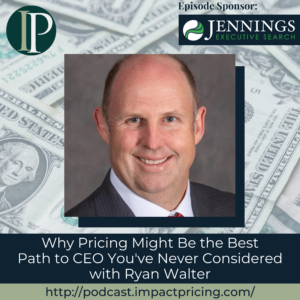
What if the pricing function isn’t just a specialty discipline—but one of the best training grounds for future CEOs?
Ryan Walter, Partner at Jennings Executive Search and author of The Pricing Talent Playbook, joins Mark to explore the evolution of pricing careers, what separates great pricing leaders from average ones, and why pricing may soon become a recognized pathway to the CEO role. Ryan draws on his experience recruiting pricing talent and leading pricing teams across retail, manufacturing, data products, and industrial businesses.
If you’re building a pricing career, hiring pricing talent, or wondering how AI is reshaping the profession, this episode offers a glimpse into where pricing is headed next.
Podcast: Play in new window | Download
Why you have to check out today’s podcast:
- Discover why pricing may become a legitimate path to the CEO role.
- Learn why pricing transformations often fail despite strong strategy.
- Understand how AI is changing pricing talent expectations and why curiosity may now be more important than technical expertise alone.
“My prediction is that the pricing function is going to end up being a path to CEO.”
— Ryan Walter
Topics Covered:
01:00 – From Professional Musician to Pricing Leader. Learn why the skills required in professional music translated surprisingly well into pricing leadership.
03:05 – The Rare Combination Every Great Pricing Professional Needs. Why pricing success requires both IQ and EQ—the ability to work with complex data while influencing executives, sales teams, and non-technical stakeholders. Ryan explains why finding both traits in one person is surprisingly rare.
05:05 – The EQ Problem Pricing Professionals Must Solve. Mark and Ryan discuss why being right isn’t enough. Learn how great pricing leaders simplify complexity, build trust, and communicate insights in ways that drive action instead of resistance.
06:50 – Why Ryan Wrote The Pricing Talent Playbook. Ryan explains the motivation behind his new book and why pricing leaders need more guidance on talent, team building, interviewing, and career development—not just pricing models and strategy.
09:20 – The Hidden Reason Pricing Transformations Fail. A fascinating hiring story reveals how a successful pricing leader was undermined when executive priorities shifted. Learn why organizational support often matters more than technical pricing expertise.
11:30 – What AI Is Changing About Pricing Right Now. Ryan shares examples of pricing leaders using AI to perform customer profitability analysis, strategic planning, and complex investigations in hours instead of weeks. The discussion moves beyond productivity into AI as a strategic thought partner.
14:30 – The New Hiring Question Every Pricing Candidate Should Expect. More companies are now evaluating AI readiness during interviews. Ryan explains what hiring managers actually want to hear—and why curiosity matters more than having the perfect answer.
17:00 – Why Pricing Professionals Change Jobs More Often. Many pricing leaders thrive on building functions, driving change, and solving messy problems. Ryan explains why some professionals leave after creating momentum—and why that’s often a feature, not a flaw.
19:15 – The Two Pricing Archetypes. Are you the builder or the operator? Ryan breaks down the two common pricing career paths: the change agent who loves creating order from chaos and the operator who excels at maintaining and evolving mature pricing functions.
22:00 – Why Pricing Could Become a Path to CEO. The episode’s biggest idea. Ryan explains why pricing professionals gain unusually broad exposure to strategy, systems, finance, customers, and operations—and why that experience mirrors many responsibilities of a CEO.
Key Takeaways:
[on pricing talent and skills ] “You need to be able to do the math and deal with the data and build models and figure out how systems work. But you also need to speak to non-technical folks in a way that they understand what your model is doing.” – Ryan Walter
[on pricing talent and skills ] “It’s not just how to do math. It’s helping as a thought partner to come up with [pricing] strategy.” – Ryan Walter
[Communication & Influence ] “You can’t tell the sales leader about the R-squared. You have to simplify that down.” – Ryan Walter
Resources Mentioned:
- Jennings Executive Search – Executive search firm specializing in pricing and commercial leadership recruitment.
- The Pricing Talent Playbook – Ryan’s new book focused on pricing talent, career development, and building pricing organizations.
Connect with Ryan Walter:
- LinkedIn: https://www.linkedin.com/in/ryan-walter3141/
- Email: [email protected]
Connect with Mark Stiving:
- LinkedIn: https://www.linkedin.com/in/stiving/
- Email: [email protected]
Full Interview Transcript:
(Note: This transcript was created with an AI transcription service. Please forgive any transcription or grammatical errors. We probably sounded better in real life.
Ryan Walter
My prediction is that the pricing function is going to end up being a path to CEO.
I think a lot of VP of pricing, the only thing they haven’t done to check a box for a CEO role is own a P&L.
So maybe at some point in your career, find your way into a role where you own the P&L and you’re operational.
[Intro]
Advertisement
Today’s podcast is sponsored by Jennings Executive Search. I had a great conversation with John Jennings about the skills needed in different pricing roles. He and I think a lot alike.
If you’re looking for a new pricing role, or if you’re trying to hire just the right pricing person, I strongly suggest you reach out to Jennings Executive Search. They specialize in placing pricing people.
Say that three times fast.
Mark Stiving
Welcome to Impact Pricing, the podcast where we discuss pricing, value, and how buyers decide.
I’m Mark Stiving, I help companies get paid for value their buyers can’t see.
Our guest today is Ryan Walter.
Here are three things you want to know about Ryan before we start.
He is a partner at Jennings Executive Search, where he helps companies recruit pricing leaders and build pricing organizations.
And by the way, Jennings Executive is a sponsor of the show, and we greatly appreciate them. He is the author of the brand new book, The Pricing Talent Playbook. It’s focused on why pricing transformations fail when companies underinvest in pricing talent.
And Ryan, he took a very unconventional path into pricing. He started from a background in classical double bass performance.
Cannot wait to hear why and how he did that.
So welcome,Ryan.
Ryan Walter
Thanks, Mark. Appreciate it. How’d you get into pricing? So I started off college as a chemical engineering major, but I was on a full scholarship to play in the orchestra.
And after my freshman year, I decided I couldn’t do both well. And much to my metallurgical engineering father’s chagrin, I chose double bass performance as my route.
So I did an undergrad at the Manhattan School of Music in New York with a principal bass player from the Metropolitan Alpha Orchestra. I got a master’s degree at USC with a couple folks from the LFL and Mike, and then was freelancing as a musician for a while.
So I originally moved to Dallas to play in the opera orchestra, and after my freshman year, decided to go back and go to business school.
So I did an MBA with a concentration in business intelligence and predictive analytics and landed at 7-Eleven’s corporate office in the Merchandising and operations analytics group where i ended up being kind of an internal consultant.
Like every time there was a complicated problem that somebody needed to go jump on and solve i did those and one of them was cigarette pricing in Florida.
So that was my introduction into pricing and I really liked it and stuck with it and went on to work at Michael’s.
And so I worked at a company that sold data as a product to market researchers, which is a totally different problem. And then went into industrial manufacturing and distribution through different companies and pricing leadership roles.
So the tie between the two, I think is interesting. If I described my base playing job in typical corporate structure speak, You have a project you need to work on. You’re going to go in a ring by yourself, diagnose and figure out how to solve really complex problems.
You’re going to then take that work, bring it together in a complex team environment and put together a presentation under a bunch of time pressure.
And then the next week you’re going to turn around and do it again.
So, you know, there’s a big tie between math and music. And I feel like with my engineering background coming in, it all kind of translated.
Mark Stiving
Nice. Nice. Okay.
So just because I’m not musically oriented at all, what is a double bass?
Ryan Walter
It’s like a great big violin.
Mark Stiving
Oh, okay. Got it. Got it. Now I can picture it.
So, you know, it’s funny because you talk about, Hey, I came from the music world.
I’ve been doing this podcast now for seven years. And I always start out with that question. How’d you get into pricing?
And no one has ever said to me, well, I went to school to become a pricing expert. Right. Ever.
And so how do you, does it matter to you what backgrounds people have when they say, hey, I’m going to get into pricing or when you’re trying to place pricing people?
Ryan Walter
You know, the thing that I loved about pricing early in my career and really why I stuck with it was it was an opportunity to be dealing with a lot of data and systems and complexity, but also dealing with business strategy.
And I got exposure cross-functionally to the executive team at a time in my career where you don’t usually get that kind of exposure.
So the thing we always look for with pricing people is that balance of IQ and EQ. You need to be able to do the math and deal with the data and build models and figure out how systems work.
But you also need to speak to non-technical folks in a way that they understand what your model is doing and get them to buy in on your strategy.
So that takes a super high EQ.
And finding somebody that has both of those is special. I think that’s what makes pricing people, whatever background you come from, if you have those two things, you can really succeed in pricing.
Mark Stiving
So pricing feels to me like it’s this very IQ oriented, I’ll use your phrases, right?
It’s very IQ oriented. It’s very logical and Hey, it’s a number. So we’re going to go do math and run spreadsheets and put this in software.
And so I get the feeling that most pricing people come from that side.
How do we teach them the EQ side?
Ryan Walter
I think most people I talk to kind of naturally have it.
And earlier in your career, you can sort of slide on it a little bit because it’s usually the more senior folks leading the pricing team that are responsible for talking to the C-level executives and the board and communicating.
But yeah, I think people have a predilection for it.
I don’t know that it’s necessarily something you can teach, but you can definitely coach it.
I’ve coached folks on my team it’s like you can’t tell the sales leader about the r squared like you have to simplify that down.
You can’t tell them that well our model is really good it uses bayesian probability to calculate inferred elasticities as a way to deal with sparsity in our segmentation tree It may be true, but folks aren’t going to trust your model because you said that.
And in a way they’re going to run away from you and be like, Whoa, that is too smart for us.
Mark Stiving
Yeah. I have to say my favorite EQ lesson that I learned and I teach all the time is I always ask the question, do you want to be right? Or do you want to be effective?
Ryan Walter
Yeah, I agree with that a hundred percent.
Mark Stiving
So, it’s pretty cool. So tell me about your book. Why did you write it? And who cares?
I’m sorry, I didn’t mean that to sound horrible, right?
Ryan Walter
You know, I came into this pricing talent space now about a year and a half ago with John and the Jennings team.
And just started thinking, you know, back on my career about talent and development and what kind of people fit into roles.
And I see a lot of writing out there around pricing strategy and modeling, but I’d seen less writing around pricing talent.
So it felt like a niche where, you know, it could add some value for folks.
So as I started thinking about writing.
Some of the chapters are aimed for, you know, pricing leaders that are thinking about building their teams or interviewing folks.
Some of the chapters are more directed toward junior career people, early career people trying to get into pricing and think about what their career path could look like.
Some of them are really written for a pricing leader to be able to give this to their CEO.
And it says all the stuff that they kind of want to say, but it’s a lot easier if it’s coming from a another source.
So the book is a collection of articles. They’re all meant to address a different problem.
So you could read the thing front to back, or you could, you know, pick and choose the chapters that were the most relevant at a given time to a problem you might be facing. It’s kind of meant to be a reference book that you can come back to.
As you think about talent from a pricing angle, well, I have a CMO or a head of sales who’s interviewing a candidate for somebody on my team. They have no nothing about how to interview pricing people.
I’m going to pass this chapter along as guidance to help them get through that as effectively as possible. It’s some of the stuff that we do in our day to day and my little gym.
Mark Stiving
Yeah, so when I write books, I love writing books.
And the reason I love it is because it forces me to think, right?
I have tons of ahas and how do I put this together and that together? And so what are the big AHAs? Give me a couple of ahas that you had as you were writing this book that says, oh, I never thought of it that way before.
Ryan Walter
Yeah, the CEO one was really an AHA for me as I thought through, why do things not go well?
We had a search where we had a pricing leader role that had become available.
The previous person hadn’t worked out. And as we dug in and asked more questions, we were finding, Oh, well, it didn’t work out because we had somebody who was very successful in the role.
And then the CFO changed and started to make the role very tactical, started taking a lot of responsibility and moving it over to the FP and 18.
And the person who was actually very strategic and was crushing it left because they were now not empowered to really do their job and to be effective.
And the feedback we got was we need somebody really more strategic in this role.
So it was a bit ironic, but I find a lot of the AHAs come in our day to day, you know, talking to candidates, talking to clients and thinking through searches.
Mark Stiving
Yeah, I find most of my AHAs come from the fact that I have the set of frameworks that I think through everything with.
And then I find something that doesn’t fit in my framework. It’s like, oh, that’s really interesting. What, what do I have to tweak? What do I have to change? Or how do I think differently in order to get that to fit into some worldview that makes sense?
Ryan Walter
You know and i think that’s another characteristic of pricing people is that. They have a framework i think we all sort of have our approach of how we think about things.
But we are so rigid that our approach is right that we’re gonna stick to it no matter what we realize when something outside the framework pops up we’re going to adjust.
And that’s one of the things I love about this role is, you know, I’m spending a lot of my day talking to folks who are really smart and have a high EQ and like thinking through problems.
So the conversations are always fun.
Mark Stiving
Yeah.
Let’s talk a little bit about AI for a minute, because I can’t have a conversation without talking about AI.
Ryan Walter
Nobody can have a conversation without talking about AI these days.
Mark Stiving
We talked about it before we hit record, but we talked about how we’re using it in our own lives. But what I really want to know is what are you seeing in the pricing world, especially the recruiting world or the pricing talent world with AI?
Because let’s say that I want to hire a new pricing person. I expect, I would hope that person uses AI to some extent, but how am I thinking about that? How should people be thinking about that now?
Ryan Walter
You know, it’s changing so fast that I’m finding for myself and for other folks we talk to, the biggest key to it is you need to be using it somehow.
And what I found and what we see others are finding is the more you use it, the more ideas you come up with for how you could use it for things.
I was talking to a person leading a consulting engagement a few weeks ago and their client had their largest customer who had grown from being $0 to 15% of their business over the last three years.
And they just had questions about profitability for this customer.
So he took all of their transaction data, their branch P&Ls, other research about the company, tossed it in the cloud.
And then argued with it for about an hour it wasn’t like the output just came out and it was perfect obviously.
But it came up with a very thorough analysis of this customers profile and their situation and because they’ve been priced really low in order to gain share.
Those prices were flowing out into the market and actually undermining their pricing with other customers and negatively impacting profitability.
And the branch became so much busier that they had to add a second shift and they were paying time and a half.
So there were labor costs.
So we were able to do something that I think would have maybe taken two weeks before.
And a couple hours in an afternoon and pull together a full analysis of this customer and their impact on this business and what their strategy ought to be going forward.
So it’s not just how to do math, but helping as a thought partner to come up with strategy.
Mark Stiving
Yeah.And what’s interesting about that exercise is it might’ve taken two weeks and we probably wouldn’t have done it because it took two weeks.
Ryan Walter
And I’m not sure that what he came up with after a couple hours in the afternoon wasn’t better than what he would have come up with after he worked on it for two weeks.
Mark Stiving
Yeah.Yeah. And so if I can repeat what you just said, your answer is just, are you using it?
Ryan Walter
And so as we talk to pricing candidates, one of the things, especially for leadership roles, we always ask questions.
We want to probe and understand stories about accomplishments. We want to understand your experience.
And what we find is people who have a lot of detail in the story, I couldn’t get my head of sales to buy into what we were trying to do and this is the data I brought and this is how I presented it and this is how I worked with his direct reports and we really were able to have a successful transformation that the sales team all bought into in order to execute it.
The folks that really get into the details of the story and can tell a story about their accomplishment and what work they did tend to be the people that rise to the top for us.
The folks that, when we ask those kinds of questions, have quite a bit of jargon, stay very surface level, tend to be the people who struggle in the roles because we find out pretty quickly maybe they weren’t the person who really drove the success or the story.
So do you have that you know what i’m saying it’s like well i used to figure this out or it came up in this problem and now that it’s been powerful enough to be really leveraged.
For a little bit now we’re hearing more and more examples of it coming up when we ask candidates about it.
And we also have some clients who are specifically asking us to probe on AI, and they’re not looking for any specific answer so far.
It’s more, they just want somebody who’s using it, it’s figuring out how to leverage it, and is curious about it as a requirement.
Mark Stiving
Yeah.
So if I were sitting in your shoes, I think I would be asking everybody I interview, how are you using AI?
Because then I could be gathering a series of here’s how you could use AI in pricing and figure out which ones make the most sense or what are the things that we could be doing.
But I think that would be pretty cool to be able to do that constantly.
Ryan Walter
It’s coming up more and more. We’re seeing more and more folks since the last, I think the early February, 2026 release of Claude and GPT with Claude code that a lot of folks are diving into really writing code and really building tools for their companies.
Could be consultants building apps, or it could be internal folks in their roles in a company building things with code that they never could have coded before. There’s some risk to that too, but we’re hearing a lot of those kinds of stories now.
Mark Stiving
Nice. Nice.
Okay. Let’s just pick a new topic. Tell me why pricing people change jobs. Tell me why they move?
Ryan Walter
So I think this is an interesting thing that we often end up explaining to clients because the pricing archetype who likes coming in and building things and making changes often changes jobs a lot more frequently than people in other business areas.
So it’s pretty common that we’ll see… Well, I arrived at this company, I moved the ball forward significantly in these ways.
And then I was ready for a new challenge and I handed the work off for somebody else to run the next leg of the race.
And I went on to pick up a new, the new thing from scratch. So one thing that makes people leave is, Hey, I just sort of moved the ball forward here and I’m ready for a new challenge. I’m kind of bored.
Another thing that will cause people to change roles is if they feel they’re not getting that executive and board support for what they’re trying to accomplish.
And if the job turns into just a never ending hamster wheel of somebody on the board asked this question and I needed to answer it by tomorrow morning at nine o’clock.
And just the constant slide building, but never really deriving any capability or able to change and impact the business.
Good pricing people will get very frustrated with that.
Mark Stiving
Yeah. So I want to go back to your first one for just a second.
First off, I have this really weird philosophy that says if you’re a pricing person in a company, you think pricing is what that company does, right?
So that’s your view of the world of pricing is this is how pricing works.
And so when we bring someone in from outside, they actually have a different view of pricing and they have the ability to see the gaps that you couldn’t see, to see the opportunities that you couldn’t see.
And so they’re there trying to try to change. Absolutely.
And so I could see the idea that says, Hey, I want to come in and I want to help you get better. I want to help you change.
And then once we’ve done it, what am I going to do next?
Ryan Walter
I’m doing quite a bit of work with the CEO of a company that does branding and marketing consulting.
And he’s thinking a lot about pricing and how to incorporate pricing into their business because they’ll go and transform a brand in a way that that company has a lot more value.
But they’re not necessarily directly supporting their clients and figuring out how prices need to get tied in to support that.
So how do we get the right connection with all four P’s within a company where the marketing group that’s really driving brand and marketing position is properly tied into the pricing and their pricing strategy from how the prices get to presented to what they are, are supporting their land promise that may be evolving.
So I think the icing fits into the full business strategy is a really interesting thing.
Mark Stiving
Yeah.
And then I, to your second point, I think that there are types of people who want to drive change, who want to make improvement.
And then there are types of people who want to do their job, right?
Let me just get the things done.
And I would guess most great pricing people are trying to drive change constantly.
And so if you put me in a role that says, I just got to answer questions all day long, or, you know, I’ve got to give discounts all day long or approve discounts. It’s like, yeah, that’s not my job.
Ryan Walter
I think there, I mean, to way oversimplify this, I think there’s two archetypes of pricing.
There’s the type of person who wants to drive change. When you tell them that everything is a mess in a company, they’re like, yes, that’s exactly what I want.
A mess sounds perfect to me. I love messes. And I’m going to come in and I’m going to clean up all the data and we’re going to do all the things.
And we’re going to build a pricing function in this organization. Like that’s absolutely an archetype of a pricing person.
There’s another archetype that likes to come after that.
And they’re the ones that after everything is kind of built and everything is implemented, they’re carrying it forward.
And it’s not as much of a stressful, high-pressure, time-bound exercise. But it’s a real skill to be able to take something that’s been built and make sure it’s staying harmonized with that business and its strategy as the company evolves.
And that’s just a different archetype of, of pricing person. And there’s plenty of roles out there for that type of person as well.
Mark Stiving
Yeah. Nice, nice.
Okay, Ryan, let’s start to wrap this up. And I want to ask, I normally ask the question, what’s one piece of pricing advice you’d give our listeners that you think could have a big impact on their business?
I’m going to tweak it just a little bit for you.
And I want to know what’s a piece of advice you would give our listeners that could have a big impact on their pricing career.
Ryan Walter
It’s been interesting for me over the last 15 plus years watching the pricing function and specialty discipline evolve.
When I first started, there were starting to be a lot of senior analysts, but there weren’t very many managers.
When I moved into a manager role, there were starting to be a lot of managers that weren’t very many directors.
And now I think we’re at a place where there are a lot of VPs of pricing out there and VPs of pricing are starting to think about what’s next. You know, my what’s next was to come over and work with John on the Jennings team in this talent role.
Other people are figuring out other interesting paths of what to do beyond VP.
So to get back to your question, I think depending on where you’re at in your career, really just trying to think forward about what does your path look like?
My prediction is that the pricing function is going to end up being a path to CEO. I think a lot of VP of pricing, the only thing they haven’t done to check a box for a CEO role is own a P&L.
So maybe at some point in your career, find your way into a role where you own the P&L and you’re operational.
Either earlier and then come back or at the end and that’s your capstone and that’s your final step to a CEO role.
But if you think about historical CEO paths, you either founded the company or you came up through finance, you were the CFO, or you came up through sales and you owned all the customer relationships.
But, you know, like I said earlier, from your earliest point in a pricing person’s career, you’re dealing cross-functionally across the whole business with data systems, strategy, and no other path up is seeing that level of breadth that the CEO ultimately has to deal with through their whole career.
So I think it ends up being a path as CEO and thinking about your own personal career path could be valuable.
Mark Stiving
Yeah, I actually love that answer.
And I would add to it, pricing people who do a good job pricing are probably the people inside the company who understand the value of what we do better than anybody else.
And so I think that’s just such a unique position that it should help everybody’s career. Yeah.
All right, Ryan, thank you so much for your time today.
If anybody wants to contact you, how can they do that?
Ryan Walter
So easy to find on LinkedIn or my email address is [email protected].
Mark Stiving
To our listeners, thank you for your time. If you enjoyed this, would you please leave us a rating and a review?
And if you have any questions or comments about this podcast, or if you want to get paid for value your buyers can’t see, email me, mark at impactpricing.com.
Now, go make an impact.
Advertisement
Thanks again to Jennings Executive Search for sponsoring our podcast. If you’re looking to hire someone in pricing, I suggest you contact someone who knows pricing people. Contact Jennings Executive Search.
[Outro]