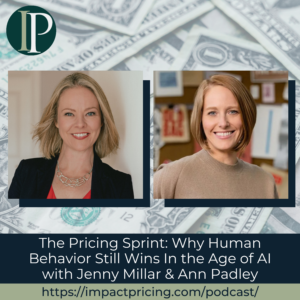
 Jenny Millar is the CEO and Founder of Untapped Pricing, and Ann Padley is a Senior Strategy Consultant at Untapped Pricing. Together, they are the co-authors of The Pricing Sprint, a practical framework that helps organizations make better pricing decisions through customer insight, behavioral science, and cross-functional alignment.
In this episode, Jenny and Ann explore why pricing is ultimately a human problem—even as AI becomes more capable of analyzing data, running scenarios, and optimizing decisions.
If you’re responsible for pricing, product strategy, or commercial growth, this episode will change how you think about behavioral pricing, customer decision-making, and why human behavior still wins in the age of AI.
Podcast: Play in new window | Download
Why you have to check out today’s podcast:
- Learn why pricing problems are often people problems—not pricing problems.
- Discover how small changes in pricing presentation, packaging, and choice can increase willingness to pay.
- Understand why AI can improve pricing decisions, but human judgment still drives great pricing.
“Most pricing problems aren’t pricing problems. They’re human behavior problems.”
— Jenny Millar
Topics Covered:
01:20 – Why Great Pricing Starts With Human Behavior, Not Spreadsheets. How human-centered design helps companies create pricing that customers actually understand and respond to.
03:59 – Are Buyers Irrational? The Debate Every Pricing Team Needs to Hear. Why customer decisions aren’t always driven by logic—and how pricing teams can use that reality to their advantage.
10:19 – The Hidden Link Between Behavioral Economics and Willingness to Pay. How customer perceptions, context, and price presentation influence what buyers are actually willing to spend.
12:15 – The Pricing Sprint: A Faster Way to Improve Pricing Decisions. Jenny and Ann break down their practical framework for testing, validating, and implementing pricing changes with confidence.
16:19 – Why Companies Consistently Misjudge Customer Value. The internal biases and assumptions that cause businesses to leave money on the table—and how to uncover what customers truly value.
21:50 – Who Should Own Pricing? Solving One of Business’s Toughest Questions. Why pricing often falls between departments and what successful companies do differently to create alignment.
26:51 – Can AI Improve Pricing Without Replacing Human Judgment? Where AI can help pricing teams move faster—and where human insight remains irreplaceable.
28:11 – Why the Way You Present a Price Can Matter More Than the Price Itself. Real examples of how small changes in pricing presentation can drive revenue growth without changing the underlying price.
Key Takeaways:
“When behavioral pricing is done right, it actually leads to higher customer satisfaction and better customer experience.” – Ann Padley
“Most pricing problems aren’t pricing problems—they’re human behavior problems.” – Jenny Millar
“Loss aversion, status quo bias, and misaligned incentives are all shaping pricing decisions inside a company.” – Jenny Millar
“Every dollar that flows into an organization is the result of a pricing decision.” – Jenny Millar
Resources Mentioned:
- The Pricing Sprint – The new book by Jenny Millar and Ann Padley that outlines a human-centered approach to pricing, combining behavioral science, customer research, experimentation, and cross-functional decision-making.
- Dan Ariely – Behavioral economist and author of Predictably Irrational. Referenced during the discussion about whether buyers are truly rational in their decision-making.
- Steven Forth – Founder of Ibbaka and longtime pricing thought leader. Mentioned during the discussion about the possibility of AI agents eventually becoming buyers and negotiating on behalf of humans.
- eBay — Jenny’s former employer, where she spent 10 years in pricing analytics and pricing strategy roles, helping shape pricing for a multi-billion-dollar business.
- University of Bristol Centre for Innovation and Entrepreneurship – Referenced as part of Ann’s background in human-centered design, innovation, and behavioral science.
- Behavioral Economics – Referenced throughout the episode as the study of how psychological factors influence decision-making, willingness to pay, and pricing perceptions.
- Human-Centered Design – A core principle behind the Pricing Sprint methodology, focused on understanding customer needs, behaviors, and decision-making processes before making pricing changes.
Connect with Jenny Millar & Ann Padley:
- Website: https://www.untappedpricing.co.uk/
- LinkedIn: https://www.linkedin.com/in/jennymillar/
- LinkedIn: https://www.linkedin.com/in/annpadley/
- Book: The Pricing Sprint: https://www.amazon.com/Pricing-Sprint-Steps-Unlock-Power-ebook/dp/B0GN8CTTW4
Connect with Mark Stiving:
- LinkedIn: https://www.linkedin.com/in/stiving/
- Email: [email protected]
Full Interview Transcript:
(Note: This transcript was created with an AI transcription service. Please forgive any transcription or grammatical errors. We probably sounded better in real life.
Ann Padley
How you present a price is just as important as the price itself. So we know through behavioral science research that the way a price is presented can have a huge influence on how people, maybe not AI quite yet, but at least on how people perceive it and whether or not they decide to buy.
[Intro]
Mark Stiving
Welcome to Impact Pricing, the podcast where we discuss pricing, value, and how buyers decide.
I’m Mark Stiving, and I help companies get paid for value their buyers can’t see.
Our guests today are Jenny Millar and Anne Padley. Here are three things you want to know about both of them before we start. Jenny is CEO and founder, and Anne is a senior strategist consultant at Untapped Pricing. They are both co-authors of the new book, The Pricing Sprint. And if my timing is right, it came out three days ago.
And Jenny is especially, both of them are especially passionate about the human side of pricing. So we’re going to talk about behavioral economics, one of my all time favorite topics.
All right, Jenny and Ann, thank you guys so much for joining me. I appreciate it.
Ann Padley
Thanks for having us.
Mark Stiving
It’s going to be fun. You could tell from my intro that I’m not a huge fan of behavioral economics, but that’s okay. I get it really well. We’re going to talk about it. It’ll be fun. So Jenny, how’d you get into pricing?
Jenny Millar
My journey into pricing started during 10 years with eBay, where I held various pricing analytics and pricing strategy roles for their $26 billion business in Europe.
And that experience opened my eyes to the power of pricing, both its ability to impact financial performance, but also to shape human behaviors in fascinating ways.
Mark Stiving
You know, every once in a while, someone tells me a job that they had and I’m like, Oh, that would have been fun. Right. And so, pricing at eBay, pricing at Amazon, these would be like really cool jobs. I think that’d be neat.
And Ann, how did you get into pricing?
Ann Padley
Yeah. So my career actually began in banking and I worked with a team and helped raise $21.6 million to capitalize a local community bank in Wisconsin.
And as I was working there, I started to really get frustrated by the letters we used to send out to customers because I felt like you almost needed a legal degree. This was like before online banking, all of that good stuff. I felt like you needed a legal degree to really understand what we were saying.
So, I started diving into human-centered design, service design, and behavioral science in order to really design better products and services that met the needs of our customers.
So that journey took me on to help businesses worldwide design better experiences. I moved to the UK, where I was part of the team that started the Center for Innovation and Entrepreneurship at the University of Bristol, and then had the pleasure of meeting Jenny, where I became fascinated in kind of how we apply human-centered design behavioral science to pricing.
So Jenny and I have worked together since then to price everything from like sportswear to software to seismic technology.
And like, we’ll talk a little bit more about it, but we do that through a process that we’ve developed called the Pricing Sprint.
Mark Stiving
Nice. Nice. Sounds fun. Okay, so let me set the table real fast on what I believe versus what you guys might believe. And I’m not going to tell you what you believe.
But my belief on behavioral economics is that we’re trying to explain buyer irrationality.
In fact, that was the title of Dan Ariely’s book, Predictably Irrational.
So my belief is that buyers are rational, but not economically rational, but they’re rational given the knowledge and the situation that they’re in.
So I want you guys to tell me, this is what we believe.
Ann Padley
Huh.
So I think when we talk about behavioral pricing, we really think about the range of factors that customers are weighing.
So I think on that, we agree.
So you mentioned kind of in context, in the buying decision, they’re rational about what they need, they understand their past experiences and maybe how that weighs in.
I think when we think about behavioral pricing, we think about there are some things that we as, I’m going to use the role ‘we’, as business leaders, as pricers, whoever the we is listening, there are some things that we can control. So we can control how prices are presented to our customers.
We can control our value proposition or how we communicate our value proposition. We can control how we position ourselves in the market. We can control to some extent that buying behavior.
But I think what you mentioned are some of those factors that we can’t control.
So the customer’s budget, their past experiences, the alternative solutions they’ve been exposed to. And I think when we’re talking about behavioral pricing, it’s really about what are those things within our control? What are those kind of levers that we can pull in order to help drive sales for the business?
But also, you know, studies show that when behavioral pricing is done right, it actually leads to higher customer satisfaction, better customer experiences.
So we’re really looking at both sides of it.
Mark Stiving
Jenny, did you want to add anything to that before I tell her how she’s so wrong?
No, she’s not. Go ahead.
Jenny Millar
Well, I was going to build on it because I think we also need to recognize the imperfect human beings on the other side of every price. And that’s the individuals and teams that are setting prices inside an organization.
So every, every dollar that flows into an organization is the result of a pricing decision, whether that’s explicit or implicit. Someone somewhere has decided what to price, how to package it, how to discount it, how to present it.
But there are various behavioral forces at play that also, I think, limit and hinder how pricing decisions are made on the organizational side of the price as well.
Mark Stiving
Okay, love that answer. Thank you.
So Ann, let me ask you, you use the word behavioral pricing a lot in that answer that you gave.
How is that different than behavioral economics? I mean, I get all the experiments for behavioral economics. I saw one on your LinkedIn post on the paradox of choice.
And so that’s certainly a behavioral economics type thing where we can influence people’s decisions just by how we present information.
Ann Padley
Yeah, so I think we’re talking about something quite similar. I think when I’m talking about behavioral pricing, it’s really about how can we as pricing professionals use insights from behavioral science and apply those to exactly what you said, how we present price, how we package offers, and yeah, how can we use what’s within our control to be able to help frame price in a way that’s more understandable to the customer and get the outcome that we’re looking for.
Mark Stiving
Okay, because I was thinking it might be bigger than that.
In your mind as you were thinking through what was going on. So it seems to me, when I teach pricing, I always teach the single most important thing is how much is a buyer willing to pay, period.
There’s nothing else more important than pricing than that. However, we can’t read a buyer’s mind, and in fact, a buyer doesn’t even know how much they’re willing to pay for something.
And so we use that as this really weird concept that says, here’s what we’re going after. But now we could take a look at both of your answers and say, Ann says, look, we could influence willingness to pay through behavioral economics.
And Jenny says, the people inside the company are trying to figure out what willingness to pay actually means, even though they have no real ability to do that.
Does that make sense?
Ann Padley
I have a question for you, Mark.
Mark Stiving
Go ahead.
Ann Padley
I’m interested if you’ve ever been in a situation where you went into it with your willingness to pay being one thing and something that happened meant that you actually ended up maybe spending quite a bit more than you expected.
Mark Stiving
Oh, absolutely.
Ann Padley
Quite a bit less.
Mark Stiving
Absolutely. Absolutely.
So when I teach pricing, I teach a concept I use called context-driven pricing, and it has three tenets to it.
One is that willingness to pay is contextual.
The other is willingness to pay is malleable, which is what you just said.
And the third one is perfection is impossible.
And so, yeah, I absolutely believe that we can influence people’s willingness to pay.
We could change their context. We could change their knowledge.
We could do behavioral economics tricks and change someone’s willingness to pay.
Absolutely.
Jenny Millar
Yeah. It’s about, yeah, shaping their choices and behaviors as well as their perceptions of value, which as you say, like is directly linked to willingness to pay.
I think what we see all the time is organizations underestimating how important the design and presentation of pricing and optionality is in that purchase experience.
So in some cases we’ve managed to drive as much upside, if not more, from just changing, making small tweaks to the number of choices or the presentational side of pricing as we have to in changing the price points themselves.
Mark Stiving
Yep. Behavioral economics works. There’s absolutely no doubt, right? There’s absolutely no doubt.
How do you correlate behavioral economics with value?
And so let me give you my definition of value since everybody defines value differently.
I think of value as the result of solving problems. And so if I were in a B2B situation, I can easily define value as incremental profit.
It’s much harder in a B2C situation, and even sometimes it’s hard to get the incremental profit in B2B.
But assuming it’s this real thing that exists, how do we correlate behavioral economics with this real thing that exists called value?
Jenny Millar
Yeah, well, I mean, I think value takes many forms, right?
So your B2B example there was a very tangible, measurable outcome around profits, could be around saving time. increasing revenue, increasing conversion, but then there are for B2B and B2C, there are intangible benefits as well.
So whether that’s social kudos or enjoyment or wellbeing or risk reduction, I think value reflects those tangible and intangible benefits or outcomes, and also reflects the availability of perceived alternatives.
And not just competing solutions, but what happens if we don’t do this at all, or we do this in-house? What does it look like?
And I think with all those factors at play, they’re all influencing that behavior, if you like, that we want to try.
Mark Stiving
Yeah. It’s like, I want to, I want to keep throwing out new concepts for you, but that’s okay. I want to ask about your book.
So tell me, what is the magic about the process that Anne has talked about? She’s mentioned two or three times now.
What is the process that we’re talking about? And can you do that relatively quickly?
Jenny Millar
So over the years, we’ve taken many leadership teams through what we call the ‘pricing sprint’. So it’s a structured process for rethinking pricing decisions.
And we began to notice the same challenges and breakthrough moments appearing again and again across actually quite different organizations.
And that inspired us to write the Pricing Sprint. which is being published by Bloomsbury, and it captures that methodology that we’ve developed and honed over the years, having helped many companies to design and test and improve their pricing.
Mark Stiving
Okay, but you didn’t tell me what it was.
Ann Padley
Yeah. So I think the pricing sprint itself as a book really provides the step-by-step guide for the process that Jenny just talked about.
So it’s really about taking a holistic look at pricing that goes far beyond the number on the price tag.
So we touch on your value proposition, your position in the market, your product. what features are most and least important to customers.
So really for us, it’s about taking this holistic view as we walk through it. It also is really connected to human centered design.
So we walk through those same kind of four step process that you would recognize as part of human-centered design.
So it’s really about going out and exploring, understand the problem we’re working to solve, or the opportunity that the business has to use pricing as a growth lever.
Designing new solutions in order to bring those opportunities to life. then validating them with the market.
So whether that is doing qualitative interviews with customers, really deep diving into their perceptions of value and their needs, their jobs to be done, which I heard was a recent episode on this podcast as well, or going out and doing a large scale market survey in order to really understand things like willingness to pay at scale. We also introduce like live testing.
So how do we actually go out and understand what customers do in a live market?
And then all the way through moving to implementation and helping organizations really embed those learnings into their pricing practices.
Mark Stiving
So, when you say the words, the pricing sprint, is that essentially coming from Agile, the software development methodology?
Ann Padley
Yep, it’s a great pickup.
So yeah, it’s coming from a lot of the tools and techniques from Agile sprint methodology, the way that we think about it, like we’ve talked about the process for pricing, the process for human centered design, and I think the extra layer that you’re picking up on there is really robust facilitation.
So guiding teams through structured decision-making, using kind of time-boxed workshops like you would see in the sprint methodology.
Mark Stiving
So in Agile, we often say we’re going to do two-week sprints.
So I’m really curious, how often do you think we should be doing a pricing sprint?
Jenny Millar
A pricing sprint could be a shorter, targeted exercise to address a certain area of pricing, whether it’s a deep dive into promotions or an overhaul of that customer-facing asset where they see pricing information in a proposal or on a web page and that can take a matter of weeks or it can be a more transformative sprint where we look more holistically to rework pricing and its role in an organisation and that might take sort of 12 plus weeks.
So the area where this diverges from agile sprints is that sort of two-week cycle. I guess to answer your question about how frequently should a business run a pricing sprint, that’s very personal to an organization, depending on the cadence of change, this is appropriate for that particular setup.
Mark Stiving
Yeah, I could see how it would be hugely different between hardware and software companies. Hugely different.
If you were to ask me what’s the biggest problem I see in the way companies do pricing, I would answer it’s that they don’t understand the value of their product the way their customers perceive it.
Now, if I were to ask you that exact same question, what do you think is the biggest problem that your clients have that influences their pricing?
Jenny Millar
Yeah, so I mean I would agree with you that inside out vantage point on pricing decisions is typically there’s a mismatch between how internal stakeholders see pricing and from a structural perspective through to a kind of asset perspective compared to those that are receiving it.
I think there are normally other behavioral factors that are limiting progress and leading to under-optimized pricing, such as loss aversion, as the fear of losing customers outweighs the potential upside from making a change.
Status quo bias, where organizations are defaulting to the current state because change feels risky.
And organizational incentives, where different motivations across teams can mean different stakeholders are pulling in different directions on price. which can again lead to that inconsistent execution of price, but also an impasse when change needs to happen.
So I think it’s those kind of dynamics that hamper or stall effective pricing.
Mark Stiving
It’s like the behavioral aspects inside the company as opposed to inside the customer. Right.
That’s something I’ve never thought of too much. I find that fascinating. Do you guys work on that area much in terms of the behavioral side inside the company?
Ann Padley
Absolutely. I think that’s where the magic of the facilitation piece that I talked about earlier really comes into play.
So as Jenny talked about, businesses are really made up of all these different competing priorities, right?
So sales wants to close the deals. finance wants to get the best margin they can for product, their priority is really like, how do we increase adoption?
And none of those views are wrong, right?
For their roles, that is what they need to be focusing on. But it means that they’re pulling their pricing strategy in a lot of different directions.
So we really look at how to bring the team together, how to align on priorities, how to design the North Star that they’re all going to be pulling towards so that when they get into a room, or worse, they’re not in a room at all and making independent decisions, they have that one place that they know they can always come back to.
And when they come up with a tough question, they can come back to that North Star and ask, okay, if this is our goal, What decision can I make that’s going to help us reach that goal long-term?
I think that’s really critical in helping reduce some of the knee-jerk reactions that we tend to see teams making in pricing to just push in that one discount just to get the month’s sales over the line or whatnot that start to undermine their overarching market position and their overarching pricing and commercial strategy.
Mark Stiving
So in my mind, I’m thinking through, okay, every time a company wants to raise prices, loss aversion goes through their head hugely, right? It’s like, how many customers are we going to lose?
Or, you know, is a customer going to call me and yell at me?
Or, you know, it’s this huge problem that we deal with. Do you name that when you’re working with them? I mean, do you actually name the behavioral economics aspects and say, here’s what’s going through your head?
Jenny Millar
Sometimes we hold the mirror up in that way. Often we are, I mean, you’ll have seen the differing opinions on price. It’s just one of those topics where everyone’s got a different opinion.
And that’s natural because each stakeholder across an organization is coming from a different, has a different perspective on the same challenge. But we like to welcome those perspectives and opinions but turn them into hypotheses that we can then go out and prove or disprove.
So, Ann was talking earlier about different sources of evidence that we might gather, either from past data, historical trading data, or from interviews, survey work, experimentation, but once we’ve got the evidence to then sort of prove or disprove a particular hypothesis, that really unblocks where a team are getting stuck. Builds that cross-functional alignment.
Mark Stiving
Nice. I actually like this concept that says, how do we do behavioral science or behavioral economics inside a company to get them to move on pricing?
Jenny Millar
Yeah.
Mark Stiving
Because I think that’s a really hard problem that not many people think about.
Jenny Millar
I agree. And I think the role of the pricing professional is changing.
So whether that’s in-house teams or pricing consultants, it’s all about influence and building that cross-functional dialogue to ensure that the alignment is there behind a pricing strategy, because only then will it be executed consistently and confidently with the buy-in of the organization.
Mark Stiving
Nice.
Well, let me ask the question that everybody always asks and it’s impossible to answer.
Who should own pricing?
Jenny Millar
Well, as I’m sure you’ve seen, pricing can sit in many places or in an organization.
And the more worrying thing is where it doesn’t sit anywhere or it kind of floats around a management team.
So I think as long as there is a pricing champion at a very senior level, and they are supported by a cross-functional team or pricing board or pricing champions across the organization. I think actually where it sits doesn’t matter too much.
What would you say, Ann?
Ann Padley
Yeah, I think that pricing champion role is really key.
So we’re often when we are working with businesses that don’t have an established pricing team, it is really about having that one person that is responsible for kind of keeping all of the balls in the air, if you will.
They often aren’t the person that actually makes those final decisions, that is the ultimate decision maker, but they’re the person that brings all of the data and all of the insights together in order to help inform that ultimate decision.
So I feel like we hear from other pricing professionals all the time, like, I made a recommendation, they took it away, they were in a room, and then made a totally different decision and just kind of ignored all of the data that I brought to them.
And what we see as the critical piece of this is having that pricing champion that’s able to connect the data and the insights and why we need to make a certain decision.
And they’re also in that room to help guide the ultimate decision that’s coming out of it.
So it’s really that connector piece that Jenny talked about that is changing the role of the pricing professional.
Mark Stiving
Okay.
Speaking of changing the role of the pricing professional, here’s a hard question that I don’t know if you guys have thought about. How is AI about to change pricing?
Especially the roles of pricing people. You can make it up as you go. It’s okay.
Ann Padley
So I think it’s a fascinating question looking like in general, it’s the biggest question that I think I hear everyone talking about, whether that’s in pricing or just about any other topic, how is AI influencing the role?
And I think that AI is going to speed up the amount of data that we can have coming in.
It’s going to allow us to more easily like run scenarios and run predictions, model different variations.
So I think in some ways it’s really going to help us be more agile in the ideas that we can come up with and the ideas that we can test through data. That said, I am not a huge fan of using only data in order to make those decisions.
So for example, I’ve heard of examples where you’re running AI focus groups and using that to determine what your customers would need.
So to me, that is hopefully not where AI is going, not where I would like to see it going. I believe there’s always going to be this human layer that needs to be added, right? We’re always going to need to go out and we’re going to actually need to talk to our customers.
Now, maybe we can use AI to draw insights from those conversations, but AI is never going to be a replacement for having those conversations with our customers.
It’s not going to be a replacement for bringing our team together in a room to make really tough decisions based on the data that we have.
Mark Stiving
Jenny, what do you think?
Jenny Millar
I agree.
So I think we can work smarter by leveraging AI, but based on everything we’ve talked about so far and that role of influence inside an organization and alignment across stakeholders, I think it will never replace the need for that human facilitation in pricing decisions.
Mark Stiving
You know, what’s fascinating is that people keep talking about AI replacing workers, especially white collar workers.
And if you think about pricing, it’s a number.
I mean, it’s not you and I know it’s not, but it’s a number. It’s quantitative. And so therefore it should be replaced with AI quickly.
Jenny Millar
Well, hey, I think AI can help simulate pricing scenarios quickly.
It can help evaluate price experiments really quickly and it can help optimization at scale.
So where you’ve got a large kind of multi-skew retailer operating globally in different markets and it can respond in a really smart and quick way to implement a pricing strategy.
Yeah, again, I think just we need human beings at the helm of the AI to really leverage it in the best way, I would say.
Mark Stiving
Okay.
By the way, I would agree with that completely. I don’t think AI, first off, I think pricing is not a quantitative problem.
Finance might look at that, but it’s not, right? It’s really a deep understanding individual buyer type problem.
So I don’t think AI is going to pull that off quickly. Now, here’s my bigger fear with AI.
How do we handle it when AI becomes the buyer? In fact, I’m gonna make the following argument. If AI was truly a buyer, behavioral economics is irrelevant.
Jenny Millar
Oh, that’s a great provocation, Mark. Yeah. When AI becomes the buyer.
So, well, I guess we need to stay on top of how humans are tasking AI to make that decision. Right. So it still traces back to the human beings, but it does add a dimension that we may not all be ready for.
Mark Stiving
Yeah, I’m not sure a good friend of mine, Steven Forth is working on this, but I’m not sure that AI is going to be a buyer for a while. I think we got some time.
So, all right, guys, this has just been a blast. I’ve really enjoyed the conversation, but I’m going to ask the final question.
What is the one piece of pricing advice you’d give our listeners that you think could have a big impact on their business?
Ann Padley
Yeah, absolutely.
So I think this one isn’t going to come as a surprise based on our conversation, but I think it’s that how you present a price is just as important as the price itself.
So we know through behavioral science research that the way a price is presented can have a huge influence on how people, maybe not AI, point yet, but at least on how people perceive it and whether or not they decide to buy.
We’ve seen this mirrored in our own work where we’ve been able to drive just as much revenue upside from changing how that price is presented as from changing the price itself.
And this, again, comes down to human behavior. Our brains are hardwired to make decisions quickly using what we’re hearing, what we’re seeing, past experiences, the context we’re in, our current needs. We weigh all of these to make a decision.
So I think my advice is exactly that, you know, that this side of pricing goes beyond the price tag itself and into human behavior. I think that if we’re neglecting this human behavior as part of our pricing strategy, we’re really missing out on a big part of what actually drives that ultimate willingness to pay in context.
Mark Stiving
Nice. And Jenny?
Jenny Millar
Yeah, so I’m going to flip to the other side of the price and inside the organization.
So most pricing problems aren’t pricing problems, they’re human behavior problems. Loss aversion, status quo bias, misaligned incentives, all shaping pricing decisions inside a company.
So the longer those behaviors go unchallenged, I think the more value businesses are leaving on the table.
Mark Stiving
Nice. Nice. Excellent.
Guys, thank you so much for your time today. If anybody wants to contact you, how can they do that?
Jenny Millar
Yeah, please contact us on LinkedIn. So Jenny Millar or Ann Padley or visit untappedpricing.co.uk. Please also do take a look at the Pricing Sprint, which is available on Amazon or other major book retailers.
Mark Stiving
All right, and to our listeners, thank you for your time.
If you enjoyed this, would you please leave us a rating and a review? And if you have any questions or comments about the podcast, or if you want to get paid for the value your buyers can’t see, email me, [email protected].
Now, go make an impact.
[Outro]