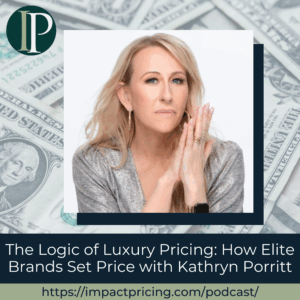
 Kathryn Porritt is the founder and CEO of Iconic Empires, where she specializes in helping elite experts build luxury and premium positioning. With a focus on monetization expertise and authority, Kathryn works with clients to elevate their brands and expand their vision of possibilities. Her unique approach emphasizes mastery, rarity, and transformative experiences, enabling her clients to connect deeply with high-end buyers.
In this episode, Mark Stiving sits down with Kathryn Porritt to explore the intricacies of selling luxury goods. They discuss the differences between luxury and premium buyers, the importance of creating an expanded vision of possibilities, and how to effectively communicate value in high-end markets.
Podcast: Play in new window | Download
Why you have to check out today’s podcast:
- Learn why luxury buyers don’t negotiate and how expanding a buyer’s future vision removes price from the conversation entirely.
- Understand the difference between premium and luxury pricing, and why treating them the same quietly caps your revenue.
- Discover how elite sellers confidently say bold prices without flinching, discounting, or overselling.
“Expand a vision of possibility for people—show them what they can’t see for themselves. When you focus on that, pricing becomes easy.”
– Kathryn Porritt
Topics Covered:
01:30 – What Luxury Buyers Actually Buy. Why true luxury customers aren’t purchasing features or value props—they’re buying rarity, mastery, and first-of-its-kind experiences.
05:40 – Premium vs. Luxury: The Line Most Sellers Miss. How premium buyers still compare and negotiate—while luxury buyers step outside price entirely.
08:45 – The “Expanded Vision of Possibility” Framework. Why the most powerful pricing conversations anchor buyers in a future they didn’t know was available.
12:30 – When Budgets Grow (Even in Corporations). How elite sellers expand scope and impact—causing “fixed” corporate budgets to quietly increase.
16:10 – Confidence, Control, and Saying the Number. Why the price you can say without hesitation determines whether the buyer trusts you.
19:40 – Intuition vs. Calculators in Luxury Pricing. How elite experts balance cost, margins, and intuition when there is no reference price.
23:20 – Why This Isn’t Just for Luxury Brands. Mark connects the dots: this is exactly how every B2B seller should be selling value.
26:40 – One Pricing Principle That Changes Everything. Kathryn’s closing advice—and why expanding possibilities is the fastest path to higher prices.
Key Takeaways:
“People at this level, people who buy luxury, like true luxury buyers, they’re looking for something that’s not necessarily about the value.” – Kathryn Porritt
“That expanded vision of possibility is the difference. And like I said, that’s when pricing becomes almost obsolete in the conversation.” – Kathryn Porritt
“For a luxury buyer, it’s not about the budget.” – Kathryn Porritt
Resources and People Mentioned:
- Iconic Empires – Kathryn’s firm helping elite experts position, monetize, and sell at the highest levels.
- Jeff Bezos – Referenced as an example of true luxury buying behavior where budget is irrelevant
- Coca-Cola – Mentioned as a corporate example in the context of budget discussions for events.
- Luxury Market – Discussed as a distinct market segment with unique buyer motivations.
Connect with Kathryn Porritt:
- Website: https://www.kathrynporritt.com/
- Website: https://iconicempire.com
- Linkedin: https://www.linkedin.com/in/kathryn-porritt?originalSubdomain=au
Connect with Mark Stiving:
- LinkedIn: https://www.linkedin.com/in/stiving/
- Email: [email protected]
Full Interview Transcript:
(Note: This transcript was created with an AI transcription service. Please forgive any transcription or grammatical errors. We probably sounded better in real life.)
Kathryn Porritt
Expand a vision, a possibility for people, show people what they can’t see for themselves. And if you focus on that, I promise you, proven it over and over and over. That’s when pricing becomes so easy.
[Intro]
Mark Stiving
Welcome to Impact Pricing, the podcast where we discuss pricing, value, and the intentional relationship between them. I’m Mark Stiving, Chief Educator at Impact Pricing. We help companies get paid more for the value they deliver.
Our guest today is Ms. Kathryn Porritt. Here are three things you want to know about Kathryn before we start. She is the founder and CEO of Iconic Empires. What a fabulous name. Kathryn works with elite experts to build luxury and premium positioning, and she specializes in monetization expertise and authority. Welcome, Kathryn.
Kathryn Porritt
Hi, Mark. It’s just such a joy to be here. I’m really looking forward to this conversation.
Mark Stiving
Okay, I told you this like 10 seconds ago, but I’m going to say it again so that everybody else can hear it. I asked you on because I want to know about luxury goods. I want to know about luxury.
By the way, to my listeners, this might be slightly different than the way we usually go, but hey, let’s go with it and see what we can learn. So, most of my clients, most of my work is B2B. We talk about, hey, we want to sell value.
And in B2B, it’s really easy. Value is incremental profit. So how am I helping my customer make more money? OK, all that said, I got another friend who sells really high-end home theaters.
These are luxury products, right? We’re selling them to multimillionaires, billionaires. And so he’s always trying to get his dealers to communicate value, to sell luxury.
So let me just toss out that wide open softball and where would you take that, right?
What does it mean to sell luxury and how do we get people’s attention this way?
Kathryn Porritt
Well, it’s so different to mainstream selling or your standard B2B selling on value.
People at this level, people who buy luxury, like true luxury buyers, not want to be luxury buyers, which have crept into the market over the last, say, five years, it’s become a really big part of the market, that aspirational luxury buyer.
But if we think about the billionaire, the person who really does buy luxury, that core part of the market, they buy something completely different. They’re looking for something that’s, it’s not necessarily about the value that’s got to be there.
So I specialize in helping personal brands sell luxury. So I’m always looking for mastery. Best in the world. What do you get? Absolute best in the world. That’s just got to be there. That’s implied. We don’t even need to talk about that. It’s the best wine in the world. It’s the best home theater in the world. It’s the best. It’s the best of the best. That goes without saying, we don’t need to go into the widgets and the whatnots to talk about the value.
What they’re really buying here is something that’s unique, something that’s novel, something that no one else has. They want to be first to market. They want to have something that no one else has. They want to have the first experience. That unique, rare, positioning is really very important.
And I often say when we’re positioning a brand to sell to the luxury market, it’s an ever-evolving positioning because you can’t just stand still and then sell the same thing to the luxury market for, you know, 5, 10, 50 years. Although there are heritage brands in the luxury market, they’re always evolving. Effectively, a luxury brand is being paid to evolve or paying to grow, which is really fun if you like that continuing evolving strategy or the growth strategy.
The other thing, so rarity is mastery number one, implicit. has to be there. Number two, rarity, really, really important. Number three is experience. There needs to be something that’s just, you know, completely blows you out of the water, completely, again, you know, rare, unique, but there has to be that experience there.
So, for your friend who sells into the theater market, if you look at a lot of the way that luxury brands sell, the way that they position, the way that they market, it’s really different to mainstream. These are the inclusions. They’re selling the experience. They’re selling the feeling. They’re selling the emotion.
How is this going to feel? How are you going to, you know, how’s this going to improve your life? That massive transformation. We call that expanded vision of possibility. Something that’s much bigger than anything else that they could have imagined for themselves.
So all of these things are not, it’s not a checklist, unfortunately. It’s a feeling, it’s rarity, it’s those sorts of things.
Mark Stiving:
Yeah, so I want to take a step back.
And so the first thing I want to say is I probably define value differently than you, but I want to, I’m going to create a common language for us. I think when you think of value, you’re thinking of, I’m going to say the words functional value. How do I use it? What’s it going to do for me?
And then there’s the stuff beyond value, which I probably would have put into the value bucket, but I’m happy taking it out for this conversation. And those are things like, I want to be first. I want this amazing experience.
So there’s this exceptional thing that’s above and beyond the functional purpose of the product.
Kathryn Porritt
I’m happy with that. Let’s do that. OK.
Mark Stiving
So I’m totally OK. We’ll say, hey, that’s beyond value. I’m with you on that. So then I’m going to try to work this backwards and say, okay, a billionaire wants a wow experience. Doesn’t someone who makes $100,000 a year?
So if I were trying to sell a theater to someone who makes $100,000 a year, I would still pitch it as a wow experience. It might be different, right? It might not be the same wow a billionaire gets, but we’re still talking about the emotions. Does that make sense?
Kathryn Porritt
It does, Mark. Absolutely.
And I would say that’s the difference between a premium buyer and a luxury buyer. They are two different things.
So you’re absolutely right. So a premium buyer is still looking for a wow experience. They’re still looking for something that’s rare and it might be that they’re a first mover and all of those same attributes. that we were talking about a moment ago.
But there’s a real difference between premium, which still your $100,000 buyer is still going to have a list of those transactional value, you know, attributes that we were talking about that they still want ticked off. For the luxury buyer, and they’re still going to be slightly price sensitive, I would say in the luxury market, it’s almost as though pricing is removed from the table. The thing that I talk about a lot with my clients in defining a luxury brand is this expanded vision of possibility.
So, if you imagine, for example, and it’s something that we can all imagine in this market, so a wedding, say Jeff Bezos just got married in Venice, that is a true luxury wedding.
I can almost guarantee that there was no discussion about price or budget. It was all about, how can we create something that’s incredibly unique and different? How can we do something that no one else has done? How can we take over an entire city and bring in all of the elite, the A-listers to the world?
How can we create something that feels amazing? This moment, this moment, this moment, this moment. That’s an expanded vision of possibility. That’s a bigger vision than any other wedding that’s ever existed on the face of the earth.
All that handcrafted lace from, you know, nuns in, I don’t know, central Italy somewhere. All the things that are rare, unique, different, and novel, and it brings together something that no one else has been able to achieve.
That expanded vision of possibility is the difference.
And like I said, that’s when pricing becomes almost obsolete in the conversation.
So for a luxury buyer, it’s not about the budget.
Mark Stiving
I could picture Bezos’s wedding ignoring the budget, right? By the way, it’s hard for me to picture that. It’s hard for me to not believe Bezos didn’t say to somebody, hey, you’ve got $100 million, go spend it.
Go make this an amazing event. But I could even buy, look, there wasn’t even that budget constraint, right? It’s just like, go do what you’ve got to do.
So your job is to help people sell to them so let’s say for the sake of argument, you were going to teach me to go sell to them. There’s only a thousand of them. I mean, it isn’t like there’s a big market. It’s, I got to win Bezos and I got to win Gates and I got to win Musk, and now I’m done.
Kathryn Porritt
Right? Yeah. So that’s absolutely true.
So the big difference between a luxury brand and a mainstream brand is really volume. So, you know, pricing, volume, all of those things, but my clients are not looking for a thousand or a hundred thousand million dollar clients. They’re looking to work with a handful, maybe four to 10 million dollar plus clients a year and work really deeply and richly with them doing things that are truly transformational.
So you’re a hundred percent right.
Mark Stiving
So when you sell to clients, are you typically selling to the individual, as in I’m going to sell to Bezos?
Or are you selling to corporations, like I’m going to sell to Coca-Cola?
Kathryn Porritt
We do both. So I tend to work with elite experts, people who are the very best of the best at what they do. So the best wedding planner in the world, the best mechanic in the world, the best functional medicine practitioner in the world, the best shaman in the world.
So I tend to work with the best of the best, and they haven’t got the pricing, the offer, and they’re not working with the people that are commensurate with the mastery that they’ve developed.
They tend to be 40 plus because they’ve had so many years in the market and they’ve developed that elite expertise. So we’re just literally repositioning them to work at that level. And the repositioning really comes down to matching the mastery with the positioning, allowing them and getting them to feel really confident about owning the fact that they are indeed the very best in the world and not being the best kept secret.
And then getting them into the rooms with the right people, Mark, because you’re absolutely spot on. And it may well be that the buyer is, the end game is, you know, Most of my clients are selling B2C, so they’re selling person to person, and a transformational health offer or a transformational consciousness offer or whatever that might be.
We also do work with a number of personal brands that are selling into the B2B market as well. That’s rare for me to do, but it’s one and the same to me is still selling human to human. We’re usually selling to the CEO or we’re selling to the CFO or whatever that might be. And the structure of that offer is usually fairly similar.
Mark Stiving
So, let me push back on that a little bit. By the way, you can tell me I’m totally wrong. I don’t mind at all. I’m going to push back a little bit.
I could easily see Bezos saying, I’m going to spend $100 million on a wedding. I could never see the company of Coca-Cola saying, I’m going to spend $100 million on an event.
I could see them saying, ‘Hey, we’re going to go do this event. What should the budget be? How much should we spend in order to get the results that we want for this event?” Whereas when I’m selling B2C, I could easily see money just not mattering.
Kathryn Porritt
So I’m going to push back slightly on that because, yeah, and it’s absolutely true for sure that the corporates will come into a conversation with a budget in mind.
Here’s the value that I want from this conversation. Here’s what I want you to do. Here’s a list of the things that I want you to be able to achieve for me. My client’s job is to expand that vision of possibilities, to listen to that and say, yes, we can do all of those things and imagine if we did this. And then the budget expands if they do a really good job.
So, I mean, Coke’s not a bad example of that. If we’re, you know, we’ve got one of the biggest brands in the universe and, you know, really well-known, if they want to create a groundbreaking, let’s say I was working with a branding explorer, an event expert, I do work with a couple of the most elite event planners in the world who work with corporates and run, you know, big awards programs and do a lot of their launches, et cetera.
They come in with a budget. Their job is to say, yes, we can do all of these things, but let’s imagine if we did this.
And then paint that picture of possibility that expands the vision for them as more creative as gets a bigger outcome than they ever envisioned.
That’s when the budget grows. And that’s where we can do things that are really novel and someone who, you know, has that elite level of expertise, isn’t just coming in and working to someone else’s, you know, contract, they’re expanding that and they’re showing them what’s possible.
They get to live more creatively in this luxury world. So there’s a slight pushback on that.
Mark Stiving
Totally okay, totally okay. So as you were talking, it reminded me of an aha moment I had over the break, over Christmas break. So I’m writing another book, and the new book is called Buyer Disconnect, and why do buyers say, let me think about that?
And so one of the things that I really, that it was just like, it’s so obvious, but I’d never thought about it before. Every time we buy something, what we’re really doing is making a prediction about the future.
And so what I heard you just describe is, oh, we’re trying to paint a picture of the future for clients that’s much bigger than the picture that they had already painted for themselves. And I thought that was just fascinating as it fits in the story.
Kathryn Porritt
It’s so true. And that is the backbone of, it’s the skill set, the number one skill set. that I teach my clients is this ability to expand the vision of possibility for the person who’s sitting in front of them. Because that’s what takes the pricing off the table.
You articulated that so beautifully. That idea of being able to anchor yourself in a future that you hadn’t believed was possible with someone who’s the most elite master in the world who can in fact make that happen because they need to have the integrity to actually make it happen, not be selling unicorns and lollipops, then we’ve done a great job. Then it’s just about the execution.Yeah, I love it.
Mark Stiving
Absolutely fascinating conversation so far. So the thing that jumps into my head so much while you’ve been talking are the words imposter syndrome. I can imagine every one of your clients comes into you thinking, I am not as good as everybody thinks I am. Is that an issue that you deal with?
Kathryn Porritt
It can be. Mostly it’s the opposite to that. So what I tend to find is that once I’ve had a conversation with someone who’s truly an elite master, they actually know in their bones that they’re the best in the world at what they do. They just haven’t been able to get in front of the right people to do what they want to do. They haven’t been able to get into the right room with the right introduction. They don’t really know what to say in the room.
We call it an iconic embodiment. I definitely feel that most of the clients that I work with, they’ve got an inner knowing that they’re actually the best. They may not be because of society and all of the, you know, particularly, I mean, as an Australian, goodness gracious, we’ve got tall poppy syndrome and all of those things that keep this societal pressure just to make yourself smaller and never, you know, big yourself up.
My friends in America, I mostly work with Americans, tend to not have that problem, which is wonderful. But they tend to have that inner knowing even if they hadn’t said that, admitted it to themselves or admitted that to someone else before. So imposter syndrome, we don’t have a huge amount of that.
If I do, it’s just we’ve got to chip away at, you know, some things that have maybe been said to them over time or some mindset things about there’s no one that would pay this amount for what I do. You know, I’m in an industry where there’s no one that would pay a million dollars for this. That’s more the thing. That’s not imposter syndrome. That’s just a belief in the market’s potential.
Mark Stiving
Okay, so now I’m going to ask you a really hard question and we’re going to go to pricing. Okay. I believe really strongly in a strategy of pricing I call context-driven pricing, which simply means charge what a buyer is willing to pay. That’s it. If Bezos doesn’t have a budget, how do you set a price for what you’re going to sell at his wedding?
Kathryn Porritt
So, I believe in exactly the same thing and I love this market. It’s so good. To be perfectly honest, I don’t have a checklist or, you know, there’s no pricing, though we have a pricing calculator to help expand people’s, you know, idea of possibility. They’re usually bands. What I tend to say to my clients is, say the number. If we don’t have a number that they’ve said or there’s a number that you intuitively feel in the moment.
So we’ve got Bezos with his wedding. Goodness, how did we end up here? We’ve got two people that don’t know anything about weddings talking about Bezos’ wedding.
But in that conversation, it’s going to be, look, let me come back to you. We’ve anchored them in the offer. We’ve anchored them in this expanded vision of possibility. Here’s all the things that we’re going to do. I’m going to come back to you with a number that makes sense. Usually what I say to my clients is, what’s your intuition? We need the costings, we need all of those things. Of course we do, obviously. But my clients have huge margins. I’m sure yours do as well with the work that you do. We’re not working on these skinny, you know, maybe we get 10% if we’re really lucky today, if we hit volume.
So it is often what the buyer will swallow, but it’s also what my client feels comfortable saying without vomiting. So, we need to get to a price point that they can actually say because remember I said to you just a moment ago and I think those two things are really linked. The number that they can actually say and what they believe the market will bear. That’s where we do our incremental price increases over time.
Oftentimes I’ll say to them, I think this is worth $4 million for the sake of argument. They’ll come back to me and say, there is no way on God’s green earth I’m going to be able to let that come out of my mouth. Okay, well let’s think about what’s the number that you can say confidently in control. in the pricing conversation without you losing. Because, you know, my opinion on sales is he who is in control will always win. And it’s very, very important that you are in control. You believe in the number and you feel really confident saying it.
So oftentimes, I don’t know where I’ve answered your question or not, but I think it’s twofold. It’s what the market will bear and It’s also what the client feels confident enough in the sales conversation to actually say. And oftentimes that will increase quite quickly. We’ve got a million dollar offer out of the way. Like I can do this. Yes. I got that number out and we’re good and we’ve delivered it right now. We’re going to four next time or whatever that number might be.
Mark Stiving
Nice. So can I give you a hint on something you could try?
Kathryn Porritt
I’d love that.
Mark Stiving
One of my favorite things I do with people who are afraid to say a price is I have them pick up an object, let’s say a pen. I just say, say the words, this is a pen. And they say, this is a pen. And I say, now say, my price is $4 million.
Kathryn Porritt
My price is $4 million.
Mark Stiving
This is a pen.
Kathryn Porritt
This is a pen.
Mark Stiving
My price is $4 million.
Kathryn Porritt
My price is $4 million.
Mark Stiving
They’re both just facts.
Kathryn Porritt
They are. They are. It’s so true.
Mark Stiving
And so oftentimes it gets people over the hurdle of, it’s like, my price is $4 million, right?
Kathryn Porritt
Yes, exactly. It’s that. You’ve lost it. It’s all gone. All that work is all gone in that one moment.
Mark Stiving
Okay, we’re going to wrap this up here in just a second, but I have to say, we started out and you used the phrase relatively quickly, expanded vision of possibilities. And that just went over my head. And you’ve said that now three or four times. And as you say it, each time you say it, it gets more and more important to me.
And so, take just a minute and talk about that phrase, because it feels to me like that is your entire business. It feels like that’s the business that all of my clients should be in if you want to know the truth.
Kathryn Porritt
Yeah. Well, it’s what makes you rare and unique in the market. And also what’s so wonderful about it is when you are an elite expert, it gives you that creativity that we often crave. So not just doing the same thing over and over again, which builds a very boring business. So that’s something of joy. This is a great way of doing it.
So, if we think about, you know, some other examples of that outside of the Jeff Bezos example. So, any of my clients, what I tell them to do is to walk into any of these conversations. We’ve opened a door for them. They’re in the right room. They’re having the right conversation with the right person. We want to do some real deep listening to what it is that that client actually wants. So let’s imagine a, you know, a situation where we’ve got, I don’t know, a client who’s in the consciousness space.
Actually, let me give you a great example of a new client that I’m working with who, she works with identity. So changes in identity for women who are 40, 50 plus, who have just become empty nesters and they’re really focused in on what is next for me. They’ve just spent their entire life, you know, being a mom, being an entrepreneur, being all the things and then suddenly it’s shifted.
Mark Stiving
What a great business.
Kathryn Porritt
Amazing business and she does such incredible work. And so, the idea of getting into a conversation with an elite personal brand, someone who has had this experience, they’ve hit 50, they’ve suddenly become an empty nester and they’re having a bit of an identity crisis. Her job is to listen to all of that very, very deeply. Hear all of those things.
Same thing that you would do in a mainstream conversation. But instead of going into the pain and pressing the bruise and all of those things, what a luxury Brand will do is then expand the vision of possibility for that person. So paint a picture using her elite expertise. Tell that person what they can’t see for themselves. Show them what that looks like. Paint that picture for them and anchor yourself in that delivery.
So that woman who’s having that identity crisis and, you know, it’s the, okay, great, we can fix all of those things. Of course we can fix all of those things. And I will anchor you to this new woman that you’re going to be, all the dreams that you’ve ever had. And let me paint a picture of what’s possible beyond that.
Mark Stiving
Okay, Kathryn, in no way am I diminishing anything you’ve ever said here, but I wanna point out that what you’re doing is exactly the same thing every B2B salesperson should be doing.
Kathryn Porritt
But they don’t.
Mark Stiving
They don’t, there’s no doubt.
Kathryn Porritt
This should be the sales pitch for everyone.
Mark Stiving
So if I’m selling you a product, you called me because you had a problem, we’re going to sell the product that solves that problem. But it turns out this product actually does way more than solves that problem, right? And so, what I really need to do is expand the vision of possibilities for this product.
Kathryn Porritt
Yes.
Mark Stiving
Absolutely brilliant. Absolutely brilliant. And as a master and someone who wants to buy unique, does that mean that they allow me to experiment, right? Hey, I don’t know if this is going to work, but let’s try this.
Kathryn Porritt
Yeah, there’s an absolute, again, I mean, I don’t want to spend too much time on luxury brands and those sorts of things, but if you think about, you know, a lot of the luxury purchases, even the things that we know really well in the luxury market, like cars, a lot of the very, very luxury cars are not, they’re imperfect.
They are experimental, they are personalized, but they’re rare and unique. And they give you this feeling of, you know, I am the most elite. I have this, you know, one of four of these. So you’re 100% right. They definitely work, don’t get me wrong, but they don’t necessarily need to be perfect because there is experimentation in being novel, truly novel.
Mark Stiving
Yeah. Okay. This has been absolutely fascinating, Kathryn. Thank you so much for joining us. I always ask this question at the very end and you may not have any idea what the answer is, but I’m going to ask it anyway. Yeah. What is one piece of pricing advice you would give our listeners that you think could have a big impact on their business?
Kathryn Porritt
I think, let’s go with the central piece of everything that we’ve spoken about today, which is, expand a vision of possibility for people. Show people what they can’t see for themselves. And I promise you, if you focus on that, I promise you, proven it over and over and over and over and over, that’s when pricing becomes so easy. So easy.
Mark Stiving
That is brilliant. And I’m going to steal your phrase, expanded vision of possibilities, unless you have that copyrighted, but I just think that’s amazing.
Kathryn Porritt
I am very happy to share it with you. The more people who learn how to sell this way, the better. I’m, I’m all for it. I love it.
Mark Stiving
Nice. Kathryn, thank you so much for your time today. If anybody wants to contact you, how can they do that?
Kathryn Porritt
They can do that through iconicempire.com. I would love to see you there.
Mark Stiving
Excellent. And to our listeners, thank you for spending time with us. If you enjoyed this, would you please leave us a rating and a review? And if you have any questions or comments about this podcast or if your company wants to get paid more for the value you deliver, email me, mark at impactpricing.com. Now, go make an impact.
[Outro]