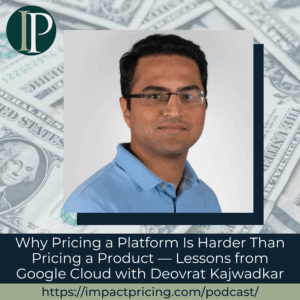
 Deovrat Kajwadkar is the Director of Strategic Deal Pricing and Monetization at Google Cloud, where he sits at the center of some of the most complex commercial decisions in modern tech. With a background in management consulting at McKinsey and deep experience in cloud and AI monetization, Deovrat brings a rare inside view of how pricing actually works when products are platforms, costs are dynamic, and value is constantly evolving.
In this conversation, Deovrat and Mark Stiving unpack why pricing is not just a “number-setting” function but the grade of how well everything else in the business is working. They explore the difference between platforms and solutions, why value-based pricing becomes harder as offerings become more flexible, and how AI is changing both how pricing is done and what pricing even means.
Podcast: Play in new window | Download
Why you have to check out today’s podcast:
- Learn why pricing sits at the heart of cloud and AI economics, touching product, strategy, sales, and profitability all at once.
- Understand how platforms, solutions, and AI fundamentally change value-based pricing, and why cost, competition, and outcomes all matter—at different layers of the stack.
- Discover why “pulling the dollar lever” is the most expensive move, and what smarter pricing leaders focus on first.
“Pulling the dollar lever is easy—but it’s also very expensive. I’d rather pull every other lever first.“
– Deovrat Kajwadkar
Topics Covered:
01:40 – Cloud Pricing as a Central Role. Deovrat explains why pricing sits at the center of Google Cloud’s commercial decisions—connecting product strategy, growth, profitability, and customer value.
05:09 – Cloud Computing for Enterprises. A clear, non-technical explanation of cloud computing for enterprise customers, from infrastructure and platforms to software and AI—and why pricing each layer is different.
08:48 – Value-Based Pricing Challenges. Mark and Deovrat discuss why value-based pricing is especially difficult for platforms, where customers use the same products in very different ways.
13:04 – Value-Based Pricing Strategies. A practical framework for pricing across the cloud stack: cost- and competition-based pricing at the lower layers, and outcome-driven pricing as offerings move closer to customer solutions.
18:10 – AI’s Impact on Pricing Strategies. How AI is changing pricing on multiple fronts—what gets priced, how costs behave, and how quickly products and value propositions evolve.
22:34 – AI in Pricing Strategies. Deovrat breaks down how AI can support pricing decisions, from customer analysis and renewals to analytics and decision support—while stressing the importance of clean data foundations.
24:12 – AI Value Delivery Challenges. Why delivering real AI value is harder than building the technology itself, and how change management and business adoption affect pricing and monetization.
27:30 – Pricing Advice for Business Impact. Deovrat’s closing advice: great pricing leaders expand their skill set beyond pricing fundamentals—and pull every lever before resorting to raising prices.
Key Takeaways:
“Pricing touches almost everything—it’s the heart of a company’s economics.” — Deovrat Kajwadkar
“The more commoditized the offering, the more cost and competition matter.” — Deovrat Kajwadkar
“As you move closer to business outcomes, value-based pricing becomes possible—but harder.” — Deovrat Kajwadkar
“AI changes pricing, but it doesn’t eliminate the fundamentals.” — Deovrat Kajwadkar
Resources and People Mentioned:
- Google Cloud – Cloud platform spanning infrastructure, AI models, developer tools, and industry solutions.
- McKinsey & Company – Deovrat’s consulting background, shaping his strategic view of pricing and technology.
- AI Models & Agentic Workflows – Referenced in the context of pricing analytics, automation, and decision support.
Connect with Deovrat Kajwadkar:
Connect with Mark Stiving:
- LinkedIn: https://www.linkedin.com/in/stiving/
- Email: [email protected]
Full Interview Transcript
(Note: This transcript was created with an AI transcription service. Please forgive any transcription or grammatical errors. We probably sounded better in real life.)
Deovrat Kajwadkar
Pulling the dollar lever is easy but also is very expensive. So I would rather pull the right levers, all other levers before I have to resort to pulling my dollar lever.
[Intro]
Mark Stiving
Welcome to Impact Pricing, the podcast where we discuss pricing, value, and the multifaceted relationship between them. I’m Mark Stiving, and I run bootcamps to help companies get paid more. Our guest today is Deovrat Kajwadkar. Here are three things you want to know about Deovrat before we start.
He is the Director of Strategic Deal Pricing and Monetization at Google Cloud. He has a background in management consulting and big tech pricing monetization roles, and he’s deeply passionate about cloud pricing. Welcome, Deovrat.
Deovrat Kajwadkar
Thank you, Mark. Thanks for having me.
Mark Stiving
Hey, this is going to be fun. How did you get into pricing?
Deovrat Kajwadkar
It just happened. I was working. So in my past life, before I joined Google, I was working at McKinsey & Company, serving customers and clients on technology strategy topics. At one point, I was serving customers or clients across financial services, healthcare, and at McKinsey, at a certain stage, you are expected to become a really deep expert into some area or some space. And I chose technology and cloud to be my area of expertise.
And this was early 2016 to 2018 timeframe where the cloud was also at its inflection point. The only cloud provider out there was AWS and, well, Azure was around. And I think Google Cloud was in its infancy. So, cloud as an industry, as a space, was at its inflection point. And I got to a point where I really wanted to go deep in that space. And I wanted to go work at a cloud company.
And between a combination of personal constraints and personal preferences of where we wanted to be, this role at Google Cloud happened. I’m like, this is Google, Google Cloud in a fast growing space. You can’t go wrong with Google Cloud. Let me see what roles they have to offer. Because I had zero doubt on the space, but not necessarily the specific function in that space.
And there was this team, I spoke to a few teams and the pricing team was growing at the time. I didn’t know much about pricing then, but what appealed to me was they were at the heart, this team that I’m now part of, is at the heart of all the commercial decisions that Google Cloud makes, whether it is on pricing new products or services or landing those prices with large customers with a backdrop of growth, profitability.
So all in all, it sounded very interesting and a complex interplay of factors in a space which was fast growing. So I thought, okay, let’s give this a shot. And here I am five years later, more optimistic and more enthusiastic about not just Cloud as a space, but Google Cloud as a company and the role that we play as the business planning and pricing team within Google Cloud.
Mark Stiving
Nice. So, quick aside, where do you live?
Deovrat Kajwadkar
I live in Austin, Texas.
Mark Stiving
Okay. I was just curious, you know, what was the thing that drew you there? So that was good.
Deovrat Kajwadkar
Yeah. No, it was my, my wife is a doctor. She had a job here. So I just moved here for personal reasons.
Mark Stiving
Yeah, like, we’re living in Austin now, what job can we get? So, what I found fascinating about the story you just told, though, is that you showed up for a pricing role, but you found out that pricing is actually the center of everything. So that’s pretty fascinating. In my mind, it is.
So let’s talk about cloud pricing for a second. And first off, describe the product of cloud for a second, because I have a perception of what I want to ask you, but I want to make sure that we’re all on the same page.
Deovrat Kajwadkar
Absolutely. Absolutely. And I would give a slightly broader answer, assuming that the viewers or the audience of this podcast may not be from the tech and the cloud space. So I think most people understand cloud as a place where they store their storage. Oh, I have iCloud. I have Google Cloud. I have Google Drive. That’s where I keep my storage. I think that’s true, but that’s a small sliver of what cloud actually is.
Think of it as your technology footprint that any enterprise needs. And I’m primarily talking from an enterprise standpoint. You can extend the same analogy for consumers and personal use as well. But I’m going to take a B2B or an enterprise lens in our conversation here. So for most enterprises, think of them as all these enterprises have massive technology needs.
They have compute, storage, networking requirements to run all their applications, their business applications, to ultimately power what products and services they offer to their end customers. Traditionally, your technology footprint was all self-hosted, self-managed. You bought your own servers, you bought your own storage, you bought your own networking cables, and you hosted all of that in your own space, in your own data center, to meet the needs of what your business needs.
Now, that could be our payroll system, that could be our HR system, that could be a business application that is core to what you do. Netflix, for example, they run all these movies and shows and they have to now store the content, stream the content, get the content to your TV in a low latency mode. Those are technology requirements that a traditional enterprise would have done all by themselves.
And here comes cloud computing saying, hey, don’t worry about your own requirements or don’t worry about managing and buying and doing all those things. Allow us to do it for you so that you, as an enterprise, can focus on the things that you are good at, things that you want to spend most time on.
And that’s where cloud computing started, where you could now rent or host your applications on a data center which was not necessarily yours and referred to as port and port to the cloud. And now you have compute, networks, and storage. These are the basic brick and mortar of a technology infrastructure, the brick and mortar of a house, but you also need your piping and plumbing and the walls and all the things that go with it.
So you now need your data layer, your analytics, you now need to host your different applications, and sometimes you don’t even want to host your own applications. You want to just use the application without worrying about what it does and how it’s made. So that entire suite of products is what is covered under Cloud Computing. Folks might have heard the term IaaS, PaaS, SaaS.
So infrastructure as a service, platform as a service, software as a service, and now AI as a service. All of these now keep getting added under Cloud Computing’s remit. So now if you think about pricing in this context, you now have to price. And I’ll talk about pricing in two different aspects. One is the list price side of the house. How much do you even list the particular product or service that you’re offering? How do you price that?
And then, because it is all enterprises, your offering may or may not meet the specific needs of every customer. And you’re talking about large enterprises, massive footprints, sometimes runs into millions or billions of dollars. So now you have to customize your offerings to them. Sometimes you will customize it using technology levers, and sometimes you will customize it using pricing levers.
That, hey, we have this product, but it doesn’t perfectly meet your needs, therefore now we need to discount its value by, say, 20%, 30%, 40%, 50%. So that is also a strategic lever that we can then use to land the products and services that the enterprises need for the price points and the utility that they need it at. So hopefully that provides a big bit of a backdrop of what we could go deeper into.
Mark Stiving
I thought that was fabulous. Thank you. So I want to define the word platform for a second, and I’m probably going to define it differently than what you would use it. But it really drives my thinking about pricing and the issue that you guys are probably dealing with. So I think of a platform as something that can solve many, many, many different types of problems. So I think of Excel as a platform or LinkedIn as a platform or Zoom as a platform.
And then I think of the opposite of that as I would call a solution. So a solution is QuickBooks, or it’s Zoom Sales Navigator in LinkedIn, or it’s Telehealth in Zoom. So we’re solving a specific problem. And when we move to solutions, it’s really, it’s much easier, I won’t say it’s easy, but it’s much easier to do value-based pricing, as in I wanna understand how much value I’m delivering to my customer.
When I’m dealing with a platform, I have absolutely no idea how much value I’m delivering to a customer. And so it’s tough to do value-based pricing. So how do you think, because I would put Google Cloud, I would put cloud as a platform because you can do Netflix and you can do, you know, Palantir and AI. And so how do you think about pricing a platform like that?
Deovrat Kajwadkar
Yeah, no, great question. I think from a platform standpoint, first, the delineation between what is a platform versus what is a solution versus what is a one endpoint capability that is part of a solution, which is part of a platform, is, in my opinion, a spectrum. And it’s hard to define a hard line where it says the platform ends here and a solution starts here and a feature begins there. It’s a spectrum.
So in that case, and you’re absolutely right, I don’t think because something is a solution or because something is a feature or because something is a platform makes value selling or value pricing any easier or harder. I think value selling or value pricing in general is extremely hard because now you’re not only dealing with, hey, what is the feature or what is the functionality?
What is the benefit that you think you’re offering versus what is the benefit that your customer thinks they’re getting? And it could be a difference of perception. It could be an economic difference. It could be a technical difference. It could be a feature parity difference. It could be a competition difference. Now there’s various elements to it. So getting that right Getting that aspect right is, in general, I find it’s hard, no matter where you go.
But having said that, a very simple framework that at least I have come to learn, I wouldn’t claim to be an expert in it, is the more commoditized your services or your offerings are, those ones you want to price it by the widget, by the hour, by the cost, by the functionality. Just because it’s a commodity, I want to be careful. I’m not going to make a generic statement by saying commodity.
There is always cost for us because there’s also features and functionality within it. But in general, if I make a broad statement, at least when I think of the cloud stack, if I start at the bottom of the stack and think of my compute network storage as my core commodity, I think I’m going to use a lot of cost plus as well as a bit of what is the competition doing? What is the core benefit? Am I trying to penetrate an environment? Am I trying to penetrate a customer?
But then as I go higher up the stack where it is not just a code widget that I’m offering, but I’m actually offering a code functionality. Take the AI world. We now have platforms where you don’t even need your own model. You can leverage our own models. Or you could leverage third-party models. You could now do customizations on top of it. I think there you start getting a little bit into what is the benefit you’re driving.
And then as we get to the top of our stack where we are now curating applications or where we are curating packaged solutions that you can simply use, like our call center solution, for example. I can now start quantifying it in terms of number of calls that you’ve diverted or number of calls you’ve contained. And that allows us to get a little bit into the value-based aspect. I’ll make one final comment and then I’ll pause.
I think we are now at a point where this whole agentic era is upon us. And we are looking at how can the solutions that we’re offering can solve business problems that cut across different environments, different units, and that has a much, much higher value to it than just going back to my call center example, just calls contained. I think calls contained is a well-known metric and has been used in the industry for quite some time.
But now if I can, let’s say if I’m a customer service agent for a large company, a telco company, for example, who’s receiving a bunch of calls, wouldn’t it be cool to get all the required information at your fingertips. Why is the customer calling? What is their code problem? What has their last order been? How are we doing on the inventory? How are we doing on the supply of these things? And give a few options.
Now you’ve automated a business process that not necessarily is call center specific, but is now cutting across a bunch of different business processes. Now you’re solving a speed to market problem. Now you’re solving a customer retention problem and those have a much much higher 10x value than simply a metric that you would have traditionally used in the past.
So we are also continuing to think about what is the end value that we’re delivering and then how can we A, quantify or qualify that value and justify that value for us to then be able to price it. So it remains an ever-evolving problem. Some players have figured out, some are still very much in flux. I don’t know if I answered your question, but it sort of goes into that.
Mark Stiving
Yeah, I thought it was very good. So are you guys actually selling the solution as in call center containment? You’re selling the solution or are you selling to people who are doing call center containment?
Deovrat Kajwadkar
No. So we are, So if you think of Google Cloud, again, I’ll speak from my experience. Most of our business is around providing, again, I go back to my stack example. Most of our business is around selling the core infrastructure of the platform. Now with AI coming, we are probably the only provider now who has a fully integrated AI stack, where we have our infrastructure, our chips, our models, our platforms where you can do AI-based development.
And then our developer layer, we have an integrated stack. But in that example that you talked about, we are also building solutions. So rather than just sell the technology stack, we are also going a step ahead and building industry specific solutions that we can now offer to some of our largest customers. It is a small part of our business. But again, what is AI if you’re not ultimately delivering business value and business outcomes. And that’s where we are pushing the boundaries.
Mark Stiving
Nice. Okay. So I’m going to make a statement. You do not have to comment on it, but I would predict that your solution business brings in higher margins, percentage margins than your platform business. And that’s because you’re selling value, not selling the commoditized capability.
Deovrat Kajwadkar
So in general, I know that is a notion that everybody holds. And it is where things need to be. But I think you also need to think about all the investments that have gone into making those solutions. So it now gets into a bit of a cost attribution problem. If my solution is better because we invested heavily in making our AI models better, would you attribute it to this solution or not?
Mark Stiving
No. No fixed cost, no fixed cost.
Deovrat Kajwadkar
So I think it comes down to where you’re drawing the line with respect to the attribution to that. In general, in a steady state world, that I have made my solution and I have now delivered and installed it in multiple places and I have made the tweaks and made it customizable for customers to use it, then the marginal cost of selling a new one is probably much lower. but I don’t think we’re there yet, especially with the AI-based solutions.
There is a lot of investment that is still happening, which will still test the maturity of are we there at a point where we can say it’s all done. I think the second dimension here is also some of these AI solutions, they actually have high running costs. When you ask your Gemini, or a ChatGPT, or a Cloud, or pick your favorite model, and when you ask it deep research, deep thinking questions, it is incurring real running costs to it.
So unlike your traditional software, I don’t think those aspects can be completely minimized. So I think the notion of these things will be higher margin is generally true, but there is a lot more nuance to it.
Mark Stiving
Yeah, I think once you throw AI into the story, because all of a sudden we have real variable costs. Right? Before AI, SAS had almost zero variable costs. You guys saw the cost, but all of us didn’t. Right? So now that we throw AI in the story, this concept of platform versus solution is even more important. That’s right. Because I can run huge costs to answer questions that are irrelevant.
And at the same time, I could have small costs to answer questions that add tons of value to my business. And so it’s really hard to do that. Okay. Let’s take a step back and tell me, how do you see AI changing pricing? And I think of AI in two different worlds. By the way, you probably have a third world that you think of, but I think of it as how do we use AI to do pricing? And I think of it as how do we price AI? And you’re probably also thinking, how do I price all of the infrastructure that’s driving AI?
Deovrat Kajwadkar
Yep. The moment you asked the question, I started parsing in my head. Are we saying AI to do pricing? Are we saying pricing? So yes, you’re spot on. I have a bit of experience thinking about all these three questions that you talked about. So let’s take the first one. How do we use AI to do pricing? I think that one is a little bit straightforward. We as pricers make a ton of decisions. We do a ton of analytics. We rely on a lot of data.
Even simple things like You’re renewing a customer. How has the customer performed? What have they used? What are they wanting to use? Where do we think their consumption patterns will go? What are the different products and services we are now offering? There’s a lot of analysis that goes into it. And the more we can use AI to either give answers to questions that would have required a ton of analysis, I think that’s one strong benefit.
Mark Stiving
Let me pause you for just a second. I just want to ask you this. By the way, I agree with that 100%. But do you think that is going to be an agentic solution? Or do you think that’s a pricer sitting down with an AI and having a conversation? I think it’s a question of what is the time horizon you’re looking at?
Deovrat Kajwadkar
So we’re tackling that question right now on our games right now. How do I build these call it chatbots, call it agentic workflows in order to get me the answers that we need. But it’s one thing to say agentic and to use those words and one thing to actually make it work. I think it goes down to how clean your data foundations are, how are you, what structures and what guardrails you are going to provide your AI tool for it to get you the right answer.
So there’s a lot of foundation cleanup, foundation building that needs to happen, something that we are actively doing as well, is to get our data foundations in place such that we enable ourselves to be able to have these chatbots or agentic flows actually give us things of value. So until we get to that point, it is going to be a pricer sitting down with either your systems teams or your data teams or your internal AI teams to build those solutions.
But I don’t think the future is too far where these things actually start delivering value. We ourselves right now have a few use cases that we’re solving, starting with very simple ones like, hey, give me a snapshot of the customer.
Look at their past contract, look at their consumption history, look at three different systems and give me a snapshot of the customer that I would have spent hours trying to get the information in order to make a pricing decision, whether it’s new incentives, new discounts, whatever it is.
So I think step one in the very near term will be a combination But the more we use it, the more we develop these tools, I think we will now be able to get the basic questions answered by these agents so that we can now start thinking about maybe this is the analog that we needed all this wine to go actually do the value-based pricing that we all need to spend time, effort, energy thinking about.
Mark Stiving
Nice. That was a fabulous answer. Thank you. So go ahead and move on to the second one. You’re going to make another point. I interrupted.
Deovrat Kajwadkar
Yeah. The first one is AI in pricing. I think we just spoke about it. Pricing AI is, there’s a few different things here. So number one is the base at which new products, and when I say product, a new model or a new functionality within a model. is unprecedented. Every two, three months, you suddenly hear, oh, now Gemini is leading. Oh, no, now OpenAI is leading. Oh, now Cloud is leading. So the pace at which this innovation is happening is just mind-blowing.
And not just the pace, but the different, there’s no single curve that you can draw from it, because now the next model could be, hey, I want to get to a 60, 70% performance, but I’m going to cut the costs by 80%, 90% or my next model is going to be so highly performant that is nothing out there, but it is also going to have a higher cost of running to it. So the pace and the spectrum of products and services that are coming out is very rapid.
So that’s one dimension. The other dimension is obviously the cost to run and all those things, and the work continues to attribute the right costs and everything. So I think that one is clearer. Then there is also a bit of, what value is the customer getting out of it? I think right now, like we just discussed, everybody is bullish about this and I think there is real value.
There are early studies that show that ROI of these experiments or proofs of concept is proven enough to fund the next set of features, but are we at a stage where we can claim 70, 80, 90 percent of business processes and enterprises are now fully AI enabled? I don’t think we’re there yet because change management is going to be a tough one to solve.
Your technology might be the best one, but integrating that into your business processes to get the business outcomes and deliver value to your end customers, I think that is always a longer pole in the tent. Until the point where folks are still bullish about the technology, I think we could keep pressing it just based on cost, performance, and all those things. But at some point when the music stops, either you would have delivered value or you wouldn’t have.
If you’ve delivered value, great, we’re in utopia land, then everything is value-based and people are actually understanding the value of it. But if it hasn’t delivered value, then we have to go back to the playing board. So there’s that dynamic to keep in mind as well.
And then my personal view on this one, I’ve spoken to a few folks and having listened to a few experts, is AI as an industry will certainly mature, but does that translate into individual companies and individual enterprises? May or may not be true. So how are you competing in the space? What is your competition doing?
So that competition view also sort of keeps in mind. So all these things are front and center as we price AI products, whether it’s a model, whether it’s a platform, whether it’s an AI-based solution, I think these fundamentals still remain true, but they’re just now faster, more dynamic and with, with things that are yet to be proven at scale.
Mark Stiving
Yeah. So I, oh, the third one, we don’t need to go into, but specific to you, it’s pricing the infrastructure.
Deovrat Kajwadkar
So, yeah, yeah. That one is slightly simpler than the second. The second one, in my opinion, is the hardest.
Mark Stiving
Yeah, I agree completely. So when I start thinking about pricing AI, and so if I’m trying to price Gemini or chat GPT or, you know, one of these, I’m thinking to myself, this is a platform and I’ve got to get my costs covered. And everybody, you know, as you said, we’re leapfrogging who’s better, who’s not better. And so to me, it’s really a game of, how do I price so that I’m covering my costs and winning customers?
So what you would essentially say is that, as products become commoditized, which it seems weird to say AI is commoditized, right? But as products are becoming commoditized, it drives towards cost. And so, the people who are going to make money out of this are the people who are actually delivering business solutions.
And so the fact that you guys are delivering business solutions says, hey, we can make money on the solution side, even though we’re doing all the infrastructure and selling it at cost, we can still make money because we’re solving problems.
I don’t think companies, I don’t think individuals are really able to take AI and say, hey, let me go build a call center application. So instead, we go to someone and we buy a call center application. So pretty fascinating. I love this whole topic.
Deovrat, this has been a ton of fun. Thank you so much for all the time that you’ve given us. I want to ask one more question, though. If you could give a single piece of pricing advice to our listeners that you think could have a big impact on their business, what would it be?
Deovrat Kajwadkar
Again, I’ll speak from my vantage point. I was never a long-time pricer or anything, but I think what I have found magic in this practice or in this function is like I said at the beginning of the call, it touches almost everything. And it can be the center and the heart of the entire economics of the company. So something that I strive for and something I ask my teams to strive for is, of course, we have to get better at the fundamentals of this space.
You have to understand all the terms that we talked about. You have to truly understand those. But I think that alone is not sufficient. You need to be dangerous enough on a multitude of topics. What industry are you working in? Where is the puck going? Where is the industry evolving to? What is the strategy that you are solving, whether it’s for your customer or for your own company, for yourself? What are the product services offerings?
How do you truly understand that? Combined with the economics of all the things and then a realistic view of the operations constraints or the system constraints or the data constraints and then how do you solve all these things in light of those constraints. So now suddenly you have to be, I spoke at a conference earlier this year and my topic was polymathic expertise.
You almost have to be good at so many things because pulling the dollar lever is easy but also is very expensive. So I would rather pull the right levers, all other levers, before I have to resort to pulling my dollar lever. So something that I love to challenge myself and my team, and I think the same advice that I’ll pass along is the broader we can expand our skill set, the more effectively it expresses.
Mark Stiving
I think that’s amazing. I often think of price, the price you put on a product, as actually a grade as to how well you’ve done everything else in your business.
Deovrat Kajwadkar
That’s exactly right. That’s exactly right.
Mark Stiving
So the more we do things right, the higher that grade is, the higher that price is. So, excellent. Deovrat, thank you so much for your time today. If anybody wants to contact you, how can they do that?
Deovrat Kajwadkar
The best way to reach out to me will be on LinkedIn, so just look me up. Luckily, both first and last name are complicated enough to not have too many search results show up, so if you get my spellings right, I think you can find me on LinkedIn.
Mark Stiving
And we’ll have the link in the show notes as well. To our listeners, thank you for your time. If you enjoyed this, would you please leave us a rating and a review? And if you have any questions or comments about the podcast, or if your company wants to get paid more for the value you deliver, email me, mark at impactpricing.com. Now go make an impact.
[Outro]