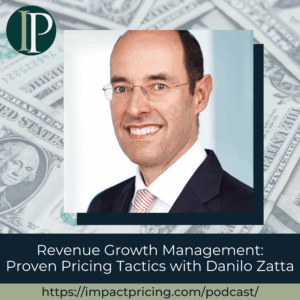
 Danilo Zatta is the author of The Pricing Model Revolution, The 10 Rules of Highly Effective Pricing, and the new book Revenue Growth Management. He is recognized as one of LinkedIn’s Top 5 Pricing Thought Leaders and brings decades of consulting experience from Accenture, Simon-Kucher, and BCG. His work is anchored in one simple insight: pricing is the “sunny side” of consulting.
He shares real examples of companies that increased profit by cutting ineffective promotions and by detecting thousands of spare-part pricing outliers with AI.
This episode explores pricing leadership, the CEO’s role, the difference between pricing truth and framework preference, and why democratized pricing knowledge makes talent the true competitive advantage.
Podcast: Play in new window | Download
Why you have to check out today’s podcast:
- Learn how AI spots hidden pricing outliers across hundreds of thousands of SKUs and turns them into instant profit.
- Discover why FMCG companies burn cash on promotions and how smart RGM frameworks finally fix it.
- Understand the real “truth” behind pricing frameworks and why people, not methodology, drive pricing success.
“Start the AI pricing journey—not by boiling the ocean—but by finding a use case that works, proves value, and then expand it.“
– Danilo Zatta
Topics Covered:
01:27 – How Dan Got Into Pricing. His shift from cost-cutting to pricing and why he calls it the “sunny side” of consulting.
06:57 – Freedom in Consulting Choices. Comparing Accenture, Simon-Kucher, and BCG—and why team chemistry matters most.
09:11 – Revenue Growth Management. How FMCG brands optimize trade terms, promos, and price architecture for profit.
11:55 – FMCG as B2B. Why FMCG selling to retailers is a pure B2B relationship with limited price control.
17:22 – Implicit Collusion in Airlines. How industries use public price signaling to influence competitor behavior.
19:13 – AI in Spare Parts Pricing. How AI identified major pricing outliers and delivered over €1M in quick wins.
24:42 – Why AI Beats Excel. AI’s advantage in scale, complexity, and instant alerts across massive SKU sets.
27:15 – Starting Your AI Pricing Journey. Begin with one use case, prove it works, then expand—no perfect data needed.
Key Takeaways:
“Pricing used to be specialized knowledge. Today it’s democratized—so what differentiates you is the team, not the tools.” – Danilo Zatta
“If you’re the market leader, you must act first. Smaller players can’t reduce promotions until you do.” – Danilo Zatta
“Pricing is never boring because every industry has its own logic, levers, and constraints.” – Danilo Zatta
Resources and People Mentioned:
- The Pricing Model Revolution: https://www.amazon.it/Pricing-revolution-pricing-cambier%C3%A0-comprare/dp/8836010547/
- The 10 Rules of Highly Effective Pricing: https://www.amazon.com/Rules-Highly-Effective-Pricing-Management/dp/1394195761
- Revenue Growth Management: https://www.amazon.it/Revenue-Management-Manufacturing-Application-Industry/dp/3319807595/
Connect with Danilo Zatta:
- Website: https://www.danilozatta.com/
- LinkedIn: https://www.linkedin.com/in/danilo-zatta
- Books: https://www.danilozatta.com/books/
Connect with Mark Stiving:
- LinkedIn: https://www.linkedin.com/in/stiving/
- Email: [email protected]
Full Interview Transcript
(Note: This transcript was created with an AI transcription service. Please forgive any transcription or grammatical errors. We probably sounded better in real life.)
Danilo Zatta
Start the AI pricing journey, not boiling the ocean, but finding a use case that works, that proves, and then expand it, roll it out. So don’t try to find the best solution, don’t try to find perfect data, but find a use case that proves your case.
[Intro / Ad]
Mark Stiving
Welcome to Impact Pricing, the podcast where we discuss pricing, value, and the explosive relationship between them. I’m Mark Stivey and I run bootcamps to help companies get paid more. Our guest today is Dan Zatta. Here are three things you wanna know about Dan before we start.
He’s the author of The Pricing Model Revolution, The 10 Rules of Highly Effective Pricing, and his brand new book, Revenue Growth Management. He was named one of LinkedIn’s top five pricing thought leaders. And he’s been with several big name consulting firms, including Accenture, SKP, Boston Consulting Group. Welcome Dan.
Danilo Zatta
Thanks a lot, Mark. I’m so excited to be with you again for the second time. So super nice to be with you. Thanks a lot for having me.
Mark Stiving
Oh, my pleasure. And remind us all, how did you get into pricing?
Danilo Zatta
Like all pricers, by chance. It was not planned. I did not want to become a pricer when I was a baby, so it came by time. It was when I started my consulting career. I was doing all types of projects. I started with some cost-cutting activities, process optimization, M&A, and when I look back at my cost cutting projects, I was working for one of Europe’s largest logistics companies. When I went into the client’s building, nobody wanted to see me around. Everybody hated me.
I was just trying ways to fire people. So discussions with the unions and always in a bad mood, everyone. So when I woke up in my hotel to go to the client’s I was in a bad mood and they were in a bad mood. Then I started my first pricing project and everybody was happy to have me. We worked and found a solution to make the company more profitable.
The people I was working with were promoted and everybody made friends with me. So I realized that pricing is the sunny side of consulting. It’s full of joy, full of great results and full of friends. So I said, why bother and stay far from the sunny side of consulting. We have to work on pricing. It’s much more fun and makes a lot of friends.
Mark Stiving
I absolutely love that story. And so let’s throw that into prospect theory for a second. Right. So losses loom larger than gains. So here we are trying to cut costs. So we’re trying to take stuff away from people and they hate us. Or we’re trying to help them with, with revenue, right? The gain side. And it’s like, Oh, you can get me promoted. That’s pretty cool.
Danilo Zatta
Now you made me curious, Mark, how did you get into pricing?
Mark Stiving
Oh gosh. So it turns out I got into pricing. When I was a kid, I would go to the grocery with my mom and I’d see prices that ended in nines. And I was always really curious. Why do they do that? Right. Do they think we’re stupid? We know that 99 is a dollar. About 20 years later, I was in a doctoral program in marketing at UC Berkeley, and I had a chance to play with scanner panel data, and it gave me a chance to test this.
And then I tested a bunch of different models to see what would fit the decision process best for the consumer. And I absolutely fell in love with trying to understand how people use prices to make decisions. It is just, I still love it today. I still find it cool.
Danilo Zatta
Cool, cool. So it was the research that opened up these new perspectives.
Mark Stiving
Yeah, for me, which is kind of unusual. Most pricing people get into it differently, right? From doing a pricing project someplace and, and seeing the impact. So. Nice. Hey, since you’ve been at so many different consulting, big name consulting companies, right? And it’s not like you job shop every year or two, you were there for a long time, each one. How do they compare when you think about them? Do they have different frameworks and were you able to learn their frameworks as you move along?
Danilo Zatta
Yeah, this is a great question. And indeed, they are all a bit different. I had the luck to start my career within Accenture, which is growing massively. So I had, I think at that time, 100,000 colleagues, and now it’s 500,000 or even more. So really huge. Well, it’s a very American culture, an American focused company that I liked a lot.
They also had at that time a very big training center for all young consultants near to Chicago, which was an amazing experience. And the strength of the company was to do both strategic work. I was in the strategy competency, but then also everything related to IT processes and change management. One of the very strong assets is the IT capabilities and very long IT projects.
So this was something that then changed by time because the strategy competency where I was in became part of an industry where IT was really guiding and I was more into strategic pricing topics. So this is why then I had the luck of joining Simon Kutcher which is an amazing school for pricing. I was also lucky that when I was hired, they were telling me, we don’t want consultants, we want entrepreneurs.
Are you willing to open up a new market and make the company grow? And I was then thrown in the cold water because in Italy there was no office. So I founded the Italian office, which became one of the most successful offices. And then I also was able to sell at that time, the largest project ever, the transformation project on a global basis.
However, as I’m married to a Bavarian wife who wanted me back in Germany, and in Germany we already had a lot of partners, I decided to go back to Germany also because the kids, I have three kids, were growing, and BCG made me a nice offer. So I joined BCG. The great thing about BCG is that they are present at all large accounts. They have an amazing network, and I was contributing to build up the pricing practice.
So also there and great frameworks, great approaches, great colleagues like at all other consulting companies. But at some point I wanted to again work in a smaller environment and I decided to step back where I also had more degrees of freedom because in these large consulting companies, there are of course a lot of rules, a lot of accounts that are already assigned to partners.
So you have a bit less room for maneuver. And I guess this is also a great advantage for you. You are, I guess, very free to, let’s say, undertake the activities that you like, to work with the clients that you like. So you’re also quite free in your choices, I guess.
Mark Stiving
Yeah, I pseudo-retired seven years ago, so I like to say I only do what I want to do at this point in time. So it makes my life really fun and easy. That’s all I can say. So I’m really curious because when I think about these three great companies plus the small companies, I’m sure they all have their own exercises or ways to think about things or frameworks. And what I struggle with is, given that experience, is there a truth in pricing? Or is it everybody’s perspective on pricing?
Danilo Zatta
Very good question. At the end, everybody cooks with the water, as people say. So it’s very much about, I think, for clients, who are you working with? Because teams vary, especially in large corporations. You have better consultants and less good consultants. So at the end, it’s always very important to select the right team that also fits your team within your corporation so that the chemistry between the clients and the consultants works well. So I think this is a bit the key to success.
Mark Stiving
So here’s what I just heard you say. The people matter. The processes are pretty similar across the consultants.
Danilo Zatta
Yeah, I mean, we are sharing our knowledge across podcasts at the pricing conferences with books. So I think lots of the knowledge that maybe 20 years ago was in the hands of you now is quite widespread. And then you are also seeing that a lot of consultants are moving. Some consultants of this consulting company are now working with these other consultants to create a spin out of a car out and they’re offering their services in this region. So I think pricing knowledge is more democratic at the moment.
Mark Stiving
Got it. So I think the reason why I find that so interesting or fascinating is because the way I think about pricing or the way I’m learning to think about pricing isn’t how anybody else thinks about it and talks about it. And so that’s just very fascinating to me that we think we have the truth.
Danilo Zatta
I like it. I like this thought.
Mark Stiving
Yeah, well, we’ll see because I’m exploring this. So let’s jump topics for a second. Tell us about your new book, Revenue Growth Management. What is it?
Danilo Zatta
What did you write it for? Here it is. So this book is about revenue growth management, a topic that is very key for retailers, but overall for FMCG companies. So the Unilevers, the Proctors, the Mondelis of this world, who are selling their products through the Carfools and the Tescos and the Walmarts. It’s about orchestrating a number of elements, which is price, its trade terms, its spec price architecture, its promotions.
So these would be some of the key elements that these guys have to master. And I’m always so fascinated about the potentials that you find when optimizing these levers. One example, salespeople at some point lose overview or become a bit lazy and are not really getting a tit for tat. So rather than being paid for every condition you’re having, they get a discount without the counter performance.
So trade terms optimization is about understanding what is our commercial strategy and how can I translate this into a number of conditions that then help me getting out of the most from my relationship with the retailer, but also embark on a journey of partnership where I give you more if you do this and then we have both a success. And there are such huge gaps, and I find it in every company, which is great because there is always room for improvement.
Or take promotions. There are so many promotions that are just burning money because they are just done as the promo calendar of last year, and then they are overlapping, and then they are addressing the wrong targets. So by reducing and cutting and killing promotions, you save a lot of money, and you are much more focused.
And here it’s fascinating because AI also comes into play and can help you understand and track which are the promotions that will bring an upside and uplift and which are the ones that should be killed. So with the modern technologies, with new tools, all this can be optimized and help becoming more profitable even in a better way.
Mark Stiving
Nice. So, you know, it’s kind of funny, as you’re speaking, I don’t do a lot of work in the B2C world, right? And so when you’re thinking about FMCG or selling to retailers, you think of it as B2C because there’s tons of data there to go play with. But in truth, everything you just talked about are the types of things we think about in the world of B2B, which is, hey, if I’m a FMCG and I’m selling to Walmart, I now have a B2B relationship. What does that relationship look like?
Danilo Zatta
Absolutely. You’re spot on. Because in the end, it’s the Procter selling to Walmart. It’s Unilever selling to Costco. It’s a pure B2B relationship. And they cannot even set prices. They can only recommend prices. Many of those retailers then stick to recommending the prices, but they are not obliged to. So there are a lot of levels and they are so specific and different compared to pharmaceuticals, compared to automotive, compared to insurance.
So this is also the fascinating thing about pricing. My wife always tells me, are you not bored to work more than 20 years in pricing? Is it not boring? I say no, because it’s always so specific and so different. Every industry is different. You have different levels, different logics, different tools to use. She’s a bit skeptical, but I think she believes me now.
So in the FMCG world, it’s a completely different world that is super specific. That’s why this book was really needed, because there is no book on this topic, and we wanted to close the gap. And I was super proud that the CEO of Nestle, the head of RGM of Ferrero, the owner of Campari Group, they all said, great to have this book, and it opened our eyes.
Mark Stiving
Nice, nice. And so give us some examples of things that FMCG companies can do in that relationship. I mean, you already gave me one that I really love, which is, hey, just because we gave a promotion last year doesn’t mean we have to give the same promotion this year.
Danilo Zatta
I was working for one leading beer manufacturer in a country, and the CEO called me in and said, I have this terrible problem with the promotions, because everybody is promoting the beer, so the shopper feels stupid if he or she is paying full price and not buying a promoted beer. And then I said, the problem is you. I told him, you are the problem because you are the market leader. You are the first one who should change this promotion fullness.
Of course, you cannot expect that a small local beer producer is doing the first step. you are the biggest, you have to change first. And then he looked at me, he was a bit shocked and he said, well, if I do this, I will lose volume. Yes, you might lose volumes, you might lose some customers that are only price seekers, but in the end, this will be paying off because you are bringing down this promotion level that is too high.
Then he didn’t speak with me for a couple of days. And then two days later he came back and said, okay, let’s make a trial. At the beginning, it was a bit tough because we lost volume, but then the others followed and they were much more focused in understanding which are the promotions that we really are making sense.
And they started killing a number of promotions that were overlapping and also having different targets because one was pushing a new configuration. The other one was trying to acquire new customers and they were overlapping. And by reducing this, by having a new promo strategy, profitability went up. Then we also introduced a tool based on AI to understand and anticipate what will be the uplift and the return on investment on the promotion.
And also this helped us kill a number of promotions and focus on others. At the end, we were saving money on promotions that were useless and focusing on the ones that were bringing uplift. also avoiding cannibalization, and the success was really huge. One of these gentlemen also endorsed the book. It was really amazing.
Mark Stiving
So you just said volume went down, but profit went up. Is that right?
Danilo Zatta
Yeah, yeah. Because they were wasting so much money in overlapping promotions. There was a promotion nearly once a week. It was crazy. And of course, if you are the market leader, then it’s your role to guide the market to stop price wars, to stop promotion excessiveness, and drive it to a higher level of pricing and lower level of promotions.
Mark Stiving
So I’m always fascinated by this pricing leader, pricing follower conversation. And so as the pricing leader, did he make an announcement in the trade press that says, Hey, we’re doing this to see what else happens to see if other people follow.
Danilo Zatta
Yeah, in this case, he did not, because everybody’s using data of a famous provider that tracks all prices and all promotions. So just by reducing them, everybody immediately saw. So there is big transparency there. But if you open up the newspaper, you would see something like this. For example, in the steel industry, then you read about ThyssenKrupp, announcing that they will increase prices because energy went up and this cost went up.
And then a few days later, you hear about ArcelorMittal and they say, oh, our costs are going up, so we will increase prices. So the first one is saying, hi, we are increasing prices. And the others say, I’m following you. We are coming. So they are always having nice margins and high prices. And through this price signaling, which is legal, you’re not, of course, doing anything that is illegal because you’re communicating this to the entire market. This is doable. Did you have any of these examples in the US?
Mark Stiving
So it turns out the airlines do this all the time. They’re announcing changes in features, capabilities, price increases. It’s pretty fascinating that if you go back to when they started charging for checked luggage, every airline started at the exact same time. So why is that? Well, because we all announced it and said, hey, let’s go do this. It wasn’t collusion. It was implicit collusion.
Danilo Zatta
Absolutely.
Mark Stiving
Pretty fascinating. I love the concept. I think it’s harder to do if you’re lowering prices though. So I would think of eliminating promotions, eliminating promotions as raising prices. Yeah. That’s good. You had said something else that I really wanted to respond to or ask you about the competing promotions. I could imagine, and I don’t know this, but I could imagine that’s caused by a whole bunch of silos inside the company, each running their own promotions. A, is that true? And B, how do you solve that problem?
Danilo Zatta
Absolutely. This was the case with a food manufacturer that was selling water, but also food and also pet food. So different things of a conglomerate and everybody was doing its own things. Well, bringing together and creating transparency, some of the executives there said, we are hiding in plain sight. Everybody was doing things that were obvious, but then with a lack of numbers, lack of reporting, lack of transparency, this was not so visible. So bringing in this transparency and reporting was helping them to get this visibility.
Mark Stiving
And so, was it a top-down, hey, we have to all change, or was it?
Danilo Zatta
Yeah, it was driven by the C-level. And indeed, if you see a C-level that is taking pricing on his or her agenda and pushing for the topic, giving it the right importance, then it’s something that helps a lot. That’s why in my book it’s called the 10 Rules of Highly Effective Pricing.
The first is the role of the CEO who should be pushing for the topic and put it on his agenda because typically CEOs are also getting a big bonus based on the profitability and the EBIT of the company. So they should be the ones pushing for pricing because then they have more money in their pockets.
Mark Stiving
I would absolutely agree with that. Let’s jump to my favorite topic nowadays. I dearly love talking about AI. And I think the reason I do is because I don’t know enough. I don’t think anybody knows enough if you wanna know the truth. So how are you using it? How do you see it being used? Start out with whatever you wanna talk about and then we’ll dive in deeper.
Danilo Zatta
So this is a great topic and it’s connected to my next book which will be coming out in January. It’s called Smart Parts Pricing, the first book on spare parts pricing. And applying AI there is a super cool thing. Why? Because it’s such a complex world where you have millions of SKUs, you have prices that were historic, you have prices of competitors, prices of suppliers, you have characteristics and features of your spare parts in terms of diameter, in terms of weight.
So combining all this is really difficult if you do it on Excel. And one of my clients, a large automotive group having over 600,000 spare parts, asked me to support them by optimizing spare parts pricing. And then I was introduced to the spare parts pricing team. And then they looked at me and they said, well, you are here because our CEO wants you here, but we don’t want you here because we are already very expensive.
We are already doing our homework. So what is your value? Why are you here? So it was a tough start. And then at the end, we were best friends because I introduced AI based pricing. So what did the algorithm do? The algorithm was gathering information related to a number of technical features, for example, diameter and weight of spare parts, and was checking if there were some outliers.
And indeed, we found thousands of outliers that were too cheap compared to other products that were technically similar. Then the second step was to introduce competitive pricing. So we had a provider of parts baskets. So this means we were comparing ourselves both to competitors and to suppliers. So OES companies that were supplying the parts.
Of course, if we have a brand, then our genuine pricing should be higher than the one of the supplier with the generic brand. And we found so many prices that were lower. So to make a long story short, we were able to spot so many outliers that immediately we had more than 1 million euros of opportunities that we translated into quick wins and this founded the entire pricing transformation.
This is the beauty of spare parts pricing combined with AI. You are very quick in understanding where I can increase prices without anyone shouting, without anyone complaining, without losing volumes, simply because prices are inconsistent and are outliers. Have you ever had such an experience? Did you ever find outliers in spare parts pricing yourself?
Mark Stiving
So not in spare parts, but when I worked in semiconductors, we did something similar in that we scraped all of the prices off of our distributors. And we could tell our distributors when they were pricing incorrectly because we knew their formulas, right? We could recalculate their formulas. We know what we sold it to them for. We know what they were selling other parts for. And it’s like, okay, we got it. We’ve deciphered your formulas. Here are some mistakes you’re making. Cool, cool.
Danilo Zatta
So very insightful.
Mark Stiving
So it’s pretty cool. But here’s the thing. I did that with Excel. Why do you need AI to do what you just said?
Danilo Zatta
You’re right. And between the two of us, you can also do regressions and find this out. The question is, how quick are you and how high is the complexity that you can match with Excel? If you are really working for a large corporation with hundreds of thousands of spare parts and with a lot of elements coming from competitive data, coming from dynamic prices moving, conditions you’re giving to different client groups, different discounting policies, different technical features, and so on and so forth, you have so many variables that it gets difficult, slow, and cumbersome to come up with quick price increases.
If you have a nicely programmed price algorithm, this will immediately create alerts and show you where you have the outliers. And then the next day, you can change the price in your system and immediately start earning more. So you can do both, but with AI-based pricing, you are quicker, faster, and can handle a much more complex situation. This is what I saw based on my experience. Would you share this, Mark? Would you share this view that with AI-based pricing, you are quicker and faster and more efficient?
Mark Stiving
So probably yes. But I think of AI, if I were trying to guess how you would use AI in this pricing thing, it wouldn’t be, hey, I’m quicker and faster at what I already know how to do. It would be, I can now do things I couldn’t do before. So, for example, maybe I have a way to figure out what inventory levels are at my competitors, and I was never able to do that before. Or I could watch price changes in some industries or some market segments, and I wasn’t able to do that before. And so that’s, in my mind, when I’m thinking about AI, it’s like, well, tell me something I don’t know.
Danilo Zatta
I fully agree with you and many of the companies I work with on spare parts pricing, they are still at the age of cost plus pricing with a lot of inconsistencies. So moving to AI based pricing and some of those had also energetic solution drives that would help you really understand how to optimize price of different parts families in a very, very effective way. This sounds in many cases like the future.
Mark Stiving
Yeah. So since you brought up cost plus and 600,000 parts, this isn’t an AI conversation, but feel free to bring it in. How do you price 600,000 parts and not do cost plus?
Danilo Zatta
Well, for example, you would start doing, let’s call it smart cost plus. If you want to see the impact of the size or the weight or the materials of the spare part, you could do competitive pricing. If you bring in parts baskets to see where I am compared to the market, compared to competitors, compared to suppliers, and then you can bring value elements because there might be some spare parts.
Think of an aircraft. If this is not there on time, even if it’s only 20 euro, spare parts, but if my aircraft is not departing, then I have to pay for 300 people overnight and rebook them and I cannot use the aircraft. So this is costing me so much money that even a 20 euro spare parts pricing, I would pay 10,000 US dollars. So then the value kicks in, so all these perspectives can be added to Cost Plus. Many are still at Cost Plus, but are missing all these opportunities because of complexity, because of limited attention to pricing, which is costing them a lot in terms of lost profits.
Mark Stiving
I love that answer. That’s actually how I think about it as well. When I try to coach a distributor or someone like that, it’s, hey, let’s start with cost plus, and now let’s pick out high branded products or high value products or, you know, products where we don’t have any competition or, and so can we create these little, let’s call it cohorts of products. Yeah, I like it. And change the plus part of cost plus, right? It can be cost-plus if you want, but just give it a higher plus.
Danilo Zatta
I like this.
Mark Stiving
High cost plus. Yeah. And so you said cost plus modified. Smart cost plus, yes. Smart cost plus. Yeah, I thought that was brilliant. That was a great way to put it. Dan, we’re almost out of time. This has been a lot of fun as always. Final question. What’s one piece of pricing advice you’d give our listeners that you think could have a big impact on their business?
Danilo Zatta
Well, my advice is to start the AI pricing journey, not boiling the ocean, but finding a use case that works, that proves, and then expand it, roll it out. So don’t try to find the best solution, don’t try to find perfect data, but find a use case that proves your case.
Mark Stiving
I think that’s a great answer. The third tenet of my context-driven pricing is that perfection is impossible. And it’s going to be impossible with AI. It’s impossible no matter what. So just go do something. And AI is a fabulous tool to help you find it.
Danilo Zatta
Absolutely. Mark, thanks a lot for all the books you wrote. I can’t wait for you to come visit me in Munich. You will need to sign them all. I want a dedication on them.
Mark Stiving
Okay, I’m going to have to rest my hand up for that. No, you’ve got as many as I do now, Dan. Thank you so much for being on the podcast. If anybody wants to contact you, how can they do that? The best on LinkedIn. All right, we’ll put your URL in the show notes.
To our listeners, thank you for tuning in. If you enjoyed this, would you please leave us a rating and a review? And finally, if you have any questions or comments about the podcast, or if your company wants to get paid more for the value you deliver, email me, mark at impactpricing.com. Now, go make an impact.
[Ad / Outro]