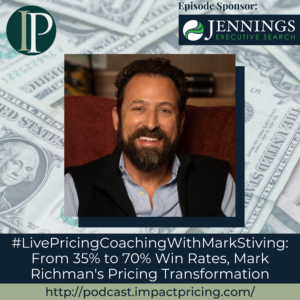
What happens when a former client returns for a live pricing coaching session?
Mark Richman, CEO of Skeleton Key, shares how applying Mark Stiving’s value-selling principles helped increase his close rate from 35% to 70% by focusing on customer outcomes instead of pitching solutions.
Now, he returns to the hot seat to workshop his toughest pricing challenges in real time—from buyers who can’t quantify value to outcome-based pricing and pricing for emotional outcomes.
This isn’t another pricing interview; it’s a front-row seat to a CEO getting his sales strategy challenged, refined, and rebuilt in real time.
Podcast: Play in new window | Download
Why you have to check out today’s podcast:
- Steal the framework that helped transform a 35% win rate into 70% — without changing his product.
- Find out why your prospects’ “solution” is often the biggest obstacle to closing the deal.
- Watch Mark Stiving challenges Mark Richman’s sales strategy and uncover the hidden pricing opportunities he almost missed.
“That willingness to not talk about what we do and that focus on why the client’s there in the first place and how you can really help them achieve the outcome they want has transformed the way I sell. I went from about a 35% close rate to a 60 to 70% close rate.”
— Mark Richman
Topics Covered:
01:30 – A Live Pricing Coaching Session Begins. Mark Richman returns to the hot seat as Mark Stiving coaches him through real pricing and sales challenges.
03:10 – Why Nobody Cares About Your Product. Mark Stiving explains why buyers purchase outcomes, while Richman shares how this mindset transformed his sales process.
05:15 – From 35% to 70% Win Rates. Mark Richman reveals the conversation shift that doubled his close rate, and Mark explains why it works.
08:45 – When Buyers Ask for the Wrong Solution. Mark Richman shares a real AI sales conversation, and Mark shows how to uncover the real problem instead.
16:20 – Pricing Emotional Outcomes. Can you charge for less stress and more time? Mark and Mark Richman debate when emotional value is enough.
19:15 – The Customers You Should Walk Away From. Mark explains why buyers who can’t define success are often impossible to serve well.
27:40 – Finding the Right Pricing Metric. Mark shares alternatives to outcome pricing that let your revenue grow alongside your customers’ success.
30:50 – The Pricing Opportunity Richman Almost Missed. A regulatory deadline becomes a lesson from Mark on willingness to pay and pricing confidence.
36:10 – The Biggest Lesson from the Coaching Session. Mark shares one pricing experiment every business should try, while Richman explains the sales lesson that changed everything.
Key Takeaways:
“You’re not exploiting the customer by charging for value. The only question is whether the customer believes the price is fair.” — Mark Stiving
“What matters isn’t your hourly rate. What matters is whether it’s a fair exchange for the value you’re creating.” — Mark Richman
“Raise your prices. Win fewer deals at higher prices and make more money.” — Mark Stiving
“Helping clients uncover the value of solving the right problem changed everything about how I sell.” — Mark Richman
Connect with Mark Richman:
- Website: https://skeletonkey.com
- Email: [email protected]
- Linkedin: https://www.linkedin.com/in/markrichman/
Connect with Mark Stiving:
- LinkedIn: https://www.linkedin.com/in/stiving/
- Email: [email protected]
Full Interview Transcript:
(Note: This transcript was created with an AI transcription service. Please forgive any transcription or grammatical errors. We probably sounded better in real life.
Mark Richman
That willingness to not talk about what we do and that focus on why the clients there in the first place and how you can really help them achieve the outcome they want has transformed the way I sell. I went from I’d say a 35% close rate to a 60 to 70% close rate on new business.
[Intro]
Advertisement
Today’s podcast is sponsored by Jennings Executive Search. I had a great conversation with John Jennings about the skills needed in different pricing roles. He and I think a lot alike.
If you’re looking for a new pricing role, or if you’re trying to hire just the right pricing person, I strongly suggest you reach out to Jennings Executive Search. They specialize in placing pricing people. Say that three times fast.
Mark Stiving
Welcome to Impact Pricing, the podcast where we discuss pricing, value, and how buyers decide.
I’m Mark Stiving, I help companies understand and shape their buyers’ willingness to pay.
Today is a very unique show.
I posted on LinkedIn the other day, I’m willing to coach a few companies. I find that when I talk on these, we talk about concepts and I’m learning from other people, but what we rarely get to do is see how these concepts apply in the real world.
And so one of my past clients, I’ll call him a friend, Mark Richman, he said, hey, I’ll do it with you. And so great, Mark’s here.
So here are three things you want to know about Mark before we start. He is the CEO and founder of Skeleton Key.
Skeleton Key, they make custom software to help companies be more efficient. And if someone had said that to me, I would say that was a horrible introduction. I already told you he’s a past client. And here’s something fascinating. He was a theater major.
Welcome, Mark.
Mark Richman
Thanks, Mark. I think that’s close enough. We do build custom software, but often we just help people make better use of the tech they have, maybe integrate things, maybe change the process they use before they use the tools they have.
But your main thrust is right. We’re trying to make businesses work more efficiently.
Mark Stiving
Nice.
And so what I hated about my own introduction is the fact that I talked about your product and my thinking so much lately has been about, it’s not about your product, right?
It’s about how are we going to help our customers?
Mark Richman
My favorite line I’ve shared and constantly repeat to my team and I’m sure I might not be repeating it verbatim from selling value was nobody cares about your product or service.
And reminding my team that they don’t really care about what we’re building they care about what it will do for them what outcome it will create for them.
And that resonates with a lot of what we talk about when we talk about story mapping and the art of changing processes and improving workflows is it’s about the goal that you have in mind.
But it’s still really easy when you’re selling a product or service or getting into the delivery and mechanics of it to start zeroing back in on the product itself.
Mark Stiving
Yeah.
One of my favorite lines is nobody cares about your product.
Now I usually stop there, but if you guys are doing services, it’s okay to add the word services in there because nobody cares. Right.
The follow on to that, which I love, and I think it really focuses people is value is the result of solving problems. Right.
I think that line really gives you the answer to what matters. People have problems and they want them solved.
Mark Richman
Yes, I’ve even found myself, since spending the time working with you, like I almost never am talking to clients about the solutions.
We’re almost exclusively talking about the problem, where they are now, how they know it’s bad, how much better it could be if I had a magic wand in my pocket and I waved it and the problem went away. Would it go away 100%? Would it be reduced by half? Is it something that constrains it from really getting as good as it potentially could be?
And we’ll come out of the end of the discussions and sales process at least aligned on what the prizes were going after and not necessarily swamped in the details of how we’re going to go about doing that.
So it gives us a shared north star. It was extremely liberating to not have to worry about the technical side of the conversation, to just be able to focus on the client’s needs and help them articulate what they stand to gain if we actually solve this for them.
Mark Stiving
Yeah, I think that’s pretty fascinating.
And most buyers come to us and they’ve already got something in mind. In fact, every time you buy something, you probably walk into a store saying, hey, I think I need a new blah, blah, blah, whatever that happens to be.
And what we’ve said is we’ve already solved the problem in our own minds. And a lot of times buyers are horrible at that because they’ve never even articulated what the problem is they’re really trying to solve.
Mark Richman
I don’t want to spoil anything, but I think I read something you recently wrote.
Mark Stiving
You could say it. It’s okay.I don’t mind at all.
Mark Richman
And it mentioned that idea. I mean, I highlighted it when I was reading it and it was, you know, that the client comes to you with a half-baked idea of the solution they already know they need, right?
They’ve named what it is for you and the frequency with which that could potentially be wrong, right? But that’s normal, right? Like, I mean, I don’t know.
If I wake up and I don’t feel well, I instantly start self-diagnosing and self-prescribing what it could be, right? I watch people do that all the time.
So it’s not unusual, but to have someone call it out and say, your clients do this, they walk in, they say, I need an X. And you’re like, maybe you need an X. Why don’t you tell me what the problem is first, right?
And I’ve had a couple of those experiences with clients since working with you where I literally walked into a meeting and the first thing the client said was, we want to know what we can do with AI. I’m like, I have no idea. Why don’t you tell me what you guys do? Why don’t you tell me what’s not working? And let’s figure out if AI is the potential solution to your biggest problems.
By the time they were done talking about all their problems, there wasn’t a single thing that they had a problem with that needed something as powerful or as complex as an AI to solve it.
But they had seized on, you know, well, this is a magic wand. It should be able to solve anything. It was like you. There’s some more foundational things we can do to help you solve that problem and get you there quicker and more reliably.
So, man, I felt you were peering into my soul when you wrote that line. Because every meeting I have with a first time client, they’re coming in convinced they know, or they have no idea, but they’re just, and then they don’t even know necessarily how to articulate the problem, but just something isn’t right. And it led them to actually at least engage in some way.
Mark Stiving
Yeah.
I mean, the latter ones are great clients because they’re open to figuring out what the heck is really going on.
Mark Richman
The biggest challenge I found, one of the things that kind of made me eager to meet with you today was, is there’s such a spectrum of, I don’t want to say sophistication, but maybe just comfort with different buyers.
So we’re always B2B, right? We’re not selling B2C.
As many different businesses there are, as many different sizes and shapes and industries, there are just as many different levels of comfort or sophistication when it comes to talking about the potential monetized value that could be created by fixing a problem in a business.
Some absolutely know their numbers and when you ask them what’s not working and they’ll tell you it’s affecting gross profit and we think it could improve by this much and or we think we could increase capacity and the marketplace has got this much demand so we’re confident we could achieve it.
And you’re really it’s really powerful ammunition they give us to help them articulate what the value of the goal would be and some context for us to talk about the interventions or benefits that we could potentially make happen right the things we could the products or services they don’t care about that we could apply.
And then we’ll get others where it’s I ask some questions to try to get them to articulate just how do they know it’s broken. How much would it be worth to them in terms of savings or increased growth or reduced risk if they were to solve it.
And they have no idea how to answer that question. And so that’s the biggest challenge I’ve run into at least so far. And I’d love your insight is just how do you help a client who’s less familiar with the vocabulary and language of value?
Articulate it in a way that they still own it. It’s still their calculator, right? Not mine.
What’s the best way to help them kind of make those baby steps to the point where they can actually with confidence start to share numbers that they may never have actually thought about before?
Mark Stiving
Yeah, so without being in the individual or each individual situation, my first recommendation or thought is, what are the KPIs they currently use?
And that’s really where value is gonna come from.
So are they watching a KPI that says, here’s what efficiency looks like, here’s what turnover looks like, here’s what close rates look like, whatever their KPIs are, what we’re trying to do is help them improve their KPIs.
In fact, probably the reason they’re talking to you is because some KPI is not behaving the way they want it to. Something’s not working.
And so I think when we can start to say, okay, look, how do we move this KPI? and what’s keeping us from moving this KPI.
Then to get from KPI to value, which I think of as incremental profit, to get from KPI to value, you’re very smart. You know how to do that. It’s really a matter of holding their hand now and saying, oh, it’s turnover.
Well, let’s talk about how that impacts your profit. And we can actually hold their hand and guide them into, oh, here’s all the different ways this is hurting your profitability.
So if we could fix this, if we get a turnover from 2% to 1%, what’s that look like profit-wise?
Mark Richman
I think that’s a totally fair answer. I think that the scenarios, and I don’t want to shanghai how this kind of conversation normally goes, but for selfish reasons, I have follow-up questions, right?
Mark Stiving
No worries.
Mark Richman
All right. One example I can think of that I wonder about is the client who says they don’t have any KPIs. for them it just feels like chaotic or they’re breaking even but they’re not making money right so there is some KPIs there right you obviously you know we’re not profitable but they’re coming in asking about a upstream problem that’s very specific they might want us to help them solve but their only KPI they have is bottom line result.
And the chain of KPIs that lead from this activity to that activity seems very opaque to them and I don’t want to put words into their mouth.
So that’s one scenario.
The other is where their reasons for making these changes have, at least they articulate, they say, are less about bottom line goals and more about frustration. They’re more emotional, right? It’s frustrating. It’s hard. There’s that whole, I’m spending time on low value activities that’s, you know, not letting me do other things.
But when I’ve asked questions about, well, now what will you do with this 10 hours you just saved? they don’t have a good answer, and that’s where the value is potentially unlocked.
They might know that they could turn that 10 hours into something better than the wasted time they were spending before, but where will they spend it, and what will the result be of that time?
Will they finally clean up their inbox that’s filled with thousands of unanswered messages, or will they sell one more client a month and make X more dollars? There’s sort of this, we’ve given them now agency to use the savings, because labor savings is a big part of what we do, but they don’t know how to pick what they’ll do with it.
Mark Stiving
Okay, so Mark, I have to say your second example I dearly loved because it just shows me that you think a lot like I do.
It’s like it has to come down to dollars, doesn’t it? And in the example that you gave, I don’t even know if I would bother with the dollars, right? I would treat it almost like a B2C buyer.
So as a B2C, when I’m gonna buy something as a consumer, you’re never gonna translate that into how much more money am I gonna make, but you’ll translate that into the three areas of consumer value tend to be social, identity, and functional. I’m sorry, Emotional, social, and functional are the three basic ways that we’re going to get value as a consumer.
And so I would live with that. If you’ve got someone on that’s really interested in solving one of those problems, as the owner of a company, solve it for him, let him be a consumer as opposed to a business buyer. And that’s totally okay.
You can still talk about the KPIs, you can still say, well, how many times or how many hours a week do you spend doing this? And what if we get that to 10% of those hours?
And they’ll love you.
Mark Richman
But then I guess what we’re counting on then and I’ve said this out loud I tried to kind of like preempt it maybe that’s part of the problem is I’ve I’ve said you know there will be intangible benefits.
Intangible as in you’ll know it’s better you’re not doing this stuff that drives you crazy you’ll go home less grumpy you know you’ll get out on time as opposed to having to like slog through it or silly mistakes won’t happen because you’re you’re not doing something that should be automated that’s kind of manual and potentially broken whatever it is.
But you know what’s the value to them to part with X dollars in investment and time spent making the change to get home early for dinner.
Or you know leave you know in time for something like it’s absolutely an emotional connection they still have to weigh do I want to spend 10 grand to do that even though I don’t know that that’s worth obviously worth 10 grand or more.
So do we go on?
Mark Stiving
Yeah.
The issue to you is you don’t know what it’s worth. And by the way, neither does he. Right. And so this is one of those cases where we’re going to say, look, is it worth 10 grand to you to do this? And if so, great. I’m happy to help.
And if not, great. I’m not the right fit. Right. I think that’s the answer because forcing value when someone can’t see it, when someone doesn’t care, I don’t think that’s the right answer. Right.
I don’t think that’s going to work for you. Right.
On the first example you gave me, which was the chaos, right? There really aren’t any KPIs. I’m going to give you an answer that you’ll hate. That’s not your customer, right?
Here’s the problem with that customer is that you don’t have any way to know what success looks like. Zero.
Let’s assume their profit margins go up next year. They’re going to say it’s because we had a better HR person come in and the team was happier and you get zero credit for it.
So it has nothing to do with you.
I would just say, look, if I’m here to deliver results to customers and they don’t know what results they want, then I’m really not the right fit.
Mark Richman
I hear that loud and clear.
So that makes me segue to a different question, maybe a completely different area, which is we have taken what we’ve learned from selling value and from working with you and used it to help us pick the right problems, right?
Help clients learn with us to articulate the value they hope to achieve and therefore prioritize the quick wins or the investments worth making because of the prize. What we haven’t done, and it’s obviously created phenomenal context within which to evaluate our price.
I’ve taken the watchword around here has been like whatever they review as a range on value we use the lower number and whatever we come up with in terms of a price we sometimes double it because of the time and investment they’re going to make that we won’t charge them for but they will inevitably invest distracting themselves from their daily work to work with us for a brief period of change.
So the goal is to create the most conservative ROI calculation I can when they uses their low end value gained and a high end actual investment both cost us another class.
Where I’m going with that is we haven’t done anything that’s value priced though. Meaning that we’re selling and pricing within a value context. and trying to weight it fairly so they can fairly evaluate it and looking at the one year and the three year to kind of give them a sense of the ROI.
But we’re not actually pinning it to a metric.
So even if they’ve articulated like rework is a metric in a manufacturing facility and every major rework costs us a thousand and we have one a week.
So that’s fifty thousand a year so we’d like to cut those in half. That isn’t a metric that we’re currently saying well you’re going to save you X number of the next three years.
Let’s pin that number let’s measure it later and then let’s take a share of that like nothing we’re doing is driven by the value gained so that we potentially get a better result for us as a company.
Because of those same variables you just mentioned in that one scenario right where they say the gain is through this or they decide to make a major capital expense and reduce their profit because this is the year to kind of reduce their tax burden.
So I’m curious what your thoughts are about using value to help a client establish a decision to move forward versus pricing based on the value using actual metrics before and after as the gauge given all the variables that could come into play.
I’m trying to decide, do I ever try to reach for that brass spring or is that as risky as it sounds?
Mark Stiving
Yeah. So first thing I want to do is I want to fix some language, right?
So I want to articulate back to you what you just said, but using language that I would normally use. Right.
And so what you’re talking about is what’s our pricing metric. So what is it that we’re going to charge for and what you typically charge for today or for the project. Right.
We’re going to have this deliverable. You’re going to pay us this much money and that’s it. Right. We’re done. You sold it using value. You price the project and the project was your pricing metric. The thing you charge for.
What you’re asking about is should I charge for incremental revenue? Should I charge for incremental sales? Should I charge for incremental leads?
So Google charges per click on an ad, right?
So this is a different pricing metric. So what pricing metric could you use that’s tied to the success of the customer?
As a general rule, when we talk about selling software, we almost always sell software based on there’s, what’s the value to the customer? How are they getting value? And so then how do I charge them per something that’s correlated to the value we’re delivering?
So as you, you know, most of the software you buy, you probably pay per seat today. And so it’s a, that’s probably the most common of all the software methodologies, even though it’s probably not the best, it’s probably the most common.
And so what you’re thinking now is, oh, oh, one more word. The one that you described to me is called outcome-based pricing.
So outcome-based pricing is becoming really popular in the world of AI agents, even though it’s not being successful today. And the biggest problem with outcome-based pricing is what you already articulated, and that’s the attribution problem.
How do I know that you did that or I did that? And so we have a really hard time with that unless you can clearly say, here’s the result that we’re gonna get.
Now, here’s what you might consider doing is as you put together your projects, not reaching for outcome-based pricing, but reaching for something else that’s a metric that’s relative to what they do.
So for example, hey, we’re going to do this project for this much. And then we’re going to, you know, we’re going to host and we’re going to maintain it.
And then we charge you per user above 20 users. So as you as a company grow, we get to grow with you because we’re maintaining all this.
And so you would essentially be doing that just like a normal software company would, even though you’re selling the project and the custom work up front as well.
Mark Richman
Yeah. Yeah. Totally makes sense. And we have adopted a version of that that is really centered around this idea that we want to help you preserve the value that we’ve created. Right.
So let’s say there’s a billion dollars worth of value to be gained across the project management in this company or whatever it is that we’re building.
And let’s say you’re going to spend, you know, a hundred thousand dollars fixing it. We want to make sure that that continues to provide that million dollars of value every year.
So there has to be some kind of deliberate maintenance monitoring support to ensure that not only does it keep working right just like you would change the oil in your car and rotate the tires or clean the gutters on your house.
We want to make sure that the utility of this thing that we’ve built for you doesn’t fall into disrepair and have a short lifespan we wanted to have the longest lifespan we also know of course that nothing static the marketplace changes your business will change it may need to be adjusted and adapted right just like. I don’t know, you buy a suit, you have it taken in, and then you put on a few pounds, you have to have it let back out, right? You need to adjust it as necessary.
And then you get much longer lifespan out of that suit. And so that is a mechanism we have used, I think, to create some additional value for us and preserve the value for the client, which is really the main reason because we have stories of like the client who built the system and five years later stopped using the system because their business had changed so much it didn’t fit them anymore.
And we failed to engage with them in a way to make sure that that thing adjusted as it needed to as they continue moving forward. But we haven’t done that pricing metric necessarily that allows that to grow if the business grows along with it. It’s more of a, you spent this much to build it, we’re gonna spend this much to maintain it. It’s a little bit more of that traditional software model I think we talked about way back when you worked with us. And not necessarily one that’s as adaptive to the additional benefit they may gain over time.
Mark Stiving
Yeah, and I think the way you want to position it, because if I pay you money to build me custom software, I expect that I own that software.
And I think the way you want to position that is, look, here’s the price if you want to own the software, but if you’re open to essentially licensing it per seat, then here’s the price for development, then here’s the per seat price.
And so now I have a choice. And I got to tell you, if you give me a low price of development plus a per seat price, that’s probably what most people would take. A, there’s lower upfront investment. There’s lower upfront risk. And now I get to enjoy, you know, I’m paying you just like I would any other software company.
Mark Richman
Right yeah that’s a whole nother leap of faith I think I need to evaluate taking because obviously that would require certain amount of protection for us as a business right you need a term of some kind a confidence of our own that they’re going to not terminate prematurely and that if they did we find a way to recoup our investment because we’re definitely taking on some risk.
But I like the fact obviously that it’s sticky right that it continues to be a tool that generates revenue over time and eventually eclipses that upfront cost and what it would have been.
Mark Stiving
Yeah.
And the way you might think about that from your side is that the upfront investment covers your costs, but not your expected profit margin.
And the profit margin comes from the licenses into the future.
Mark Richman
Right. That’s worth writing down. I don’t know if I get a transcript of the, I’ll have to watch my own podcast with you maybe.
Mark Stiving
Yeah.
By the way, to the listeners, Mark, he read the book ‘Selling Value’, that was my third book, and I gotta say that he loved it because he called me and said, hey, can I work with you?
And so I’m hugely appreciative. And when he says the word selling value, what he’s talking about is that third book.
Mark Richman
Yeah huge eye opener. I could go on about that book but I don’t want to monopolize it.
It’s your book and you’ve got other things you’ve written since then and lots more content you put out.
So another big challenge I’ve had I think has been and we talked about this a little bit before we started recording was clients who we think about this. I ran into several situations where we have a good value conversation.
The value is it maybe as fully defined as i’d like it to be something fully monetized but there are things like existential threat to the business or compliance risk to the business.
Like they have to. Make a change have to build something new after update what they have to do it by a deadline if they don’t bad things will happen.
But it’s challenging to put a number. onto those things. So those things remain a little bit more emotional or amorphous in terms of their definition.
Then there’s some very practical things. We’ll say four hours a week here, ten hours a week there. You know, we can reduce travel expense by five percent or something like that. And so we have some numbers, but they are relatively small by comparison to the other number. And in some of the scenarios that works, there have been several scenarios where even with that hybrid mix, there’s still lack of confidence in the buyer to actually make the decision.
Something about it feels to me about the ambiguity about those bigger numbers is not enough to help tip the balance into their confidence being high that they should make this investment. So I see it’s a really good solution for them.
I think they know on some level it is, but there’s something about the dollar amount so small, maybe compared to our price it’s almost one to one, but there’s this other big unpriced value that they’re going to get that’s looming over everything but doesn’t have a number on it.
And that somehow feels like the obstacle to get through.
Mark Stiving
Yeah, so what you’re describing is in the new book that you’re actually reading for me, thank you, for the listeners, it’s called ‘Buyer Disconnect’.
And what you’re talking about is how I move from decide to commit.
And so you may be the preferred vendor. You may be, oh my gosh, you’re the only one who could solve this or the only one we’ve talked to who could solve it, but yet I’m not ready to sign on the bottom line yet.
And so when we think about that decision, here’s what’s going on. In order to make you the preferred vendor, I’m looking at the different options that I’ve considered. And I’ve said, hey, these guys, I think they’re going to be able to solve it better than anybody else. I think they’re reasonably priced. I choose them.
But now am I actually willing to take the risk? Am I actually willing to live with all of the outcomes? And so the answer to that question is we always have to go back to the status quo. So we’re not competing against any other vendor at this point in time. We’re competing against, do you want to just stay where you are or do you want the solution to this problem?
Now, my guess is, from the description that you gave me, that they haven’t recognized the importance of this catastrophic event that could happen.
Or they haven’t internalized it or said, this is really real. Because what I was hoping you were going to say at the end is, you know, there’s a regulation. And so they have no choice. They have to go do this thing.
Otherwise, they’re in violation of some regulation. In which case, we could say, yes, they’re going to buy something. The commit thing’s already decided. Now all we have to do is decide how do we win the preference piece.
Mark Richman
So it’s interesting.
So in all fairness, they did decide to do it. All right. And we are moving forward. But you really surfaced there something that I came to as sort of like, man, here’s an opportunity that’s right in front of me to have a much higher price. Right. There was a regulation. There was a deadline.
Our pricing was not around any of those kinds of metrics. Our pricing was effectively a kind of a cost plus model. Right. What is it gonna take us for to do this. We’re offering as a fixed fee. How do we add some you know a little bit of contingency in there.
And mostly we’ve been focused on this idea of like help them tell us what the value is to them, set that context for our price kind of estimated the way we’ve always estimated it, and make sure that we include that preserve and sustain model as well.
So it’s a baby step in the direction of getting to a different pricing metric for us. But when I saw that there was a regulation and a deadline, one of my first thoughts were, okay, well, I don’t know if I’m remembering from the first book or if I’m just remembering from conversations that that’s a, as a seller, that’s a really important signal that willingness to pay might be higher and price sensitivity might be lower.
And there might be an opportunity there for us as a company to get a piece of that additional profit because the clients in a bit of a jam right. Not in all the negative ways that that could come across as taking advantage of them but maybe you know build a little bit more contingency to go a little bit above and beyond in the project. You know allow ourselves some flexibility there to not just go as lean as we could or normally might.
And I didn’t seize it. I didn’t feel like it was either right or necessary, but there was something about for me even as the seller who recognized that that was a really important constraint. They were up against that wall. I didn’t want to exploit it, but I’m not sure that I, at the same time, I’m not sure if I used it as effectively as I could to help them commit.
So I’m curious what your thoughts are, I guess, about the whole scenario. Is that a missed opportunity for higher prices? Is there a way to use that to help the client commit more quickly.
Mark Stiving
Yeah. So first off, it was a missed opportunity.
But what’s really weird is the set of words you’re using, right? And so I didn’t want to exploit them. I didn’t want to take advantage of them.
And so let’s assume for a second that I’m going to, uh, you’re going to sell me some software and I’m going to make a million dollars. And you say, oh, okay, I’ll do that for a hundred thousand. And let’s say that I say, I’m going to make 10 million and you say, I’ll do that for a million.
Aren’t you exploiting me if you charge me a million to make a hundred million? Aren’t you taking advantage of me? And so the whole point is we’re delivering value to a client and we’re charging a price that’s fair to the client.
But in your mind, you didn’t see it as fair. You saw it as something else. And fairness, I don’t care what you think is fair. Obviously you care, but I don’t care, right?
You know what, who I care about is the client. What does the client think is fair? And so that’s what I would be thinking about, is what do they perceive? And it wouldn’t surprise me if they would say, look, if you can get me to break even, I can save enough hours to pay for this thing, I’m a happy camper. I don’t need to make a margin on it, because I just solved my regulation problem.
I mean, they may even pay you without that, right? They may even pay you saying, look, it’s going to take me more work, but I still have to do it in order to be in this business.
And so that’s just the way it’s going to be.
So yeah, I would say that you left money on the table and that it was your mindset that caused the problem.
Mark Richman
Yeah, I don’t disagree.
I think one of the lessons you taught was this idea of have my team do their estimate. know what the value is to the client and then tell them what I think the example you said was tell them what I think the price of the solution should be.
And then see what our hourly rate or our effective rate or whatever it was be. Don’t go in with a cost plus model is going to take us 50 hours times X dollars per hour plus whatever contingency.
But just say this is the value we’re going to create. Here’s a fair percentage of the value we’re going to create. Something that’s tolerable by a client and fair for us. It’s still a good deal for them.
Do that math and then use what that tells you whether like that’s half our normal rate or that’s five times our normal rate. What matters is that it’s a fair exchange for the client.
So I don’t think we’ve been doing that as rigorously as we could. And I think that’s mostly been because we don’t always have as much of the monetized value up front.
Like that example we went back to a few minutes ago where sometimes the client may not be able to give me that number. It might be just something that emotionally matters to them or that there is this existential threat and they just want it to go away.
Without that number it feels a little harder for me to guess what is a fair price then because I don’t have that number myself.
So maybe that’s the question there is, when there is value to be created for a client that they can’t monetize for you, but you still want to create a price that is your fair share of that value, what’s the seller to do?
Mark Stiving
So you want a number, and I can’t give you a number, right? I can’t give you a percentage. Obviously, I can’t give you a percentage of good feelings.
But here’s what I can say is raise your prices. Right? Let’s pretend that you’re going to continue to do cost plus, which you happen to know that I hate, right?
But let’s pretend that you’re going to continue to do that. We’re going to estimate our costs and we’re going to raise our margin.
Here’s what I would recommend is gut feel. How much value are we delivering? Oh, these guys are a one. That means we’re going to give them the highest margin we would ever take. Right?
And these guys are a five, you know, it’s going to be a risky deal. We’ll take, we’ll quote them the lowest number we would ever take. And so at least in gut feel, you’re tweaking your own margin based on how much value you think you’re delivering to the customer.
Now, my preference is that, let’s assume, I’m just gonna make numbers up, let’s assume you do a 20% profit margin expectation. What if tomorrow you change that to 30%? And so you started losing a few deals, and you’re like, yeah, okay, I lost a couple deals, but I won a bunch of other deals at 50% higher profit margin. That’s not a bad bet.
So even that’s not horrible. I would say keep driving margins up as long as you can win business.
Mark Richman
Yeah, I think you’re right. I don’t think we’ve been trusting the gut feel enough to give us the confidence we need to tinker with the margin, but it sounds like you’re recommending an experiment that based on.
If I remember correctly, the demand curve. You shared that example to me. We could make up for whatever we lose if we’re winning more deals at higher prices at the same time.
Mark Stiving
You can win fewer deals at higher prices and make a lot more money. Yeah.
And also remember price is an indicator of quality. When you’re too cheap, I don’t think you can do the job.
Mark Richman
Yeah there was several mentions of the I like that section in the new book about discounting and the signals it sends.
I remember early days of my business when one of the ways we got lots of business was offering discounts on retainer hours or something like that.
And figuring out how to book those into our accounting system and it was just silly. And we were just basically discounting the perception of the marketplace of the value of what we were offering.
And that was another one of those examples where I read it and I was like, I think he’s like peering into my soul and showing me all the things we’ve done in the past as a seller that we need to stop doing. So I wish you’d written that earlier in my career.
Mark Stiving
So do I. Wish I’d written it earlier in my career.
Mark, we’re running out of time. But first, thank you very much for being here.
Mark Richman
My pleasure.
Mark Stiving
I’m going to ask you the question I always ask at the end of every podcast anyway.
What’s a piece of pricing advice you’d give our listeners that you think could have a big impact on their business?
Mark Richman
A piece of pricing advice?
So it’s going to sound obvious, but to me, I think it’s about educating yourself on how to have conversations with your clients about the value that will be created if their problem was solved.
For me, that meant reading your book. It meant not talking about solutions in meetings with clients in the beginning stages of the work.
They come in with a solution in mind, maybe the right one, maybe the wrong one. they want to talk about the solution I say we’ll get to that let’s talk about the problem and help me understand why we’re even talking and how will you know it’s worth investing to solve it what’s the price you’re going after.
And that willingness to not talk about what we do and that focus on why the clients there in the first place and how you can really help them achieve the outcome they want has transformed the way I sell.
I went from I’d say a 35% close rate to a 60 to 70% close rate on new business and I stopped selling what we do.
I stopped talking about our process and all those other things. They came up when they asked questions but the focus just became much more on helping the client tell me the value of solving the problems that they need solved.
And if you can adopt that and learn that skill your clients will First of all, they’ll pick the right things to solve in the first place, so you’ll actually have bigger impact because you’ll be focusing on the right problems.
We’ve all taken orders from clients, solved problems for them, and they’ve been less than excited afterwards, even though we did just what they asked us to do because they just want a lot of value at the end of it because we never unpacked it.
So take the time, unpack it with them, be patient while they figure that out. They will share with you information that will help you close that deal.
Mark Stiving
Yeah. Excellent, Mark. I appreciate that.
And did I mention that I changed my pricing metric? All I want is a percentage of your increase in close rate. Yeah.
Mark Richman
When I hire you again, we’ll have to negotiate that.
Mark Stiving
Mark, thank you so much for your time today. If anybody wants to contact you, how can they do that?
Mark Richman
The best way would probably be to go to my website, skeletonkey.com, two words put together, skeleton and key, and there’s a contact us form there, or you can reach out to me, [email protected].
Mark Stiving
Perfect. And to our listeners, thank you for your time. If you enjoyed this, would you please leave us a rating and a review?
And if you have any questions or comments about the podcast or if you want to get paid for value your buyers can’t see, email me, mark at impactpricing.com.
Now, go make an impact.
Advertisement
Thanks again to Jennings Executive Search for sponsoring our podcast. If you’re looking to hire someone in pricing, I suggest you contact someone who knows pricing people. Contact Jennings Executive Search.
[Outro]