Steven Forth published a this week on his Substack, Pricing Innovation, titled With Generative AI, Why Have a Pricing Model at All? The central question came from a procurement expert he interviewed, Harish Rahi: given the ability of AI agents to manage complexity and negotiate on behalf of buyers and sellers, why have a pricing model at all? Steven takes the question seriously, and so should we.
Here is my take.
Pricing Is Zero-Sum at the Transaction Level
For any given transaction, with terms set, the price is a zero-sum game. There is a cost to the seller and a value to the buyer, measured in incremental profit. A fair price sits somewhere between those two numbers. Every dollar the buyer saves is a dollar the seller does not capture. That tension is not a flaw in the system. It is the system.
This does not mean pricing models have to be adversarial. A pricing model’s metric, terms, and packaging can be designed to align seller success with buyer success. Outcome-based pricing is the clearest example. When the seller only wins when the buyer wins, the model itself becomes win-win even though the price within any given transaction is still zero-sum. Pricing models are the mechanism through which fairness gets negotiated.
Solving Attribution Does Not Solve the Tension
Steven acknowledges that the value attribution problem (figuring out how much each party contributed to the value created) is unsolved. His vision depends on AI solving it well enough that agents can negotiate a fair price directly.
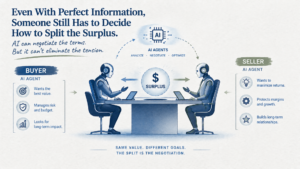
Let’s grant that assumption for a moment. Even with perfect attribution, even if both sides know exactly what the value is and what the seller contributed to it, the zero-sum tension within the transaction remains. Knowing the size of the surplus does not tell you how to split it. The buyer still wants more. The seller still wants more. Perfect information doesn’t eliminate negotiation.
The Innovation Incentive
A system that negotiates every transaction to an equitable split removes the seller’s ability to capture exceptional upside when they deliver exceptional value. And that upside is precisely what funds the next innovation.
Pharmaceutical companies spend billions developing new drugs because they expect to capture billions in return. That expectation is what makes the bet rational. Eliminate the upside and you eliminate the bet. The patients who benefit from the next breakthrough drug pay the price for capping the returns on the last one. None of this defends pricing excess. The incentive to create value depends on the ability to capture some of it.
A world that always negotiates to fair reduces the incentive to create it. Over time, that leaves less to distribute.
Prices Are Information
Prices reflect scarcity. When something is scarce, its price rises, telling buyers to economize, telling sellers to invest in creating more, and telling the whole system where resources are needed most. A fair price negotiated by agents optimizing for equity ignores that signal entirely. It treats price as a way to split surplus rather than as information the market needs to function.
Remove the price signal and you blind the market to scarcity. Resources stop flowing toward their highest value use. The system that was supposed to be fairer becomes less efficient and ultimately less productive for everyone.
Why Pricing Models Exist
Steven’s question deserves a direct answer. Pricing models exist because prices do more than split surplus. They carry information. They signal value, scarcity, and innovation potential to everyone in the market simultaneously. A world without pricing models trades market intelligence for the appearance of equity, and will discover the cost of that trade over time.
The tension between buyer and seller is not a bug. It is the engine.
Share your comments on the LinkedIn post.
Now, go make an impact!
A note on process: Every idea, argument, and opinion is mine. Claude made the writing better.
Tags: ai negotation, ai pricing, outcome pricing, pricing, Pricing AI, pricing economics, pricing innovation, pricing models, value attribution