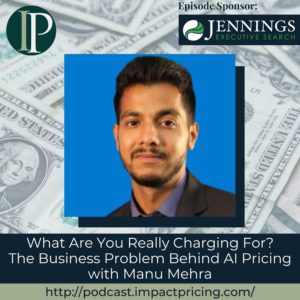
Manu Mehra is Head of AMER Industries Strategic Deal Pricing at Databricks, with more than 12 years of experience across pricing, product, cloud, and AI, including Google Cloud and Thermo Fisher Scientific. He brings a practical perspective on how AI is changing the way companies think about outcomes, value, platforms, and pricing models.
In this episode, Manu explains why traditional pricing models don’t neatly fit AI, why outcome-based pricing is compelling but difficult to standardize, and how companies can turn platforms into solutions around specific business problems.
Mark challenges him throughout the conversation, especially on the attribution problem: if AI creates the value, how do you know AI actually caused it?
Podcast: Play in new window | Download
Why you have to check out today’s podcast:
- Learn why AI is pushing pricing toward outcomes.
- Discover how platforms become solutions customers will pay more for.
- Understand the attribution and standardization challenges behind AI pricing.
“Pricing cannot be an afterthought. It has to be integrated within the product roadmap.”
— Manu Mehra
Topics Covered:
01:15 – How an accidental pricing analytics role led Manu to a career spanning product, cloud, AI, sales, finance, and strategic deal pricing.
03:30 – Why Pricing Has to Start With the Product. Why integrating pricing into the product roadmap can create value before launch instead of scrambling for cost-plus pricing afterward.
05:30 – Why AI Breaks Traditional Pricing Models. Why subscription, license, and consumption models don’t fully fit AI when thousands of customers can pursue completely different outcomes
08:00 – The Hardest Problem With Outcome-Based Pricing. Why AI outcomes are difficult to standardize across billing, finance, legal, and revenue recognition—and why 10,000 customers could mean 10,000 different outcomes
11:00 – What Actually Counts as an AI Outcome? Manu uses a QBR example where AI can automate 95% of the SQL work, turning hours and effort saved into a measurable form of value.
13:30 – The Attribution Problem: Did AI Really Create the Value? Mark and Manu debate how to determine whether AI actually caused increased revenue, lower costs, or other gains—or simply helped the business get there faster.
16:00 – Platform vs. Solution: What Are You Really Selling? Why a broad platform can have wildly different value depending on the customer’s use case—and how platforms can become solutions by solving specific business problems.
19:00 – How to Turn Products Into Business Solutions. Manu explains how compute, data, and AI layers can be combined into packaged solutions instead of being sold as isolated products.
21:30 – How Customer Segmentation Makes AI Pricing Scalable. Why identifying recurring customer patterns can help companies map different business problems to repeatable combinations of SKUs instead of creating a custom solution for every customer.
24:00 – Why AI Companies Use Credits. How credits can create cost predictability, manage backend costs, and give customers flexibility across different AI capabilities.
27:00 – When Credits Make Sense—and When They Don’t. Why platform customers may value the flexibility of credits while digital-native customers who already know exactly what they want may have less need for them.
30:00 – The Pricing Advice Manu Wants Leaders to Hear. Why pricing should never be an afterthought and why the industry is moving from cost-plus toward value-based and outcome-based pricing.
Key Takeaways:
“The reason is, even though you might be a platform organization or you’re selling a platform, but end of the day, you’re still trying to solve a customer problem.” — Manu Mehra
“The tricky thing with outcome is it’s very hard to standardize it.” — Manu Mehra
“Pricing needs to be integrated during the product roadmap.” — Manu Mehra
Connect with Manu Mehra:
- LinkedIn: https://www.linkedin.com/in/manumehra1/
Connect with Mark Stiving:
- LinkedIn: https://www.linkedin.com/in/stiving/
- Email: [email protected]
Full Interview Transcript:
(Note: This transcript was created with an AI transcription service. Please forgive any transcription or grammatical errors. We probably sounded better in real life.
Manu Mehra
Don’t think of pricing as an afterthought. It has to be integrated within the product roadmap
[Intro]
Advertisement
Today’s podcast is sponsored by Jennings Executive Search. I had a great conversation with Jon Jennings about the skills needed in different pricing roles. He and I think a lot alike. If you’re looking for a new pricing role or if you’re trying to hire just the right pricing person, I strongly suggest you reach out to Jennings Executive Search.
They specialize in placing pricing people. Say that three times fast.
Mark Stiving
Welcome to Impact Pricing, the podcast where we discuss pricing, value, and how buyers decide. I’m Mark Stiving. I help companies understand and shape their buyers’ willingness to pay.
Our guest today is Manu Mehra. Here are three things you want to know about Manu before we start.
Manu is the head of AMER Industries Strategic Deal Pricing at Databricks. He spent more than 12 years working in pricing product cloud and AI, including at Google Cloud.
And he’s developed a framework he calls O.U.T.C.O.M.E, those are periods in between each of those letters, for outcome-based GenAI pricing.
Welcome, Manu.
Manu Mehra
Hey, Mark. It’s a real honor to be here and super excited.
So hey, listeners, my name is Manu Mehra, and super excited to be here and talking to Mark for the next one hour.
Mark Stiving
Oh, well, it’s not gonna be an hour. It’s gonna be 20 to 30 minutes.
Manu Mehra
Oh, okay.
Mark Stiving
But that’s okay. Okay. How did you get into pricing?
Manu Mehra
I would say, like, that was definitely an accidental thing that happened, Mark. So when I was graduating from Texas Tech in 2015, December, I started working for a startup in Texas, and I was still based out of Lubbock, which is West Texas in the university town, and I was just trying to move to a bigger city, to be honest.
I was like, “Okay, how can I move to New York or I can move to California and kind of explore more opportunities?”
And there came a- about Thermo Fisher Scientific, so I was applying to all kind of roles, and mostly on the analytics side. And one of the roles that I had applied to was for a pricing analytics role for a senior pricing analyst position at Thermo Fisher Scientific in Carlsbad, which is the suburbs of San Diego, and it was just an accidental thing.
And 2017, October, got through the interview, accepted the offer, started working, and I would say in the first month itself, Mark, I was very clear that this is the area where I really want to go long term in my career.
And I think the big thing that really stood out for me when I joined pricing at Thermo Fisher was that it’s such an inclusive function where you can really impact the top line and the bottom line of the company.
Now, you work with, like, so many different stakeholders. On a daily basis, I was working with, like, product, engineering, sales, finance, legal.
So I think just the impact that I could generate with this function was, like, unmatched anywhere else, and it was a good mix of understanding the technology, but also driving the business in the right direction.
So I think that was just an accidental thing, and since then have st- Like been around pricing, went to Google after that, and now at Databricks.
So yeah, I think it’s like, I would say almost 10 plus years in pricing, but still it’s my dream role.
And I always say pricing is as much of an art as in science. So there is an art to it, the customer psychology side, but also there’s a science to it, like the value the customer perceives.
And I think that has been my big motivation to stay in this career path for the last 10 plus years.
Mark Stiving
Nice. By the way, I think we should just clip that answer and use it anytime someone says, “Why are you in pricing?” ‘Cause that was a great answer.
Manu Mehra
Okay.
Mark Stiving
Right? I’m gonna summarize it in the following way. What you said was, “I get to touch a whole bunch of different places in the company, and I have huge impact.”
Manu Mehra
Totally. Yeah.
Mark Stiving
Right? And those are beautiful reasons- Yeah … right? That’s like, why, why wouldn’t you wanna be in pricing?
Manu Mehra
Exactly. The impact and the visibility you can generate in this role, I think it’s unmatched. No offense to any other roles, but I’m just, like, biased towards pricing roles, so yeah.
Mark Stiving
Yeah, yeah. And the other thing I find that’s really interesting, and I don’t know if you’ve gone this far, although given that you focus on outcome-based pricing, you probably have.
And that is most people in the company, even if their role should be to understand the customer, they don’t understand the customer.
Manu Mehra
Oh, yeah. It’s one of the hardest things to do, so.
Mark Stiving
Yeah. And so it’s really nice that we, from a pricing perspective, say, “Look, we’re out there trying to figure out what they’re willing to pay. We get value. You need to get value.” Right? “Let’s make sure everybody in the company gets this.”
Manu Mehra
Yeah. Yeah. So- And also, like, one of the things that I’ve realized, Mark, just to expand on, like, at least my little experience that I’ve had in pricing is pricing cannot be an afterthought.
Like, pricing needs to be integrated during the product roadmap because if it’s an afterthought, then we are, like, scrambling for cost plus pricing or cost plus some kind of margin that we are trying to drive, versus if it becomes of, like, the zero to one product roadmap and, like, there is a pricing vertical that’s working parallelly with the engineers and the product managers.
I think that’s where the real value is driven because then you don’t have to, like, do an afterthought and look for value.
You are already creating the value while you’re building the product.
So I think that’s the big difference I see the industry evolving towards, especially with, like, the gen AI pricing and the agentic AI and everything around it.
So yeah.
Mark Stiving
Nice. Nice. And I just wanted to throw out one thing before we move on. I love that you worked at Thermo Fisher ’cause that was like… I had the privilege of teaching them at Carlsbad a long, long time ago-
Manu Mehra
Oh, wow …
Mark Stiving
about pricing.
Manu Mehra
Yeah.
Mark Stiving
So
Manu Mehra
it was- No, I think it was a great adventure for almost three years that I worked with some really smart leaders out there.
But yeah, I had a lot of fun. I think that’s where I fell in love with pricing, to be honest. That was my first role in pricing, so.
Mark Stiving
Yeah. Nice. Nice. Let’s jump into talking about AI for a second. And so let me toss out the easy… Ah. Is this easy, even easy for you? I’ll find out. Why is AI changing pricing so dang much?
Manu Mehra
I think, like, the biggest change that is happening is if we think about, like, the evolution of pricing, we had the subscription pricing, and then we went to license-based pricing and the consumption-based pricing. I think all these models have proven efficacies. They are really great. But when it comes to AI, it has to be an outcome-based pricing because the way a company uses AI could have so many different variations.
A good example to think about, if I’m serving 10,000 customers Every customer has a very different outcome they’re trying to achieve, and that’s where AI, like the outcome-based pricing for AI becomes so essential, and that’s why it is so different from how we have been doing pricing historically.
Because none of these traditional models, even though they can help evolve the model, but none of these exactly fit the puzzle.
So I think the, we have to like build a new puzzle to kind of understand how the outcome is kind of retrieved by the customer.
A good example is, let’s say if I’m trying to automate some of my Jira tickets, for example, right? And I wanna like do everything through an agent, right? Now, the idea is how many tickets is the agent solving on a every day?
What’s the amount of rework the agent is doing? Is the agent really hallucinating? Can it be better done by a human?
So I think that’s where like, to answer your question, Mark, like that’s why the AI is so different, like the AI pricing is so different, and that’s why I’m trying to explore more on the outcome-based pricing.
Now, the tricky thing with outcome is it’s very hard to standardize it. Because again, going back to the same thing, if I’m serving 10,000 customers, every customer perceives a very different outcome.
So how do you standardize it? Because your billing systems need to be robust to standardize stuff.
Like otherwise, if we are building a custom model or a custom outcome for every customer, it’s gonna be like so hard for our billing system.
So I think that’s where the evolution needs to happen. I don’t know what the right answer is today because still a lot of work needs to be done in this area, but I think that’s where I see the difference between pricing AI versus doing the traditional and the more legacy methods.
Mark Stiving
Okay. I have to say that you redeemed yourself a little bit at the end of that answer, ’cause I was gonna disagree with you vehemently.
But I think in general, you’re right in that we want to move– I think outcome-based pricing is the holy grail.
That’s what we want to get to. Yeah. The problem I have with outcome-based pricing is that attribution is so hard, and so there are so few examples in the world today where we can say, “Yes, I can attribute an agent did this.”
Manu Mehra
Yeah.
Mark Stiving
Have they actually produced an outcome that mattered to me that I’m willing to pay you for?
Manu Mehra
Exactly.
Mark Stiving
And so when we get that, then I’m with you completely.
Manu Mehra
Yeah.
Mark Stiving
But what I was really gonna disagree with, and so this is an interesting thought, right? I think we can get closer to outcome-based pricing when our agents are providing a specific solution, right?
So resolutions for customer support calls is a specific solution.
And once we move to, I’m gonna call it a platform, and so you work at a platform company, and Google was a platform company.
And so when we’re dealing with platforms, I don’t see how you ever get to outcome-based pricing.
Let’s just talk about AWS for a second, right? How would AWS ever do outcome-based pricing?
Manu Mehra
It’s hard, right?
Mark Stiving
They’re gonna sell compute time all day long.
Manu Mehra
Yeah. Yeah, I agree.
Mark Stiving
Oh, come on, disagree with me. Let’s go, Manu. [00:09:00] Let’s go.
Manu Mehra
Well, I, I think like, I think like just the standardizing of outcomes is really hard, is what I see. Like I could do an outcome-based pricing for a standalone customer, but again, like it’s so difficult because then there are like 10,000 outcomes, and how does your billing system support that? How does finance support that?
And again, like all these things, when you put on a contract, they become very custom. So legal will have issues, finance will have issues. There’s revenue recognition.
So how do you go around making these patterns standardized so that you’re not doing like a one-off for every single customer?
So I think that’s where the gap is. But yeah, I have to agree with you, it’s really hard to do outcome-based pricing right now.
I think we’ll pass that stage once we have enough data to say, “Okay, these are the 50 or 100 most possible outcomes that a customer in a certain segment is looking for.”
And I think that’s where, to your point, Mark, like if we can convert the solutions to outcomes, because end of the day, customers wants to pay for value. And what does value generation mean? It is basically solving a certain use case for the customer.
So as long as we can convert these use cases or these business outcomes to, let’s say, different AI outcomes, I think that’s where the standardization would happen. But yeah, I still feel there is some way to go because again, you’re selling compute, you’re selling data analytics, and you’re selling the AI layer.
So right now, packaging all this together to say, “Okay, you need a certain amount of hardware in a certain database environment with a certain foundational model, and this is driving a certain outcome,” and that becomes the outcome that you’re gonna pay for.
So now clubbing all this together is the harder part, I think. So yeah.
Mark Stiving
So let’s talk about– Okay, I’ll just toss you the hard question. Define outcome-based pricing or define an outcome in outcome-based pricing.
Manu Mehra
I think outcome is like in simple terms, an outcome is anything that a business user is trying to achieve in a simple methodology.
For example, if let’s say an analyst had to write thousands of lines of SQL code every month to generate a QBR report versus a model can go in and do 95% of that job, now that’s a clear outcome. That’s the number of hours saved. That’s the number of efforts saved from the analyst that you can now automate all of this, and it kind of spits out this QBR or even a monthly business review for the leadership.
Now, that’s an example of clear outcome that AI was able to completely automate end to end.
Maybe there was a 5% amount that was spent by the human to kind of interpret the results and maybe bring out the real insights, but the SQL part of it, that was completely automated. So now that’s a clear outcome in my eyes how, how that was achieved.
An another outcome could be, okay, sales had to go through 10 steps to generate an opportunity in any CPQ environment versus now AI can go in, look at everything, and generate an end-to-end opportunity for the sales rep.
So that’s like 80%, 90% of the job done for the sales rep, and they can spend more time selling the value to the customer versus struggling through all these stages.
So I think those are clear outcomes that– and I’m practically using these examples because I think that kind of translates and clearly shows what an outcome means for AI. Again, this is just few examples.
The examples could be low-hanging fruits, some difficult things that we are trying to do with AI, but these are the outcomes that are like really clearly value driven, and they are showing the amount of hours saved, amount of effort saved, and the extra steps that any person in a business org had to take.
So yeah.
Mark Stiving
Okay. Just this morning, I got into a LinkedIn conversation with a couple other pricing experts, and it’s really interesting ’cause we’re trying to define the word outcome for outcome-based pricing.
And so I’m gonna tell you how you defined it relative to the conversation we’re having. Yeah. Right.
So what you just said was, I would put that in, you combine output and outcome in the same thing, meaning, hey, the fact that I delivered a report to you, it saves you time ’cause you were gonna produce that report anyway. That was my output, and so therefore, we’re gonna call that outcome-based pricing.
There are other people, Michael Mansard in particular, he would define that as output-based pricing.
And then outcome-based pricing is essentially, I increased your revenue. Mm-hmm. I absolutely decreased your costs, and I can identify exactly where it came from, and my revenue comes from… I’m sorry, my price comes from how much I saved you. Yeah. Right? As in outcome-based pricing.
So I think the difference between those two definitions, one is, here’s a KPI the company tracks, and we’re influencing that KPI.
And then the other, here’s an output we generate that we can tie to value, right? I mean, we can tie it to a change in, in something that happens inside the company, so we can get people to pay us for it. But it isn’t the KPI a company actually cares about, if that makes any sense.
Manu Mehra
It does. Maybe, like one argument I would throw there, Mark, is when we talk about, like this other person talked about, like, okay, I’m increasing the revenue and that’s an outcome. Would that outcome not happened without AI or would that happen anyways?
I think that’s another thing that I would want to deep dive is like, if AI wasn’t there, would I not save that much, like COGS, or would I have not increased the revenue, or was it just a faster way to getting to it?
So I think that’s another thing I want to like deep dive to understand, like is it totally driven by AI or AI was more an assistance there.
Mark Stiving
Yeah. And so what you just said to me is, uh, what we call the attribution problem, right? Did AI really do this? Yeah. Right?
And so are we gonna give AI the credit? And by the way, I’ve been in pricing for a very long time. You’re in pricing.
My guess is you’ve probably experienced something like this, but we’ll take some action. We know it’s gonna increase the ASP. The ASP goes up, and sales goes, “No, no, no, that was us. We changed our sales methodology.”
Manu Mehra
Yeah.
Mark Stiving
“We negotiated better.” Or marketing goes, “No, no, no, that was us. We found a higher quality of customer who’s willing to pay more.” Exactly. It’s, it’s an attribution problem. We know we did it, but everybody else takes the credit.
Manu Mehra
Or like instead of selling the products in silo, we started packaging it better, and hence our ASP went up because we are now doing a packaged solution versus like selling one-off products.
So I think, yeah. And that’s a tricky part, right? Like which team takes the credit for it and how do you attribute that extra gains that you’re making, whether it’s on the revenue side, COGS side, maybe acquisition of new customers for that matter.
So I think, yeah, it’s a hard one, so.
Mark Stiving
Yeah. And so that’s the whole attribution issue.
So now I wanna talk I’m not sure if I described it completely, but I want to describe the definition between a platform and a solution in my mind, right?
So a platform is where you work today, Databricks, it’s Google, it’s Zoom, it’s LinkedIn.
So what a platform does is it solves a huge variety of different problems that have very, very different amounts of value associated with them.
So, for example, on Zoom right now, we’re doing a podcast, and I get paid zero for this, right? Or I could be closing a multimillion-dollar deal over Zoom- Yeah right? Which has a huge amount of value.
So now we can see the difference in value based on what the use case was. Okay.
So that’s what I call a platform. A solution is more like a specific… You know, we’re, we’ll talk about Fin AI and, and resolving customer support calls, or we’ll talk about Charge Flow and resolving chargebacks on credit cards.
And so each of these are specific solutions to a problem that, that’s easier for us to quantify the dollar value Right.
Okay, so you’re with me so far in the difference in the definition?
Manu Mehra
Agree. Yep.
Mark Stiving
So the fact that you’ve worked, at least today, at Thermo Fisher, you probably worked at a solution company.
Manu Mehra
Yeah.
Mark Stiving
But you work today for a platform company. How do you think about pricing a platform?
Manu Mehra
I think like end of the day, even a platform is trying to solve a certain business problem.
So if you think about it the way I think about it, like these two are very closely intertwingled because the reason is, even though you might be a platform organization or you’re selling a platform, but end of the day, you’re still trying to solve a customer problem.You’re trying to solve like a customer solution.
So let’s say you have a customer who is moving from on-prem to cloud, and now you want to save– show them the cost savings, or you’re gonna show them the path to how you get to this migration. I think that’s a solution achieved because now you’re moving from on-prem to like a cloud platform.
It could be any platform for that matter.
So I think like, even though we can like differentiate the two, like the platform versus the solution, but the platform eventually will provide a solution to the customer. It will solve a customer problem.
So I think those two are like very closely… Maybe we define it differently, but I would say like platform is still giving a customer solution.
That’s how I see like today’s vendors kind of selling the products, like positioning your platform as a solution to the customer.
Mark Stiving
So I’m gonna s- by the way, I don’t understand your business very well at all, so I could be totally wrong.
But if I think in terms of Zoom or Link- l-let me use LinkedIn, ’cause I think LinkedIn is a fabulous example.
Manu Mehra
Yeah.
Mark Stiving
Right? So you and I probably use LinkedIn, and neither of us pays for it, neither of us gets any money for it, and right? It’s like, okay, we use it for free, and we’re not the people LinkedIn cares about other than they love having our data on their platform. They sell it to salespeople-
Manu Mehra
Mm-hmm …
Mark Stiving
Using Sales Navigator.
So they sell you more access, more capability. They sell it to recruiters at probably ten times the price they charge salespeople.
Manu Mehra
Right.
Mark Stiving
Right? And here’s the difference. You know, recruiters get a ton more value, so they were able to tweak their product and say, “Hey, I’m gonna go solve a recruiter problem, and I’m gonna charge recruiters a lot more money, and I’m gonna solve salespeople’s problem differently, and I’ll charge them less money.”
Right? Okay, so you’re with me so far.
So I could see how you would say, “Oh, people who are transferring from on-prem to the cloud, this is the problem we’re solving, so therefore we can charge them this to solve that problem.”
And so I would think of that as a solution more so than I would think of that as a, as a platform.
Manu Mehra
Exactly.
Mark Stiving
But on the other hand, I’m on the cloud, I can do anything for you, right? What do you want? And that feels more of a platform, and I can’t pick and choose what you’re gonna do on my platform.
Manu Mehra
Yeah, I think like you’re right, Mark. So yeah, if you think about like cloud at a high level, yes, it’s definitely a platform.
But let’s say if I am trying to train my agents, now that’s a solution that the platform is providing you. So now you could be using any platform, any foundational model for that matter, but end of the day, you’re still trying to solve a problem.
You’re still trying to solve a business problem.
So even though you start at the platform level, but if you start integrating products and the layers on top of it, let’s say you start with the compute portion, you layer on data layer on top of it, and then you layer on the AI layer on top of it.
All these three are working together to kind of provide you a solution.
So yes, these are individually platforms, but when they come together, they are solving a business problem. That’s how I would basically– At least that’s how I’m seeing the industry and how people typically in cloud talk about it.
So like, yes, and that’s why I was like one of the things that I touched upon is like instead of selling like products in silo, we are selling like a package solution, so it kind of solves a business problem.
So I think like, yes, individually these are platforms, but if you club them together, it’s a solution to the customer.
But yes, LinkedIn, and again, going back to your example on LinkedIn, yeah, I am on the free version. I don’t pay anything. But let’s say a recruiter buys this paid version, which gives them better outreach to like better candidates or they’re trying to reach out to people.
So I think now that’s a solution that they are trying to solve for their hiring managers. Like, okay, how do I get better in-individuals or how do I– Like let’s say they are trying to hire like a leader in a specific space with a very, very specific skill set they’re trying to figure out.
Now, LinkedIn is a platform, but it’s providing a solution to the recruiter to narrow it down to, let’s say, top 10 candidates.
They really want to like hire, let’s say, a VP level role or something like that. So I think that’s where the platform eventually could convert into a solution if used in the right manner, as I would say.
Mark Stiving
No, I think you’re spot on, and that was exactly the point I wanted to make on LinkedIn, is that they’ve taken their platform and turned it into solutions.
Manu Mehra
Totally, yeah.
Mark Stiving
You and I are still on the professional category. Yeah. And so even if we wanted to pay them more money to get more search or more something, we would still be in the platform group, right?
‘Cause- Yeah … ’cause it isn’t a specific function or specific purpose that we’re using them for.
So I love what you [ described where you said, “Hey, here’s these three layers that we put together.”
And the fact that you say the words, “We’re solving a business problem,” just hearing you say those words makes me happy.
But what I have a hard time understanding is how is it that since everybody comes to you with a different business problem, how do you price that as this, you’re gonna get your 10% of the result of the incremental profit for solving that problem?
Manu Mehra
Yeah.
Mark Stiving
Right. How do you do the pricing for that?
Manu Mehra
I think end of the day, for any vendor, like you are selling a limited number of SKUs, right? And now it could be thousands of SKUs or tens of thousands of SKUs.
I think every business problem is solved by a different permutation and combination of those same set of SKUs.
So let’s say, let’s talk about a company A which sells like, let’s say, 10 SKUs. Now, those 10 SKUs could be utilized in such different ways that it could solve 100 business problems.
So I think end of the day, what we need to understand is what kind of business problem are we trying to solve for the customers, and what set or what package of SKUs are able to solve that problem.
So end of the day, you still have those 10 SKUs, it’s just the way you use those SKUs to kind of arrive at a business solution.
So I think it’s the same set of SKUs, just like some customers might use some SKUs more than the other and vice versa.
So I think that’s where you start pricing is because end of the day you’re trying to like sell a solution and you’re doing a competitive benchmarking alongside that.
So as long as you can understand that business problem that the customer is trying to solve for, it’s gonna come out of that limited number of SKUs.
And again, now bigger the company, more number of SKUs, more solutions. But I would say like most of the customers fall in like, I would say, certain patterns where you can kind of do that segmentation to understand, okay, certain segment of customers are looking to solve a certain kind of problem, and hence this set of SKUs can solve that problem.
So I think that’s how I see pricing, and that also makes pricing much simpler. Because otherwise, if you’re trying to create a solution for thousands of customers, it’s gonna be really hard, and none of the systems are built that way to kind of bill your customers or the invoicing systems or your legal systems or anything for that matter.
And I think that’s where this customer segmentation becomes really handy.
And I remember like early on in my career when I was on a pricing analytics side, I used to do this K-means clustering or things like those.
So I think those kind of problems were like easily solved back then with like just finding patterns within your customers.
So I think that’s a good example where I have practically used in one of my roles back in the day. So yeah.
Mark Stiving
Yeah. So it’s a fascinating answer. Maybe I don’t understand what you guys do very well or what, what the whole infrastructure piece means, but what you described to me is how I would describe almost any solution company.
Manu Mehra
Yeah.
Mark Stiving
Right? Where we’re gonna do packaging, right? I’ve got a whole bunch of different features and which features do I put in which package and, you know, it’s exactly LinkedIn.
So LinkedIn puts these features in Recruiter and these features in Sales Navigator and these different features in Professional.
So it, it sounds almost like the same thing, which means it’s not really a platform. You guys are trying really hard to say, “Hey, what are the solutions that we can build for our customers so that we can charge for the value of the solution we’re delivering?”
Manu Mehra
Yep.
Mark Stiving
Would that be accurate?
Manu Mehra
Yeah. I think that’s a yes.
Yeah.
Mark Stiving
Okay. Awesome. I didn’t expect that. I honestly didn’t expect that. I,
Manu Mehra
I think, like, end of the day, we have to solve a business problem for any customer, right? Like, in any industry for that matter.
So I think, like, that’s where I think, like, the customers are willing to… And I think your books touch upon that as well, Mark, like, where customers are willing to pay.
We just need to understand what value are we delivering to the customer.
So if we can translate that value to the customer, the willingness to pay will come from there.
So I think that’s where, like, having very clear business solutions. And again, I’m not that technical, but people on the technical and the engineering side, they go and talk to the customers across companies.
So I think that’s where it makes a real difference, where if you can translate that value, there would be willingness to pay.
Mark Stiving
Yep. I couldn’t agree more with that.
Manu Mehra
Yeah.
Mark Stiving
I mean, that’s amazing. I think it’s amazing. So I’m gonna change topics a little bit ’cause this is another one that a lot of people in AI are now struggling with.
What are credits and why do we use them, and should we be using them?
Manu Mehra
I think like the simplest way to kind of define any form of credits is like it’s an investment any company makes into the customer because let’s say if a customer, going back to my example, if a customer is going from on-prem to cloud, there would be a double-dipping, right?
Where they would be running their workloads on-prem, and they would also be running their workloads on this new cloud environment, whichever they are moving on.
So it’s just a mechanism where the companies are trying to solve for that double-dipping and also kind of make sure that the cost is more predictable to the customer.
Because with AI, like the cost can really shoot up. So kind of bringing that predictability is really important. So I think that’s where this mechanism of credits comes across, like which is very widely used across the industry. Yeah.
Mark Stiving
So why couldn’t you just say, “I’m gonna cap your spend”? Why do you have to put credits on it?
Manu Mehra
I think also because you have your backend cost to retrieve, so it’s not in the easiest way to say, “Okay, I’m gonna cap you out,” because if, if the customers are running certain workloads forever or like some of the critical jobs that keep running like twenty-four/seven, I think there is a cost behind the scenes.
So just capping your price or capping your total cost to it can really be detrimental to like the top line and the bottom line of the companies, right? So I think that’s where, like of course there are some cases companies could do it, but I wouldn’t say like 100% of the cases you can cap that fee or ca- because otherwise it will become like a license-based business or a subscription-based business where you’re paying this fixed fee versus like let’s say if, if a company is running compute twenty-four/seven, now there is a cost to retrieve for the vendors, any vendors for that matter.
So I think that’s where it’s really hard to say that I’m gonna cap it forever because you could end up in like negative returns.
Mark Stiving
Yeah. So, you know, I think we’re talking about different things here though, and I would like to explore this with you. So I think of a credit as I’m gonna give you a subscription, it’s $10,000 a month and I’m giving you 1,000 API calls Right?
So I just sold you 1,000 API calls for $10,000 or whatever it is.
So you now have a credit. Now it turns out that I– instead of that, what I’m gonna do is I’m gonna sell you 10,000 credits, and each API call costs you 10 credits. By the way, you can also do a MCP download for 10 credits, or you could do, uh, something else for three credits.
And so this is how I think of credits, and so companies don’t do it for one reason, they do it for lots of reasons. Is that true or?
Manu Mehra
I would say yes, because also like sometimes like you’re doing credits because let’s say it’s a competitive takeout, you’re trying to win a customer and you see like this is a very viable and an easy way to explain to the customer like how this would translate versus if you were to like go and discount different products, it would be harder for the customer to understand.
So credits is just like a very simple mechanism to kind of explain it to the customer to your example, Mark, like now those 10,000 credits could be used for anything, as you pointed out, right?
Like whether for API calls, whether it’s like making an MCP connection, whether it’s retrieving the data, it could be an egress cost associated with it.
So yeah, it could be used for a variety of ways and it also gives… I think the biggest advantage is it gives flexibility to the customers. They’re not tied to a certain product on a certain discount. The credits gives like complete flexibility to the customer on where they want to use it.
So yeah, I think that’s, that’s a big flexibility to the customer and you see that industry is moving towards that, so yeah.
Mark Stiving
Okay. And so the reason I asked is because I see platform companies having to use credits, right? Because, you know, I don’t wanna buy every API call from you. I wanna buy a big bucket and let me use it how I want to. Yeah. ‘Cause there’s a whole bunch of different things. I see solutions companies potentially using credits in the short term, but moving away from credits because, I mean, why would I buy a credit if I know exactly what I’m buying, right?
I don’t go to McDonald’s and buy a credit so that I can trade it in for a hamburger.
Manu Mehra
Yeah.
Mark Stiving
Right? I just buy the- I go to McDonald’s and buy a hamburger.
Manu Mehra
Yeah.
Mark Stiving
Right?
Manu Mehra
Yeah. Agreed, agreed. I think, like, it could be, like, used in so many different ways. I think to start with, to us- as you said, like, it gives flexibility, but if the customer…
Like, and that’s where I think digital natives make a lot of difference because digital natives, let’s say if you’re talking about a legacy customer who’s coming from, like, an old school methodology, for them credits could work versus, like, a digital native who is, like, built on cloud.
I think for them they just know exactly what kind of solution they’re trying to build, and I think that differentiates the two.
Like, the flexibility versus somebody actually needing the flexibility and somebody not needing the flexibility because they exactly are built on cloud from day one. So…
Mark Stiving
Nice, nice. Manu, we’re actually a little bit over time. Thank you. This has been so much fun.
Let me ask you the final question, though.
What is one piece of pricing advice you’d give our listeners that you think could have a big impact on their business?
Manu Mehra
I think, like, the one piece of advice who’s, especially with people who are trying to, like, get into pricing or even the leaders who are trying to get into pricing is don’t think of pricing as an afterthought.
It has to be integrated. Like, again, going back to the point I made in the starting, it has to be integrated with the product roadmap. That’s number one. And any person who’s starting off in their career early on, there are so many different ways you can get into pricing.
There is pricing analytics, there is product pricing, there is deal desk, there is deal pricing, strategic deal pricing.
There is new age AI pricing.
So I think, like, there are so many avenues to explore, so I think one advice is don’t take it as an afterthought.
Gone are the days where we did cost plus pricing. Now we are moving towards value-based pricing or what we call today the outcome-based pricing. And then, of course, it’s a great career path for anyone who’s trying to get into it, and I think you’ll have a lot of fun.
You meet amazing people, and you make a lot of good friends along the way.
Mark Stiving
Awesome answer. Absolutely love it, Manu. I’m gonna share one more thought because of what you just brought up, and I think this is so funny.
Almost every hardware company I’ve ever worked with, they do some version of cost plus pricing, right?
And I’ve always thought, “Oh, SaaS companies have it so easy because they have zero marginal cost, so they have to price on value.”
Manu Mehra
Yeah.
Mark Stiving
Right? Now that SaaS companies are facing token prices, many of them are going to cost plus pricing, and I just find it so funny.
Manu Mehra
Yeah, it’s like going back, right? So yeah, yeah.
Mark Stiving
It’s great.
Manu Mehra
Yeah.
Mark Stiving
Manu, thank you so much for your time today. If anybody wants to contact you, how can they do that?
Manu Mehra
Oh, definitely reach out to me on LinkedIn. So my LinkedIn is a public profile. They can definitely reach out to me on LinkedIn and I’ll be more than happy to collaborate, talk to people, and just like expanding my network in general.
I know like there are amazing pricing people out there, so yeah, LinkedIn is like the best platform to reach out to me.
Mark Stiving
Excellent. And I have to say, the thing that you said today that I was most pleased with was the fact that even as a platform company, you focus on the value of solving business problems.
Manu Mehra
Totally.
Mark Stiving:
And I just, I just think that’s amazing, so.
All right, to our listeners, if you have any questions or comments about the podcast or if you want to get paid for value your buyers can’t see, email me, [email protected].
Now, go make an impact.
Advertisement
Thanks again to Jennings Executive Search for sponsoring our podcast.
If you’re looking to hire someone in pricing, I suggest you contact someone who knows pricing people. Contact Jennings Executive Search.
[Outro]