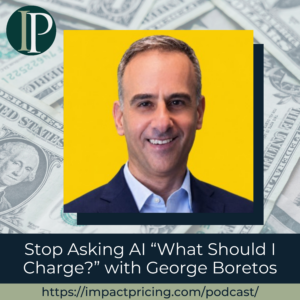
George Boretos is the founder and CEO of FutureUp, where he helps companies uncover hidden revenue and margin opportunities through AI, predictive analytics, and pricing science.
In this episode, he explains why AI can’t simply tell you what to charge, how machine learning can uncover pricing opportunities, and why competitor pricing data can sometimes make your model worse.
Podcast: Play in new window | Download
Why you have to check out today’s podcast:
- Learn where AI actually helps pricing from price optimization and segmentation to uncovering underpriced customers.
- See why more data isn’t always better.
- Discover what your sales data can reveal about willingness to pay, price variation, and hidden revenue opportunities.
“Don’t use AI to actually get specific pricing directions and price point suggestions. Don’t follow it blindly.”
— George Boretos
Topics Covered:
00:00 – Why “What Price Should I Charge?” Is the Wrong AI Prompt. Why general-purpose AI lacks the context and pricing intelligence to set your price.
03:30 – Where AI Can Actually Improve Pricing. How AI can support optimization, segmentation, packaging, and tiering.
06:30 – Why There’s No Single “Right” Price. Why pricing requires different methods for different businesses.
09:00 – The Pricing Data AI Needs. Why transaction volume isn’t enough without price variation.
12:00 – What Win/Loss Data Reveals. How won and lost deals can reveal win probability and market exposure.
14:30 – Finding Customers You’re Undercharging. How price differences can uncover segments and pricing patterns.
17:30 – When Competitor Data Hurts Your Model. Why adding competitor pricing data can actually make a model worse.
20:30 – Why Market Indicators Can Matter More. How market trends can sometimes explain pricing better than competitors.
23:00 – Why Companies Ignore Pricing. Why simply caring about pricing can unlock major margin opportunities.
25:00 – Pricing Strategy vs. Execution. Why the best pricing strategy still needs strong execution to work.
Key Takeaways:
“Use AI as a tool… Don’t use it to actually get specific directions, specific price point suggestions.” — George Boretos
“Pricing is a great differentiator. It can move mountains, it can increase margins, revenue, everything.” — George Boretos
Connect with George Boretos:
Connect with Mark Stiving:
- LinkedIn: https://www.linkedin.com/in/stiving/
- Email: [email protected]
Full Interview Transcript:
(Note: This transcript was created with an AI transcription service. Please forgive any transcription or grammatical errors. We probably sounded better in real life.
George Boretos
Start doing things, care about pricing, not just AI in pricing, but care about pricing.
Because this is the missing element out there. Most companies really don’t care about their pricing. Pricing is a great differentiator. It can move mountains, it can increase margins, revenue, everything.
And 90% of the companies don’t really care, don’t do anything about it.
[Intro]
Mark Stiving
Welcome to Impact Pricing, the podcast where we discuss pricing, value, and how buyers decide.
I’m Mark Stiving, and I help companies understand and shape their buyers’ willingness to pay.
Our guest today is Mr. George Borettos.
Here are three things you wanna know about George before we start.
He is the founder and CEO of FutureUp, where he helps companies uncover hidden revenue and margin opportunities using AI, predictive analytics, and pricing science.
George believes AI’s greatest value isn’t replacing pricing professionals, it’s helping organizations discover opportunities.
And he’s recognized as a Thinker’s 360 Top 50 AI Thought Leader, which of course makes me nervous to talk to him because we all don’t know enough about AI.
Welcome, George.
George Boretos
Hi, Mark. Great to be here again, after, I think, a couple of years.
Mark Stiving
It has been a couple of years, and I love having you back.
So, first off, remind us, how did you get into pricing?
George Boretos
I started before 30 years, when I started working, initially for the first 20 years as a business executive, and I got into marketing.
And back then, there were no distinct pricing functions, so I was responsible, eventually, not just for marketing, but also for price, which is one of the four P’s of market.
And I learned to love it. And eventually when I started my own company or companies and became an entrepreneur and a start-upper, I’ve started using AI in pricing.
So AI in pricing for me is part of my career and what I do for almost three decades.
Mark Stiving
Nice.
I’ve been probably doing it about the same amount of time. So when you think of AI and pricing, first off, I want to set the table.
Are we talking B2C, B2B, both?
George Boretos
Both. I would say my strong point is B2B, but I also have experience in customers in B2C retailers.
Mark Stiving
Nice.I love hearing that answer.
B2C feels like we’ve been able to do AI machine learning type pricing capabilities for a long time because of all the data.
And B2B’s biggest problem is a lack of data.
And so how do we use AI to help us make, I mean, what kind of pricing decisions could we make with AI?
George Boretos
Well, lots of different pricing decisions.
First of all, price optimization.
So what’s the best optimum price where you can maximize, for instance, your revenue or your profitability.
But there are some other side benefits that you can use or use cases where you can use AI, for instance, segmentation.
Segmentation, price sensitivity wise, something that will use AI…packaging, different tiering, architectures, things like that. They are very useful applications of AI.
Just to answer your previous question, your first question about B2B not be so compatible with AI because it doesn’t have big data, so it’s less mature and less penetrated by AI technology, which is true.
And these are barriers, definitely, plus the complexity of the business because pricing decisions is not just a split second spontaneous purchase. It’s a difficult, complex negotiation pattern with many people involved and so on and so forth.
So there is complexity. You don’t have a lot of data. There’s a lot of customization.
But that doesn’t mean that you can’t use AI, but you can use general purpose AI. Like we can to some extent, at least with B2C, you need more sophisticated models, usually models that have some econometric intelligence inside them to compensate for smaller data sets and the complexity, the additional complexity that you have.
So definitely you can do that, but it’s more difficult.
Mark Stiving
Okay, so I’m going to ask an embarrassingly stupid question, so make fun of me.
I work for some B2B company and I got access to Anthropic, Claude, and I want to type in there, what price should I charge?
Why is that an insane prompt?
George Boretos
It’s not insane, but it’s wrong to expect Claude or any other tool to answer something like that because it’s difficult for two reasons.
First of all, Claude doesn’t have all the statistical knowledge, first of all, to do that.
It’s a general purpose tool. We need to remind ourselves of that. It’s a broad tool. It can do wonders, but it’s not highly specialized.
And for price optimization or pricing, you need something very, very specialized. But the single and most important reason is that this is out of context.
Claude is not accountable for your business. Claude doesn’t understand exactly what is happening in your business, for ChatGPT or any other tool, were just entaverns, a general pattern that happened to be similar to something else.
But actually, in reality, in real life, nothing is quite similar or exactly the same. So you need context. And for that, we need humans. Yes, use Claude to get some starting points, some general directions for that, it’s great. But don’t use it to actually get specific directions, specific price point suggestions, for instance.
Don’t follow it blindly and definitely use your own mind in order to channel your efforts to the right direction.
Use AI as a tool, even if you’re using specialized tools. not just Claude, which is general purpose and therefore a bit more dangerous for such a specialized topic like pricing and price optimization.
Mark Stiving
Yeah, so can I take a shot at answering my own question for a second?
And I want to hear your feedback on this.
AI just takes what it knows about the world, right?
So we’ve scoured the web, we know everything that’s on the World Wide Web. And pricing isn’t really well established.
As in, you and I probably approach every pricing problem differently. Every pricing expert probably approaches it differently. Every pricing book talks about it differently.
So there isn’t an answer in the web that says, here’s how to do pricing.
And by the way, sometimes your method is the right method, and sometimes my method is the right method. It’s just not a known science.
And so to ask it to set a price, it has to use something, and that something just isn’t there.
What do you think of that answer?
George Boretos
I fully agree. It’s exactly as you said.
The whole pricing premise, and I’m not talking about specifically AI and pricing, but the whole pricing.
And field is less mature than other fields like marketing, for instance. And therefore, there is still a lot to be discovered there.
And therefore, there is no specific benchmark or a unique point of reference or a source of truth where Claude at CHatGPT can search the web and find exactly what you are looking for and provide the right answer. There is no single correct answer.
Usually you have to combine different methods, adapt it a lot for your own purposes, objectives and the specifics of the pricing problem to solve for your company or industry.
This is why it’s very difficult to get a great answer for all of these.
Mark Stiving
Yeah, I think you’re spot on. No two industries are alike. No two companies are alike. No two product lines inside the same company are alike.
And so it’s always a different set of goals, a different set of issues that we’re dealing with.
So when we do that. So how do you handle that? The fact that we just said, look, pricing doesn’t exist on the web.
So you can’t go in and say, hey, set me a price. You have to feed it a way of thinking. So what are some tricks on how you fed it?
George Boretos
Well, I don’t.
I’m using my proprietary model for that. because I don’t think that Claude or all these tools can help me. I’m using this pricing model for almost three decades. I have used it in B2B, B2C, small companies, big companies.
The results are almost always the same and great. I’m very happy for that.
What I am using Claude and all these tools is for programming, for software, for coding.
So implementing the model into a software environment, that’s all there is to it. Especially if you want to scale up or improve performance or do the things that the model can do at scale, obviously you need a software environment.
On the GenAI tools that I can do great things with coding can definitely help. Sometimes if I want to test a few new directions to involve my model, yes, I can make a discussion with GenAI tools, but that’s all there is to it.
I never asked them to do this thing for me or build a model for me. Actually, I have, and it was completely disappointing, the results that I got.
Mark Stiving
Yeah, I find that when you ask it something that you know really, really well, it’s horrible, right?
It just doesn’t know. And then what’s so funny about that is when you ask it something you don’t know well, you trust it. Even though you know things that you know well, it’s not good.
George Boretos
Yeah, but you have to test it even if you don’t know something very well, then you double check whatever you get from them.
What I usually do is that I use Claude for instance, and then I double check with the Chatgpt, then I do some searching and possibly ask a couple of people that I know that are experts in a specific area, and if everything checks out fine, then yes, I can trust it.
Otherwise, not really.
Mark Stiving
Yeah, exactly. And so given the answer that you gave me a minute ago, I think my memory failed me.
You are mostly doing machine learning in your AI, and you’re not using the LLMs or the Gen AI tools that all of us are playing with constantly nowadays.
George Boretos
Exactly what you said. The model is a machine learning model. I’m using Gen AI just to create the code, nothing else. Mm-hmm.
Mark Stiving
Yeah, and so that means what you do is even harder. Right, because you’ve actually got to go find the data and find the information to put it in and say, here’s the model.
We’re going to write that code. We’re going to write that model.
George Boretos
It is, but I have been doing that for three decades.
So obviously I have an unfair advantage, sort of, because the model is there. I have evolved it a lot, perfected it, tested it in different environments and so on and so forth.
But I don’t have to reinvent the wheel again. I’m not using different models per customer. The model is broad enough and can be adapted to specific customer requirements or needs or the peculiarities of their business or industry.
But I don’t have to really discover a new model each and every time. So this makes it a bit easier.
Mark Stiving
As I picture what you do, something that feels really hard to me, so I just want to ask you how you handle this, is let’s say that I’m dealing with a company that it’s an enterprise level company.
They sell a range of products or a product I’ll say to a range of customers. And so when I sell to a customer that’s 20% of my revenue, it’s heavily negotiated deal for one customer.
And then I sell to the long tail and it’s, I set a list price and you buy it or you don’t buy it, or maybe I sold it through distribution, right?
And so those feel like two hugely different problems to me. How do you handle that?
George Boretos
Well, sometimes you can’t. I mean, if half of the revenue goes to one customer and this is just a few transactions per year, then this should be separated.
You can’t handle it statistically. There’s no way you can do that just with 10 transactions per year or something like that.
But you can definitely optimize the rest of the revenue, which is scattered around different customers and so on and so forth. There are limitations in using AI. I’m not just talking about my model, but for any model, you should have at least 200, 300 transactions per year.
Plus, you need to have some price variation. If you have thousands or millions of transactions, but at the same price, more or less practically it’s like having one transaction point.
And this is one of the first things that the system that I have does, it takes out all the data or things that we can use in order to get all the pricing information that we need.
So is the data set big enough? Do we have a lot of diversity in the data and variety of prices and so on and so forth?
And sometimes you might see that, let’s say 20% of the revenue is kicked out because it doesn’t have the necessary data, either quality-wise or quantity-wise.
The case that you mentioned, for instance, We don’t have to do it automatically, but even in the system we would have said that, okay, for this customer, obviously we can’t do anything else.
The long tail is not such a problem by the way, because we can definitely deal with small products, thousands of products that overall constitute a big part of our revenue, but each and every product doesn’t have a big revenue.
But they do have a few hundred transactions a year. That’s definitely manageable.
Mark Stiving
So many, many years ago, I was working in semiconductors.
And so I spent a bunch of time thinking about pricing for many, many different products. And one of the things that we played a lot with was win-loss data.
So we actually looked at the deals that we lost as well as the deals that we won. And we tried to use that in a logistic model.
So you probably understand that, but the listeners don’t, but that’s okay. Do you use loss data?
And do you ever have access to loss data? Because I find that that’s pretty rare to get access to that.
George Boretos
It’s exactly as you said, it’s real.
If we can use it, for instance, if the customer has a great CRM system with lots of won but also lost cases, then definitely we can use it.
And the purpose of using loss and win data is to identify the probability of winning specific deals.
Which is different from having sales data where there is a bias, because obviously sales data means that you won the deal and you won the case and you don’t have lost cases there.
But on the other hand, you have also what we call exposure. You don’t have full exposure in your CRM. You know all the deals that you were aware of, and you either won or lost them.
But you might have even more deals that came out through natural signers, recurring customers. They didn’t go through the CRM system, small codes, or even big codes. They didn’t go through the CRM process. Perhaps there was no negotiation, but eventually they generated some revenue, or not so revenue.
This is part of the sales data set, and this is what we call exposure, how much of the universe of potential deals eventually end up being won deals in your case, even if they don’t go through your CRM.
The ideal setup would be to have access to both data sets, getting different parts of the information, but usually that’s not the case.
Usually we just have Sales data, not one loss information.If we do, we can use them all.
Mark Stiving
Yes. So talk me through sales data, because here’s one of the thoughts that I have on that.
And by the way, I just think about this stuff because I find it so fascinating. So anytime I win a deal, so anytime somebody buys something from me, here’s what I know. They were willing to pay me at least that much, but odds are really good they were willing to pay me more.
And so how do you get to that willingness to pay or optimal market price when all I have is win data?
George Boretos
Yeah, but you do have win data at similar, let’s say, customers with different rates, different prices.
So even with the Nikita, if you see that, let’s say, 70% of the cases of similar bills, similar customers are at, let’s say, $5, but you do have 30% at $7, then most likely you are leaving some money on the table.
And what we can do with the naked eye, obviously the AI system can do it scientifically and in more depth.
This is exactly what it tries to understand. Are there any similarities, any segments where we should have the same more or less price but we do have price diversity. This is happening for a reason.
That means that in some cases, we might be undercharging a product that could be charged a bit higher. Of course, in some cases, it’s the other way around. We discovered that the customers are paying a lot of money, much more than the market should pay or is paying right now, and we are losing volume in this case.
But this is part of the exercise to discover the overcharged and undercharged products. This is exactly what the system does.
Mark Stiving
Okay, so I think I heard you.
Let me walk you through an example and see if you can help me untangle this.
So I charge $5 and I win 1,000 customers. I charge $7 and I win 300 customers. What I really want to do is look at the 300 customers who still bought at $7 and see if I can create a segment for them so that I can charge $5 to everybody else and $7 to the people who are willing to pay me $7.
George Boretos
Yeah, but there could be different explanations.
Sometimes it’s just random, because there is a lot of dealmaking, negotiation, some randomness in what we do.
So it could be that these customers are not distinct or unique or a different segment, but it just happened that we gave a smaller or a larger price there.
But it could be the case that based on several specific characteristics of the customers, that these customers that were charged more or less, let’s say, live in a specific place in the world, or they are bigger customers or smaller customers.
This is exactly the reverse engineering that the system tries to do.
If we see different prices or different won rates, if we have lost won information, or a smaller bigger disk and so on so forth can we reverse engineer and understand what’s the archetype that generated this result?
Is it bigger customers, smaller customers, and so on and so forth.
And we can look at several different things, customer characteristics, geography, market indicators that may shift from time to time, deal characteristics, and so on and so forth.
And usually, we can reverse engineer, and this is done, we decipher the whole thing, and then we can predict, optimize, and so on and so forth.
Mark Stiving
Okay, now let’s throw a huge monkey wrench into the story.
My competitors have prices too. Do I want to know my competitors’ prices? Because they raise in lower prices and that changes my win rates.
George Boretos
Very, very recently, before a few days, I launched a post about that.
And it was a real case from a customer before some time. And we had access to competitor data. So we trained and fitted the model initially without any competitor’s data. It worked fine.
The model had great accuracy, predicted well, and so on and so forth.
But the customer insisted that since we do have competitor intelligence, we should use it.
So I did. Then compared the new model with competitor intelligence versus the other model, the initial one. The model fully collapsed with competitor data, which was a surprise.
But then when I looked closely at what the competitors were charging, It seems that they were a bit off orando, that my customer was the only rational. layer in the market. This is why we really didn’t need any competitors and agents.
It could ruin the model. Most of this intelligence is already reflected in your sales data or your homeless rates. And you don’t need anything else. This is especially true and especially important for B2B companies where usually you don’t have competitors intelligence.
And so, what can you do there? You shouldn’t do anything. You shouldn’t analyze your data. Obviously, you can. And there is a great way to test things out. You just use a model without competitor intelligence. You see if it’s accurate. If it’s accurate, then you don’t really need to know competitors’ prices.
This is partly effective on your sales or your own lost data.
If not, then you’re missing something. Possibly, that’s competitor intent.
Mark Stiving
Oh man, you just caused me to have two different headaches at once.
So first off, I have a hard time believing that we could say a model is accurate because I don’t think they’re ever accurate. I think this one’s better than that one. So we could say, hey, it’s improved.
And then the second one is I could see how competitor data is completely irrelevant if the competitors never change their price. And so now it just doesn’t matter.
But I think if my competitors were changing prices, my buyers, unless they’re not comparing me to competition, my buyers are comparing my price to my competitor’s price.
It has to have an impact on their decision.
George Boretos
Sometimes they are just changing their price based on some market indicator or market trend.
So it’s the market trend that you should follow.
For instance, what is happening today with oil prices fluctuating, there are some products that are highly related. So all competitors shift around these changes in oil prices or energy prices, so you don’t really have to follow your competitors because we are all following the same thing, the oil prices that fluctuate.
In most cases, you can identify the key market indicators that you need to follow, so you don’t care then about your competitors.
In some cases, especially in B2C, where you do have information and sometimes you do see that you are attacked by specific competitors, then yes, it would make sense to include computer intelligence as well, but based on my experience, in most cases, marketing indicators are more than enough.
Mark Stiving
Yeah. And my experience is the competitors, companies don’t change prices very often.
And so it’s pretty, and if they do, they do it in a pattern that makes sense and your data would capture that anyway.
So it doesn’t really matter. So, but I find the problem fascinating. All of this is.
George, we’re starting to wrap. Oh, go ahead.
George Boretos
Yeah, no, I just want to say that unfortunately in most cases and for most customers, the default is that we need competitive data.
If we don’t have it, we can’t move ahead with any AI initiative because simply this is the most important piece of information out there.
And this is completely wrong in 95% of the cases.
Mark Stiving
Yeah, yeah.
George, this has been fascinating as always. Here’s your final question. It’s the same one I gave you last time.
What is one piece of pricing advice you’d give our listeners that you think could have a big impact on their business?
George Boretos
I would say start doing things, care about pricing, not just AI and pricing, but care about pricing because this is the missing element out there.
Most companies really don’t care about their pricing. Pricing is a great differentiator. It can move mountains, it can increase margins, revenue, everything.
And 90% of the companies don’t really care, don’t do anything about it.
If you are in this small minority of 10%, where you start to care about that and focus, start using experts, methods, tools, et cetera.
You can really change your company, you can really change your profitability, and it’s one of the easiest way, it’s not easy, but it’s one of the easiest way to do that, as opposed to changing your product, changing your channel, changing your whole organization.
That’s the one piece of advice, but I will give another one.
Pricing strategy is great, but execution is even more important. So when you do something, think about it thoroughly, but eventually have something in mind how you are going to implement that.
If you have any resistance to change or any organizational limitation that will limit you from actually implementing what you have in mind pricing-wise.
Mark Stiving
I absolutely love both answers. I want to say something about the first answer, though, for just a second.
And that is, the more I’m in pricing, the more I think that people are just scared because they don’t understand it. Right?
It’s such a powerful variable, and they just don’t know what to do with it.
So it’s easier to deal with all those other things that they know how to deal with.
George Boretos
Yeah, it’s easier, but it’s difficult when you see the repercussions of your idleness pricing wise, because everybody complains about lower margins, profitability, etc.
And then the usual workaround is what? Okay, let’s spend more on advertisement or marketing or whatever to increase volumes and then magically profitability will increase.Ignorant.
Mark Stiving
Never, never.
George, thank you so much for your time today. If anybody wants to contact you, how can they do that?
George Boretos
I think the easiest way is my LinkedIn profile. They can use my name, George Boretos, and do this. We can communicate with anyone around the world.
Mark Stiving
All right, and to our listeners, thank you for your time today.
If you enjoyed this, would you please leave us a rating and a review?
And if you have any questions or comments about this podcast, or if you want to get paid for value your buyers can’t see, email me, [email protected].
Now, go make an impact.
[Outro]