
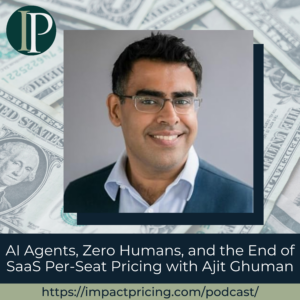
 Ajit Ghuman is the co-founder of Monetizely, former VP of Product at Segment, and author of Price to Scale.
In this episode, Ajit breaks down one of the biggest pricing challenges AI companies are about to face: what happens when software no longer supports employees — but starts replacing them entirely?
If your company is building, pricing, or monetizing AI products, this episode will change how you think about per-seat pricing, buyer psychology, and the future of SaaS monetization.
Podcast: Play in new window | Download
Why you have to check out today’s podcast:
- Understand why per-user pricing may stop working as AI agents increasingly replace human workflows inside software products.
- Learn Ajit Ghuman’s 3-part “Agentic Pricing Spectrum” for evaluating AI products based on autonomy, operational scope, and output-to-cost dynamics.
- Discover why buyers are suddenly comfortable with tokens, credits, and bundled AI pricing — even when they don’t fully understand what those units actually mean.
“Unless you understand what your market is, who your buyers are, what do they want… it’s the only thing that I start with when I do any project.”
— Ajit Ghuman
Topics Covered:
02:02 – Why Pricing Became the Most Direct Link to Customer Value. How pricing became the clearest connection between products, value, and business strategy.
06:29 – The AI Pricing Problem Nobody Has Fully Solved Yet. Why AI is forcing SaaS companies to rethink seats, tokens, outcomes, and margins.
07:38 – “Zero Human Companies” and the End of Per-User Pricing. Ajit explores a future where AI agents replace entire job functions — and asks the terrifying question: what happens when there’s no user left to charge for?
12:30 – Why Cursor Still Charges Per User (For Now). A fascinating breakdown of AI coding tools, human “anchors,” and why most AI products still can’t fully move to outcome-based pricing.
16:51 – The Coming AI Commoditization Wave. Why Ajit believes agentic AI companies could rise — and collapse — dramatically faster than traditional SaaS businesses.
23:07 – Why Buyers Suddenly Accept Tokens, Credits, and Weird AI Pricing. Ajit explains how ChatGPT normalized token-based pricing — even though most buyers still don’t fully understand what they’re paying for.
26:00 – The Real Reason AI Pricing Feels So Chaotic Right Now. Inference costs are dropping, users are disappearing, and pricing anchors keep shifting faster than companies can adapt.
29:35 – The One Pricing Principle That Still Matters in the AI Era. Despite all the chaos around AI monetization, Ajit says successful pricing still starts with deeply understanding your buyers and their problems.
Key Takeaways:
“The anchor is still the human… but the moment the human disappears, per-user pricing starts breaking.” – Ajit Ghuman
“Agentic AI may compress 20 years of SaaS evolution into just a few years.” – Ajit Ghuman
Resources Mentioned:
- Cursor — Used as a real-world example of current AI pricing models
- Harvey AI — Referenced as an example of high-value AI transformation inside the legal industry
- Anthropic — Mentioned in relation to inference models powering AI tools
- OpenAI — Referenced throughout the discussion on tokens and AI pricing behavior
- Salesforce — Discussed in relation to potential future shifts away from per-seat pricing
- Zoom — Used as an example of changing pricing priorities during growth stages
Connect with Ajit Ghuman:
- Website: https://www.getmonetizely.com/
- LinkedIn: https://www.linkedin.com/in/ajitpalghuman/
- Email: [email protected]
Connect with Mark Stiving:
- LinkedIn: https://www.linkedin.com/in/stiving/
- Email: [email protected]
Full Interview Transcript:
(Note: This transcript was created with an AI transcription service. Please forgive any transcription or grammatical errors. We probably sounded better in real life.
Ajit Ghuman
I feel like the buyers have learned a new UI and the buyers have learned for now the new language of tokens and credits as much as I can see.
And these products are comfortably selling their generative capabilities or AI capabilities in this fashion, not necessarily pay as you go, but from a lump sum basis.
So I feel like given the exposure, you can pretty much benchmark your pricing models against the large model providers and people will be okay paying as long as you can keep their costs predictable.
[Intro]
Mark Stiving
Welcome to Impact Pricing, the podcast where we discuss pricing, value, and how buyers decide.
I’m Mark Stiving. I help companies see value through their buyers’ eyes.
Our guest today is Ajit Ghuman.
Here are three things you want to know about Ajit before we start. He is the co-founder of Monetizely, a pricing strategy consulting firm. Former VP of Product at Twilio Segment, where he focused on product-led growth and monetization.
And he’s the author of Price to Scale.
Welcome, Ajit.
Ajit Ghuman
Thank you so much for having me, Mark, again.
Mark Stiving
And I forgot one other really important thing. A couple of weeks ago, Ajit and I had lunch. I happened to find myself in Vegas. I reached out to him. I said, oh, wow, you’re in Vegas.
Let’s have lunch. And I so rarely get to actually meet pricing people. It was fun. Thank you so much for entertaining me that day.
Ajit Ghuman
No, thanks for reaching out. It was fun to talk about pricing and non-pricing topics.
Mark Stiving
Yeah, you can never talk about it often enough. That’s my attitude. So let’s start with the easy question. How did you get into pricing?
Ajit Ghuman
Most of my career in Silicon Valley has been in product marketing. I found myself in product marketing doing pricing at some point. And I realized that pricing was in a domain that is generally very nebulous in terms of connection to value.
Pricing was very strongly attributable to value or at least impact on the bottom line, or at least the top line.
And that made me very interested because as a product marketer, we could, you know, I’m using the word we because most product marketers are unable to prove the value of their work.
And what is starting to happen is that product marketing tends to roll up into demand gen and the person who’s done demand gen for most of their career tends to become the VP of marketing.
So it started to be like, hey, I know all the strategy about this product. I know the positioning, I know how this should work. But the demand gen person runs the team because they can attribute their leads into opportunities and so on.
But when I started working on pricing project, I’m like, yeah, I can do that finally. Plus given a little bit more of an analytical background, it was coming naturally to me.
So I thought, okay, let’s just do this full time.
Mark Stiving
Okay. And so why are you still in it?
Ajit Ghuman
I feel like I’m good at it.
That’s the long and short of it. I feel I’m good at it.
Whenever new things happen in the market, I still find it very easy to explain, create a framework, educate somebody on how to go about it.
And the more I learn, it’s becoming sort of a doctor type of career. Like, hey, you come and you told me this thing. I’m like, yeah, this is most likely what’s happening to you.
I’ve seen 20 or 30 other patients like you. And we’ve done surgeries, we’ve done small things, we’ve done all sorts of things.
Now it’s becoming that sort of thing, which I really appreciate because now every other conversation becomes a much faster time to value for somebody.
And that doesn’t necessarily happen if you’re working a particular job for a company because you have to take your time, settle into a company.
But as a consultant, it’s like being a doctor, which is fun.
Mark Stiving
Yeah.
And so let me pull on that doctor analogy for just a second. I find it interesting because you’ve seen a whole bunch of different companies now.
What usually happens when you go to the doctor is you walk in and you say, hey, I’ve got these symptoms.
Ajit Ghuman
Yeah.
Mark Stiving
And what the doctor usually does is ask you a bunch of questions so they can figure out what’s the real problem.
What’s really going on?
And once you’ve seen a bunch of examples, it’s so much easier to go find the real problem than it is to say, oh, yeah, here, take this painkiller. Make the headache go away.
Ajit Ghuman
Yeah, true, true. That is very true.
Many times when companies come in, they talk about symptoms such as, you know, our discount rates are all over the place.
Some customers pay less than we want them to, you know, maybe we’re not charging enough, all of those things.
And we have some shelf where, so there’s a list of symptoms that we get, but then what we want to do is figure out where in their life cycle is this business. Where are they wanting to get?
And then we’ll ask them some basic questions about their existing model from which we will know what is likely happening.
Because what tends to happen with companies is things follow this sort of normal distribution of a company’s life cycle. You’re small, then you start to be like a market darling. Everybody tends to come to you and then you sort of fade away.
You know, if that is the ideal sort of situation.
So based on where you are on this curve your pricing model always is lagging your company strategy by a year or two if you’re good maybe six months but it’s always going to lag a little bit your company is going to move forward and then you realize oh i need to change my model to match my current stage.
A company such as zoom that got a lot of business when the pandemic started is focusing on sales velocity. It is inherently different from a company that is trying to expand margin and market share and is earlier on, right?
Like they want to expand deal sizes. Those are very different pricing projects.
So depending on where they are in their journey, we can understand what might be important from them from a pricing model perspective.
So we ask such questions to figure out where they are in their journey first.
Mark Stiving
Yeah, that’s perfect, perfect.
So let’s jump topics for a second and talk about the thing that, oh, everybody’s worried about today, and that is pricing AI.
And specifically, let’s focus more on agentic AI as opposed to trying to teach Sam Altman how to price open AI.
So first off, give me a shot at defining agents, and then what are your thoughts about how do we price this?
Ajit Ghuman
Yeah. Yeah.
So I was so excited about this discussion that whole of last week I was thinking about agentic AI. I’m like, I just really need to put my framework together.
So here’s what we have. It’s going to come out in my newsletter.
We’re going to have a bunch of different blog posts. We’re also going to create an agentic AI index, but essentially there are three main things about agents that you need to understand to figure out their pricing model.
Now, when I say pricing model, I am not talking about packaging. Every product needs to figure out its packaging for its different segments. There is nothing really new happening there.
When I’m using the word pricing model, I’m really meaning the metric and as well as how much money they can get from the product.
So the three things that will help you figure out what to do with an agent, we call it the agentic pricing spectrum.
The first is how autonomous is the agent? I’m now using the term zero human because eventually I believe most companies are going to be zero human companies. So how autonomous is this product?
Number two, how broad is the operational domain of the agent? Is it just helping you book your airline tickets? Is it your entire STR function? Is it your entire HR function or is it your CEO itself?
And finally, the output-to-cost curve.
So if the output-to-cost is a linear curve, that means that you really have to worry about your margin a lot.
And you can’t really change that metric to forget about your margin. But if your output-to-cost curve is exponential, that as you get more and more customers, and as you use more and more, your output is exponential.
But the cost is not increasing compared to the value that you’re adding. Think of like an AI, like this legal firm, Harvey AI, just started a few years ago. It’s $11 billion worth now. It’s insane.
But that is the amount of money in the legal industry that it is allowing to bring in, right?
So the revenue that’s able to bring in is infinitely more relevant compared to the costs, which are actually declining more exponentially as well.
So now if I take an AI, agentic AI system, and I think of these three attributes, I can figure out what the pricing metric should be, and I can figure out how much I can actually get for it, right?
So let’s do an example, Cursor, right? Cursor is something that is helping a developer build products faster.
So the human is definitely still in the picture. The human is maybe 50% in the picture. Now we can have a debate, is the human 40% in the picture, 60%? But they’re very much in the picture.
If they’re very much in the picture, what does that mean? That they are still an anchor to this whole process. The developer is still an anchor. It’s not human independent yet.
Number two, the operational domain. It’s helping you program, right? It’s a medium-sized operational domain. It’s not very small. It’s not very broad.
And then finally, what is the output-to-cost curve? It’s not exponential, and it’s maybe a little bit better than linear.
So medium, medium. Inflecting is how I would define, I would rate this agent in the agentic pricing spectrum.
Now, how are these AI coding agents being priced today on a per month basis and you get a certain number of executions within that per user per month fee.
Can they change their pricing lever? They could, but it is still hinging on the person, the developer.
So if it is hinging on the developer, you might as well make it on a per-user, per-developer basis.
So it reduces the amount you can play with there. If it did not hinge on the developer, you could have said based on the lines of code it is producing or based on some other attribute that is more towards outcome-based pricing.
But Cursor is not at the outcome-based pricing level. The anchor is still the human. And then since the output to cost curve is not necessarily exponential, you have to price very cognizant of other players in the market. How is somebody going to get this job done? As soon as this segment started, it also started to get commoditized.
And AI inference costs are only exponentially reducing time over time.
So you cannot charge a lot. You can charge a little bit, but the only way, only strategy for these firms like Cursor to win is to change the habits of people and become a brand.
Instead of actually adding more value, or it’s just still a race to the bottom in terms of inference costs. And everybody is, they’re working on top of Anthropic or other models. They just recently moved to one of the Chinese open source models.
So that is an example of how you would rate this AI agent.
Now, there are other agents which are more easily outcome based, but this one, I don’t think it can go there yet.
And it cannot charge a lot more based on the dynamics of the market yet.
Mark Stiving
Yeah, so first off, I love those three points.
In fact, I really love the first one and the last one. We could talk a little bit more about the second one in a minute.
So on the first one, I hadn’t heard it said that way, but in reality, what you’re saying is, can I still charge per user or not? Does that even make sense?
Because if I have zero users or if I have zero human, then I can’t charge per user. That makes no sense whatsoever.
And so depending on how much the human is involved, we could probably still use a per seat or per user metric if we wanted to.
So I thought that was brilliant.
Nice way to just say, look, does that make sense or not?
The last one, this is the problem that everybody thinks about when we think about AI. And that’s the fact that we’re now taking SaaS and adding real life costs to it.
We never had costs before.
And so the question is, is it linear? Is it not linear? I think one of the biggest problems companies see today is they don’t know. The costs are unpredictable. The usage is unpredictable.
And so what you said with Cursor, which I thought was pretty neat is per user, you get X amount of usage, whatever that happens to be.
And then we’re going to cap it, and then we’re going to give you more on top of that.
Ajit Ghuman
That tends to be the strategy employed by someone who wants market share but will throttle usage.
Other companies that don’t necessarily want that much market share will sell you bundles of usage like Elevenlabs. They’ll say so much usage at 30 bucks, so much usage at 100 bucks. It will still not be pay as you go because they want more deterministic. revenue.
They can’t have completely variable revenue but they’ll sell you bundles and within the bundle the margins are all accounted for.
That tends to be the way a lot of AI is priced and that tends to make sense given the cost implied and also that the three-part tariff models are the highest monetizing model for most companies.
Yes, the cost is very relevant with AI companies however the cost is also exponentially decreasing.
Mark Stiving
Yeah.
So let’s jump to the second one, because I mean, the first and the third one, I could see clear implications of pricing.
So let’s talk to the second one. And that was the breadth of the domain.
Ajit Ghuman
Yeah. Yeah.
So let’s talk about a company that is trying to automate.
Let’s say I’m trying to automate some of my email follow ups, right?
I have a sense of how much that is, like there is some ballpark in my mind, maybe it’s a 20 bucks a thing, five bucks a thing, there’s some ballpark.
But if my entire function can be offloaded, I just wrote a blog post about this. There’s this guy on Twitter that I follow, Brian Rommel, and he’s sort of on the cutting edge of AI thought leadership.
He just started something called the Zero Human Company, where Grok is the CEO and he’s hiring other agents to do different things.
So if your entire job functions are like, AI is your marketing function and it is going to hire sub-agents to do its job.
Now, the way I, first of all, even if there was human involvement and I as the CEO, I’m involved in managing it, whatever, but it is, this is still a whole domain that I got enable, right?
Am I going to pay the cost of 10 marketing people? Is that my cap that I could have had a 10 person marketing team? Is that the cap for this agent?
So there is two questions that come.
How much am I willing to pay and what is the metric by which I’m willing to pay?
So the metric now is more outcome-based for me. If you are going to bring me X amount of leads from a traditional marketing function, like I told, we started in the beginning of this conversation saying, I have attributable, marketing is a very attributable function.
So you bring so many amount of leads for me. This is the ideal use case for an outcome-based pricing function, right?
You give X many leads. I know my current model is based on whatever LTV to CAC ratio. I can figure out a number to pay this agent. This is so helpful.
The question is, how much am I going to pay? Am I going to pay on a per annum basis as much as I would have paid for a team or less, right?
Like my point there is that the price somebody is willing to pay is the lower of the value that I get. and the alternatives available to me so the moment a product like this is made available there’s going to be somebody else in the market that offers it as well.
And then there is this downstream competition that starts so on a metric basis the metric probably does not change but how much you can make out of this there is a very very short-term arbitrage and even that AI is also my point is AI is eating itself.
As well so these companies might You might see in the next few years, a lot of agentic companies coming into the picture.
You will also see them exiting the picture. So this whole agentic wave, I do not believe is going to last as long as SaaS did. I believe agentic is the next three, four years maximum.
Mark Stiving
Oh, that’s pretty interesting.
I certainly buy into the concept that says, if you build an agent, I can go build an agent.
And so we’re going to be competing on whatever that agent does. And so we’re going to drive it down towards costs.
So I can buy that argument. But I think what we’re missing in that is there are switching costs, there are comfort levels.
I use Fathom to record my Zoom calls. I get calls all the time or emails all the time.
You should try this one. You should try that one. It’s like, no, no, no. I’m used to this. I’m going to do this. I don’t want to go switch.
Ajit Ghuman
100%. 100%.
I’m calling them the brand effects, you’re calling them switching costs.
You know, if there is a brand that has built a lot of equity, definitely that brand, what I’m predicting is that there is more consolidation, that that brand in that segment wins.
But a lot of segments also get consolidated, like what Fathom is doing, there’s going to be a free product somebody else offers, like Microsoft is going to offer tomorrow. .
Fathom is doing such rudimentary things that you’re going to question why am I paying them 20 bucks a month when Zoom is just bundled for free or Microsoft 365 is bundled for free.
So there’s going to be consolidation like tomorrow, like maybe in a month’s time on this product because really there’s not much differentiation that it is offering and you’re going to question that $20 spend.
Might as well have a few Starbucks.
And then, you know…
Mark Stiving
Wait, wait, just pause for just a second. Here’s what went through my mind. How many people are still paying AOL for dial-up service?
Ajit Ghuman
Right.
We are still having the discussion assuming that there will be humans on the other end paying for this stuff. First of all, what if there is a big recession and people start losing their jobs due to your AI?
What are humans going to be paying for then?
And eventually, if AI is going to be managing all of these systems to begin with, because that is the end destination for agentic AI, AI will make the most cost optimal decision for your company.
That, all of that included, I am still, what I am trying to say is that there is a short-term arbitrage, but there is also a singularity event.
And the assumptions that we have had going into it, that a human has switching costs and is, you know, has his favorite things.
And, you know, a lot of things that existed before are just not going to be how the economy will work in as little as two years.
Mark Stiving
I’m not sure I agree with you, but we are going to see.
I have no idea what the truth looks like.
Ajit Ghuman
We will see in this wild roller coaster.
Mark Stiving
Yeah, so I wrote a post the other day, and by the time you listen to this, it’s probably old, so look a month or two back, but it essentially said, look, when every innovation happens, the world says, yeah, yeah, yeah, now we’re gonna lose all these people, right? These people are gonna lose their jobs.
And if you think about it, let’s just go to SaaS for a second, right?
SaaS made every one of us more effective and more efficient at our jobs.
And so theoretically, if you believe this story that says AI is gonna replace us, then you would believe that SAS would have eliminated a whole bunch of roles because it made us all more efficient.
But it didn’t. What it did was it gave us the ability to do more.
And so we all became more productive. We took on more responsibilities.
Ajit Ghuman
Not necessarily.
A lot of people in the tech industry benefited a lot, but a lot of people in the white-collar industry, blue-collar industry lost their jobs.
That’s the whole argument for Rust Belt America being disenfranchised.
So a lot of automation had a real impact on people who used to have blue collar jobs and could not have them.
And it created a lot of disharmony in society. And the rich got richer and the poor got poorer.
And that has been the story of the last 20 years.
Mark Stiving
Maybe on the blue collar side, but can I say this one?
I love this line because I used it the other day with one of my clients. One of the best things about blue collar jobs is AI can’t turn a wrench.
Ajit Ghuman
Hmm.
Mark Stiving
Now, it turns out that with robotics, if you’re going to do the same thing over and over again, sure it can.
But if you’re an HVAC person and going into people’s houses and climbing through ducts and trying to figure out what the problems are, AI is going to be, it’s going to take much longer to replace those.
Ajit Ghuman
Right, right.
At the same time, if you go to San Francisco today, in one hour time span, you will find at least 10 Waymos.
Mark Stiving
Yeah, I haven’t ridden one yet. I need to do that one of these days.
Ajit Ghuman
Yeah, me neither.
Mark Stiving
I’ve seen it driving, but it’s like, I gotta get a ride in one.
Ajit Ghuman
Yeah, I think so. The thing that I think is the most interesting for some people, you know, fear-inducing, for others it is just interesting, is that the unclarity of how much of an exponential change there is going to be.
As I say these things, we have the framework for AI pricing. We’re doing pricing consulting.
We don’t know if tomorrow Claude gets up and like, yeah, I’ll tell you I know everything about how Monetizely does it. I’ll tell you how to do your pricing.
And pretty soon it’s not telling other people, right? It’s just agents talking to other agents.
Unfortunately, as much as it does not, I do not think that the future is going to have jobs for even this type of thing.
I think that for the reasons and research that I have done, yes, agentic AI pricing is here, agents, that whole world will be built. The only thing I’m saying is about time compression.
SaaS has about 15 years of runway, maybe 20 years if you start with the whole Salesforce thing starting.
Now, I believe the runway is maybe a fourth of that for this agentics set of things. And from there, what other technologies emerge, it changes in a very rapid fashion.
So, and then the eventual destination is as less as five years time, in my opinion, is a very different world, where today we’re very excited about AI and all of the things it is unlocking.
Tomorrow, it will be like, what do we do now? And I don’t have the answer to that question, but I am saying that that is the destination that we are headed to already.
Mark Stiving
We are going to see. That’s all I could say.
Ajit Ghuman
Yeah.
Mark Stiving
So I was going to bring up a different topic, and now I know exactly how you’re going to answer it, but I’m going to bring up the topic anyway.
So everything you talk about, and most pricing people, including me for the longest time, was about what should companies be doing, right?
So how do we price this AI and how is that going to affect us?
And my work lately has been on how do buyers make decisions.
So what’s going on? And when I start looking at the way we think about pricing AI, what it looks to me like is we’re going to confuse buyers even more than they’re confused today.
Ajit Ghuman
Currently, if you’d look at buyers, buyers are also users, buyers are also consumers.
So, you know, I just noticed in the last three months, I switched back between India and the US.
Every laptop I’ve glanced at accidentally while getting coffee or something, I have only seen one product open. It is ChatGPT.
Whether it be India, whether it be the US, I have only seen ChatGPT. I’ve seen nothing but ChatGPT.
So I feel like the buyers have learned a new UI. And the buyers have learned for now the new language of tokens and credits as much as I can see.
And these products are, you know, comfortably selling their generative capabilities or AI capabilities in this fashion.
Not necessarily pay as you go, but from a lump sum basis.
So I feel like given the exposure, you can pretty much benchmark your pricing models against the large model providers and people will be okay paying as long as you can keep their costs predictable.
Tie to outcome is the harder part because I know buyers will want to tie to real outcomes. Like what does that get me?
And I don’t know what 10,000 tokens mean. I don’t know what a million tokens means. But at the same time, they’re going to want to build in some stability of spend because that is what enterprises have generally wanted.
Now, this is just a conjecture, right? I have no data either way.
But I feel like people have been a little bit normalized to buy tokens and credits rather than pure outcomes. which is tokens and credits are actually further away from an anchor that people had like the earlier anchor people had was user and you could have said how is this going to make my user more effective.
But at this point I feel that this is becoming like I’ve seen some VCs posting how much is token spend as percentage of employee revenue.
So this is the new metric I’ve seen, which at least for now makes sense to me as a question that buyers may ask, like how much, how much is our total token spend? What is a token?
Maybe that is a discussion companies will have. And they’ll say, okay, if you’re spending 200K on a software developer, we’ll spend another 100K on tokens.
And one by two is the spend ratio.
Anyway, those are some of my preliminary thoughts on the topic.
Mark Stiving
It’s an interesting way for companies to think about it, right? How much should I spend on tokens?
And so when you start thinking about tokens, I think about, you know, I’m going to spend money on cloud or I’m going to spend money on open AI and APIs.
And so these are almost always engineering things.
But as soon as you start thinking about agents, I’m trying to sell an agent, you know, think about the legal industry that we were talking about.
I can almost guarantee you they’re not selling by token, right? They’re selling by something else.
Ajit Ghuman
Harvey is selling by seat. Harvey is selling by seat.
Mark Stiving
Most of the world doesn’t understand tokens. Engineers understand tokens.
Ajit Ghuman
Yeah, yeah.
Mark Stiving
And even if they don’t really understand it, they accept it as, oh, this is compute power. I’ve been buying at AWS and it’s this sort of thing.
Ajit Ghuman
Yeah, yeah.
So it could also be that tokens, you know, since I also mentioned that inference costs are reducing exponentially, if there are organizations where the user still needs to be the controlling anchor, it could still be priced back to users. because initially there is a huge margin issue with AI products, but the margin issue is reducing.
So there are two things that are changing at the same time. Both the anchor is changing, which is the per user, because also users are getting fired.
Why the user was being hard for us to price per user because of the high token spend.
And if we did per user, we could be losing margin.
So while that is getting better, even the user construct is going away.
So two things are conflicting.
One, the costs are in the short term high, but they are going lower. At the same time, the anchor of per user pricing itself is going away.
So which is why this is a very weird place to be in today or the next few years, because how do we have stability over how companies buy?
Governments may buy per user, but large employers have already started firing all of the users.
They may still push for per user, but is this the right thing for somebody who’s selling to sell for?
Because if I know that the users are going to reduce, I’m not going to sell per user.
I will maybe want to sell you bundles of tokens again, or I may say, give me an enterprise wide license.
Because I want to make money with my costs going down.
At the same time, the buyer wants to make money. He’s like, I know your costs are going to go down. So give me either per user, or even if you give me this, then give me something back from how much money you’re going to make from the reduction.
The only thing that is the takeaway from this is that the rate of change is so high that nobody has a moment to actually settle on a new anchor.
Like I could have said like, no, the costs are high Mark, and this is how it will be done.
But every month we do this pricing course.
And every time we, I started to provide a new example for AI every month, that whole example, something big has changed.
I don’t even have the words to explain the rate of change.
When we said that, Hey, we provide an example of that. In 2028, Salesforce will want to move away from per user pricing. That happened in just one year from my providing that case study example to the students who are taking the course or something similar to that. It’s not that they’ve moved already.
So every time I say X thing may happen by Y date, that tends to be Y divided by three or four.
So I, this is the biggest challenge today is that some people are doing one thing, some people are doing something else because the rate of change is so, so high that nobody actually knows what to do.
Mark Stiving
Yeah. We can talk about this for hours, I think, but we’ve already talked for long enough.
We’re going to have to wrap this up. I am still going to ask the final question.
What is one piece of pricing advice you would give our listeners that you think could have a big impact on their business?
Ajit Ghuman
Let’s always start with your customer segments and market, no matter how much technology is changing, no matter the rate of change, no matter any of it, unless you understand what your market is, who your buyers are, what do they want, even if they be robots, which I’m happy that we are not there yet, but it is all a question of who they are. as to what they need.
And start with what they need. Start with what they really, you know, what will solve their problem.
Unfortunately, it’s not a very sexy piece of advice, but it’s the only thing that I start with when I do any project.
Mark Stiving
It’s actually a great answer.
Ajit, thank you so much for your time today. If anybody wants to contact you, how can they do that?
Ajit Ghuman
You can contact me at [email protected]. My website is www.getmonetizedly.com. Or you can find me on LinkedIn. I’m Ajit Ghuman.
Mark Stiving
Perfect. And to our listeners, thank you for your time. If you enjoyed this, would you please leave us a rating and a review?
And if you have any questions or comments about the podcast or if you want to see value through your buyers’ eyes, email me, [email protected].
Now, go make an impact.
[Outro]