After a deal falls apart, the explanation comes quickly.
“We lost on price.”
Most of the time, that statement is true. If the price had been low enough, even zero, the buyer would have said yes. From a technical standpoint, price was the obstacle.
From a leadership standpoint, that conclusion is useless.
Lowering the price always makes a trade easier. It reduces what the buyer has to give up. That doesn’t explain why the buyer hesitated in the first place. It only explains how the hesitation could have been bypassed.
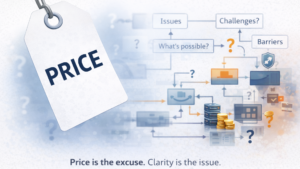
Price is where the decision shows up, not where it is made.
When a buyer cannot clearly justify the trade, price becomes the safest objection. Saying “it’s too expensive” is easier than saying “I don’t fully understand what I’m getting,” or “I’m not confident this will work for us,” or “I can’t defend this decision internally.” Price provides cover for uncertainty.
This is why price objections often feel vague. There’s rarely a precise counteroffer or a clear threshold. The buyer isn’t negotiating a number. They’re expressing doubt without having to diagnose it.
Sellers respond in predictable ways. They defend the price. They benchmark competitors. They offer discounts or concessions. Sometimes the deal closes. When it does, everyone feels relieved and quietly reinforces the belief that price really was the problem.
But something important just happened. The company won the deal by reducing the buyer’s sacrifice, not by strengthening the buyer’s belief that the trade was worth making. The underlying uncertainty remains. It just got cheaper to ignore.
Over time, this creates a pattern. Sales teams learn that discounting works. Leaders learn to expect it. Pricing becomes a negotiation tactic instead of a reflection of value. Deals close, but margins erode and confidence never really improves.
The uncomfortable truth is this: if you can win a deal by lowering the price, you could likely have won it by clarifying the value. One approach reduces revenue. The other increases trust.
This doesn’t mean price never matters. It always matters. It is part of the exchange. But treating price as the explanation for a lost deal prevents better questions from being asked.
Which buyers see the value?
What do buyers believe they are getting?
Why does the trade feel hard to justify at this price?
Until those questions are addressed, “we lost on price” will keep sounding right and leading nowhere.
Business leaders who accept that explanation end up incentivizing discounts. Leaders who reject it learn to diagnose decisions. One path makes deals cheaper. The other makes them easier.
Price didn’t lose the deal. Uncertainty did.
Share your comments on the LinkedIn post.
Now, go make an impact!
 Tags: b2b sales strategy, buyer psychology, pricing, pricing strategy, sales, sales leadership\revenue optimization, sales strategy, value communication