If you spend enough time talking about pricing AI, someone will eventually say this:
“Per-user pricing makes no sense for AI.”
Conceptually, they are right. Practically, they are often wrong.
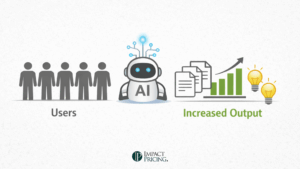
AI frequently automates human work. It increases output without increasing headcount. In theory, pricing per user should collapse as AI gets better. And yet, some of the most successful enterprise AI products are still priced per user. Microsoft Copilot is the most visible example.
This is not ignorance. It is strategy.
Enterprise pricing is not just about matching price to usage or value in a clean, theoretical way. It is about matching price to how buyers buy. CIOs, procurement teams, and finance departments are deeply conditioned to think in users, licenses, and annual budgets. Per-user pricing fits their mental models, approval processes, and forecasting tools.
That matters more than most pricing frameworks admit.
Microsoft charges $30 per user per month for Copilot across Office products. Does that perfectly track usage? No. Does it perfectly track value? Also no. Some users barely touch it. Others use it constantly. But it works because Microsoft already sells software this way, already has enterprise contracts structured this way, and already knows how buyers justify these purchases internally.
This is a crucial lesson for pricing AI.
A pricing model does not exist in isolation. It sits inside procurement workflows, budgeting cycles, and political realities. If your pricing model is elegant but creates friction at purchase time, it will lose to a less precise model that buyers understand instantly.
That does not mean per-user pricing is always right for AI. In many cases, it is a temporary compromise. As buyers gain more visibility into AI-driven outcomes, and as finance teams start asking harder questions about ROI, pressure will build to move toward metrics tied to activity, outputs, or results.
But timing matters.
For enterprise buyers, familiarity reduces perceived risk. Pricing AI in a familiar way can accelerate adoption, even if it is not the long-term end state. This is especially true when AI is embedded into an existing platform rather than sold as a standalone solution.
The mistake is not using per-user pricing. The mistake is assuming it will scale forever.
Pricing AI is not about being theoretically correct on day one. It is about being commercially effective in the real world. Sometimes that means meeting buyers where they are, even if you already know where they will eventually need to go.
Share your comments on the LinkedIn post.
Now, go make an impact!
 Tags: ai pricing, b2b sales strategy, pricing, Pricing AI, saas pricing models, sales strategy, Usage-Based Pricing