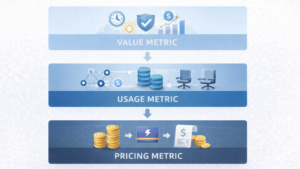
To understand what credits really do, it helps to separate three ideas that pricing conversations often blur together.
A value metric is how buyers measure value: revenue protected, time saved, risk reduced, outcomes achieved. This lives entirely in the buyer’s head and organization.
A usage metric is what the product actually measures when something happens: seats used, API calls made, tokens consumed, actions executed. This lives inside the system.
A pricing metric is what the seller charges for: seats, transactions, usage units, or credits.
In traditional SaaS pricing, these three layers are tightly connected. Buyers understand the pricing metric and how it relates to usage. They observe it over time and can loosely translate usage into value.
Credits may appear to break this structure, but they do not.
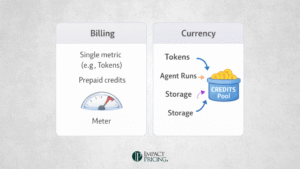
Credits are a pricing metric. Buyers pay for credits. But credits are not what gets consumed. They convert into usage like tokens, compute time, actions, workflows, or messages, based on rules defined by the seller. Those rules may vary across packages or customers, and they may evolve as the product changes.
Credits do not remove usage from pricing. They introduce a translation layer between usage and price. What changes is how directly buyers can see the relationship their behavior and cost.
With credits, buyers commit before they fully understand how price will map to their own behavior. The seller defines the usage rules. The seller measures consumption. The seller determines how different actions draw down the credit balance. Buyers infer the mapping later, through invoices and dashboards, rather than through upfront understanding.
In traditional usage-based pricing, buyers can observe how their actions drive usage and how usage drives cost. Even when the relationship is imperfect, they develop expectations through experience. They learn how behavior translates into spending.
Credits change this dynamic. Buyers still learn, but they learn inside a system whose rules they do not control and cannot directly observe.
Credits shift learning from observation to trust.
That shift is intentional. Credits give sellers flexibility. They allow pricing to survive product evolution. They reduce early friction when value and usage are hard to predict. For complex platforms and AI systems, that flexibility can be powerful.
But it comes with a tradeoff.
When usage definitions change frequently, or when they are hard to understand, buyers struggle to rebuild their mental models. Conversations move from value to reconciliation. Pricing feels arbitrary even if it isn’t.
Credits are not wrong, but they are not magic either. They do not eliminate usage metrics. They centralize control of them. And that means the success of credit-based pricing depends less on abstraction and more on how carefully sellers design, explain, and govern the usage rules underneath.
That is the real work credits demand.
Share your comments on the LinkedIn post.
Now, go make an impact!
 Tags: credit pricing, credit-based pricing, credits, pricing, pricing metric, pricing models, saas platforms, Usage-Based Pricing