You can listen to the full audio version of this blog we call — Blogcast.
AI has made pricing complicated again.
In SaaS, sellers could rely on predictable usage and stable costs. With AI, both sides are uncertain. Buyers don’t yet know how much they will use it, what it will do for them, or how to measure success. Sellers don’t know which use cases will stick, how compute costs will evolve, or how value will scale.
In this environment, credits have become a convenient middle ground. Credits aren’t a pricing metric; they are a mechanism for managing uncertainty and commitment.
The Real Problem Credits Solve
Credits solve a psychological problem more than an economic one.
Buyers are hesitant to commit to usage-based or outcome-based pricing until they understand what “usage” or “outcome” really means. By pre-purchasing credits, they can experiment freely within defined limits. Sellers, in turn, get early cash flow, a stronger customer commitment, and a chance to observe real behavior before finalizing value metrics.
We have seen this pattern before. When cell phones first appeared, most people did not know how much they would use them. Service providers responded by selling prepaid minutes, a form of credits. Buyers gained control and avoided surprise bills, while carriers secured upfront commitment.
As both sides learned what “normal usage” looked like, prepaid credits evolved into monthly subscriptions and, eventually, unlimited plans.
The same pattern is repeating in AI. Credits make it possible for buyers to explore while sellers learn. Over time, as value becomes clearer, companies can replace credits with direct pricing metrics that reflect outcomes, usage, or results.
Credits aren’t an end state. They are a bridge between uncertainty and value clarity.
What Credits Are (and Aren’t)
A credit is a prepaid unit of entitlement. Buyers pay in advance for a defined quantity of access, activity, or capability, then consume those credits as they use the product.
Here’s the key point: credits aren’t a metric. Metrics define what the buyer pays for, such as tokens, minutes, images, or API calls. Credits define how the buyer pays for them. They act as a neutral currency that can be exchanged across multiple metrics or use cases.
Credits make sense when the types or intensities of what buyers consume vary. They serve as a common denominator for different forms of usage that don’t share a single pricing metric.
The true value of credits lies in their behavioral impact, not their mathematical value. They create a safe space for learning. Buyers learn how they’ll use the product. Sellers learn how value forms.
But credits can obscure value. Buyers rarely understand what a credit actually represents. One credit might equal a thousand tokens, a conversation, or a process run. When buyers can’t link spending to outcomes, they perceive risk. That’s why clear conversion, transparency, and reporting matter more than the credit model itself.
Tokens and Credits: Two Bridges, Two Purposes
Tokens and credits often look similar, but they solve entirely different problems.
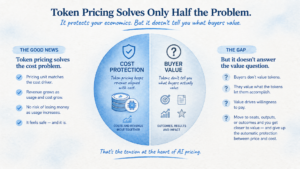
Tokens bridge technology and economics. Tokens translate the technical work of AI models into measurable, billable units. Each token represents a piece of computation, a way to connect engineering effort to cost and revenue. Tokens make AI pricing possible. They are cost-driven, rooted in the economics of compute and model usage.
Credits bridge economics and perception. Credits sit above tokens. They make pricing understandable and approachable for buyers who don’t think in tokens or inference calls. A credit might buy a set number of tokens, API calls, or tasks. In AI, tokens are often one of the underlying items that credits are composed of or used to purchase. Credits give the buyer a sense of control while helping the seller package complex, variable costs into something commercially usable.
In short: Tokens make AI billable. Credits make AI buyable.
Over time, both bridges can fade. Tokens tend to remain inside the cost model, invisible to buyers. Credits, however, are temporary. They exist only until sellers and buyers both understand what real value looks like. Once that happens, credits can be replaced by clear usage or outcome-based pricing.
Credits in Platforms vs. Solutions
Credits work best in platforms, not solutions.
A platform serves many use cases, each with different value drivers. It might provide infrastructure, APIs, or a set of tools that customers use in unpredictable ways. Because the value varies widely across users and activities, no single pricing metric captures it well. Credits become a flexible exchange mechanism that lets buyers explore the platform and allocate spending where they find the most value.
A solution, on the other hand, solves a defined problem that buyers understand. Its value can be measured more directly, perhaps per user, per transaction, or per outcome. Credits can add unnecessary abstraction. They make it harder for buyers to connect price to results, which weakens the perception of fairness.
Platforms trade precision for flexibility. Solutions trade flexibility for clarity.
Designing Effective Credit Systems
A good credit system feels invisible. Buyers understand it easily, track it effortlessly, and never think it is unfair.
To design one well:
- Keep conversion simple.
- Tie credits to value, not cost.
- Provide clear visibility.
- Avoid surprise expiration.
- Keep credits portable across the platform.
- Use consumption data to learn about value.
- Plan the exit strategy.
Credits are most powerful when they foster trust as a company learns what value truly means.
When to Use Credits (and When Not To)
Credits are useful only when the product’s usage is varied and value uncertain. They are unnecessary when the pricing metric is simple and stable.
Use credits when:
- You operate a platform with diverse use cases.
- You are in an early market with learning on both sides.
- You offer a multi-product portfolio.
- Usage varies widely over time.
Avoid credits when:
- You sell a clear solution with measurable value.
- You use simple per-user or access metrics.
- You serve regulated buyers who require itemized pricing.
Credits work best when usage spans multiple activities that are hard to measure consistently. They add little or no value when a single, stable metric captures most of the buyer’s value.
Credits as a Strategic Bridge
Credits aren’t the destination. They are the scaffolding that supports a company while it learns what value really means.
They let markets mature without stalling adoption, help sellers secure commitment without overpromising, and help buyers experiment without fear.
Every burned credit tells a story about how value flows through the product. Studying that story allows companies to design better pricing metrics that reflect real impact.
When designed transparently and retired gracefully, credits aren’t a pricing crutch. They are a learning tool that prepares both sides for the real conversation: how much value the buyer receives and how much of that value the seller deserves to capture.
Share your comments on the LinkedIn post.
Now, go make an impact!
 Tags: AI, Artificial intelligence, credit, credit system, value