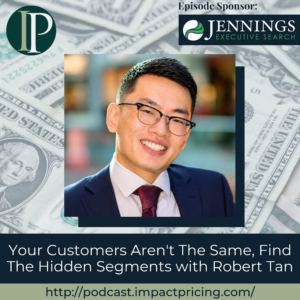
Robert Tan is the founder and CEO of High Point Insight, where he helps B2B SaaS companies uncover overlooked customer segments. A data scientist turned product leader, Robert shows companies how to find hidden use cases in their existing customer base and turn them into new growth opportunities.
Your customers may use the same product, but they don’t necessarily get the same value from it.
In this episode, Robert explains how analyzing customer behavior, usage data, and customer interviews can reveal segments hiding in plain sight. He shares how one software company discovered nine distinct customer segments, including groups it hadn’t even realized it was serving.
The opportunity? Find the customers getting the most value, understand the problems they’re solving, and build products and pricing around those differences.
Podcast: Play in new window | Download
Why you have to check out today’s podcast:
- Discover how hidden use cases can unlock your next growth curve.
- Learn how customer data and interviews reveal segments you didn’t know existed.
- Find out why different customer problems can justify different products, packages, and prices.
“It’s all about finding those pockets of value, really understanding their world.”
— Robert Tan
Topics Covered:
01:18 – Find Your Next Growth Curve in Your Existing Customers. Robert explains how overlooked use cases can help companies break through a growth plateau.
03:45 – The Hidden Opportunities in Your Customer Data. Why companies can know their customers for years and still miss valuable segments.
07:05 – What Is Value? Robert and Mark explore how value connects to customer satisfaction, problem-solving, and willingness to pay.
10:15 – One Product, Nine Different Customer Segments. How a small business software company discovered that some customers didn’t need its payroll features at all, uncovering new product opportunities.
14:00 – Combine Customer Interviews with Behavioral Data. Why Robert talks to customers before running quantitative analysis, and why data alone can produce little more than a scatterplot.
17:25 – Why Some Customers Are Worth 10 Times More. The LinkedIn example shows how recruiters, salespeople, and job seekers get different levels of value from the same platform.
19:30 – Platforms vs. Solutions: Where Is the Value?. Robert and Mark discuss why solving a specific problem can create more pricing power than offering a broad platform.
22:00 – How AI Is Changing the Future of Software Segmentation. Why AI makes it easier to build specialized products and blurs the line between platforms and vertical software.
24:00 – Don’t Be Afraid to Raise Your Prices. Robert shares his advice on building a business where customers expect regular price increases.
Key Takeaways:
On finding hidden customer segments: “There are often a tremendous opportunity hiding behind. If you just ask the right questions, all the treasure trove of data that is, they have accumulated to that point.” – Robert Tan
On discovering pockets of value: “It’s all about finding those pockets of value, really understanding their world.” – Robert Tan
On why customer interviews matter: “We always use the qualitative data from talking to the customers, talking to the company staff to inform the direction of the quantitative analysis.” – Robert Tan
People / Resources Mentioned:
- High Point Insight – Robert’s company, helping B2B SaaS businesses uncover overlooked customer segments.
- LinkedIn – Used as an example of a platform serving distinct segments, including recruiters, salespeople, and job seekers.
- OpenAI and Anthropic – Discussed as examples of how AI companies are pursuing different use cases and customer segments.
- AWS – Referenced as an example of a broad software platform that supports specialized applications.
Connect with Robert Tan:
- Website: https://highpointinsight.com/
- Email: [email protected]
Connect with Mark Stiving:
- LinkedIn: https://www.linkedin.com/in/stiving/
- Email: [email protected]
Full Interview Transcript:
(The full interview transcript is available below for readers who want to explore the conversation in more detail. Read the full transcript for more insights from Cecilia Mallen and Mark Stiving.)
Robert Tan
Don’t be afraid to raise your prices. Train your customers that you’re a company that constantly raises its prices. And when you give the notification, you do not need to explain why.
[Intro]
Advertisement
Today’s podcast is sponsored by Jennings Executive Search. I had a great conversation with Jon Jennings about the skills needed in different pricing roles. He and I think a lot alike. If you’re looking for a new pricing role, or if you’re trying to hire just the right pricing person, I strongly suggest you reach out to Jennings Executive Search. They specialize in placing pricing people. Say that three times fast.
Mark Stiving
Welcome to Impact Pricing, the podcast where we discuss pricing, value, and how buyers decide.
I’m Mark Stiving, I help companies turn hidden value into willingness to pay.
Our guest today is Robert Tan.
Here are three things you wanna know about Robert before we start. He is the founder and CEO of High Point Insight, helping B2B SaaS companies uncover overlooked customer segments. He’s a data scientist turned product leader.
And here’s a really cool thing. He spoke with Warren Buffett last year.
Welcome, Robert.
Robert Tan
Thank you for having me, Mark. It’s a pleasure to be here.
Mark Stiving
Hey, it’s going to be fun. So as I went through the way you think, the way you do things you write about, et cetera, I think we’re going to agree with everything. I’m going to try really, really hard to disagree with you somewhere.
I have no idea where it’s going to be yet, but I’m looking forward to it as we go through this.
Robert Tan
I love intellectual challenges.
Mark Stiving
Yeah. So how’d you get into pricing?
Robert Tan
Yeah, so you know, I spent my career in technology working both as a data scientist and later turned as a product manager.
And I had a lot of opportunity to really work on all facets of the product. But pricing is one of the most fun elements because it is one of the fastest things you can change that can have an immediate impact on your revenue and profitability.
And it’s also something that I believe most people are also a little bit scared to touch. It’s very, it can be very intimidating, right?
The moment that you bring up pricing, it’s like, ooh, you know, raising our prices, changing our prices. It can feel really like a big identity kind of challenge.
It’s a very, very interesting topic.
Mark Stiving
Yeah, I agree with that last statement 100%. I think if you could argue that there’s a single thing that keeps companies from changing prices, it’s fear.
Robert Tan
Absolutely.
Mark Stiving
So, all right. So we’re going to talk about segmentation and in particular use case segmentation. I use a different language, but first give me an overview on what it is that you’re doing and how you think about this. I don’t need the whole seven step process yet, but give us a quick overview.
Robert Tan
Yeah, absolutely. So Mark, have you ever encountered a situation where let’s say a startup successfully finds its initial product market fit. Okay.
And they build on that product market fit for five, six, seven, eight years. And things are awesome. Things are great. Things are growing. It’s hockey stick. And then somewhere along those lines, it starts to slow down, starts to plateau, right? The classic escrow of like, okay, things are slowing down. We’re doing the same things that we’re doing. last year, okay, same product, same marketing, maybe adding a few features here and there, but things are just slowing down. Okay.
And what essentially, I help companies do is find additional use cases that can build the next S-curve towards. That really is really the name of the game. How do we find those like ways that people are using the product today that are maybe not very obvious or are well understood?
Because we have to remember that if a company has already a thousand or 2000 users, chances are not everybody’s using and gaining the value in the same way.
And so how are they gaining value? Is there entirely different product opportunities behind these like pockets of like users, right?
And oftentimes there is. And so that’s what I help companies discover.
Mark Stiving
So, okay. I’m going to disagree with you on the first thing. I don’t think it’s oftentimes. I think it’s always.
Robert Tan
Okay. Okay. Well, I’m happy to be wrong on that one. I mean, yeah, it’s something that I see very, very common.
And you know, one of the kind of the common challenges is that the founder of McKinsey. Okay. Once said that it was Marvin Bauer who once said is that most businesses don’t fail because they answered the question incorrectly is because they never asked the right question and they always incremented themselves into a corner on the wrong assumptions. Right.
And what I see is very commonly in the market is that a lot of founders, especially in the five, between five to 10 years, if they haven’t iterated on the product, they know their customers very, very well. They insist they know their customers very well, but there’s often a tremendous opportunity hiding behind.
If you just ask the right questions, all the treasure trove of data that is, they have accumulated to that point. It’s sort of like if they’ve been accumulating oil for the last two million years, all it takes is one little match at the right place and really set it on fire.
And so that’s, you know, I’m sure that you see this opportunity all the time too.
Mark Stiving
Yeah, I just couldn’t agree with you more. So tell me, what do you think value is?
And we’re going to get into how we find it and all that stuff in a second, but I ask pricing people this all the time. They don’t agree with the definition. I have my own definition, which I’ll share with you in a minute, but I’d love to know your definition. What is value?
Robert Tan
Yeah, that’s a fantastic question.
The simplest way that I can characterize it really is the satisfaction beyond what you paid. And the reason I say this is because it applies both to the value that the customers get and the value that the company gets, right. The company pays for its staff, the technology, right.
And it gets, of course, revenue, but also maybe brand recognition, right. Social equity, if they’re doing really good work, the customers of course, get value of anything that the product provides them and they pay the price, right.
Anything in excess of that, I define as value. Yeah.
Mark Stiving
Yeah, so let me tell you why I don’t like that definition. Not that it’s a horrible one by any means. I don’t like it because I want a price based on value. And your definition included price in the definition. It’s tough for me to do that. So here’s my definition. I think value is the result of solving problems.
And I think you are going to love that given what you typically do and the way you think, right?
So a use case is a problem. It’s a high level problem. I call it a foundational problem, but it’s a big problem.
And so what’s the value? The value is when I go solve that problem. And how much am I willing to pay for it? Depends on how bad the problem is.
Robert Tan
Right. Yeah, I mean, I do definitely agree with an aspect of that definition, because if you’re able to solve a problem in a very innovative way, a very big problem that others can’t solve, you’re providing naturally a lot of value, right?
So, you know, that’s like, okay, what is the value of going to Mars and backing up, you know, the biosphere and humanity? Okay, well, that was a very unique problem, right?
Whether, you know, people agree or disagree, whether it is a problem we’re solving is another question, but it’s like, okay, That is a very, very unique problem, okay, that maybe very, very few people on Earth are able to solve.
And so, okay, what is the value of that? Well, I mean, it would be kind of sad if humanity kind of died on Earth, right?
So it’s like naturally very, very unique. So I do agree with some aspect of that. And then the question is, well, what is the maximum amount of value that you can extract in exchange for the value that you provide, right?
And I think that’s where you get really in the topic of Well, okay, pricing, how do you structure it, price points, you know, how do you communicate in a way that, you know, exerts the most influence over somebody, a prospect.
Mark Stiving
Yeah. So let’s jump into segmentation by use case then. And can you give, I’ve got a couple examples I use all the time, but I’d love to hear one of yours.
If you’ve got a relatively simple example that says, here’s how a company segments by use case.
Robert Tan
Yeah, absolutely. So one of the examples I like to give is around, well, actually I gave you kind of a couple of examples. So with a company that we work with, one of the leaders inside of the small business software, okay.
And they had a lot of different products, invoicing, payroll, you know, accounting. And what we found was that they had a problem with their apparel business specifically. Okay.
So in the US Mark, if you have yourself or any of your listeners had the, uh, experience, let’s say of paying full-time employees in the U S. they will know that it is quite a hurdle to jump through. You got federal taxes, you got state taxes, maybe you have the misfortune of having to deal with local taxes. If you’re in Pennsylvania, there’s all sorts of hoops that you have to jump through.
So most business owners, practically all of them, use some sort of a feature to help automatically deal with those taxes. They call that automated tax filing.
So the data suggested that users who are on this feature stayed around seven to eight times more in terms of retention than the ones that didn’t.
So it was a prime directive for the company to get as many business owners on this feature as possible. Makes sense. Right.
The problem was that the rate of this kept going down. It started with 90% that slide that slide down 85, 80 and went below 80. The folks were like, okay, there’s something wrong. Can we need to look into it? Cause this is not just a blip.
So fast forward. It turned out that there are actually nine different segments. Okay.
The people really believe that it was just one single unit of people, which is small business owners. How different could they be?
Well, it turns out that there are nine different segments and two of those only paid contractors. And if you know anything about paying contractors, you’ll know that contractors have no payroll taxes.
And at the end of the year, you only have to file one little form that an intern can fill out. You don’t need a CPA or software unit to do that.
And so this segment was growing like mushrooms inside your customer base and they didn’t even know. They had no idea until somebody actually went in there and looked at the numbers and they were growing at a clip of 200 to 300%.
So it was clear that of course this would sway the numbers, right? So boom, mystery solved.
But beyond that, they discovered a completely new use case. Okay. Businesses that have, let’s say an S-Corp business with a solo owner that only surrounds themselves with contractors and no full-time employees. Those are very unique setup that they haven’t seen before.
And so naturally that opened up a whole universe of new product that you can deliver to these customers. So that’s really what I mean by use case.
Okay. So people have different use cases for payroll. There is one product, but the value that they get out of the system looks very differently and the features and the pricing and the packaging needs to be needs to speak to that use case.
Mark Stiving
I absolutely love that example. One of the exercises I typically do with my clients is I do something I call valuable features.
I’m going to say it as though we’re using usage data, although they usually don’t have that usage data, where we just take a whole bunch of different customers and a whole bunch of different features and say, how much does each customer use each feature?
If you assume that value is the result of solving problems, the way I look at it is a feature solves a problem. If a customer is not using it, they don’t have the problem.
And so now we have this ability to look through this matrix of data and say, OK, who has similar sets of problems? And is that really a different segment? And that’s how I typically think of this.
I don’t know. So do you have something similar?
Robert Tan
Yeah, absolutely. So Mark, it seems like what you’re talking about is like, okay, let’s dive into the data, right?
Mark Stiving
Oh, like, oh, I love data, but I don’t think everybody else will, but go ahead. Let’s go.
Robert Tan
So, so, you know, kind of talking about what we talked about, about things being intimidating in the district of pricing, it’s probably data, right? So data, Oh, like what is data SQL, right? How do we deal with it? How do we talk to it?
Well, So we look at very similar things, Mark. So as part of what we typically look for in our process, we look at retention data. We look at revenue data. We look at the behavioral data in addition to speaking to actual customers.
But in terms of the behavioral data, here’s where things get very unique. Okay. Because of course, for people that have lived and breathed their entire life in technology and software, they won’t appreciate just how much richness and how much data they’re able to work with in a way that let’s say a retail business might not be able to do, right?
Or a manufacturing business. So those industries are catching up on, they have to like retrofit all the machines with like sensors to be able to collect that data, but software naturally spits it out by in volumes, right?
And so what we look at is really behavioral data as well. So Teachers are using it, or they are. If so, how much is it?
Mark Stiving
Just to make sure, Robert, when you say the words behavioral data, that’s what I called usage data. Is that correct?
Robert Tan
That’s correct. Yeah. I believe we’re talking about the same thing, which is how many employees have they paid? How often, how much money did they send? You know, are they using tax filing or not? So maybe some months yes, some months no.
And so all of that is something that we account for. We analyze and we gather all of it. And now with a general AI, we can actually enhance that data in a way that we clean it. It’s a whole new world out there. Yeah.
Mark Stiving
Oh, nice. Okay.
So, um, how do you add in interview data? Right. So I get the data. I mean, I dearly love data, but now as soon as we start interviewing people, it has to do with what are the questions we ask? How do we interpret it? What are we going to use it for?
So what’s your thinking around that?
Robert Tan
Yeah. So our philosophy is that the short answer is that we always use the qualitative data from talking to the customers, talking to the company staff to inform the direction of the quantitative analysis. Okay.
So we talk to the customers before we look at data. One of the very common issues that we see is that companies try to do the reverse. They say, you know, we’re going to use all these fancy machine learning models to perform segmentation and then see if divine something.
95% of the time it falls flat and it’s just a fancy scatterplot of dots and a lot of mystery. And so the quantum data only gets you so far. Okay. The value and talking to the customers, you get to ask them follow-up questions.
You get to ask them about their lives, what motivated them, things that will never show up in a data warehouse. And that helps really direct the direction of the analysis.
Mark Stiving
Yeah. Let me show you how I handle that. And by the way, I like your method better. It’s just more work.
My method is I make the assumption that people inside the company actually understand their customers. They just don’t know how to organize the thinking.
And so when we go through these exercises and we find, you know, different segments, I just ask him, why did these guys buy this? And these guys don’t buy this.
And usually they’re pretty good. Now I’m sure that you get even more accurate answers than I do, but no one’s asking the people inside the company, these questions.
Robert Tan
That’s right. Yes.
And oftentimes something that we hear is that to connect exactly what you’re saying, Mark, is that the value of bringing on an external fresh perspective is that we get to just talk across all levels of the company.
And what we find is that the people at the front lines, if you ask them the right questions. They have an immense treasure trove of data. So we always love to always ask, so how long have you been at this company?
Because if somebody has been there for seven years, it’s like, okay, we’re going to get into a great conversation. And even if someone has been only there for three months, it’s also a great conversation because you get to see, you know, for their own fresh eyes.
And oftentimes the value isn’t just organizing. the perspectives and thinking across all levels of the company in a way that the execs can just understand very simply. It’s like, aha, okay, great. Thank you for providing us the perspective from all across the company.
Mark Stiving
Yeah. So can I share with you my favorite example of market segmentation by problem?
Robert Tan
Yes, absolutely.
Mark Stiving
Right. So the one that I use more than anyone else is LinkedIn.
And the fact that LinkedIn is essentially resume storage and search. And yet they’ve identified four market segments. They call them recruiters, salespeople, job seekers, and then professionals or everybody else.
And I just find this so fascinating because everybody cares about finding resumes and finding people. And, and yet they charge recruiters 10 times more than they charge salespeople.
So it’s just fascinating to me.
Robert Tan
Yes, no, I absolutely agree. I believe they’ve done a pretty good job with just identifying who gets an immense value out of the system and leverage, right?
I mean, if a recruiter is able to identify 10 superstar performers and then charge, let’s say 20, $30,000 for each one to be sold. Well, I mean, you know, you’re talking about a single recruiting agency gathering hundreds of thousands and millions of dollars of value out of LinkedIn.
It kind of makes sense that LinkedIn tries to get us a piece of the pie, right? Rather than just selling a $50 per month, you know, LinkedIn premium subscription.
So it’s a completely different ballgame to the point that we’re saying about value Mark, completely different magnitude of value.
And, you know, something that I’m also seeing in the market live right now, as we kind of see the AI space play out is take OpenAI and Anthropic, for example. Enfropic, as we know, they really went all in on the problem, the use case of work, right?
We create AI for work, whereas OpenAI initially went the consumer route. And we saw that their revenue got really hardcapped last year, whereas Anthropic really took off at the start of last year. because they really went in on the value of work. And so on a use case basis, we can see that if an engineer, let’s say, pays $20 a month for that ChatGPT subscription, they might be burning through $10,000 worth of Anthropic tokens while they’re working at the company, right?
Vastly different value points because they’re solving vastly different problems. If the engineer is using ChatGPT for making dinner plans, that’s one form of value.
If the engineer is making an app that otherwise would have taken six months to make in a week, that’s a very different value, right?
And so that’s something that I’m also seeing play on in the market in real time as well.
Mark Stiving
Yeah. And, and so now the interesting question, let’s just talk about Anthropic for a second, right? So they’re going to make tons of money on the work side, but how do they build a market segment that says, Hey, we’re going to do this for consumers?
So I want the $20 a month and I want to solve these problems, but I don’t need to solve those problems. And I think that’s really what we’re talking about, is how do we do that segmentation.
Robert Tan
Yeah, it’s an interesting question and it seems like for one reason or another, they, well, I mean, maybe Dario had really the foresight to do it. And he seems to be right in this regard almost, because I believe the latest, you know, I mean, I don’t want to kind of date the podcast, but as of this point in time, Anthropic is actually on a higher valuation path than OpenAI.
And they have the foresight to really go deep on the work side. And maybe later, once they feel like that market is starting to exhaust, you know, and we’ll see if that really ever happens, they might go after the consumers, but consumers is also a much easier problem to solve in a way, right?
Because the feature requirements are in a way. almost simpler to make, right? If Anthropic really wanted to kind of build a GPT marketplace, because it doesn’t really have that in the same way that chat GPT does, we can really do that over a span of a couple of weeks. It’s not very hard, right?
But creating that brand positioning to be the trusted work partner, That is very different. We recently saw one of the big interface changes in chatGPT. They had such a hard time kind of breaking the consumer mindset that, ‘hey, you can use chat GPT for work too’. They included a separate tab along the top that says work. Okay.
Great, like they really had to make that little UI change to really communicate that you can use ChatGPT for work, right? So they’re really trying to break into that segment because I believe it seems like what’s happening, this is just my take, I could be completely wrong, is that it’s easier to go from work into consumer than consumer into work.
And yeah, Anthropic seems to be doing a good job of that so far.
Mark Stiving
Yeah. So, uh, when I talk about the LinkedIn story that I already shared with you, I often say, look, let me tell you a fictional story about how this started. Right.
And so LinkedIn used to just be resume storage and search, and they were selling, you know, extra search or extra whatever. And some brilliant product manager said, you know, who gets the most value out of what we do? And that’s recruiters. We should build a product just for recruiters.
And so essentially that’s what you just told us about Anthropic, right? We’re going to build, we’re going to figure out who the highest value market segment is and we’re going to build for them.
Robert Tan
Yeah, that’s exactly right. It’s about all about finding those pockets of value, really understanding their world. Right. I’m not a recruiter. I hire people, but I’m not a recruiter. Right. I’m sure you’ve hired people, Mark, maybe you use recruiters in the past, but like we, we don’t fully know their world until we actually go talk to them and live there. Try to get a sneak peek into their life a little bit. Right.
Because that’s, that’s where the value is. especially for people that are not necessarily super technical, they might not even be able to articulate their needs very well until somebody that’s product and technical minded actually goes and talks to them.
So it’s a fascinating project of discovery.
Mark Stiving
Yeah. So I want to try to focus us a little bit on something else for a second. Love the Anthropic story, but here’s what I hate about Anthropic or chat or any of these guys.
And that is the fact that I call it a platform, not a solution. And what that means is that we can do many, many different things, solve many, many different problems for many, many different customers. And so it’s really hard to say, here’s the value of what we do. And they end up charging based on tokens, right? They end up charging around cost plus or driving their costs, their prices down as low as they can in order to win the biggest market while still covering their costs.
And yet you jump to someone else, you know, we’ll go to LinkedIn again, right? I’m going to the recruiter market segment. I know what problem I’m solving. I can actually charge a huge premium because I’m solving a very specific problem for them. And I see that in today’s world pretty badly.
Robert Tan
Yeah. Yeah. You know, there’s a question I believe inferred from what you’re saying, Mark, which is that there’s the horizontal and vertical aspect of software, right? When you talk about a platform, I mean, AWS is a granddaddy of like software platforms. So let’s take them for example, you can build anything out of AWS, right? They’re like the ultimate Home Depot for like tools. Okay. You want to send email or you want to host like a real time database, you know, you want to use satellites. I mean, you got everything from spade to tractor in there.
And so, okay. Fantastic. We also know for a fact that there’s a lot of vertical businesses, vertical software that’s built on AWS, right? Probably a lot of horizontal. And so what it seems like you’re saying is that platforms like Anthropic and open AI.
And, you know, increasingly there’s suspicions that they might make even their own cloud, the AWS of open AI, they might do that internally, is that they’re looking to, of course, empower vertical and horizontal application layers on top.
And interestingly enough, we’re seeing also OpenAI build its own vertical applications. So I’m not sure if you saw that, but as of a few months ago, they launched ChatGPT for law. So even they’re trying to try to get a piece of the pie for the vertical applications.
So it really is a bit of a wild west right now because it’s how easy it is to build software products. Like if we imagine AWS 10 years ago, if they want to build verticals, let’s say for every industry, Boy, that is a big, big wide field, right?
The potential applications is very, very hard and maybe against their business interests to do so. But in today’s world where, you know, we’re like, we’re building a software application that normally would have taken a year to do in the span of three months, two months, three months.
Yup. ChatGPT, OpenAI, they can just do the same thing for every vertical if they really wanted to. And we’re seeing them start to do that. So where’s the line? I believe the line is getting increasingly blurred because of how fast and easy it is to actually do things, Mark. Yeah.
Mark Stiving
Yeah.No, I agree completely. But I love, I did not know ChattGPT came out with ChattGPT for Law.
And I love that idea, that concept, because they’re now solving a more specific problem. They should be able to get a higher margin on that set of products. Probably not smart enough to charge more for it, but still.
Robert Tan
Yes. Yeah, exactly. And I mean, you’re bringing a fascinating question mark, which is like, what is the role of vertical products in the future where if the platforms are able to just speedily build everything, right?
Is there still going to be some corner of the niche markets where the big guys can’t really reach or will AI be flexible enough so that way it can really reach those deep pockets and crevices of these niche markets, you know, pushing out, you know, dedicated verticals. I mean, yeah, this is a very interesting question.
Mark Stiving
Yeah. And one of the other things I’ve been seeing that tags onto what you just said, and that is vertical software companies today actually compete with Claude and chat GPT, not in the sense that chat is creating a competitive solution, but the buyer can say, Oh, I can do that myself. Right. I don’t need to buy Salesforce. I can build my own CRM just using AI.
Robert Tan
Yep. And funnily enough, that’s actually something that we’re doing of our own, you know, we’re paying thousands of dollars every year for a CRM that we don’t, I mean, we use an aspect of it. It’s pretty light.
And so we’re just having the team build it because we have, you know, the ability to do so in the span of a week, you know, I mean, five years, even Forget it. Like even two years ago, this was a little bit unthinkable for like an everyday, you know, business owner, right?
It’s like, Oh yeah, we’ll just build our own CRM. It’s like, well, what’s the point of that? We will just buy something because it will be very expensive to build. Now we’re halfway done and we started last week.
Mark Stiving
Yeah. And what’s so funny is you can ask the AI, what are the features we need? Right.
So, you know, you don’t have to worry about forgetting or not thinking of something cause they’re going to help you figure it out.
Robert Tan
Yeah, no, absolutely. AI is getting better and better at understanding context and application makers to be fair.
There’s how smart the AI model is and also how good the companies are making them are making it easy to import data from Google drive, from your email, from your Slack, right?
Because it gets better and better when you have more context. You don’t want a situation in the future where. you’re talking of AI, but AI has missed that message from Slack that something got done and it assumes it’s not done.
And then all of a sudden you have to like update it on the context. And now you’re keeping multiple versions of the truth of reality, which is very annoying.
And so, yeah, I’m very excited at what the future holds. I mean, it’s going to be a whole new world out there. Yeah.
Mark Stiving
And what’s so fascinating is nobody knows where it’s going, right? We all have guesses, but nobody actually knows.
Robert Tan
Yeah.
Mark Stiving
Robert, this has been absolutely fascinating. I could do this for another hour, but I’m gonna have to wrap it up. Let me ask you the final question.
What is one piece of pricing advice you’d give our listeners that you think could have a big impact on their business?
Robert Tan
The best piece of advice I recently heard is don’t be afraid to raise your prices. Train your customers that you’re a company that constantly raises its prices.
And when you give the notification, you do not need to explain why.
Mark Stiving
I’m with you on two out of three there, but totally okay. I love, I love the first two points. Love the first two points.
So Robert, thank you so much for your time today. If anybody wants to contact you, how can they do that?
Robert Tan
They can visit highpointinside.com. Yeah. Or email me directly at [email protected].
Mark Stiving
Perfect.
And to our listeners, thank you for your time. If you enjoyed this, would you please leave us a rating and a review? And finally, if you have any questions or comments about the podcast, or if you want someone to guide you while you’re leading your own pricing and packaging transformation, feel free to email me, [email protected].
Now, go make an impact.
Advertisement
Thanks again to Jennings Executive Search for sponsoring our podcast. If you’re looking to hire someone in pricing, I suggest you contact someone who knows pricing people. Contact Jennings Executive Search.
[Outro]