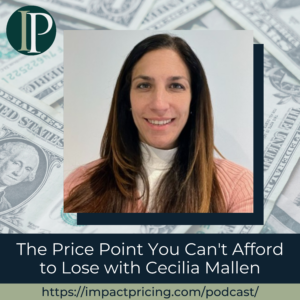
Cecilia Mallen is the International RGM Consumer Centricity Director at PepsiCo and has led revenue growth management across Europe, Mexico, the UK, and global markets. She turns consumer insights into pricing, promotion, pack, and portfolio decisions.
In this episode, Cecilia shares how consumer behavior should shape pricing decisions. She also challenges companies to stop focusing only on stealing market share and start growing the entire category.
**The next opportunity to meet Cecilia Mallen in person will be at EPP 20 Years Global in Amsterdam on 17–18 November. Register here to secure your ticket.
Podcast: Play in new window | Download
Why you have to check out today’s podcast:
- Discover why entry price points protect consumer access and why losing them can cost you category buyers.
- Learn how to use consumer research, willingness to pay, and buying occasions to make smarter pricing and pack decisions.
- Understand why category growth beats market-share battles and how affordability can drive sustainable growth.
“Think about, today, affordability. Make sure that the consumer can afford your products, and you have that willingness to pay from them.”
— Cecilia Mallen
Topics Covered:
02:30 – Understanding What Consumers Are Willing to Pay. Why willingness to pay requires more than research tools. Cecilia explains how brand, product attributes, business knowledge, and sales execution all influence the final price.
05:00 – Why Conjoint Analysis Shouldn’t Make Your Pricing Decisions for You. Learn how to use conjoint research alongside brand and consumer insights without taking the results too literally.
07:30 – Why Consumer Research Doesn’t Always Reflect Real Buying Behavior. Consumers don’t always know what they want until they’re standing in front of the shelf. Cecilia explains why stated preferences need to be interpreted carefully.
09:30 – How to Design Pack Sizes Around Buying Occasions. From on-the-go snacks to sharing packs, discover how consumer needs, occasions, competition, and retailer margins shape pack decisions.
13:00 – Shrinkflation: Protecting Affordability Without Losing Consumers. Why smaller packs have different price sensitivities, how key price points influence buying decisions, and why brands need to protect consumers’ pocket money.
16:30 – Stop Chasing Market Share. Start Growing the Category. Cecilia shares why businesses should focus on bringing more consumers into the category instead of simply taking customers from competitors.
19:00 – Why One Pricing Strategy Doesn’t Work in Every Market. Learn how market maturity, income levels, consumption patterns, channels, and geography influence pricing and pack strategies.
22:00 – The Price Point You Can’t Afford to Lose. Cecilia’s final advice: protect entry price points because they give consumers access to the category, even when those products generate less volume.
Key Takeaways:
[on protecting entry points] “Sometimes you overlook this, because there’s not much volume on these price points, but it’s very important to keep them and protect them.” – Cecilia Mallen
[on understanding willingness to pay] “How to understand the willingness to pay is like the most critical thing about pricing in itself.” – Cecilia Mallen
[on using conjoint analysis] “You need to understand the brand, understand your consumers, and take it directionally.” – Cecilia Mallen
People / Resources Mentioned:
- PepsiCo: Global food and beverage company where Cecilia leads International RGM Consumer Centricity.
- Conjoint Analysis: Consumer research method used to understand preferences and trade-offs between product attributes.
- Shrinkflation: Reducing product quantity or pack size while maintaining or changing the price.
- Campbell’s Soup: Referenced by Mark as an example of encouraging category consumption rather than focusing only on market share.
Connect with Cecilia Mallen:
Connect with Mark Stiving:
- LinkedIn: https://www.linkedin.com/in/stiving/
- Email: [email protected]
Full Interview Transcript:
(The full interview transcript is available below for readers who want to explore the conversation in more detail. Read the full transcript for more insights from Cecilia Mallen and Mark Stiving.)
Cecilia Mallen
Think about, today, affordability. Make sure that the consumer can afford your products, and you have that willingness to pay from them.
How you do that, sometimes, very often, is like having your entry price points. Don’t forget about that, because that’s the entry for the category.
Sometimes you overlook this, because there’s not much volume on these price points, but it’s very important to keep them and protect them.
[Intro]
Advertisement
Every year, the best pricing and commercial strategy minds in the world find each other in one place. This November, that place is Amsterdam. EPP is celebrating 20 years by bringing 1,000 pricing and RGM leaders together for its global summit, November 17th and 18th. If pricing is your profession, this is where you belong.
Register at pricingplatform.com.
Mark Stiving
Welcome to Impact Pricing, the podcast where we discuss pricing, value, and how buyers decide.
I’m Mark Stiving, I help companies turn hidden value into willingness to pay.
Our guest today is Cecilia Mallen. Here are, oh, I messed that up. Cecilia Mallen. Here are three things you want to know about Cecilia before we start. She is the International RGM Consumer Centricity Director at PepsiCo.
She’s led revenue management across Europe, Mexico, the UK, and global markets. And she turns consumer evidence into pricing, promotion, pack, and portfolio decisions.
Welcome, Cecilia.
Cecilia Mallen
Hello. Thanks for having me here, Mark. Nice to meet you.
Mark Stiving
Nice to meet you, and it’s going to be fun. How did you get into pricing?
Cecilia Mallen
I think it was just by coincidence. It has always been something interesting to me. But after I finished my MBA, I got into a pricing role.
It was not formally revenue management yet. It was like not a function by then, but then it started maturing within the company. That’s where it gets interesting because it’s not only about pricing, it’s like more than that.
So I guess it has evolved since I started my career in pricing probably 12 years or so ago. But it’s a very exciting journey so far.
Mark Stiving
Nice.
Well, one of the things I love about pricing is that it actually touches so many different functions inside a company. And so calling it revenue management makes so much more sense than calling it pricing.
Cecilia Mallen
I definitely agree with that.
We sometimes simplify it and say it’s pricing. But as I said, like it’s, it goes beyond, I would say. And I think the function in itself, as I was saying, has matured in many companies. And that’s why many people and many companies are starting to get a bit more into it.
Because then when you go more than that, I’m making broader than like just pricing. This is when you drive growth.
But I think that will be the big difference between just trying to optimize your pricing and try to think a little bit further.
And now I’m way more into really understanding the pricing in itself from the consumer perspective. So really end to end. And that’s why it’s like really interesting to me and how it has evolved.
Mark Stiving
Nice. So I spent a lot of time thinking about pricing, of course, but I spent a lot of time thinking about how much is somebody willing to pay? And I think about how much value do they get from our products.
So are those topics that drive you as well? And how do you use those in your work?
Cecilia Mallen
I mean, how to understand the willingness to pay is like the most critical thing about pricing in itself. How to find out it in the best way as possible.
I think it always has a bit of a art element. So there’s a lot of research that you can do to find out how much really somebody is willing to pay for something. And you start disintegrating the parts of the product, like the brand and then the attributes themselves. and so on.
But I think what’s interesting is how you really apply it and take it into the execution part where you should always apply a bit of your knowledge of the business and there’s the art and craft element of it.
Another way apply it like at the end we can do like a very robust kind of diagnosis of what the portfolio should look like where your brand should sit against others and so on you can have many tools like conjoined regression analysis and even more like AI based ones and at the end you need to find the price that the consumer sees and that’s where it becomes interesting.
It’s not about averages, it’s not about like having a visible price to the consumer but like by store then you have to understand how to slice and dice it and this is where your knowledge of the business and how to Work closely with sales is like the kind of ways that you can apply it in a better way.
And then you translate it into more strategies, customer strategies, and so on.
Mark Stiving
So talk to me a little bit about conjoined.
I’ve always loved conjoined analysis. It’s such a cool application or statistical tool. But do you think it really works to say, hey, somebody cares about this attribute more than that attribute, and then somebody else cares more about this first attribute? Does it really work?
Cecilia Mallen
I think that what works is the analysis of a conjoint, the outputs of it, alongside other things. So you need to understand the brand, understand your consumers, and take it directionally.
I think it works, but only if you are careful on how to use like the outputs of it not take it literal and say like I have to be like at 110 index on average because if I do one or two percent higher pricing than what I have today then I will optimize it no and then you need to understand where your price hot price points should be.
And that’s probably not the average price that the conjoint is telling you yet the conjoints are becoming better. Like when I started, as I said, like 12 years ago or so, my career, yeah, the conjoints were not as robust. Like you would see like a lot of images and then you make some choices, isolated images.
And it was very hard to compare one product versus the other. And now you can see the shelf, you can simulate promotions, you can do much more with it. So it’s a bit more real and you can get like much better insights out of it.
Mark Stiving
Yeah, so if I combine the two answers you just gave me for a second, do you run different conjoins for different stores?
Because that would be a really fascinating way to say, hey, we need a different price at this store than we do at this store.
Cecilia Mallen
I would run the conjoints more by channel than stores themselves. But something that is important is to try to simulate, like, the most typical store that the consumer would see.
So if I go to a traditional trade shelf, you need to make sure that whoever is answering the conjoint is, like, really taken to this type of stores and set themselves within that supervision, within that mindset, so that they can simulate their choices in a better way.
You can slice and dice the different types of stores, but it depends on what your objective is. If you want to start doing like a much better segmentation and optimize your products based on that, then probably you need to try to get to different types of stores, like hyper stores versus convenience versus like a traditional trade, like more moms and papas.
But it depends on what you want to bring out of it. The objective is very important, and that will help you design the Conjointly the best way as possible.
Mark Stiving
Yeah, I think getting that goal right in the beginning is always the most important thing, right? What are we trying to prove or what are we trying to find out?
Excellent.
What do you think about the difference between stated preference and behaviors? Because that’s one of the things we always hear about when we think of market research studies.
Cecilia Mallen
People can say a lot of things in a choice study, right?
Mark Stiving
Yes. I’m buying a Maserati next week, just ask me.
Cecilia Mallen
You lie a lot to yourself and to whoever commissioned the study, right?
So you need to really try to take things directionally and understand how to use them. Never take them literally because sometimes people tend to lie.
It depends also on the country though. I think in some countries you get a bit of a more biased answers than others, but never take things literal from what the conjoined is telling you.
Mark Stiving
That makes sense.
I don’t know the people lie, but I think they don’t know, and so they just like guess or something.
Cecilia Mallen
As well, as well.
So, for example, sometimes you don’t know the grammage if I’m going back to my world within potato chips.
For example, you see a bag of chips and then you see the other size. You don’t really know when you buy a bag of chips if you want the 50 grams or the 60 grams. You don’t know. You just see it when you have it in front of you. Then you kind of know which one you want and what price you would pay for it.
So those are the kind of things that you need to be a bit careful with on the conjoints.
Mark Stiving
Yeah, and what’s funny about your world is people are always making choices between two different brands, two different products.
It’s never just a, ‘Am I going to buy this or not’ type decision.
Cecilia Mallen
You can’t walk away when a brand is very strong. There are consumers who, I mean, if they don’t find it, they just don’t buy anything. But it’s like this is probably less of a possibility. You always have like some sort of substitute.
But this understanding of what products are not exchangeable and people would just go walk away if they don’t find them is really important because these ones drive the real incrementality when you optimize your assortments as well.
Mark Stiving
Yeah. So I’m going to ask you a question that I actually have no idea what the answer is, which is pretty rare for me. How do you do packing? How do you figure out I want six cans or I want eight ounces or I want four bags of eight ounces in a box? How do you make that decision? I’m totally lost.
Cecilia Mallen
Well, it depends, I would say. If you already have a market and you’re follower, it’s easier just to potentially have a similar pack size or potentially slightly bigger so that the consumer might pick you because it has a higher count or more grams or whatever. If you are the market leader, it’s probably different.
And the way I would analyze it, that’s the optimal way I would say, is to really understand the demand spaces on the occasions. What is driving the consumer choice?
Is it like an on-the-go pack, like a pack that fits in my bag and that I’m going to go like and take the bus and then go to work or go back home or whatever.
So what mid-state? is very important.
So if it’s a young person, probably he or she would want like bold flavors. I prefer this brand when I’m on the go, going back to the example of on the go, they get very hungry until they want to get home. So probably they want a bigger bag.
So for this type of consumers, maybe we go to like a heavy solo, we call it kind of bag, which is bigger than the usual solo bag, let’s say.
So this is the way we try to think about it. So we say the occasion is a party, then you have a group of friends. So it’s like, what type of consumer would want this?
These are the type of things that should drive your pack decision. Of course, and there are a lot of elements, so you can have your ideal bag, but then you need to hit a price point. Your competition would be at a certain level.
Then probably your retailer would want a higher margin and you cannot give it away. So probably you will go with a lower price and so on. So you have a lot of considerations. But for me, the main one should be your consumer patient, because that is what drives the demand.
Mark Stiving
I absolutely love that answer. So let’s pretend like we call this a market segment, right?
So it’s young people who are hungry, have to work, but want to eat something before they make it home, right? And so that’s a segment, or at least it’s a use case. How many use cases do you have?
You’ve got to have hundreds.
Cecilia Mallen
And you need to understand how many use cases you have against many other types of use cases.
So we have consumer research to understand how many occasions for each type of consumer, for each part of the day, for each need state you would have.
So then you understand, so, okay, so the biggest demand is around this pack size. A lot of people would go out on Fridays and they would want to gather with friends and buy this pack size.
And that’s where you probably will have to concentrate. If you’re already in that tax size, then you need to understand where you’re on their index versus competition or where your competition might be.
And it doesn’t necessarily need to be within the same category.
So what people want that you’re not giving them today.
Mark Stiving
Yeah, that’s insane. That’s awesome. So can I, I want to change topics slightly. And one of the things we hear, at least recently, we saw a ton about, although it’s slowed down a little bit, and that is shrinkflation.
Are you familiar with that word, shrinkflation?
Cecilia Mallen
Yeah.
Mark Stiving
Okay.
So here’s how I interpret shrinkflation, right? I’m going to call it package size elasticity versus price elasticity. And it feels to me like package size elasticity is really low and price elasticity is much higher.
First off, does that make sense?
And secondly, if it does, what’s the ratio, right? Is it 2 to 1, 5 to 1, 1.1 to 1? What do you think?
Cecilia Mallen
Marc, this is a very hard question and it depends a lot on where you are and what, in this case, if we’re talking about pack sizes, what pack size you are in.
The smaller packs tend to have a higher price elasticity. You remove a couple of grams. It’s true that, I mean, you prefer to remain in a particular price point because it’s a hot price point.
You have like the one euro price point or the 10 pesos price point, whatever it is. That’s very important because when you go out of that price point and when it’s pocket money and so, then you can lose a lot of share.
Of course you shouldn’t abuse the shrinkflation because then you even go to like a different shopper mission and then like people notice. People of course don’t appreciate it.
So I think this is something that you need to be very careful about and not like try to take advantage of the consumer because that’s not the case.
In reality, what you’re trying to do is to protect the pocket money of the consumer because you need to somehow make it work, make the P&L work and economics work.
Mark Stiving
That was a beautiful spin on that answer. Excellent job, Cecilia.
I was in a store the other day. I do not shop very often at all. I was in a store the other day and a candy bar I think was $2 and the only thing I could think about was I used to pay 25 cents.
It’s like, oh my gosh, everything is so much more expensive and I could see why that would be a huge difference.
Cecilia Mallen
Yeah, I think those are the prices that you actually notice. When it’s part of like your bigger basket, probably you don’t notice that that much. So these are the ones that we tend to protect the most.
Mark Stiving
Yeah, back when I was in a doctoral program, one of my favorite studies that I read was the prices that people remember.
And they would ask people right after they left the grocery store, how much did you pay for this? And they just don’t know, which was shocking to me.
Cecilia Mallen
Yeah, but there are things that people don’t remember. And then you have many other elements into it, right? So sometimes you put the price on the pack, then people start, I mean, those things stick.
So it’s good and bad, like it can protect your branding and your share. But then to get out of those, it’s very hard. So yeah, have to look at the balance.
Mark Stiving
But one of the things I was going to say is, I don’t think it really matters if people don’t remember the price they paid.
Because when they’re standing in front of the shelf, they’re choosing between your brand and a competitor’s brand. And they’re using the price in that decision.
Cecilia Mallen
That’s perfect.
And probably it’s just like the relativity of between one and the other. And then, like, this one used to be more expensive. So I prefer my brand. Or my brand is getting more expensive versus the other one.
Why is this happening?
Sometimes you do a little bit of math in your head, very simple one, or at least some consumers try, and these kind of things you do remember. When it’s like many times, it’s like very obvious that you’re getting more expensive relative to competition, then it becomes a little bit more visible.
I think it’s much better that the consumer don’t remember how much they paid. But when they do remember, you need to be careful because that’s where you lose them.
Mark Stiving
Yep. We know the price of milk and the price of eggs and the price of bread.
Cecilia Mallen
Yeah.
Mark Stiving
So I have another question, another topic I want to cover. But before I do that, what are you going to talk about at EPP? What’s your subject?
Cecilia Mallen
Yeah, I don’t have a subject. It’s a panel discussion, like on the RGM strategies that have worked with people. So I guess it’s going to be open ended. I don’t know what the questions are going to be like.
So I think it’s going to be an interesting discussion with other people as well.
Mark Stiving
Excellent. Give me your favorite RGM strategy.
Cecilia Mallen
I cannot disclose that now. I don’t know yet.
I think it’s to think about category growth rather than share growth.
When you start thinking about growing rather than just stealing the share from others, that’s where you really drive sustainable growth.
Particularly, again, in our case, because we’re leaders in most markets, we need to change our mindsets. And this is not only trying to optimize your little pricing and try to get it right based on the simulator that you have.
No, you have to think further to get more consumers into your category. And that requires much more, again, than just pricing. Think about new packs, new consumers, how to attract them. What can be attractive to them?
And what are the barriers for them to buy your product today? what they need, etc. So I think this is like a mindset shift that we’re trying to implement and has started to work pretty well.
Mark Stiving
I love that thought process.
Back when I taught, I used to teach Campbell Soup, right, the leader in soup. Their tagline was always, soup is good food. They’re essentially saying, eat more soup.
Cecilia Mallen
Yeah.
Mark Stiving
Because if you eat more soup, we sell more soup.
Cecilia Mallen
Exactly. So that’s kind of the mindset. If you’re just thinking about stealing from others, you don’t grow.
Mark Stiving
Nice. Nice. So now I want to talk a little bit about globalization, if I can.
It feels to me like this is really hard. And how do you do research and understand, hey, I’m going to treat this market like this and another market differently.
Or how do you say, look, these guys all behave the same. I’m just going to treat them all the same. That seems like a really hard decision.
Cecilia Mallen
So we look a lot at the maturity of the markets.
We really try to understand what is the consumption per capita of our products, what is the income level. So there are many variables that can drive your maturity, like the channel and maturity as well.
So all these elements can help you at least have like clusters of potential behavior and strategies to go after each of the countries.
It’s very hard to have one size fits all because now like this doesn’t tend to work and people like tailor things and also the customers want to learn things and so on so we need to try to tailor strategies but with certain principles and the maturity level is something that help us a lot to really drive that thinking.
Mark Stiving
Yeah, now that you say that, it probably makes the same amount of sense to do that inside a country with different demographics, different neighborhoods, where the stores are, different types of stores.
Cecilia Mallen
Yeah, you can do it in many levels.
So overall, yeah, by country, but sometimes within a country you have many countries. So you have many different maturity levels.
You look at megacities, how they behave versus rural areas. It’s very different.
So you address pack sizes, prices, everything in a different way.
Even channels, how to address what assortment you should offer. There are so many things that you can tailor based on that. But what stands is the principles.
When you have these guiding principles it’s much easier to drive your strategy and stuff like just tailoring for the sake of tailoring and everybody would say like but I’m different my country’s different you know what yes but there are certain things that you can see stand
Mark Stiving
Yes. Yeah. Excellent.
Cecilia, this has been a ton of fun, but I’m going to have to wrap this up. Let me ask you the final question. Okay.
What is one piece of pricing advice you’d give our listeners that you think could have a big impact on their business?
Cecilia Mallen
That’s a very hard one.
I would say, think about today, affordability. Make sure that the consumer can afford your products and you have that willingness to pay from them. How you do that sometimes, very often, is like having your entry price points.
Don’t forget about that because that’s the entry for the category. Sometimes you overlook this because there’s not much volume on these price points.
But it’s very important to keep them and protect them.
Mark Stiving
Excellent. Thank you so much.
And Cecilia, thank you for your time today. If anybody wants to contact you, how can they do that?
Cecilia Mallen
They can send me an email. I can give you my details.
Mark Stiving
Please.
Cecilia Mallen
Yeah.
Mark Stiving
We’ll put them in the show notes for you as well.
Cecilia Mallen
Okay. Yeah. Happy for people to contact me.
Mark Stiving
All right, and to our listeners, thank you for your time.
If you enjoyed this, would you please leave us a rating and a review?
And if you have any questions or comments about the podcast, or if you want someone to guide you while you lead your own pricing and packaging transformation, email me, [email protected].
Now, go make an impact.
[Outro]