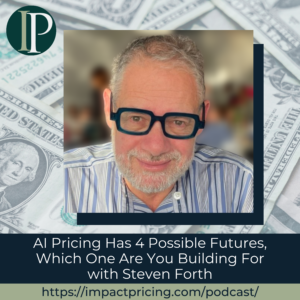
Steven Forth is a principal at PatternMind and co-author of Pricing for the Agent Economy, with deep expertise in pricing strategy, scenario planning, and the emerging agent economy.
In this episode, he brings a different way of thinking about AI pricing: instead of trying to predict one future, build strategies that can survive several possible futures.
Mark challenges Steven throughout the conversation, particularly around value attribution and credit pricing, creating a fascinating debate about whether outcome-based pricing is truly scalable, whether credits will survive, and what AI buyers may demand next.
Podcast: Play in new window | Download
Why you have to check out today’s podcast:
- Learn how scenario planning can help you prepare for multiple AI pricing futures instead of betting on one forecast.
- Discover how value attribution and credit adoption create four possible paths for AI pricing—and what each means for your business.
- Understand why credits, outcome-based pricing, and fungibility could reshape how buyers and vendors exchange value in the agent economy.
“Rather than thinking about, how are you going to predict what’s going to happen? It’s, what are the early indicators? What are the early warning system you can put in place?”
— Steven Forth
Topics Covered:
01:15 – Why Forecasting Isn’t Enough for AI Pricing. Steven explains why traditional linear forecasts assume one future while scenario planning prepares for multiple possible futures—especially when major uncertainties could fundamentally change the market.
04:00 – The Critical Uncertainties You Need to Track. Learn why identifying uncertainties isn’t enough—you need to watch for early evidence and warning signals showing which future is beginning to emerge.
05:30 – What COVID Taught Steven About Agile Scenario Planning. Steven shares how the pandemic exposed the limits of traditional scenario planning and led to a faster approach focused on cycling through critical uncertainties as conditions change.
08:00 – Why AI Makes Agile Scenario Planning More Important. With generative AI moving rapidly and no one knowing exactly how the market will evolve, Steven explains why businesses need to remain open to a wider range of possible futures.
09:30 – Will AI Software Still Be Differentiated? Steven explores whether generative AI will wash out software differentiation and whether large language models themselves will eventually converge.
12:00 – The Credit Fungibility Question. Discover why buyers may want credits that work across ecosystems while platform companies could benefit from making credits transferable—and why smaller vendors may resist.
14:00 – Why Buyers, Platforms, and Niche Vendors Want Different Things. Steven breaks down the competing incentives of buyers, ecosystem platforms, and focused vendors and explains why the future of credits may depend on which group has the most power.
16:00 – The 4 Possible Futures for AI Pricing. Steven introduces the two critical uncertainties—value attribution and credit adoption—and shows how combining them creates four distinct pricing futures.
18:00 – From “Blind Faith Credits” to the Outcome Rush. Explore what happens when buyers resist credits and value attribution remains difficult versus a future where outcome-based pricing becomes easier and more scalable.
20:00 – What Niche Vendors Should Do in Each Scenario. Steven explains how pricing strategy changes depending on which future emerges—and why companies that can move fastest toward outcome-based pricing could dominate their markets.
22:00 – The Three Hurdles to Outcome-Based Pricing. Learn why outcome pricing requires agreement on the outcome, the ability to determine who contributed to the value, and enough predictability to make the economics work.
24:00 – Mark Challenges the Value Attribution Problem. Mark argues that pricing metrics already solve one form of attribution, while Steven clarifies the harder question: who actually contributed to the economic value created for the buyer?
26:00 – Can AI Actually Claim the Economic Outcome? The conversation explores why customer support resolution is a promising niche case for outcome pricing—but why multi-agent value attribution remains an open question.
28:00 – Why Credits Are Really a Pricing Currency. Mark argues that credits function like a company’s internal currency, while Steven points out that credits can support multiple pricing metrics and flexible consumption.
30:00 – Will Buyers Eventually Reject Credits? Mark challenges whether buyers actually want credits, while Steven suggests the more important question may be which vendors figure out how to move beyond them first.
32:00 – The Pricing Advice AI Leaders Need in 2026. Steven’s final advice: understand how your buyers are using AI to make purchasing decisions—or risk making critical pricing mistakes.
Key Takeaways:
“The future is not set. And that there is more than one possible future. And that different futures could emerge in different parts of the market.” — Steven Forth
“We have to be open to a fairly wide range of different futures and agile scenario planning I think is a better way to do that.” — Steven Forth
“If your strategy is only viable on one scenario, you’re accepting a lot of risk into your organization that you don’t need to.” — Steven Forth
People / Resources Mentioned:
- Michael Mansard & Wolfgang Ulaga — Steven’s co-authors on Pricing for the Agent Economy.
- Shell — Mentioned in Steven’s discussion of traditional scenario planning.
- Rotterdam — Steven references the city’s scenario-planning approach, where major infrastructure investments were designed to remain viable across multiple scenarios.
- Lovable & Perplexity — Examples of companies using credit-based pricing and the different ways buyers have responded to those models.
- Salesforce, SAP, Oracle & Microsoft — Discussed as ecosystem platforms that may have incentives to make credits fungible within their ecosystems.
- Scenarios for Pricing in the Agent Economy — Steven’s Substack article that provides the framework discussed in this episode.
Connect with Steven Forth:
- LinkedIn: https://www.linkedin.com/in/stevenforth/
- Substack: Search for Steven Forth on Substack https://pricinginnovation.substack.com/ for his writing on pricing, scenario planning, and the agent economy.
- Email: [email protected]
Connect with Mark Stiving:
- LinkedIn: https://www.linkedin.com/in/stiving/
- Email: [email protected]
Full Interview Transcript:
(Note: This transcript was created with an AI transcription service. Please forgive any transcription or grammatical errors. We probably sounded better in real life.
Steven Forth
At this point in time, in the summer of 2026, you really need to understand how your buyer is using AI to make buying decisions. And if you don’t understand that, you are going to make critical pricing mistakes.
[Intro]
Mark Stiving
Welcome to Impact Pricing, the podcast where we discuss pricing, value, and how buyers decide.
I’m Mark Stiving. I help companies understand and shape their buyers’ willingness to pay.
Our guest today is the one and only Mr. Steven Forth. I’m gonna tell you three things about Steven today, even though you know everything there is to know about him.
He is a principal at PatternMind now. He’s co-authoring a new book, Pricing for the Agent Economy, with Michael Mansard and Wolfgang Ulaga.
And his next book is going to focus on scenario planning, which is what we’re going to talk about today.
Hey, welcome Steven.
Steven Forth
Hey, thanks Mark. And Mark, I just want to call out that I like the way that your, your introduction has evolved in line with your work and the focus on how buyers decide, because that’s really where I think a lot of the action is going to be over the next couple of years.
Mark Stiving
Yeah. You know, it’s funny. I’ve always thought that I was in pricing and over the last couple of years, few years, I realized what I really am is someone who understands how people make decisions.
And that’s, that’s what I’ve been writing about and talking about. So it’s, it’s fun.
And I think it’s a unique perspective, which is probably why you and I disagree a lot or me and Michael or me and anybody.
And so, Hey, we’re going to disagree some today too, like always.
Steven Forth
Let’s dive in.
Mark Stiving
Hey, so first off, give us a quick primer on scenario planning. What is it? Why do I care?
Steven Forth
Yeah, so scenario planning is really based on the idea that the future is not set. And that there is more than one possible future. And that different futures could emerge in different parts of the market.
So a lot of forecasting that people do is very linear. And they say, this is where we are now. And based on the data we’ve collected, this is where we are going to be in three years, three years from now.
And it’s based on some sort of projection of the current state of affairs. And it doesn’t take into account all of the uncertainty that really exists in the world that we live in.
And scenario planning is a way to jog us out of our fixed ideas and get us thinking about different possible futures.
Mark Stiving
So the first thing that jumped to my mind is back when we do forecasts, you know, we always give a, this is what I think is going to happen. Here’s the conservative estimate. Here’s the aggressive estimate.
Steven Forth
Yeah. So you get a range or a degree of confidence and a range and yeah.
And all of those things are good and very important, but we’re talking about something fundamentally different here. We’re not talking about a range. We’re talking about one future may happen or another future may happen.
General artificial intelligence may emerge in the next five years or it won’t emerge. That’s not a question that you can answer using a forecast. Those are two very different futures.
Mark Stiving
It’s like we have a binary that’s going to happen, right?
Steven Forth
One thing or another thing may happen. We don’t know which.
We could spend a lot of time arguing about it, but those arguments or those conversations are going to be a lot more productive if we frame them as what ifs and not this is.
But scenario planning gets really powerful when it takes two or more of these things, and they’re called critical uncertainties, and it puts them together.
And that’s where you start to get really big insights. Now, you could say that, you know, in the real world, there’s lots of critical uncertainties. Why limit it to two?
And, you know, the main reason is, is because, you know, human information processing is limited and trying to hold more than four scenarios in our mind is hard.
There are some people that use three dimensions of critical uncertainty, which gives you eight future scenarios. Great.
Mark Stiving
Yeah, so we don’t need to go overboard.
Let’s keep it relatively simple today. By the way, what we’re talking about, Steven wrote in a Substack article, it’s titled ‘Scenarios for Pricing in the Agent Economy.’
And so if you want to see what it is that we’re talking about as we go through this, feel free to go there and get a little bit more insight.
Steven Forth
Yeah. And this is the penultimate chapter of the Pricing for the Agent Economy book, because the Pricing for the Agent Economy sets out what Michael and Wolfgang and I believe is going to happen, but we could very well be wrong. As a matter of fact, we almost certainly are wrong.
So this expands the space so that we can start asking what if questions. And what I did for that post is I, I boiled it down into three different groups of scenarios.
And I think the one we’re going to focus in on today is really more on the pricing mechanisms. What could happen with the pricing mechanisms?
Mark Stiving
Yes, we are. But before we do that, I don’t know if I’m going to read through all of these. Let me read through a half dozen of your critical uncertainties.
Because I think that, to me, that was fascinating. It’s kind of like saying, here are the things we just don’t know. Here are the things that could go one way or the other.
And I think this is probably the most important part of the scenario planning. And that is saying, hey, we just have to identify these.
Steven Forth
Yeah, yeah. And not just identify, identify and track.
So say, OK, what’s the early evidence that one or the other of these possibilities is resolving?
Mark Stiving
OK, so I’ll save the two that we’re going to talk about a little bit more. I won’t mention those, but some other ones. And I don’t know if you if you’re prepared to talk about them as I mention them or if you want me to read the whole description.
Steven Forth
I can talk about them.
Mark Stiving
Good test. OK, perfect. I’ll jump into differentiation. This is your number one.
Steven Forth
Yeah. So one of the big questions with what’s happening and we’re focusing on the software space is can we still create differentiated solutions or is generative AI going to wash out differentiation so that it becomes very, very difficult to differentiate any piece of software and there’s an adjacent question to that, which is, are the large language models themselves going to differentiate from each other or are they going to converge?
And if anyone tells you that they know the answer to that question, I would wonder if they’ve really thought about it.
Mark Stiving
Yeah, it’s really interesting is as soon as you start describing it, I start going through my head to say, how would I predict this, right? What do I think is going to happen?
So it’s pretty interesting, pretty interesting.
Steven Forth
But I think more than thinking about how are you going to predict what’s going to happen, it’s what are the early indicators? What are the early warning system you can put in place?
So you’ll get early signals about what’s happening and where it’s happening.
Mark Stiving
So that kind of leads us, although I wanted to go through a few of these, let me switch topics real quickly. That kind of leads us into when you wrote about agile scenario planning, right?
So go ahead and give us a quick description of that. And I find that fascinating.
Steven Forth
Yeah. So, so this happened back in COVID.
So, you know, cast your minds back to when COVID was starting to happen. And, you know, it was a big deal. It changed the economy and it changed many of our lives.
And two things sort of happened from this. One is how many companies had, even ones that do scenario planning like Shell, how many of them had scenarios in place that dealt with a pandemic breaking out?
I could only find one. I looked at the time and I could only find one. And it was, I can’t remember the name, but it was actually a food distribution company in Texas. There must have been more, but they didn’t surface.
So that was one issue is, okay, so the whole scenario planning process failed because it did not address this. You can’t even call it a black swan event. We knew there was going to be a pandemic at some point. We just found it convenient to ignore it.
But anyway, but then the other thing that happened was a quasi-government organization up in British Columbia, where I live, came to me and said, wow, there is so much changing and we were caught so unprepared. We need to create scenarios for this so that we can plan better and be better prepared both now and next time.
But during the sort of chaos and confusion of the COVID pandemic, especially the early part of it, we could not put together a coherent, simple set of four or eight or nine scenarios that we felt would really prepare this organization for the future.
So what we did instead was just accept that and say, yeah, the old, more formal approach where you do deep dives on, and let’s face it, in 90% of the cases, it’s in four different scenarios. That’s just not going to cut it when there’s so much change happening.
So we shifted the focus from the scenarios to the critical uncertainties and gave them a way of rapidly combining and cycling through critical uncertainties and tools to know how things were resolving.
And they found that this was a much more effective way for them to operate in a rapidly changing, somewhat chaotic situation that they were in during COVID.
Now, as it happens, that particular organization has gone back to a more traditional scenario planning process post COVID. Whether it should or should not have this, I won’t venture an opinion on it. But, you know, if you think about where we are with the adoption of generative AI today, it’s a similar sort of thing, right? Things are moving very fast. There’s a lot of uncertainty.
Anyone who says that they know how this is going to play out is either fooling themselves or trying to fool you or probably both. And we have to be open to a fairly wide range of different futures and agile scenario planning I think is a better way to do that.
It moves at a faster cadence, it accepts more uncertainty, it doesn’t lock things down as much. So that was the idea behind it as we developed it.
Mark Stiving
Yeah. And I could see as you learn more, some scenarios become clear, some become unclear, some become possible, you know, new ones pop up that we never even dreamed of.
And so that’s what’s going to happen with this AI world today. There’s no doubt in my mind that we don’t see it.
Steven Forth
Yeah. Some resolve and some become irrelevant. You know, just like, you know what? It didn’t matter.
So we can get rid of that critical uncertainty, not because it resolved, but because it turns out, you know, not enough turns on it. Yeah.
Mark Stiving
Okay. Let’s toss out a couple more of the critical uncertainties and then we’ll dive into that first scenario plan that you put together that I want to disagree with you completely on, if that’s okay.
Steven Forth
That’s the purpose of scenarios is to provoke conversation. Yeah.
Mark Stiving
So let’s talk about, let’s talk about credit fungibility, not credit adoption. Cause we’re going to do credit adoption a little bit later, but credit fungibility.
Steven Forth
Yeah. So this is one of the interesting ones, right?
So first of all, what’s the idea. So the idea is so that today when I buy credits for say lovable, I cannot use them for claude code. Or when I buy credits for Figma, I cannot use them on HubSpot. But why is that?
Because it’s, and I mean, the reasons are obvious, right? One part is that the, the mechanics to do that don’t exist. And the other reason is that, you know, HubSpot sees no benefit in my buying credits on HubSpot and then expending them somewhere else.
So those are all reasons why it wouldn’t exist. However, if you flip that, powerful ecosystem vendors like Salesforce, and SAP, and Oracle, and Microsoft, they have a big incentive to make credits fungible at least across their ecosystems.
And buyers want credits to be fungible across their ecosystems because it reduces their risk. I may not know if I’m going to use all those credits for HubSpot or Figma, but if I can move them about where I need, I’m more willing to spend money on them.
And then you can see secondary markets and credits evolving, credit futures evolving and so on, which of course leads to the conversation of, well, why use credits at all? Why don’t you just have them as dollars? But that’s a different, different critical uncertainty.
So it’s a, it’s a super interesting one and I I really have no point of view on whether credits will become fungible or how fast it will happen.
Mark Stiving
So I’m going to take what you just said though, and I’m going to apply a different metaphor to it or analogy to it.
And so that’s kind of like saying I am a, Oh God, I used to a long, long time ago, I worked for a company called Tektronix, right? And this was in the early days of PCs. Yes, I’m old. And we would resell PCs. Right. And so to me, that’s kind of like, am I going to let you spend your credits on these PCs that we’re reselling? Because now I could be, you know, I could be Salesforce or HubSpot and reselling Figma credits and getting a little bit of margin on it, but you’re now getting access to, you know, a different platform than mine.
So I could easily see that happening, but I could also see that most companies don’t sell other people’s PCs. Right?
Most companies build it in and sell their stuff. So I, that’s an easy one to say, Hey, there’s two different scenarios. And I, and I don’t know which one would happen.
Steven Forth
Yeah. And I think it depends on the relative strength of three different groups. Buyers want this, CFOs want this, because it makes a lot of sense to them. They don’t like to be locked in. They are going to hate having credits that expire. It’s going to lead them to spend less money on credits. So, you know, the buyer is going to want it.
Platform company probably wants it too, because as you said, it can take a slice out of the transactions and it just makes its ecosystem bigger, stronger, better integrated. But the smaller companies or the more focused companies almost certainly don’t want it or It’ll take a lot of work to design a system that they’re going to see as to their advantage.
So what’s the relative power of those three groups? We don’t know. And it’ll be different in different situations.
Mark Stiving
Yeah. So that was the other thing I was going to bring up on the example that we’re going to run through. And so bring it up now. It feels to me like all the scenarios could happen. Yeah. It isn’t just, Hey, which one is going to win? It’s really under what circumstances is this one going to be playing out and under what circumstances is a different one going to play out?
Steven Forth
Yeah. And, and where.
You know, the city of Rotterdam has a great approach to this. So I don’t know if this is still true, but at one point the city of Rotterdam had formal scenarios that were part of its city planning process. And any major infrastructure investment had to be viable across three out of four scenarios.
So they didn’t say four out of four. You only had to be viable across three out of four. So, you know, any, any corporate strategy should be viable over more than one scenario.
If your strategy is only viable on one scenario, you’re accepting a lot of risk into your organization that you don’t need to.
So, yeah, so I think you’re, you’re absolutely right. But knowing where the each scenario is, is resolving is also a very powerful strategic tool.
Mark Stiving
Okay, let’s jump in since we’ve only got a little bit of time left. Let’s jump into the scenario that I wanna play with with you.
And so the two attributes that we’re gonna look at, I should say the two key uncertainties are value attribution and credit adoption.
So go ahead and describe those. By the way, I disagree with both of them, but go ahead.
Steven Forth
Well, let’s agree as to what we’re disagreeing about first.
Mark Stiving
That’s totally fine. Totally fine.
Steven Forth
So value attribution is one of the critical uncertainties.
And the question is, is this a hard problem to solve or is it an easy problem to solve? And along with that, when could it be solved? Or maybe some people think it already is solved.
So that’s one of the critical uncertainties. And the other one is credit adoption. Will buyers resist? You know, and today, I would say that more than 50% of buyers don’t like credits. Now, are they actively resisting? They’re not really being given a choice.
So, you know, maybe they’re not resisting, but they’re being dragged kicking and screaming into the credit world.
But there are other cases, especially with well-designed credit systems, where buyers are really happy with it. You know, I’ve, I’ve spent a lot of time in both Lovable’s and Perplexity’s Reddit feeds and 12 months ago, maybe even nine months ago, people at Lovable did not like their credit system, but they’ve become more and more enthused with it and more and more accepting of it and finding it working better and better for them.
Perplexity, now perplexity is newer to credits than Lovable is, but if you go to Perplexity’s Reddits, there’s a lot of people that are kind of upset about the way perplexity credits work and how they’ve been designed.
So I think part of this is just that, you know, most credit pricing models out there are poorly designed and are designed with the vendor’s interests first and forefront and not the buyer’s interests.
And I think a lot of this will go away as credit based pricing systems, you know, mature and get to be designed better and designed more and more in the buyer’s interest.
But the critical uncertainty here is will buyers fight back against credits or will they demand credits?
Mark Stiving
Got it, and so before I tell you that I disagree with both of those and why, let’s just actually talk about the four pieces of the scenario, right?
Because if you put those on two axes, right? So we put value attribution on one axis, we put credited adoption on another axis, and of course you draw the four quadrant boxes, we have four different scenarios.
And one of the things you do is you name them, which I think is really cool.
So let’s name the scenarios, and then why do I care? How am I thinking about this, assuming that these really are uncertainties?
Steven Forth
Yeah, I think it, you know, why you care really depends on which of those three roles you play, right?
Whether you’re a buyer, whether you’re an ecosystem player or whether you a let’s call a sort of niche vendor.
So let’s just say that, you know, in a world where let’s go for niche.
Mark Stiving
Let’s play it all for niche vendor.
Steven Forth
Yeah, let’s go with it. Cause that’s what, you know, many of the people listening to this podcast are. Although I hope you’ll draw in more buyers as you work more and more on the decision side.
But anyway.
So let’s just say that, you know, value attribution, you know, remains a very hard problem and people resist credit adoption.
So, you know, if that’s the case, I think outcome based pricing will be very uncommon. I think it’s hard to get to outcome based pricing without value attribution.
And if buyers are really resisting the adoption of credits, I think you’ll get very, very slow credit adoption.
Mark Stiving
So Steven, I was going to read the name, but you said you might’ve changed some of the names, so I don’t want to read it.
Can you give us the name of the quadrant in case, in case you’ve renamed it?
Steven Forth
Yeah. So I’m, I’m still calling this one, you know, blind faith credits.
Mark Stiving
Which is a great name, by the way.
Steven Forth
Now let’s look at the opposite of that, right? Buyers are really enthusiastic about credits and value attribution proves to be a, a very solvable problem.
I think then you get a rush towards outcome-based pricing. And as we’ve discussed in the past, you know, credit-based pricing can be used for almost any pricing metric you like, including outcomes.
So it doesn’t mean that credit-based pricing goes away, but more and more pricing will be based around outcomes because we’ll have a flexible, adaptive pricing system and we’ll have solved the value attribution problem.
And if we can get to that sort of ideal world, I think we’ll see a lot of outcome-based pricing systems. So.
Mark Stiving
Okay. So now I’m a niche vendor, what am I thinking of differently for those two boxes?
Steven Forth
Yeah. So the, let’s call it the pessimistic blind faith scenario versus the outcome rush.
So if it’s blind faith, you’re going to really probably continue to base your pricing on whatever you do now with a little freeze of credits across the top, mostly to capture cost issues.
And I’d say that’s really where we largely are today. If value attribution gets solved, and buyers become much more flexible in the ways they’ll buy, then whoever moves to outcome-based pricing fastest and deepest is going to win the bulk of their market.
Because outcome-based pricing, it is the ideal way to price if you can address the sort of three hurdles. And just to remind people, the three hurdles or blocks to outcome-based pricing are one, can you agree on the outcome? Which is actually harder than you would think in some cases.
Second is if multiple people are contributing to the outcome, can you actually say how much each party contributed? If you can’t do that, I don’t think you can do outcome based pricing.
And finally is you have to have some level of predictability, but the same technology that is likely to solve the value attribution problem is also going to make prediction much easier and much more effective or outcome prediction.
It’s going to be a very different world that we live in. And the companies that are able to move their fastest are going to dominate.
Mark Stiving
Nice.
Steven Forth
At least for this niche vendor side. It’s a different story. I think when you’re talking about platform companies.
Mark Stiving
Yep. Okay.
So we’ve only got a few minutes left. Now, can I tell you why I disagree with you? Just because, you know, I can’t go through one of these with you without disagreeing somewhere.
Steven Forth
Please do.
Mark Stiving
So you may have noticed on LinkedIn, I’ve been in a conversation about what is outcome-based pricing, and it’s actually a fascinating problem to try to figure the answer to this out.
And we can talk about that some other time. But in my deep thought and deep dive discussions with my good friends called AI, one of the realizations I had is that all pricing metrics solve the attribution problem.
Because we never ever price on something that we can’t attribute. Now, attribute to an outcome or attribute to something? So I happen to know that you used a token. I happen to know that you got a report. I happen to know that we resolved a customer support call.
And so that is always 100% done. Now, it just depends on what level we’re doing it at.
Steven Forth
Yeah. So I think that, you know, to be clear though, what we’re talking about here is value attribution, what contributed to value or what actually contributed to the outcome that was valuable to the buyer.
And so the only one of those that you mentioned that I think actually gets to that is ticket resolution. And ticket resolution, Lendesk and Intercom FinAI, that’s always held up as, you know, this is outcome-based pricing. This is what the future is. Yeah. Okay. Although the real outcome is not necessarily that you solved a ticket. It’s that you’ve got a happy customer.
But putting that aside, that’s a, you know, like an ideal case for outcome-based pricing because there’s a ton of data, so it’s easy to make predictions. It’s relatively easy to agree if a ticket was resolved or not, because it turns out that it’s not so easy as you think.
Anyway, but it’s compared to other things, it’s relatively easy and you can track the financial value quite easily. So that’s like a little niche case. And it’s not clear to me that it’s actually signaling the future.
Mark Stiving
So in this research I did on outcome-based pricing, that issue of value, economic value, I’m going to say it that way, right? That issue of economic value is a really important one.
And there are so few companies or metrics that we see out there that do this. Right. So completed support calls is one. I don’t know if you know chargebacks from companies like charge flow or companies that are going to save you tax dollars or medical bill dollars by going through your bills.
So these are obvious, Hey, I’m truly getting you economic value. Right. But these are real. Oh, by the way, one of my favorites, contingency fees for lawyers. Yeah.
Steven Forth
Another great one was, you know, the people that negotiate your SaaS contracts for you. And they get paid by the percent by which they reduce the SaaS contract. So yeah, but Mark, we’re agreeing with each other right now.
These are niche plays and it’s not at all clear to me that the value attribution problem can be solved. And I’m even planning to write a book about it. I’m working on the assumption that it can be solved.
And this is the multi-agent value attribution problem, right? When there’s multiple. things contributing to the creation of value.
So can this be solved or not? I don’t think we know. So I think we agree that, you know, value attribution can be solved in certain niche cases.
The question is, can it be solved generally? And to me, that’s an open question right now. And the answer to that question will have a big impact on how pricing unfolds over the next few years.
Mark Stiving
Okay. And so if I were going to define value attribution, because I think that’s a little bit ambiguous, but if I were to define it, I think I would say economic value attribution.
So can we clearly say this is how much profit we’re going to make our customer when they do this?
Steven Forth
And how much of that can we really claim that we are responsible for? Sure. Sure.
Mark Stiving
Okay. Excellent. That’s one. Now let’s talk about credits. I was waiting. We’re going to run over a few minutes, but, well, first off, I’ve been thinking about credits way too much and I am so positive now that credits are simply a company currency.
There’s nothing else to them other than a company currency. And so they’re complicating things. You know, I can go buy Euro and go to Spain and buy different things in Spain. Right?
And so what I did in my world, since I live in dollars, what I really did was I bought credits. We just named them euros. Right? And so now I can go spend my euros on things.
And so that’s exactly what credits are. But in the end, credits are spent on a pricing metric. So there are always pricing metrics underneath credits.
Steven Forth
Yeah. Or metrics, plural. If you only have one pricing metric, you don’t need credit based pricing.
Mark Stiving
Yes. Now, when I get an Amazon gift card, essentially I just bought a credit that I can go buy a whole bunch of different things using an Amazon gift card.
Or you know what, I could give them dollars and I can buy a whole bunch of different things with dollars.
Steven Forth
Yeah. Why did you buy them the Amazon gift card when you could have just given them money?
Mark Stiving
That’s a gifting problem. That’s not a me buying thing, right? So why doesn’t Amazon require me to buy a gift card before I’m allowed to buy in their store?
Steven Forth
Don’t give them any ideas.
Mark Stiving
Exactly. Exactly. So this is where I’m coming to on credits. And so when I think about the future of credits, I actually think, as you stated earlier, buyers don’t really like them. They don’t really want them.
And so what’ll end up happening isn’t do buyers adopt them, it’s really what competitors have found a way to get away from them first. Because I’d rather deal with a company that’s going to sell me something in dollars, not somebody who’s going to sell me something in credits.
Steven Forth
That’s a good critical uncertainty. So rather than arguing about that, we could add that as a critical uncertainty and then track and see how it’s resolving.
Mark Stiving
And as you stated earlier, I don’t really know the answer. It’s just what I believe. Right.
Steven Forth
But as you also stated earlier, both may be true in different parts of the market.
Mark Stiving
Yep. Exactly. There’s zero doubt in my mind that credits will exist. Right. Forever. Unless we find something better to replace them, but they’re going to exist. It’s just that I think people want to get away from them.
Steven Forth
Yeah. But then the question becomes, why do people want to get away from them?
And there’s a couple of different possibilities there. And I don’t know if you saw, I did a little series of LinkedIn polls on this recently.
Mark Stiving
I think I saw those.
Steven Forth
Yeah. And you know, I don’t think the results were surprising. About 50% of people don’t like credits, which is okay, but more seriously, I forget the numbers now, but you know, roughly 60% of people think that the reason that there are problems with credits, either because it’s inherent to credits or because companies are intentionally designing credit-based systems that benefit the seller and are not in the interests of the buyer. which having sat in on a dozen or so conversations about the design of credit-based pricing systems, I got to say, those people are right.
There’s an awful lot of people thinking about credit-based pricing, and they’re not thinking about how to design it in the buyer’s interest.
Mark Stiving
Yeah, I could see how it’s both sides of that, right? So one is, look, let’s just use the obvious one. If you give ChatGPT credits and then ChatGPT comes out with something new, they don’t have to go price it. They do, they have to price it, but they price it in credits and they don’t have to convince you to buy it or try it because you’ve got credits. You can just go use it.
And so, yeah, the idea of innovation and quickly pricing innovation makes so much sense from the seller’s perspective and maybe even from the buyer’s perspective.
But I also think that on the buyer side, we’re now asking, you know, now you’re asking me to manage euro, right? And I got to manage other currencies depending on where I am.
Steven Forth
And, you know, which brings us full circle to the question about fungible credit.
Mark Stiving
Yes.
Steven Forth
Yes.
Mark Stiving
Awesome. Steven, I always love talking to you, but I will ask you the final question, just in case you have a new, unique answer you want to give today.
What is a one piece of pricing advice you’d give our listeners that you think could have a big impact on their business?
Steven Forth
So I really think that at this point in time, in the summer of 2026, you really need to understand how your buyer is using AI to make buying decisions.
And if you don’t understand that you are going to make critical pricing mistakes.
Mark Stiving
I dearly love that. And, can we get back on and just debate that issue for a little while? Cause I probably have different opinions than you do on that as well.
Steven Forth
Look forward to that.
Mark Stiving
So what’s actually funny is although I thought I was going to disagree with you, we ended up agreeing on all this stuff anyway. So, Oh, well.
Steven Forth
I think we agree because we clarify our positions, not just to each other, but to ourselves.
Mark Stiving
Yes. Yes. Steven, thank you so much for your time today. If anybody wants to contact you, how can they do that?
Steven Forth
Connect with me on LinkedIn. I will connect with most people or send me an email to stevenat pattermind.studio.
Mark Stiving
And search for Steven Forth on Substack. He’s got a great Substack. It’s where he puts out tons of content or you can get links to it on his LinkedIn page.
And then finally, if you have any questions or comments about the podcast, or if you want to get paid for value that your buyers can’t see, email me, [email protected].
Now, go make an impact.
[Outro]