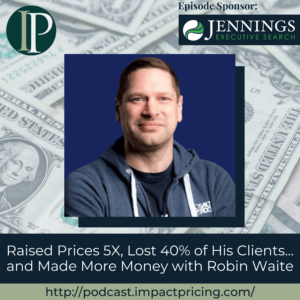
Robin Waite is the founder of Fearless Business and author of Fearless Pricing, helping coaches, consultants, and freelancers stop selling time and start charging for results.
In this episode, Robin shares the experiments that transformed his business—from raising prices 5X (and making more money with fewer clients) to packaging expertise into premium offers. Along the way, Mark challenges Robin on value-based pricing, guarantees, and competition, creating a practical and engaging debate.
If you’re still charging for your time instead of your results, this episode will make you rethink your pricing strategy.
Podcast: Play in new window | Download
Why you have to check out today’s podcast:
- Learn how to charge for results, not hours, and package your expertise into premium offers.
- Use a simple pricing exercise to see if your prices can actually hit your income goals.
- Discover why higher prices often lead to better clients, less stress, and more profit.
“It’s all about results and outcomes. If you can’t articulate what they actually want to achieve by working with you, you shouldn’t sell to them.”
— Robin Waite
Topics Covered:
02:00 – The 5X Price Increase That Changed Everything. Robin shares how raising prices dramatically increased profits—even after losing 40% of his clients.
05:15 – From Burnout to Business Coach. Why Robin walked away from his agency and discovered his passion for pricing and productizing services.
12:30 – Can You Really Charge Based on ROI? Mark challenges Robin on value pricing, competition, and money-back guarantees.
16:00 – Inside Robin’s New Book, Fearless Pricing. How to package services, overcome pricing fears, and escape hourly billing.
21:00 – Will AI Kill Hourly Billing? Robin explains why AI will make experts more productive—but many will still charge the wrong way.
23:30 – Meet “RobBot” How Robin is using AI to turn eight years of coaching into an on-demand business coach.
25:00 – The One-Page Pricing Plan Every Business Needs A simple exercise to calculate the right price based on your income goals and capacity.
Key Takeaways:
“You need to become a master at working out the return on investment your clients are going to get when they work with you.” — Robin Waite
“The goal of running a business is not to enroll every single client. The goal of running a business is to build a profitable and sustainable business.” — Robin Waite
Resources Mentioned:
- Built to Sell by John Warrillow – The book that inspired Robin to productize his services.
Connect with Robin Waite
- LinkedIn: https://www.linkedin.com/in/RobinMWaite
- Book: Fearless Pricing: How to package your offering and confidently charge more : https://www.amazon.com/Fearless-Pricing-package-offering-confidently-ebook/dp/B0FC6Y77LR?ref_=ast_author_mpb
Connect with Mark Stiving:
- LinkedIn: https://www.linkedin.com/in/stiving/
- Email: [email protected]
Full Interview Transcript:
(Note: This transcript was created with an AI transcription service. Please forgive any transcription or grammatical errors. We probably sounded better in real life.
Robin Waite
So it’s all about results and outcomes. If you can’t get to the number of like, what is it that they actually want to get through working with you, you kind of, you shouldn’t actually sell to them if you can’t articulate that.
[Intro]
Advertisement
Today’s podcast is sponsored by Jennings Executive Search. I had a great conversation with John Jennings about the skills needed in different pricing roles. He and I think a lot alike. If you’re looking for a new pricing role, or if you’re trying to hire just the right pricing person, I strongly suggest you reach out to Jennings Executive Search. They specialize in placing pricing people. Say that three times fast.
Mark Stiving
Welcome to Impact Pricing, the podcast where we discuss pricing, value, and how buyers decide.
I’m Mark Stiving, I help companies understand and shape their buyers’ willingness to pay.
Our guest today is Robin Waite.
Here are three things you’ll learn about Robin before we start.
Robin is the founder of Fearless Business, where he helps coaches, consultants, and freelancers package expertise into premium priced offers.
His newest book came out today, according to the recording, but it was probably six weeks ago by the time you hear this. It’s called Fearless Pricing. It focuses on overcoming imposter pricing and escaping hourly billing.
And Robin believes most service businesses don’t have a marketing problem. They have a pricing and capacity problem.
Welcome Robin.
Robin Waite
Thank you, Mark. It’s a pleasure to be, I’m very humbled to be on a pricing related podcast.
Mark Stiving
No worries. How did you get into pricing?
Robin Waite
A bit of a happy accident really. I’ve been in business 22 years in total.
I started running a marketing agency back in 2004. As a naive 20 something year old, you know, you think you know it all. So we just kind of went out and started selling websites and branding projects and things like that to clients.
And essentially we kind of copied what everybody else was doing. And it was probably about four, four years into that business where all of a sudden it’s kind of scratched my head going, hang on a second. We’ve worked really hard for four years. Where’s all the money?
And at that particular point in time, I don’t know if you remember the financial crisis that hit in sort of 2007, 2008 affected a lot of business
Mark Stiving
Sadly, way too well.
Robin Waite
Yes, it hit a lot of businesses very hard, small businesses in the UK especially, you know, the sort of the impact that rolled out and there was probably about 20-25 local agencies doing various sort of freelancing gigs in Stroud, my local town.
We were one of them and for those that did web design, they were all driving all the hosting and care plan service fees down because they thought that was a way to win business when the economy was going through this crisis.
And I had several stand-up arguments with my business partner. I was like, we’re not making money as it is now. If we put our prices down, we’re going to lose money. I can’t see how this would work.
And I was adamant that we should put our prices up. And he said, Oh, well, okay, we’ll do it by 10%. But we can’t do it until January, because we do it annually. And I was like, who made up all these dumb rules, right?
You know, that you can only put your prices up once a year, and maybe by 10%. So I went behind his back, and I put our we had a basic, like website hosting package kind of makes me cringe a bit because it was so low, but 10 pounds a month, we used to charge to host our clients websites back then.
And went behind my business partners back and I put up to £50 a month. And my business partners were so angry. But it was really, I said, happy accident. What happened was 40% of our clients did leave.
So we expected some to leave, but 40% felt like a lot. And my business partners were like, I told you so.
But 30 days later, when I checked the profit and loss accounts, our revenue for hosting fees had gone up by two and a half times.
So we had 40% fewer clients, but two and a half times more revenue just with that one decision. And then a Brucey bonus happened as well on top of that. I used to track religiously the number of support calls which we used to get from our clients as well, because there was that time element to the service which we used to offer.
And our support call was dropped by over 80%. So 40% fewer clients, two and a half times more revenue.
But, and like the best part for me was the 80% fewer support calls because we literally were fielding calls. This is before sort of Zendesk and all those excellent sort of help desk tools. We were literally fielding calls.
So those just disappeared overnight. And of course it was the clients who didn’t value us even at £10 a month who left with all of their problems, you know, their ridiculously high expectations of this service we should be delivering, you know, the moon on a stick basically for £10 a month.
Mark Stiving
Yeah, I think that’s a great story.
So many issues I have with that story though, but it really is a good story. How do we know it applies to any other business, right?
So why wouldn’t every company just say, hey, let me go 5X my price?
Robin Waite
Yeah, great question.
I mean, so first and foremost, we were massively underselling ourselves for the value which we added in any way into our service. So that was the first learning.
Mark Stiving
Wait, how did you know that?
How do you know that you were under, besides the fact that raising the price worked?
Robin Waite
Because several of our clients, right, think every time you put your price up, right, you’ll get an email or a letter from, you know, I had a letter from E, which is a mobile phone provider here in the UK, and they said, oh, we’re putting your prices up by 7.9% or something.
And it irked me, right, even as the pricing guy, it kind of irked me a little bit because I was like, There was no, it was cold, it was just that we’re putting them up and there was no real justification in there.
What I did with many of our clients is I just gave him a quick call and said, Oh, Hey, by the way, we’re adjusting our prices. I know this is a tough time to do it, but, and I kind of just gave them the rationale.
And then I told them what extra we were going to add in. So it wasn’t just five extra prices and no extra value is right. We’re going to, we’re going to use this as an opportunity to be able to stack more value.
So we added in an extra half an hour’s worth of consulting time within that, which nobody ever took us up on in the end. I didn’t know that was going to happen.
And the second thing is we had a, at the time we had a five, nine uptime guarantee on our site. So we raised that to a three, nine uptime guarantee, which basically meant our sites went from, we gave ourselves about an hour a month to do updates down to six minutes a month to do updates.
So that would be the amount of time the sites would be down. But I explained this to them on the call and several of those clients, when I spoke to them and told them we were reviewing their prices, they were like, well, we were kind of expecting it.
We felt that like 10 pounds was too good to be true anyway.
So we got that immediate feedback and I was like, we should have done this a heck of a lot sooner rather than waiting four years.
Mark Stiving
Nice. I absolutely love that. So why didn’t you, I’m sorry, before I jump into that.
Robin Waite
Yeah.
Mark Stiving
So when did you say, okay, I’m going to stop being a marketing person. I’m going to start being a pricing person.
Robin Waite
We roll forward to 2016, so I’d run that business for 12 years. My business partner had exited a couple of years before that, so I’d bought him out. And then life changed. I met my wife. I was between daughters, so my second daughter was about to arrive.
But because we were a successful small local agency, we were just overrun with projects and clients. You know, there was challenges with the team, possibly because they were managed by me. I don’t know. But it just felt like when I was three weeks away from my daughter, Sophie, arriving, we had two planned cesareans that we were still pulling all nighters to get projects over the line and getting called in at weekends when if stuff didn’t get rolled out properly and just constant sort of firefighting when you’ve got a small agency with that, you know, still a high, high volume of clients.
And just one day I just, I, I was out with my cycling buddies. I just had a mental breakdown. I just was overwhelmed by the amount of work I’d created for myself.
And again, didn’t know then what I know now. I would have done things probably slightly differently.
But the following Monday after that, I just went into the office and told the team that I was closing the agency down. I was done with it. Because I couldn’t see a way out at that particular time apart from walking away from it.
Thankfully, in the following week, word spread and somebody came in and made me an offer for the client base and a couple of bits of IP that I designed within the business.
So we productized a couple of design packages. and sold those at a far higher day rate than many of our competitors.
But the transition happened when I eventually went back to work, going to networking meetings. Of course, the first question they ask you is, well, what do you do?
And I said, well, nothing. And that just, you know, breeds curiosity from people and like, well, what do you mean nothing? I said, well, I’ve sold my agency. I’m just here. I enjoy business. I just wanted to come and have some conversations.
Anyway, people then asked me if they could pick my brains and could I teach them how to grow their business and potentially sell it?
So I never charged for it. Again, it sounds daft now looking back at it as the pricing guy, but I didn’t charge for it at the time. They bribed me with coffee and cake, and then I would just have a chat, they would pick my brains.
Turns out I was actually quite good at it, but a lot of the conversations which I had with people were about their pricing, how they structured their offer. It wasn’t so much pricing at that time, it was more the structure of the offer, like productizing the service rather than selling time for money.
And so I worked with a number of accounting practices and web design agencies, because that’s what I’d done for a period of time, and freelancers to help them start to build packages.
And then, so that was 2017 when I officially launched the business. And then pretty much every conversation I was having from that point onwards had an element of pricing in it, whether it was capacity-based pricing, whether it was setting the own goals. They, you know, setting their prices in a way that they could never achieve their financial goals because their prices were just so low or their hourly rate was so low and they didn’t have enough hours to fulfill it.
And it was, it’s probably the last sort of four or five years that I’ve really deeply started studying pricing in particular and really work making that one of my core pillars in my coaching.
Mark Stiving
Nice. I love that.
One of the things that I find interesting, given what you just described and what the story was with your marketing company, is that the marketing company story says, hey, we have to raise prices, but most of the consulting that you’re doing, and I got to say, this is true with what I think of and work on too, it isn’t, here’s the number.
It’s really, here’s how to structure your pricing. Here’s how to think about your pricing.
Robin Waite
That’s it. How you articulate your value is the thing ultimately.
Because it’s easy, when somebody says, how much is it? It’s easy to sell lots of 50 bucks an hour.
Because it’s a smaller number and we can see ourselves kind of selling that. Whereas really when you’re trying to articulate the value, you need to be, I always tell my clients to be, they need to become a master at working out the return on investment their clients are going to get when they work with them.
So it’s all about results and outcomes. If you can’t get to the number of like, what is it that they actually want to get through working with you, you kind of, you shouldn’t actually sell to them if you can’t articulate that.
A lot of the time, so there’s this shift as well from kind of being an order taker, you know, standing at the coffee counter taking somebody’s order versus actually, I tell you what, let’s make this the best possible experience you’re ever going to have when you come in and buy a latte from our coffee house.
You know, we’ve got entertainment, we’ve got music, we’ll have good networking, we’ll like create a whole experience from just selling a cup of coffee rather than it just being about, oh, here’s your latte. When you put that into terms for a consultant where maybe they’re competing against other consultants charging day rate, for example, again, because it is so common for consultants to charge day rates, that’s how everybody believes that they should sell their time.
Whereas hypothetically, let’s say you were going to you’re doing some consulting work for a $10 million a year revenue business, and your work could add just 10% to that, their top line, and maybe all of that falls to the bottom line, so actually increase their profit significantly.
Does it matter whether it takes a day or 100 days, but let’s charge 100K for the $1 million uplift, right?
And you can start to see then that the value proposition is entirely different. Rather than what I can do, it’s actually, what can I actually do for you, for your business?
Mark Stiving
Okay.
So first off, I have to tell you that I love what you just said, but I’m going to argue with it.
Robin Waite
Please.
Mark Stiving
So, and by the way, I have this problem as a pricing person too, and you probably do too. We walk into a company, it’s a billion dollar company and you know, we’re going to move their needle at least $10 million, just like that, right? With ease.
So they should be able to pay me 10% of that. They’re going to pay me a million bucks, but they could go hire any of a ton of other consultants that’ll charge them way less than a million bucks.
And they think they’ll get something similar or, you know, almost as good or even better. And so the competition thing still plays a role, even though we do the ROI calculation.
Robin Waite
Yeah.
Would you be able to hang your hat on that result though, Mark? Would you be able to confidently walk in there and say, look, if we don’t get that million, you know, million dollar or $10 million uplift, it’s free.
Would you be that confident in your abilities?
Mark Stiving
Absolutely, because I’ve never seen it not work.
Companies make so much money with what we do, but the other side is, does the company actually go implement what you say?
Because you don’t run the company, you give them advice.
Robin Waite
That’s it.
I mean, that falls down into the camp of, right, let’s get a watertight contract put together where, hey, this is what I’m going to do and this is what I expect of you guys to do in order to implement these changes.
But what you’ll find is, if 100 consultants pitched, you’ll probably be the only one that walks into the room and says, I’m that confident in my abilities to create that uplift, I’ll give you a full money back guarantee on it.
If we can’t do that, you don’t pay. You get to keep whatever profits we have generated.
The other 99 consultants, I can guarantee all of them will not have the confidence to put a money back guarantee on it. And the difference there is purely because they’re worried about their mortgage and putting food on their table. They’re making it all about them.
Whereas when you can confidently walk into a business and be a part, be a partnership, I’m here because I want to get you great results. Because if I get you great results, you’re going to come back and buy more from me. And it’s not about, it’s all about the client.
We’re always told, aren’t we? The client is the customer is always right. The customer is the most important person in that, in that partnership.
And I think the moment you start to make it about yourself, you’re actually devaluing that relationship, that partnership.
But it’s just the nature of the beast. Most of us mere mortal, humble small business owners, human beings, we’re not born with trust funds and we don’t have 100 grand or a million dollars sat in the bank. We don’t have the leverage to be able to just walk away from a deal if it doesn’t look right. We’re hungry to get deals.
But I think that neediness does trip a lot of consultants and freelancers up.
Mark Stiving
Absolutely.
Once you stop needing the money, it’s easy to negotiate.
It’s easier to negotiate and it’s easier to price. So tell me about the book. What is the new book about?
Robin Waite
So the new book is really just, it’s all of my sort of thoughts and principles around different ways to productize services.
So I use a lot of case studies in there. around sort of my agency days. So for example, one of the things which we used to do was graphic design, so logo design for small businesses locally.
And again, competing against the other agencies where we used to charge sort of £50 an hour, say, for design work. I’d been mulling over, there was a fantastic book called Built to Sell by John Warrillow. I don’t know if you’ve ever read it. Absolutely brilliant.
Mark Stiving
I don’t think I’ve read it, but I’ve seen it.
Robin Waite
Yeah, it’s a brilliant book. It’s kind of told us a story, a parable.
But I read that, and then from that, I came up with this concept of like, because traditional design agency, I call it design agency ping pong, right, where you send a proposal out for some work, and they come back and quibble a proposal, you eventually agree on a price, and then they give you the brief for the logo.
A few months later, you come back with the composites.
And then they say, well, I like the color in that one, the font in that one, and the whatever type, the logo in that one, can you smush them together?
And so you end up in this game of ping pong.
And it was so frustrating for us as designers, but it was also, I could see it, frustration for our clients as well.
But on our side, we didn’t pay for all of the charge, sorry, for all of the sort of back and forth communication. We just charged for our design work because we thought that was how to do it.
So I thought, there has to be a better way than this. And I mapped out, and this is kind of all explained in the book as well, the whole productizing piece.
So I mapped out initially seven steps in our logo design process, and that took us down from average about two to three months to deliver a logo down to about four to six weeks, but it was still ping pong and it was difficult.
And then I thought, because I’m the fearless business coach, I wasn’t back then, but stupid probably, I don’t know, but I thought, wouldn’t it be cool if we could do this in a day?
And it so happened a client who we’d worked with on a previous project came in and said, Oh, we’re doing a product launch on Tuesday.
Is there any any way you could we want you to do the logo for it? Because our designers fallen ill? Can you do it? It’s like Thursday. And I’m like, No, we can’t possibly do that.
He said, Come on, Robin, you I was like, well, we’ve been thinking about doing these one day branding workshops. I think if I can organize a design or I’ll facilitate it, but we need you to come in, you know, on Monday and we can knock it out of the park, I reckon in a day.
Brilliant. Sign me up. How much is it? And I just blurted out at the time, 1800 pounds.
And so more than three times that sort of typical effective hourly rate we had been charging. And he went, yep, great. Send me a bank details, Robin, the invoice. I’ll pay that.
And literally paid it, you know, before he left the office. I was like, great. Crikey, it was that easy? Payment in full in advance, three times the price. Yes, he wanted it. It’s that typical sort of triangle, isn’t it, of like, do you want it done fast and well? Well, then it’s going to be expensive.
There was a bit of that going on. And we did it. It was a bit, you know, ropey, but we got it over the line. We delivered his logo.
He was happy and came back again for others in the future. And we ended up delivering about 40 of these. in the following year. And then I got my second big lesson, which also I share this, and this is spoiler alert. People aren’t going to want to buy the book now because I’m going to give it all away now.
But a few weeks later, I had a mentor who I’d been on a course with, and he said, oh, Robin, I heard about these one-day branding workshops you’re doing. I could really do with your help tomorrow. I’ve got a client. They’re a software business. Could you come and do it?
I was like, where is it? And he said, York. I live down in the far southwest of the UK. York is like about as far away at the other end of England as you can find. I was like, no, Nick, I’m not interested. Not for 1800 quid. It’s just not worth it. And he said, give me five minutes. I’ll call you back. So he calls me back five minutes later and he said. I booked you for 18,000.
Are you happy to drive up to York?” I was like, already in Carnic. And then again, they paid in full in advance. I paid Nick his 20% for negotiating the deal. That was a one-off, but again, it was like massive light bulb moment around like this whole notion of kind of building packages instead of selling time for money.
So that’s the productization piece. The second piece obviously is the pricing side of it.
So it goes through a lot of the mindset. What is our money story? Why do we have such anxiety when somebody asks us how much something is?
How to sort of overcome and handle some of the objections. So again, separating yourself when somebody has an objection over price and again, not making it about yourself. Well, that’s their money story, which is raising the objection. It’s not a problem with necessarily your product or offer.
So there’s a lot of that sort of softer side of it as well. In the book where I go through lots of case studies, talking about people’s client case studies, where I talk about their mindset before and after the the pricing changes.
And then there’s a bit in there about sales as well. So how do you handle objections around price? How do you shift the narrative away from sort of time and materials into more of like a value-based pricing, like the example which you gave earlier on, Mark?
Mark Stiving
Yeah. Very nice. Very nice.
I’m shocked that people still do hourly pricing because it has been so long since people have been preaching, stop doing this, right? It makes no sense. There’s a million reasons not to do it, both for you and for your client.
There’s just so many reasons not to do that. But I have a feeling, and I’d love to hear your opinion about this, that with AI coming on, hourly billing is just going to go away because I can now do what it used to take me 10 hours in an hour.
Robin Waite
Yeah. I mean, people will find other ways to fill up their time, but the trouble is, I think again, like I said, it’s easy to sell lots of little, you know, lots of 50 bucks an hour and people will still find ways to do that.
You look at pretty much every single service-based business out there and the vast majority of them are still selling time for money, whether it’s freelance consultant, coach, therapist, cleaner, you name it, because it’s easy to sell those little bits of time.
Is AI going to disrupt that? I think what will ultimately end up happening is they will still charge time for money hourly rates, but they’ll end up doing 10 times the amount of work. Does that make sense?
Those that don’t know better will still end up charging hourly, but they’ll just be far more productive with their time. They won’t end up selling any more hours. That’s the way that I see it happening, really.
And you still need coaches, you still need consultants and freelancers. There are still experts. I think they said that AI’s acceptance in the market is at something like 0.4% in the small business community.
So it’s nowhere near market domination yet. It’s still very, very low. It’s like tip of the iceberg type territory. Imagine the industrial revolution, the industrial age was sort of a hundred year span that we went through. The AI era is no different. We’re only two years into that.
Mark Stiving
Yeah, I have a feeling it’s going to go much faster than the Industrial Revolution.
Robin Waite
It definitely will go faster, but I think we’re like a tenth of the way into that journey.
Mark Stiving
So I also think that people overemphasize what AI can do for them right now. But that doesn’t take away the fact that I know I can do what I do much, much faster.
So anybody who’s using AI as a tool is probably doing what they do better and faster.
Robin Waite
Yeah, I mean, look, as a coach, I see it more as like, my role here is to stack more value.
If I can add more value into the service, which I’m giving clients, so I can help them to confidently charge more, but I can do that more efficiently, there’s value there for both of us to take.
So just as an example, we’re building RobBot at the moment to work behind the scenes, which I don’t know why, but I very diligently, I obviously could, maybe I predicted this was going to happen at some point, but I very diligently have documented and recorded all of my coaching calls over the past eight years since I’ve been coaching online.
Transcripts, video files, the works, I have files of them. And so we’re training RobBot at the moment on all of those recordings so that somebody can just go in there and then search for, hey, I’m building out a graphic design package, how do I go about pricing it?
And then it will go and find the recording, go straight to that timestamp bit, and then deliver that piece of coaching.
So, you know, they’ve got the option of on-demand RobBot if they want, you know, three o’clock in the morning, whenever they’re doing their working on their business, or they can show up to a Wednesday weekly call and chat with me, real Rob, if they want to.
Mark Stiving
Real Rob.
Nice. Nice. So this sounds fascinating. I’m pleased to hear about the new book. That’s going to be great.
Let’s start to wrap this up. And here’s the final question for you. Sure.
What is one piece of pricing advice you’d give our listeners that you think could have a big impact on their business?
Robin Waite
Oh, great question.
So first and foremost, the goal of running a business is not to enroll every single client.
The goal of running a business is to build a profitable and sustainable business.
And so many business owners, they kind of think they just got to go and grab as many clients as they possibly can do, irrespective of the cost that that is going to have on their business.
So they forget to work out kind of overall what their capacity is, for example.
So I I’ll try and summarize this because I know we’re at the end of it.
So a really simple exercise you can do based around capacity-based pricing is like business plan on a page.
And I’m going to make the numbers super easy for myself so I can do it quickly. Let’s say you’re a coach and you want to earn $100,000 a year.
So that’s question one. That’s nice and easy. What’s your revenue goal for the next 12 months? Second question is, how much do you think you’re going to charge for rendering that coaching service to a client?
And let’s say that coach says, well, about $1,000. Now, gut instinct, you and I know that that’s probably cheap. They’re just starting out. They’re not sure. They’re not confident. They’re not sure how much they should charge.
So what we do then, third question, we take the big number divided by the little number and we say, okay, great.
So you’re happy that you need 100 clients at $1,000 to make 100K. And normally when I do this, that’s three questions. Normally their eyes pop out of their head and they realize 100 clients is a lot to service as a small service business.
So then we realized, okay, I don’t have the capacity to deliver 100 clients. I also don’t have the marketing knowledge to be able to attract and enroll 100 clients. So that’s unrealistic.
So question number four is, well, what is realistic?
How many clients would you like to work with to hit that 100K? And they might say, well, 20 clients feels about right. Okay, take the big number, 100K, divide it by 20 clients.
Next thing you know, we’re at 5K. Again, their eyes pop out of their head. They’re like, God, who’s going to pay 5k for coaching? That’s just ridiculous.
So we go through that conversation. But the reality is like, all we’ve got to do is figure out how to stack enough value into that 5k to get a client a full and remarkable outcome, you know, the results, whatever they want.
So we don’t need all of the clients effectively. And 20 clients a year as a coach or a consultant, or a freelancer, or just somebody running a small business, means what you end up with is hopefully well-qualified, fun clients that you get to work with, that because they’re paying more, they’re more committed, that because you’re not working all of the hours, you actually get some time free to spend with your family.
But also, you know, pays the bills and gives you a bit of spare time, hopefully, to put into other projects like writing books or going down the archery range and shooting or getting out on your bike or hanging out with your buddies or talking business, whatever you love to do alongside working in your business.
So just some really simple, basic, like business plan on a page calculations can put you in a really solid place, you know, starting point for your business.
Mark Stiving
So I’m going to summarize what you just said, Robin, and that was price times quantity equals revenue.
Robin Waite
That’s it. Yeah. Basically. Yeah. In a nutshell.
Mark Stiving
But people don’t think about it, right? You’re like, okay, here’s the revenue I want.
Robin Waite
What I got to figure out my price on my quantity.
They’re like, oh, my, my auntie, son, uncle, Jim, Bob down the road said that I’d be really great at this thing. They go out and start trying to find clients for it.
And then they scratch their head going, why is the business not working? Why is it not paying me the money I want? Because they just haven’t got a very simple plan to start off with.
Mark Stiving
Excellent. Robin, thank you so much for your time today. If anybody wants to contact you, how can they do that?
Robin Waite
Yeah, great question. LinkedIn’s probably the best but please jump onto there, share whatever pricing questions, problems you’ve got, and I’ll be happy to answer that. I love a good voice note as well.
So just drop me a voice note on LinkedIn. That’d be great. And obviously go to that saying the book Fearless Pricing is available on Amazon as well.
So go and check that out if you can.
Mark Stiving
Excellent.
And to our listeners, thank you for your time. If you enjoyed this, would you please leave us a rating and a review?
And if you have any questions or comments about the podcast, or if you want to get paid for value your buyers can’t see, email me [email protected].
Now go make an impact.
Advertisement
Thanks again to Jennings Executive Search for sponsoring our podcast. If you’re looking to hire someone in pricing, I suggest you contact someone who knows pricing people. Contact Jennings Executive Search.
[Outro]